NJEDA.com contains a link to translation services provided by Google™ Translate, a free online translation service. Google™ Translate is subject to its own terms of service, which can be viewed at (https://policies.google.com/?hl=en). The link does not constitute affiliation, endorsement, support, or approval of Google™ Translate.
Neither the NJEDA nor the State of New Jersey (collectively, the “State”) reviews the services, information or content provided by Google™ Translate. Information translated by Google™ Translate may not be accurate or current and is used at the user's sole risk. The NJEDA has no obligation to offer translation, and this service could change or be discontinued at any time.
The State expressly and fully disavows and disclaims any responsibility or liability in respect to any cause, claim, or consequential or direct damage or loss, however described, arising from the use of Google™ Translate.
NJEDA.com is provided "AS-IS" with no warranties, express or implied, and its use confers no privileges or rights.
For additional language assistance, please click here to contact NJEDA to request assistance.
Program Provides Up to $75,000 to NJ Startups Furthering Clean Tech R&D in NJ
The application for Round 2 of the Clean Tech Seed Grant Pilot Program can be found at: https://www.njeda.gov/clean-tech-grant/. Applications will be accepted through March 21, 2022 at 5:00 p.m.
Similar to the inaugural round of the program, Round 2 of the Clean Tech Seed Grant Pilot Program will provide grants of up to $75,000 for R&D activities to very early-stage, New Jersey-based clean technology companies. These grants will help clean technology-focused businesses create proof-of-concepts and prototypes so the companies can more readily attract outside investors and, in some cases, begin to generate revenue. Specifically, the program will fund projects that are developing or testing clean technologies intended to recapture or avoid emissions of greenhouse gases and/or criteria pollutants, or to enable such avoidance or recapture. The following technology areas are eligible under the program: Chemicals/Advance Materials, Energy Distribution/Storage, Energy Efficiency, Energy Generation, Green Buildings, Transportation, Waste Processing, and Water and Agriculture.
CSIT will host an informational webinar, including a walk-through of the Clean Tech Seed Grant Program – Round 2 application on Wednesday, January 26, 2022. Registration information can be foundhere. A recorded version of the webinar and copy of materials presented will be made available on the CSIT webpage following the event.
This latest round offers double the amount of funding that was available in the initial round of the Clean Tech Seed Grant Pilot Program. CSIT awarded a total of nearly $750,000 to 10 companies statewide through the program’s first round last year.
All applicants for the Clean Tech Seed Grant Program should be between a minimum technology development level of Technology Readiness Level (TRL) 2 (applied research) and maximum of TRL 7 (full-scale, similar (prototypical) system demonstrated in relevant environment), based on the Department of Energy definitions. Applicants should use the tool included in the Technical Proposal attachment on the application portal to determine TRL score.
Additional eligibility criteria require that applicants:
Be authorized and in good standing to conduct business in New Jersey as evidenced by a New Jersey current New Jersey tax clearance certificate;
Have a minimum of one full-time equivalent employee (working 35 hrs. per week) including founders, with at least one employee working 50% of their time on the project being proposed;
Have 50 percent or more of the work of its employees, including founders and contractors conducted in NJ (calculated on a full-time equivalent basis – 35 hours per week);
Have 50 percent or more of employees including founders/contractors live or pay withholding taxes in NJ;
Have less than two million dollars ($2,000,000) in prior third-party funding over its lifetime (excluding government grants);
Have less than five hundred thousand dollars ($500,000) in previous calendar year sales revenue.
Applications from businesses located in an Opportunity Zone-eligible census tract, minority- or woman-owned businesses or businesses with technology coming out of New Jersey universities are all eligible for bonus points with respect to the scoring criteria. At least one award will be reserved for an applicant that is a women-owned company as certified by the State of NJ and one award will be reserved for an applicant that is minority-owned as certified by the state of NJ.
About CSIT
In August 2018, Governor Murphy signed legislation re-establishing the former New Jersey Commission on Science and Technology as the CSIT. Comprised of representatives from the public and private sectors, as well as academia, the Commission is tasked with leading the way in promoting the state as a home for academic and technological research, development, and commercialization.
To learn more about state resources available to New Jersey entrepreneurs and early-stage companies, visit http://www.njeda.gov/csit or follow @NewJerseyEDA on Twitter, Facebook, LinkedIn and Instagram.
###
Latest Funding Round Will Make up to $75,000 Available to Companies Furthering Clean Tech R&D in NJ
The Clean Tech Seed Grant Pilot Program provides grants for R&D activities to very early-stage, New Jersey-based clean technology companies. These grants will help clean technology-focused businesses continue their work toward the proof of concept and prototyping stages, at which point they can more readily attract outside investors and, in some cases, begin to generate revenue. Specifically, the program will fund projects that are developing or testing clean technologies intended to recapture or avoid emissions of greenhouse gases and/or criteria pollutants, or to enable such avoidance or recapture. The following technology areas are eligible under the program: Chemicals/Advance Materials, Energy Distribution/Storage, Energy Efficiency, Energy Generation, Green Buildings, Transportation, Waste Processing, and Water and Agriculture.
This latest round offers double the amount of funding that was available in the initial round of the Clean Tech Seed Grant Pilot Program. CSIT awarded a total of nearly $750,000 to 10 companies statewide through the program’s first round last year.
“Startups within New Jersey’s clean technology industry are impacting the world in immeasurable ways,” said CSIT Executive Director Judith Sheft. “During the last round, we received applications from a broad range of companies throughout this crucial sector and we look forward to supporting even more young companies as they work toward commercialization and enter the global marketplace.”
CSIT will host an informational webinar, including a walk-through of the Clean Tech Seed Grant Program – Round 2 application, on January 26, 2022. Registration information can be found on the CSIT webpage. A recorded version of the webinar and copy of materials presented will be made available on the CSIT webpage following the event.
Applications can be submitted starting on January 24, 2022 at 10:00 a.m. and will be accepted through March 21, 2022 at 5:00 p.m. Similar to the inaugural round of the program, qualified applicants can receive up to $75,000 in grants through Round 2 Clean Tech Seed Grant Pilot Program. The funding is being provided through NJBPU’s Clean Energy Program.
“NJBPU is proud to work with our partners at CSIT and the NJEDA to place money into the hands of the small businesses statewide helping to pave the way toward a clean energy future,” said NJBPU President Joseph L. Fiordaliso. “By providing this very early-stage funding, we are setting the foundation for these companies to flourish in the Garden State and to help us meet Governor Murphy’s goal of 100 percent clean energy by 2050.”
All applicants for the Clean Tech Seed Grant Program should be between a minimum technology development level of Technology Readiness Level (TRL) 2 (applied research) and maximum of TRL 7 (full-scale, similar (prototypical) system demonstrated in relevant environment), based on the Department of Energy definitions. Applicants should use the tool included in the Technical Proposal attachment on the application portal to determine TRL score.
Additional eligibility criteria require that applicants:
Be authorized and in good standing to conduct business in New Jersey as evidenced by a New Jersey current New Jersey tax clearance certificate;
Have a minimum of one full-time equivalent employee (working 35 hrs. per week) including founders, with at least one employee working 50% of their time on the project being proposed;
Have 50 percent or more of the work of its employees, including founders and contractors conducted in NJ (calculated on a full-time equivalent basis – 35 hours per week);
Have 50 percent or more of employees including founders/contractors live or pay withholding taxes in NJ;
Have less than two million dollars ($2,000,000) in prior third-party funding over its lifetime (excluding government grants);
Have less than five hundred thousand dollars ($500,000) in previous calendar year sales revenue.
Applications from businesses located in an Opportunity Zone-eligible census tract, minority- or woman-owned businesses or businesses with technology coming out of New Jersey universities are all eligible for bonus points with respect to the scoring criteria. At least one award will be reserved for an applicant that is a women-owned company as certified by the State of NJ and one award will be reserved for an applicant that is minority-owned as certified by the State of NJ.
Seventy percent of the awardees in the first round of the Clean Tech Seed Grant Program were businesses located in an Opportunity Zone-eligible census tract, minority- or woman-owned businesses, and/or businesses with technology coming out of New Jersey universities.
“Under Governor Murphy’s leadership, the state is taking a whole-of-government approach to creating an equitable green economy as we work toward his goal of making New Jersey 100 percent clean energy by 2050,” said NJEDA Chief Executive Officer Tim Sullivan. “Our robust suite of programs positions us to cultivate the growing number of clean technology companies within our state.”
In January 2020, Governor Murphy unveiled the state’s Energy Master Plan, which outlines key strategies to reach the Administration’s goal of 100 percent clean energy by 2050. In May 2018, Governor Murphy’s Executive Order No. 28 directed the NJBPU, in partnership with other state agencies, to develop this statewide clean energy plan and shift away from energy production that contributes to climate change. The Energy Master Plan laid out ways to fuel the clean technology economy through workforce training, investments in developing clean energy knowledge, and the growth of world-class R&D.
About CSIT
In August 2018, Governor Murphy signed legislation re-establishing the former New Jersey Commission on Science and Technology as the CSIT. Comprised of representatives from the public and private sectors, as well as academia, the Commission is tasked with leading the way in promoting the state as a home for academic and technological research, development, and commercialization.
About NJEDA
The New Jersey Economic Development Authority (NJEDA) serves as the State’s principal agency for driving economic growth. The NJEDA is committed to making New Jersey a national model for inclusive and sustainable economic development by focusing on key strategies to help build strong and dynamic communities, create good jobs for New Jersey residents, and provide pathways to a stronger and fairer economy. Through partnerships with a diverse range of stakeholders, the NJEDA creates and implements initiatives to enhance the economic vitality and quality of life in the State and strengthen New Jersey’s long-term economic competitiveness.
About NJBPU
NJBPU is a state agency and regulatory authority mandated to ensure safe, adequate and proper utility services at reasonable rates for New Jersey customers. Critical services regulated by NJBPU include natural gas, electricity, water, wastewater, telecommunications and cable television. The Board has general oversight and responsibility for monitoring utility service, responding to consumer complaints, and investigating utility accidents. To find out more about NJBPU, visit our website at www.nj.gov/bpu.
To learn more about state resources available to New Jersey entrepreneurs and early-stage companies, visit http://www.njeda.gov/csit or follow @NewJerseyEDA on Twitter, Facebook, LinkedIn and Instagram.
###
TRENTON, N.J. (December 9, 2021) – The New Jersey Economic Development Authority (NJEDA) today released for public feedback a draft rule proposal for the Historic Property Reinvestment Program, as established under the New Jersey Economic Recovery Act of 2020 (ERA). The Historic Property Reinvestment Program is a $50 million competitive tax credit program to leverage the federal historic tax credit program to incentivize transformative rehabilitation projects of identified historic properties.
The program, which is capped at $300 million over six years, focuses on historic preservation as a component of community development. Awards of up to 40 percent of rehabilitation costs are available for qualified properties, up to a maximum of $4 million. Qualified properties in a Government Restricted Municipality or Qualified Incentive track may be eligible for up to 45 percent of rehabilitation costs, up to a maximum of $8 million. Awards are scored on a competitive basis.
Members of the public are encouraged to review the preliminary rules and submit written feedback through an online form available on the Economic Recovery Act website. The NJEDA will also be hosting two listening sessions for public input on the draft rules.
“Governor Phil Murphy and the Legislature advanced the ERA with the goal of creating programs that prioritize equitable and inclusive development,” said NJEDA Chief Executive Officer Tim Sullivan. “The Historic Property Reinvestment program will do just that by ensuring that iconic New Jersey properties are renewed in a way that respects history while creating assets that support dynamic community development that enriches the lives of local residents.”
Draft Historic Property Reinvestment Program rules are available now for review here.
Members of the public can also provide input during the NJEDA’s public listening sessions, which are scheduled for the following times:
Members of the media interested in attending the session or submitting questions are asked to email media@njeda.com.
In addition to the Historic Property Reinvestment Program, the ERA creates a suite of programs that includes tax credits to incentivize job creation, new construction, and revitalization of brownfield properties; financial resources for small businesses; support for new supermarkets and healthy food retailers in food desert communities; new funding opportunities for early-stage companies in New Jersey; and support for the growing film and digital media industry. The NJEDA will continue to engage the public as new programs and rules are developed.
Please be advised that a telephonic meeting of the New Jersey Economic Development Authority is scheduled for 10:00 AM, Wednesday, December 8, 2021.
The Members will convene to via conference call only. Members of the public may participate in the meeting by calling in on the conference line. Members of the public will have an opportunity to speak during the public comment segment of the meeting.
The following conference number is being provided:
Members of the public are encouraged to call in prior to the time the meeting is scheduled to begin to avoid any delays.
The agenda can be found 48 hours prior to the meeting on our website: https://www.njeda.gov. The meeting will also be recorded and posted to the NJEDA website shortly after the conclusion of the meeting.
This latest version of The Economist’s Corner focuses on trends in New Jersey’s manufacturing sector. The report shows manufacturing in recent years is gaining an increased share of New Jersey’s economy following years of contraction. Moreover, recent trends towards job reshoring provide further impetus behind New Jersey’s manufacturing sector continuing to increase share of New Jersey’s dynamic economy.
New Jersey’s Manufacturing Sector: Industrial Vigor, as Viewed Through Four Charts
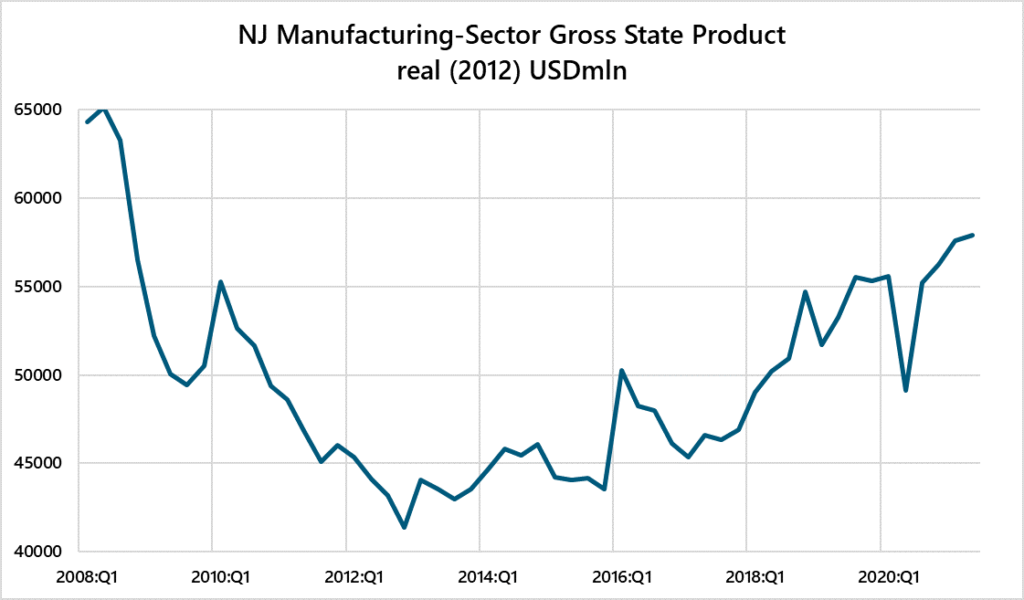
Manufacturing industry Gross State Product – Trending upward since 2018
Over the past four years, manufacturing has been one of New Jersey’s fastest expanding industries, growing at a 5.6 percent annualized pace. The strength has been concentrated in non-durable manufacturing – areas such as food and chemical products. This recent strength in manufacturing is quite a contrast to what the experience was in the aftermath of the 2008-09 recession, when manufacturing contracted at a 3.0% annualized rate through 2016.
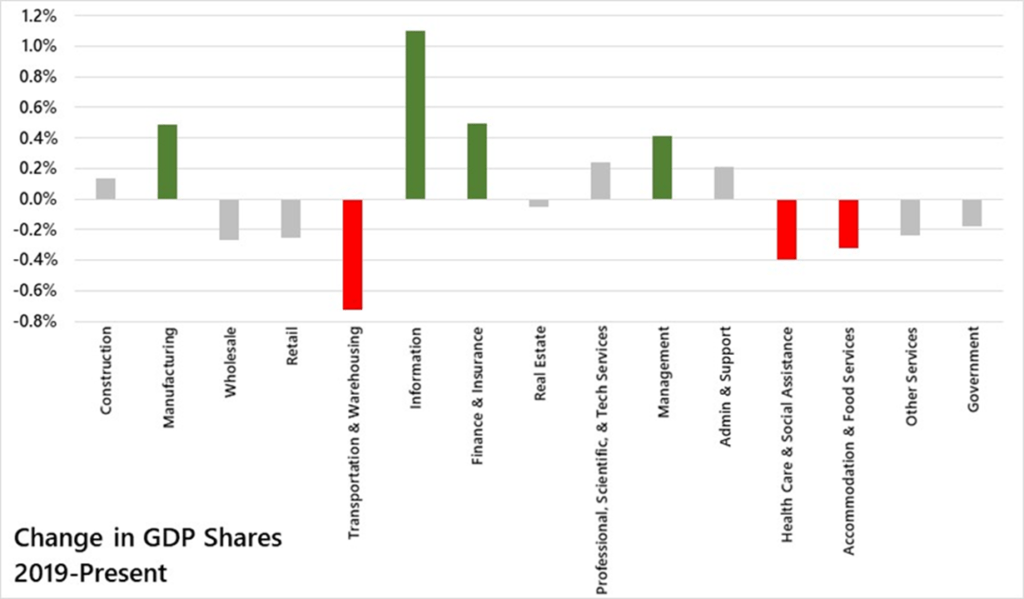
Manufacturing, along with some other high value-added industries, is increasing as a share of New Jersey’s economy
Not only is manufacturing expanding at a solid clip, but it is becoming an increasing share of New Jersey’s overall economy. This chart looks at how shares of GDP have changed since the period right before the pandemic to today. As the chart shows, manufacturing as a share of the economy has increased by approximately 0.5 percentage points. Manufacturing currently accounts for around 11.3 percent of private-sector GDP.
Labor market indicators and Federal Reserve surveys point to continued solid growth
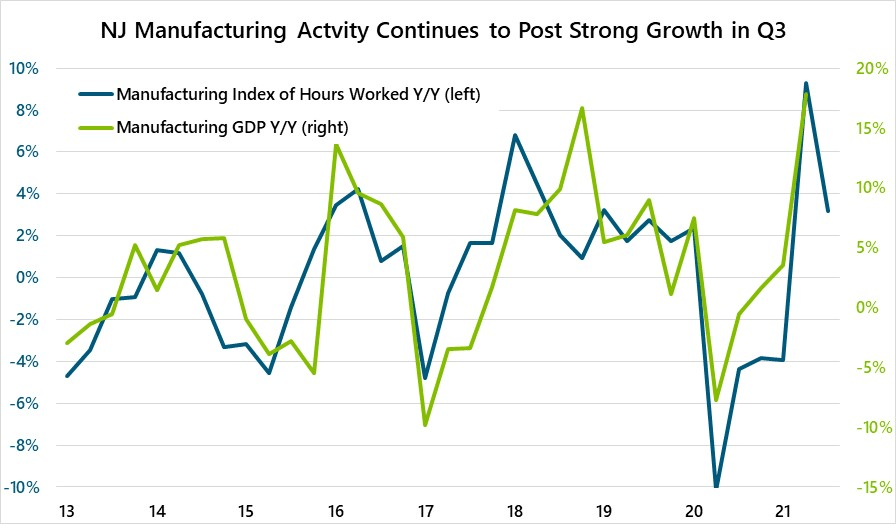
Economists are always on the lookout for leading indicators that provide information on how economic activity is performing now and into the future. These next two charts do just that.
This is a chart of year-over-year changes in both the manufacturing index of hours worked and manufacturing GDP for New Jersey. The manufacturing index of hours worked is the product of the number of manufacturing employees and the hours they have worked. Essentially, it provides a measure of the amount of labor input in a given quarter. Given labor is a significant input in the manufacturing process, tracking labor output can tell us about manufacturing output. Here we see, through Q3, that manufacturing labor input continued to grow at very strong rate in line with manufacturing GDP near 10 percent year over year growth. Thus, manufacturing output continued to grow at a solid clip in Q3.
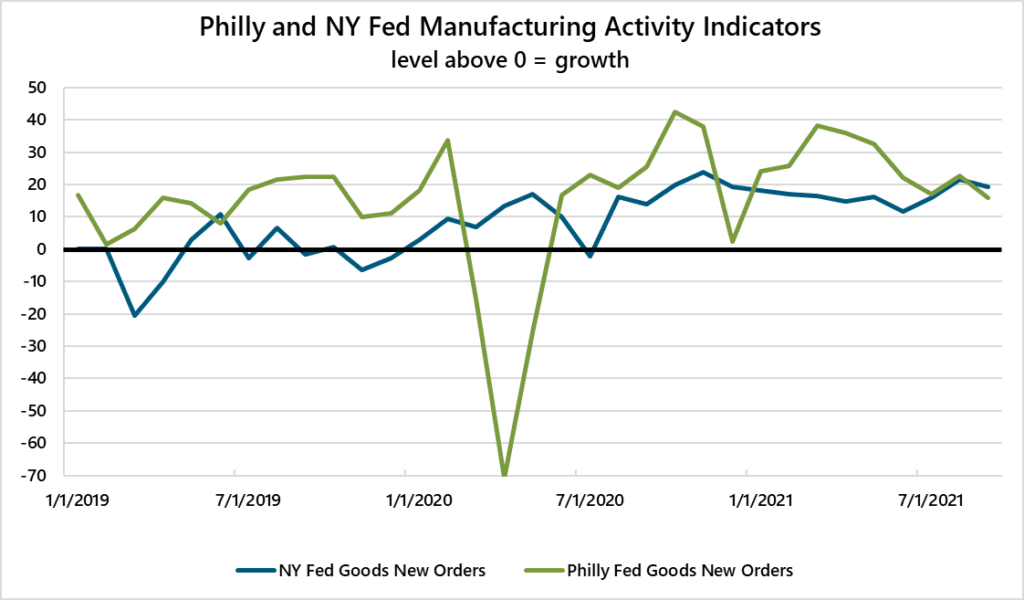
This chart shows data from two very useful surveys of manufacturing activity run by the Federal Reserve Banks of New York and Philadelphia. Here we are focused on indices for new orders, which is extremely helpful data for understanding near-term manufacturing activity because today’s orders become tomorrow’s production. Thus, when new orders are growing at a strong pace, it is a clear sign future production will, in turn, be strong.
In this context, anything above 0 indicates growth, so current levels near 20 signal double-digit growth. The one disclaimer is that it depends on whether demand is being filled by new production or previously produced inventories. However, given that inventories are stretched fairly thin currently, the ongoing growth of new orders signals a solid pace of manufacturing sector activity in Q4 and, likely, beyond.
A New Jersey Geography of Manufacturing Jobs, 2010-2019
This section provides an analysis of New Jersey residents who are manufacturing industry workers, as reported by the United States Census Bureau. The data presented here pertains to New Jersey residents and where they live, in contrast to where the manufacturing jobs or employers are located.
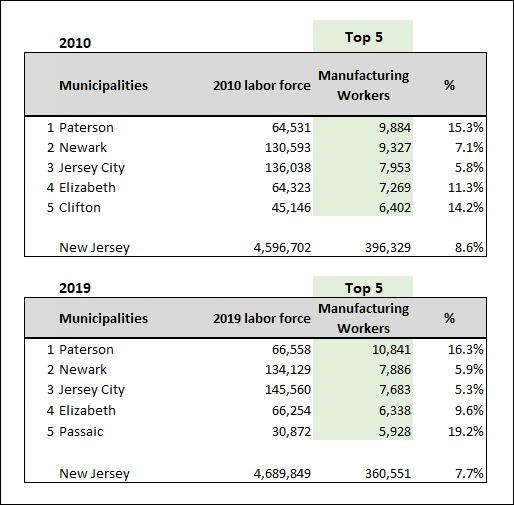
In the nine years just prior to the COVID-19 pandemic (2019 vs. 2010), New Jerseyans employed in manufacturing decreased from 396,000 (8.6 percent of the work force) in 2010 to 361,000 (7.7 percent of the work force) in 2019 — a 9.9 percent decrease in residents employed in manufacturing. However, there are some interesting trends throughout the state, including some places where the number of residents employed in manufacturing has increased. Moreover, as the analysis above shows, manufacturing in New Jersey in recent years is growing at a solid clip, which may reverse the shifts of the past nine years.
Top five municipalities in manufacturing worker residents in New Jersey, by percentage of workforce, 2019 vs 2010
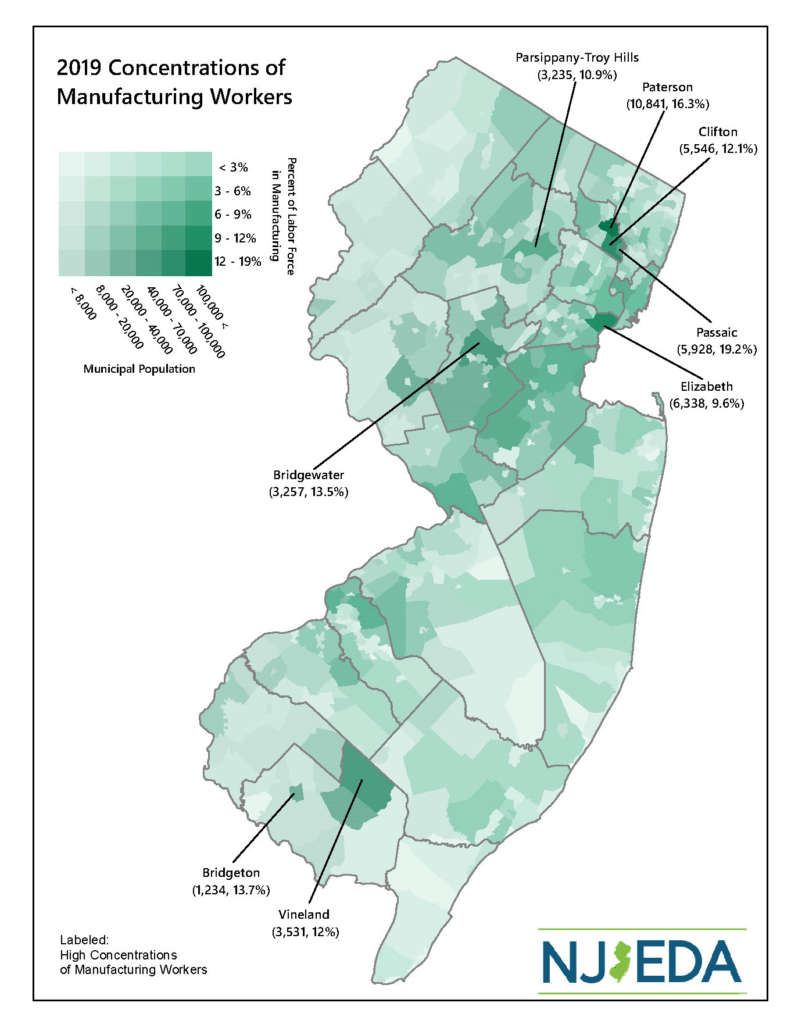
Looking at the raw numbers of residents in each municipality, the most populous cities unsurprisingly have the largest numbers of residents employed in manufacturing. The top five municipalities for manufacturing worker residents in 2010 included Paterson (9,884), Newark (9,327), Jersey City (7,953), Elizabeth (7,269), and Clifton (6,402). These rankings stayed mostly the same through 2019, except for the fifth spot, which switched from Clifton to neighboring Passaic. Clearly, the center of New Jersey manufacturing workers remains the northeast urban areas near New York City. The following map shows manufacturing worker density by municipality, both in levels and as a percent of labor force.
Map of manufacturing worker residents in New Jersey, levels and share of work force, 2019
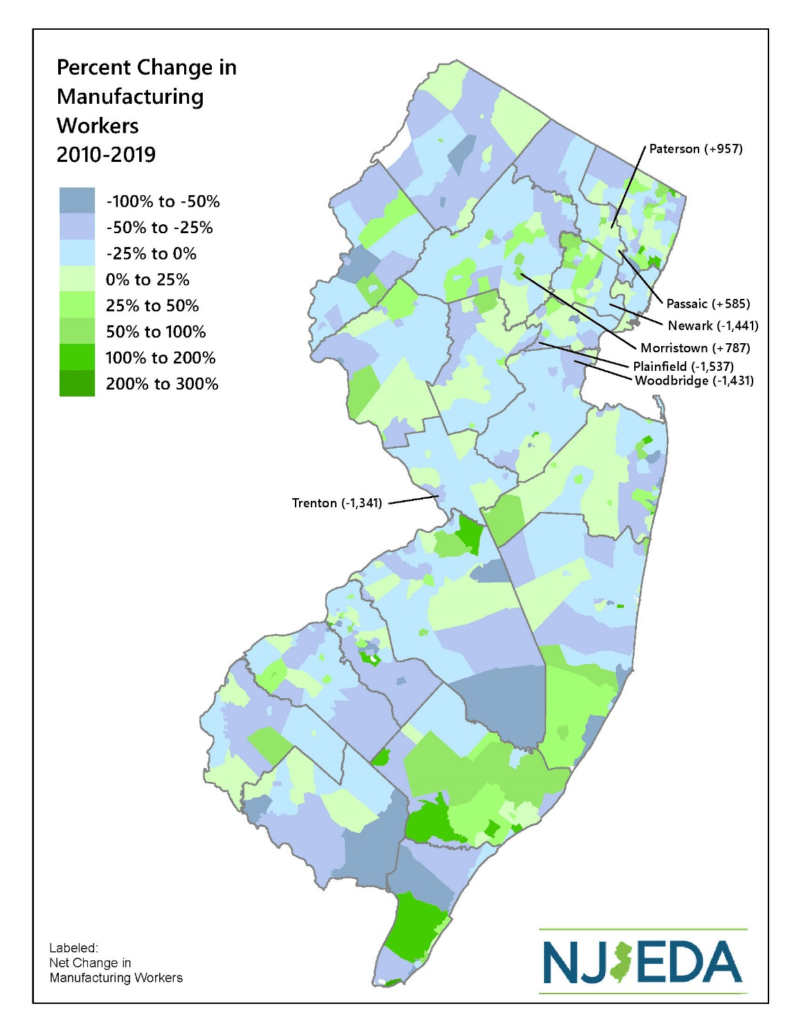
Looking at the following map related to changes across the state, rural areas generally saw decreases in manufacturing employees. Whether this is caused by changes in manufacturing locations, movement of residents, or a combination of factors would need further study support. However, there is evidence from the 2020 Census that indicates rural communities are losing population.
Map of percent change in manufacturing worker residents in New Jersey, 2019 vs 2010
Outside of the northeastern manufacturing area, there is a notable increase in manufacturing employees in Atlantic County and Southern Ocean County. It will be of interest to follow how New Jersey’s new wind port, which is being built in Salem County, supports further manufacturing sector employment in and around the region.
The towns that saw the biggest decreases in residents employed in manufacturing from 2010-2019 share some similarities to those above. Plainfield (-1,537), Newark (-1,441), Woodbridge (-1,431), and Linden (-1,265) are also in this concentrated northeast urban area, while Trenton (-1,341), which has the fourth most manufacturing residents in the state, is not.
Reshoring Jobs: a Pre-COVID Trend Accelerated by the Pandemic
Among the many lessons the world has learned from the COVID-19 pandemic is the is the vulnerability of the global supply chain. Estimates suggest the pandemic affected 98 percent of global supply chains.[1] Companies that had previously prioritized a lean supply chain model that prioritized cost reduction and just-in-time production were not well prepared for major worldwide disruptions.[2]
As a result of the pandemic, some firms started to consider “reshoring” – the practice of bringing manufacturing and services back to the United States from overseas.[3] A May/June 2020 survey of 750 North American manufacturing firms found that 69 percent were either “likely” or “extremely likely” to reshore their overseas operations.[4] It is worth noting that the pandemic did not seem to cause the sudden interest in reshoring – rather, it accelerated an existing trend.[5]Evidence shows, over the past decade, China has lost the most reshored U.S. jobs (40 percent), followed by Mexico (23 percent) and Canada (10 percent). Over the past several years, the number of jobs cumulatively reshored to the United States has increased from about 100,000 in 2013 to over 500,000 in 2020.[6] In 2020, reshoring logged a record high 109,000 jobs announced.
The pandemic was the main driver of this recent surge, but analysts also view this landmark development as a combination of other factors, including greater U.S. competitiveness due to corporate tax and regulatory cuts, and rising concern over China’s competitiveness.[7] In general, a number of variables unrelated to the pandemic factor into a company’s decision to reshore. Rising wages in hosting countries are one of the most frequently cited reasons. Other reasons include protection of intellectual property, shorter supply chains, and the value of the “Made in USA” label as factors in decisions resulting in reshoring.[8] Despite the impact of COVID-19 and some promising developments in recent years, it’s important not to assume that reshoring is inevitable. Decisions on supply chains are made based on business fundamentals such as production costs and access to large markets. COVID-19 will likely not significantly affect those factors.
$20M Expansion to Pilot Program Helps Jersey Shore Businesses & Organizations Purchase Zero-Emission Medium-Duty Vehicles
TRENTON, N.J. (December 1, 2021) – The New Jersey Economic Development Authority today opened applications for its popular New Jersey Zero Emission Incentive Program (NJ ZIP) pilot to businesses and organizations in the Greater Shore Area to help them offset the cost of purchasing new, zero-emission medium-duty vehicles (MDVs). Last month, the NJEDA Board approved a $20 million expansion of the program funding pool, which builds on momentum generated since the launch of the clean energy initiative. NJ ZIP is also available to entities in the greater Newark, Camden, and New Brunswick areas.
With this expansion, nearly $45 million has been allocated to the voucher pool. Applications are being accepted on a rolling basis and can found at http://www.njeda.gov/njzip. The website also includes links to useful resources for potential program applicants, including: webinars for vendors and purchasers, eligibility requirements, frequently asked questions, accounting of remaining funds, and a link to email the NJ ZIP program manager directly.
Businesses and organizations in the four designated greater community areas can apply for vouchers to purchase new, Class 2b to Class 6 zero-emission MDVs. The size of vouchers awarded through the program varies depending on the class of vehicle being purchased, from a minimum of $25,000 for Class 2b vehicles to $100,000 for Class 6 vehicles. Bonuses are available for small businesses (fewer than 25 staff or less than $5 million in annual revenues); women-, minority-, and veteran-owned businesses; vehicles that are manufactured in New Jersey; and small businesses that scrap their eligible MHDVs. More information on eligibility and processes is available at https://www.njeda.gov/njzip.
“Our shore communities have repeatedly experienced the long-term impacts of climate change over the last decade and it is incumbent upon us to continue to create and leverage innovative solutions to blunt these effects,” NJEDA Chief Executive Officer Tim Sullivan said. “NJ ZIP sits at the intersection of clean energy and environmental justice and is a vital part of Governor Phil Murphy’s whole-of-government approach to combating climate change and spurring economic opportunities in historically overburdened communities.”
For the purposes of this pilot expansion, the Greater Shore Area is defined as the overburdened communities within or intersected by a line set at a 10-mile distance from New Jersey’s eastern Atlantic shore, spanning approximately from Sandy Hook Bay to Delaware Bay. This includes the following municipalities:
Absecon, Asbury Park, Atlantic City, Barnegat Township, Berkeley Township, Bradley Beach Borough, Brick Township, Brigantine, Cape May, Colts Neck Township, Eatontown Borough, Egg Harbor City, Egg Harbor Township, Farmingdale Borough, Galloway Township, Highlands Borough, Holmdel Township, Howell Township, Keansburg Borough, Keyport Borough, Lacey Township, Lakewood Township, Little Egg Harbor Township, Long Branch, Lower Township, Manchester Township, Middle Township, Middletown Township, Neptune City Borough, Neptune Township, North Wildwood, Northfield, Ocean City, Ocean Gate Borough, Ocean Township, Pleasantville, Point Pleasant Beach Borough, Red Bank Borough, Seaside Heights Borough, Shrewsbury Township, Somers Point, South Toms River Borough, Stafford Township, Tinton Falls Borough, Toms River Township, Tuckerton Borough, Union Beach Borough, Ventnor City, Wildwood, Woodbine Borough
Vouchers are available on a first-come, first-served basis, with set-asides for the Greater Shore Areas, small- and micro-businesses, and passenger transportation. Based on the continued positive results of this expansion of the pilot program, additional expansions or a longer-term program with expanded eligibility may be proposed.
This latest NJ ZIP expansion is being funded using proceeds from New Jersey’s participation in the Regional Greenhouse Gas Initiative (RGGI), a multi-state “cap-and-trade” program regulating carbon dioxide emissions, that New Jersey was rejoined by Executive Order of Governor Murphy in 2019. More information about New Jersey’s plans for using RGGI funding is available https://www.nj.gov/rggi/index.html.
About the New Jersey Economic Development Authority
The New Jersey Economic Development Authority (NJEDA) serves as the State’s principal agency for driving economic growth. The NJEDA is committed to making New Jersey a national model for inclusive and sustainable economic development by focusing on key strategies to help build strong and dynamic communities, create good jobs for New Jersey residents, and provide pathways to a stronger and fairer economy. Through partnerships with a diverse range of stakeholders, the NJEDA creates and implements initiatives to enhance the economic vitality and quality of life in the State and strengthen New Jersey’s long-term economic competitiveness.
TRENTON, N.J. (November 23, 2021) – Holiday shopping presents many opportunities to show your support for locally-owned businesses in New Jersey. With close to one million small businesses that call the Garden State their home, the support we show our small business owners during the holidays will have a more far-reaching effect than you may anticipate.
When you consider that according to the U.S. Small Business Administration, there are 937,436 small businesses in New Jersey that employ around 1.9 million people, which translates to half of all employees in the State, you can begin to understand the monetary impact small businesses bring to our economy. Three times more money returns to the local economy when you shop locally, while eating at locally-owned restaurants brings in two times more money, according to a series of independent-business impact studies conducted by Civic Economics, a consulting firm for local businesses.
To date, in line with Governor Phil Murphy’s vision for a strong recovery, the New Jersey Economic Development Authority (NJEDA) has approved 92,300 grants, loans, guarantees of loans, and technical assistance totaling nearly $667 million through COVID-19 relief programs. Of that, more than 77,790 grants totaling over $589 million have been awarded.
“In support of Governor Murphy’s goal of a stronger, fairer New Jersey economy, the NJEDA developed numerous programs and services to help our small businesses effectively navigate the economic difficulties caused by the pandemic,” said NJEDA Chief Executive Officer Tim Sullivan. “When small business owners have the local support, on top of any federal or state resources they might be eligible for, the light at the end of the tunnel becomes much brighter, not just for that business, but for the entire community.”
Sullivan added that in order to ensure equitable and inclusive distribution of support, one-third of grant funding approved has been for businesses in the 715 census tracts deemed eligible for consideration as Opportunity Zones.
“Minority- and women-owned businesses were impacted particularly hard by the pandemic, and the holidays are a great time to show our support,” said NJEDA’s Chief Diversity and Inclusion Officer Michelle Bodden. “COVID-19 exacerbated the existing challenges faced by businesses owned by people of color, and an equitable and successful recovery is imperative to the economic future of all New Jersey families.”
Bodden noted that outreach efforts for almost all the Authority’s COVID-19 relief programs targeted minority- and women-owned businesses as well as businesses in historically marginalized communities. As a result of these efforts, nearly 30 percent of the grant funding the NJEDA made available to COVID-19-impacted businesses went to women- and/or minority-owned small businesses.
Whether you decide to shop in one of your town’s many small businesses or opt to hit the road and visit your favorite New Jersey small-town vacation destination, shopping locally during Black Friday, Small Business Saturday and Cyber Monday will prove to be of vital importance to our local economies, as the money you spend at these brick-and-mortar, mom-and-pop shops, will in turn support the communities they serve in several ways.
When small business owners use their earnings to pay for the local products and services they need, that money continues to circulate within the community. By shopping local, you are not just supporting small business owners, you str also supporting their families, their employees and their employees’ families. Additionally, a portion of the taxes charged on your purchases helps fund local police and fire departments, build and improve your schools, and keep roads and bridges in good condition. Therefore, shopping locally also benefits local facilities and municipalities.
The NJEDA’s support for small businesses in the state has not been limited to financial relief program. The Authority has also provided funding to create the E-Commerce Technical Assistance program services to help businesses operate safely during the COVID-19 pandemic. In July of 2020, the Authority engaged the services of Hudson Integrated, Positive Solutions, and Suasion Communications Group to help businesses that normally rely on foot traffic and in-person transactions identify and implement the website and ecommerce capabilities they need to stay in business while complying with health guidelines and changing customer preferences. Through support from this program, more than 60 New Jersey businesses have pivoted to expand their online capabilities, which has helped them continue to serve their customers throughout the pandemic, and also capitalize on opportunities to reach more customers, such as Cyber Monday.
Another NJEDA program that has received high praise for the positive impact it’s had on struggling communities is Sustain and Serve NJ. The program provides eligible entities with grants of between $100,000 to $2 million to support the purchase of meals from New Jersey-based restaurants that have been negatively impacted by COVID-19. So far, $34 million has been awarded to 29 organizations throughout the state to partner with over 400 restaurants and meal delivery services in all 21 counties. Governor Murphy announced another $10 million for the program earlier this month. Sustain and Serve NJ is now on track to provide more than 4.5 million meals.
Some programs created under the Main Street Recovery Program, established under the New Jersey Economic Recovery Act of 2020 (ERA), signed into law by Governor Murphy on January 7, 2021, are designed to assist growing small businesses. This includes the recently-launched Small Business Lease Grant, which offers reimbursement of a percentage of annual lease payments to for profit businesses and non-profit organizations in eligible areas that plan to lease between 500 – 5,000 square feet of new or additional market-rate, first-floor office, industrial or retail space for a minimum five-year term. A sister program, the Small Business Improvement Grant, will offer reimbursement for costs associated with making building improvements or purchasing new furniture, fixtures and equipment.
The NJEDA’s Board also recently approved the creation of the Main Street Micro Business Loan, which will provide financing of up to $50,000 to eligible micro businesses in New Jersey with ten or fewer full-time employees and no greater than $1.5 million in annual revenues. The Program is the successor to the Micro Business Loan Program established by the NJEDA in 2019.
New Jersey keeps making huge strides in its efforts to attract entrepreneurs from all sectors of the economy who see the state as an ideal place to start a business. Trenton’s pro-business approach and a growing state economy have made this possible. Nevertheless, the support small business owners need to see their business thrive comes from members of its own community and this holiday season gives us all a great opportunity to show that support.
Our small businesses are counting on you this holiday season! Remember, #NJShopsLocal!
About the New Jersey Economic Development Authority
The New Jersey Economic Development Authority (NJEDA) serves as the State’s principal agency for driving economic growth. The NJEDA is committed to making New Jersey a national model for inclusive and sustainable economic development by focusing on key strategies to help build strong and dynamic communities, create good jobs for New Jersey residents, and provide pathways to a stronger and fairer economy. Through partnerships with a diverse range of stakeholders, the NJEDA creates and implements initiatives to enhance the economic vitality and quality of life in the State and strengthen New Jersey’s long-term economic competitiveness.
TRENTON, N.J. (November 10, 2021) – The New Jersey Economic Development Authority (NJEDA) Board today approved the creation of the Main Street Micro Business Loan, which will provide financing of up to $50,000 to eligible micro businesses in New Jersey with ten or fewer full-time employees and no greater than $1.5 million in annual revenues. The Program is the successor to the Micro Business Loan Program established by the NJEDA in 2019.
The Main Street Micro Business Loan is the newest product from the Main Street Recovery Fund—a $100 million suite of programs created or expanded under the Economic Recovery Act of 2020 (ERA), signed by Governor Phil Murphy in January 2021. The ERA includes tax credits to incentivize job creation, new construction, and revitalization of brownfields and historic properties; financial resources for small businesses; support for new supermarkets and healthy food retailers in food desert communities; new funding opportunities for early-stage companies in New Jersey; and support for the growing film and digital media industry.
“New Jersey’s economy depends on small businesses for the jobs they provide and the unique character they bring to our communities, said New Jersey Governor Phil Murphy. “As we emerge from the pandemic, we need to set the stage for a stronger and fairer recovery that creates opportunities for businesses that may have been left out in the past. The Main Street Micro Business Loan Program does just that by helping the smallest of businesses overcome some of the longstanding hurdles associated with accessing capital.”
With $20 million in funds allocated from the Main Street Recovery Fund, financing from the Main Street Micro Business Loan will cover future operating expenses such as inventory, equipment (that does not require installation or construction work totaling more than $1,999.99) and working capital to fund business operating expenses. The loan will have a standard 10-year term and the interest rate will be 2 percent, with no interest and no payments due for the first year.
“Micro businesses, which are often led by women and people of color, are an essential part of the state’s economy, and a major creator of jobs. Unfortunately, they often face disproportionate challenges when it comes to accessing low-cost financing,” said NJEDA Chief Executive Officer Tim Sullivan. “In line with Governor Murphy’s vision for a stronger, fairer New Jersey economy, the Main Street Micro Business Loan Program will ensure more businesses have access to the resources they need to not only survive the economic effects of the pandemic, but to regain their economic stability and build their resilience to future economic disruptions.”
To help ensure all Opportunity Zone eligible tracts in New Jersey receive opportunities for investment that are equitable and inclusive, $8 million will be set aside to support eligible businesses and nonprofits with a primary business location within the 715 census tracts designated as eligible to be selected as an Opportunity Zone.
Nonprofit, for profit, and home-based micro businesses interested in applying for the Main Street Micro Business Loan must meet the following eligibility requirements:
Must have less than $1.5 million in annual gross revenue for the most current fiscal year (to the extent the business has annual revenues)
Must have no more than 10 full-time employees
Must be legally registered to do business in New Jersey, with a business location (other than a home office) in New Jersey
Must be in existence, as evidenced by date of formation/incorporation, and in operation for at least six months prior to the date of application being made publicly available
Must be in good standing with the New Jersey Department of Labor and Workforce Development (LWD) and NJ Department of Environmental Protection at the time of application to be eligible for a micro business loan
Must provide a current tax clearance prior to approval to demonstrate the applicant is in good standing with the NJ Division of Taxation.
The Main Street Micro Business Loan will not require collateral, as the underwriting criteria will be based solely on credit score. Only not-profit organizations will need to be fully underwritten and required to meet a 1.0 debt service coverage ratio. For all other for-profit entities, at least one owner must have a credit score of 600 or greater to be considered eligible. Personal guarantees of all owners or principals will be required of for-profit entities, but not from nonprofit organizations.
Additionally, borrowers under the Main Street Micro Business Loan may be eligible for the balance of the loan to be forgiven at the end of the fifth year. To qualify for this forgiveness, the applicant must be current on all loan payments with no delinquency of more than 90 days and must be able to certify that they are still open and operating as detailed in the loan agreement. Furthermore, recognizing the extraordinary economic circumstances that make this program necessary, the NJEDA reduced the non-refundable application fee to $100 and a closing fee of $400.
Applications for the Main Street Micro Business Loan will be reviewed on a first-come, first-served basis, based on the date/time at which the Authority receives the completed application. Any pending applications to the prior Micro Business Loan Program can still proceed toward closing on their loan. Past recipients of the Micro Business Loan Program are eligible to apply for the Main Street Micro Business Loan. Due to the favorable terms of this product only one application per EIN is allowed.
About the New Jersey Economic Development Authority
The New Jersey Economic Development Authority (NJEDA) serves as the State’s principal agency for driving economic growth. The NJEDA is committed to making New Jersey a national model for inclusive and sustainable economic development by focusing on key strategies to help build strong and dynamic communities, create good jobs for New Jersey residents, and provide pathways to a stronger and fairer economy. Through partnerships with a diverse range of stakeholders, the NJEDA creates and implements initiatives to enhance the economic vitality and quality of life in the State and strengthen New Jersey’s long-term economic competitiveness.
TRENTON, N.J. (November 3, 2021) – The New Jersey Economic Development Authority (NJEDA) announced today that it will host a virtual workshop to provide information on how to obtain and maintain the necessary documents from state departments. The ‘Navigating State Departments’ Workshop will be held at 11:00 a.m. on November 9th, 2021 and will connect business owners with the people and information they need to start and maintain their business long-term.
This is a great opportunity for New Jersey’s small businesses, startups, and nonprofits to learn how to properly navigate the numerous programs and services offered by State entities, such as how to properly register a business in New Jersey; how to obtain a tax clearance certificate; how to certify a business as women-, minority-, or veteran-owned; and ways to access free available technical assistance, federal resources, and mentorship opportunities, among other relevant topics.
TRENTON, N.J. (20 de octubre 2021) – El proceso de aplicaciones para el subsidio de alquileres para pequeñas empresas de la Autoridad para el Desarrollo Económico de New Jersey (NJEDA, por sus siglas en inglés) abrió hoy 20 de octubre a las 9:00 a.m.
El subsidio de alquileres para pequeñas empresas otorga subsidios de hasta el 20 por ciento de los pagos de alquiler anual a pequeñas empresas y organizaciones sin fines de lucro que tengan contratos de alquiler nuevos o modificados a la tasa de mercado por al menos 250 pies cuadrados de espacio a nivel de la calle. Las aplicaciones se aceptarán de forma continua hasta que se otorguen todos los fondos.
Tenga en cuenta: Este anuncio es solo para el subsidio de alquileres para pequeñas empresas, que es un programa independiente del subsidio para la mejora de pequeñas empresas. Las solicitudes para el subsidio para la mejora de pequeñas empresas se lanzarán en una fecha próxima, la cual la NJEDA comunicará al público en su sitio web y a través de sus cuentas de redes sociales antes del lanzamiento del proceso de aplicaciones.
Detalles del Programa
El subsidio de alquileres para pequeñas empresas es un programa de $10 millones diseñado para revitalizar los centros urbanos y las calles principales al compensar una parte del costo asociado con las empresas y organizaciones sin fines de lucro que alquilan espacios a nivel de calle.
A través del programa, las empresas y organizaciones sin fines de lucro elegibles que tengan contratos de alquiler nuevos o modificados a la tasa de mercado pueden recibir dos subsidios por un total de hasta el 20 por ciento de los pagos de alquiler anual. El primer subsidio se pagará a las entidades inmediatamente después de que sean aprobadas para el programa y ejecuten el acuerdo del subsidio, y el segundo subsidio se pagará después del primer año de alquiler.
Para ser elegibles, las empresas y organizaciones sin fines de lucro deben tener un nuevo contrato de alquiler, una enmienda del alquiler o una extensión del alquiler que incluya al menos 250 pies cuadrados de espacio de oficinas, comercial o minorista a nivel de la calle. El solicitante también debe comprometerse a permanecer en el espacio alquilado durante al menos cinco años. Los criterios completos de elegibilidad están disponibles en https://www.njeda.gov/small-business-lease-grant/.
De acuerdo con el compromiso del gobernador Phil Murphy de lograr una recuperación más sólida y justa de la pandemia de COVID-19, el 40 por ciento de los $10 millones asignados al subsidio de alquileres para pequeñas empresas se destinará a empresas y organizaciones sin fines de lucro en las secciones del censo que fueron elegibles para ser designadas como Zonas de oportunidad. Esta focalización ayudará a garantizar que los recursos estén disponibles para las entidades y comunidades propiedad de minorías y mujeres que han enfrentado desafíos importantes como resultado del COVID-19.
El subsidio de alquileres para pequeñas empresas es el primero de varios programas que la NJEDA lanzará en los próximos meses en el marco del Programa de recuperación de Main Street. Creado bajo la Ley de Recuperación Económica de Nueva Jersey de 2020, el Programa de Recuperación de Main Street es un programa de apoyo a pequeñas empresas de $100 millones que financiará múltiples productos de asistencia financiera con el fin de respaldar el crecimiento y el éxito de las pequeñas empresas en New Jersey. Más información sobre el Programa de recuperación de Main Street está disponible en https://www.njeda.gov/main-street-recovery-fund/.
Acerca de la Autoridad para el desarrollo económico de New Jersey
La Autoridad para el desarrollo económico de New Jersey (NJEDA) es la agencia principal del Estado para impulsar el desarrollo económico. La NJEDA tiene el compromiso de hacer del Estado de New Jersey un modelo nacional para el desarrollo económico inclusivo y sostenible al centrarse en estrategias claves para ayudar a construir comunidades fuertes y dinámicas, crear buenos trabajos para los residentes de New Jersey y ofrecer oportunidades para una economía más sólida y justa. Mediante asociaciones con diversas partes interesadas, la NJEDA crea e implementa iniciativas para mejorar la vitalidad económica y la calidad de vida en el Estado y para fortalecer la competitividad económica a largo plazo de New Jersey.
Para obtener más información acerca de los recursos de la NJEDA para empresas, llame a la línea de atención al cliente de NJEDA al 844-965-1125 o visite https://www.njeda.gov y siga a @NewJerseyEDA enFacebook, Twitter, Instagram y LinkedIn.