NJ’s Venture Capital Deal Flow More Than Doubles to $5.5 Billion in 2021
as State’s Innovation Ecosystem Sees Flurry of Activity

Trenton, N.J. (March 4, 2022) – The New Jersey Economic Development Authority (NJEDA) today announced that New Jersey now ranks ninth in the nation based on venture capital (VC) dollars invested per state. According to PitchBook, innovation-focused companies in New Jersey secured $5.5 billion in 219 venture capital deals in 2021, up from $1.7 billion thorough 154 deals in 2020. This represents a significant improvement for New Jersey relative to 2017, when the state saw a total of $818 million in 143 venture capital deals. In this latest ranking, New Jersey jumped three spots from where it stood at #12 in 2020, and seven spots from #16 in 2013. New Jersey’s share of the Northeast market also grew, by 1.4 percentage points in 2021 to 5.5 percent.

“We’re very encouraged to see the VC community invest in New Jersey startups on a scale we haven’t seen in decades,” said Governor Phil Murphy. “It’s well known that New Jersey is the birthplace of innovation, but investors are clearly showing that our state is the future of innovation as well.”

Throughout his first term, Governor Murphy prioritized recapturing New Jersey’s role as a leader in innovation and creating the most diverse and inclusive innovation ecosystem in the nation. In January 2021, the Governor signed the New Jersey Economic Recovery Act of 2020 (ERA). In part, the ERA calls for the establishment the New Jersey Evergreen Fund (NJIEF), which is designed to create the ecosystem conditions necessary for entrepreneurs to succeed. Expected to launch this year, the NJIEF will create a platform for even greater investment opportunity in NJ businesses by leveraging public and private funds to invest in New Jersey-based companies. Details of the NJIEF, which is currently under development, can be found at https://www.njeda.gov/evergreen/.

The ERA also made enhancements to the state’s Angel Investor Tax Credit Program. Last summer, the NJEDA approved expanding the Angel Investor Tax Credit Program based on those enhancements as well as revisions made to the program through legislation signed by Governor Murphy in 2019. Examples of the enhancements include increasing the amount of tax credits available annually under the program from $25 million to $35 million. It also increased the amount of tax credits available per qualified investment in an emerging New Jersey technology business from 10 percent to 20 percent and adding five percent bonus credit for qualified investments made in a New Jersey certified minority-or women-owned technology business or a technology business that is located in a qualified Opportunity Zone or New Markets Tax Credit Census Tract.

Last year, the NJEDA approved a record-breaking 559 Angel Investor Tax Credit Program applications, a nearly 400 percent increase over 2020. These approved applications represented the injection of more than $100 million in 39 New Jersey businesses. This constitutes a more than threefold year-over-year increase in investment and tax credit totals.

“The Murphy Administration has taken numerous steps to bolster New Jersey’s innovation economy and the investment community is taking notice,” said NJEDA Chief Executive Officer Tim Sullivan. “In addition to our spot within the Top 10 spot for venture capital dollars, we are also seeing companies of all size choosing to benefit from all that New Jersey has to offer. This, in turn, will lead to the creation of thousands of jobs and bring in even more investment dollars in the coming years.”

As an example, Sullivan cited the commitment of the NJEDA and Princeton-based venture capital firm SOSV to bring SOSV’s acclaimed HAX hard tech startup development program to Newark. SOSV will also establish the U.S. headquarters of the HAX program at the Newark site. SOSV selected Newark as the location for the new HAX program through a competitive process that included locations across the country. SOSV intends to take 100 companies through the HAX program over the next five years and invest $25 million in these startups. The NJEDA has also committed $25 million toward this initiative.  Participating companies may receive up to $50 million from SOSV as follow-on financing to support the companies as they grow. With this support, companies participating in the HAX program are expected to create at least 2,500 new, high-paying jobs in the decade ahead as well as attract millions in new capital.

The NJEDA’s Angel/Venture Capital Funding website launched in early 2021 to showcase capital raises, along with mergers and acquisitions throughout the Garden State. Investors or founders interested in having their investments listed on the page should email njinvestments@njeda.com.

About NJEDA

The New Jersey Economic Development Authority (NJEDA) serves as the State’s principal agency for driving economic growth. The NJEDA is committed to making New Jersey a national model for inclusive and sustainable economic development by focusing on key strategies to help build strong and dynamic communities, create good jobs for New Jersey residents, and provide pathways to a stronger and fairer economy. Through partnerships with a diverse range of stakeholders, the NJEDA creates and implements initiatives to enhance the economic vitality and quality of life in the State and strengthen New Jersey’s long-term economic competitiveness.

To learn more about state resources available to New Jersey entrepreneurs and early-stage companies, visit https://www.njeda.gov and follow @NewJerseyEDA on FacebookTwitter, Instagram, and LinkedIn.

###
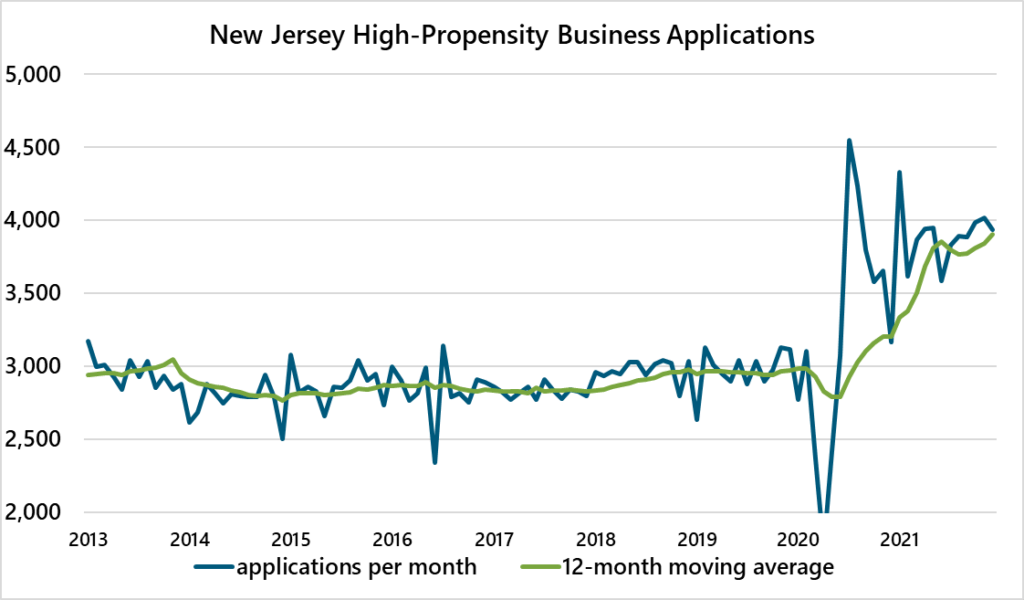
Sometimes, a shock as damaging as a pandemic has a beneficial underside for the economy. For example, we’ve seen a surge in entrepreneurship emerge from the COVID-19 economic shock, as evident in a proliferation of applications to start new businesses. The chart below shows the rate of “high-propensity” business applications filed in New Jersey. As the chart shows, the pace of these applications increased from a rate of approximately 3,000 per month pre-pandemic to near 4,000 now – up more than 30%. The high propensity distinction is important, as these are applications for new businesses likely to be incorporated and create positions for new workers, as separate from applications for businesses likely to be unincorporated sole proprietorships. In this way, these businesses are likely to provide the main sources of income for their owners and provide employment for others.

The cause of this jump in business creation is up for dispute. From our lens, a mix of jobs lost and abundant opportunities to innovate encouraged many people to venture out on their own instead of relying on the status quo. The benefit of this entrepreneurship wave is likely self-evident, but it’s worth noting that entrepreneurship benefits the economy as a whole as well as the individual entrepreneurs. For the economy, entrepreneurship drives the evolution necessary to keep an economy growing. For individuals, entrepreneurship and the value created therein generates economic opportunities and wealth.

So, who are all these new entrepreneurs? For New Jersey, the evidence suggests a growing share of these entrepreneurs in New Jersey are Black. There are few datasets that provide information on business ownership by race, and the ones that do exist tend to release data with a one-to-two-year lag. Thus, if we want to examine in real time what is happening to business ownership by race, we need to rely on proxies of business ownership.

To this end, we follow a method used by Dr. Robert Fairlie[1] with University of California, Santa Cruz, to estimate small business ownership by race using Current Population Survey (CPS) microdata on self-employment. The CPS is a monthly nationwide survey of individuals that includes questions on labor market status, such as employed or unemployed and, if employed, whether the individual is salaried worker or self-employed. As did Fairlie, we use data on self-employment as a proxy for small business ownership. Fairlie reasoned business ownership could be estimated this way because, if a person is a small business owner, that person is going to identify as self-employed. Moreover, we only include self-employment where it is indicated as the primary employment source. Many people are employed in a wage and salary position and own a business as a secondary source of income, and we do not wish to include these estimates in our dataset.

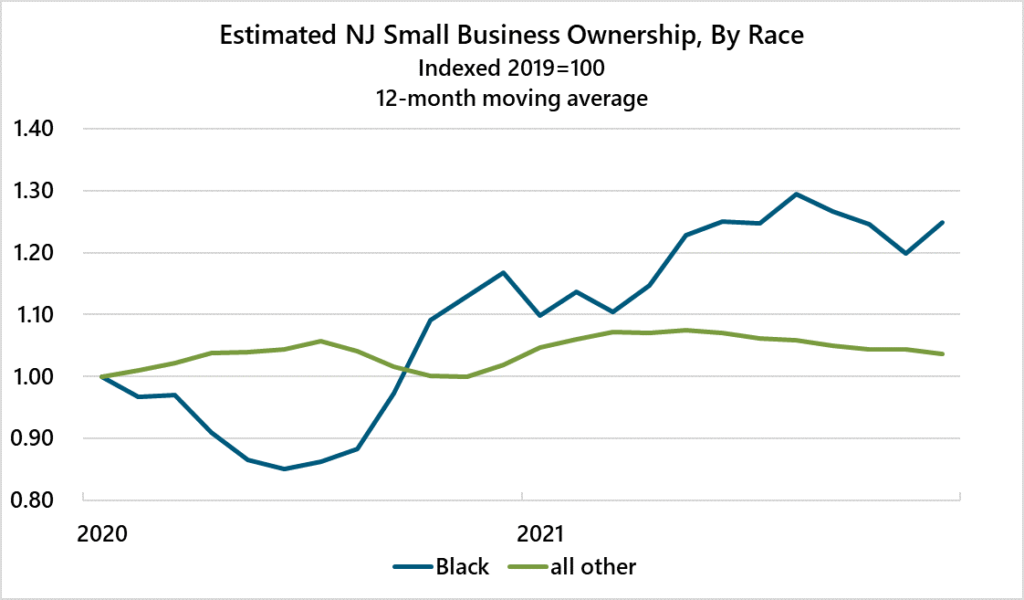
The chart below shows the growth of small business ownership by race, indexed at the 2019 level = 100. We are forced to smooth the data using 12-month moving averages as the data are not seasonally adjusted and are very volatile on a month-to-month basis.

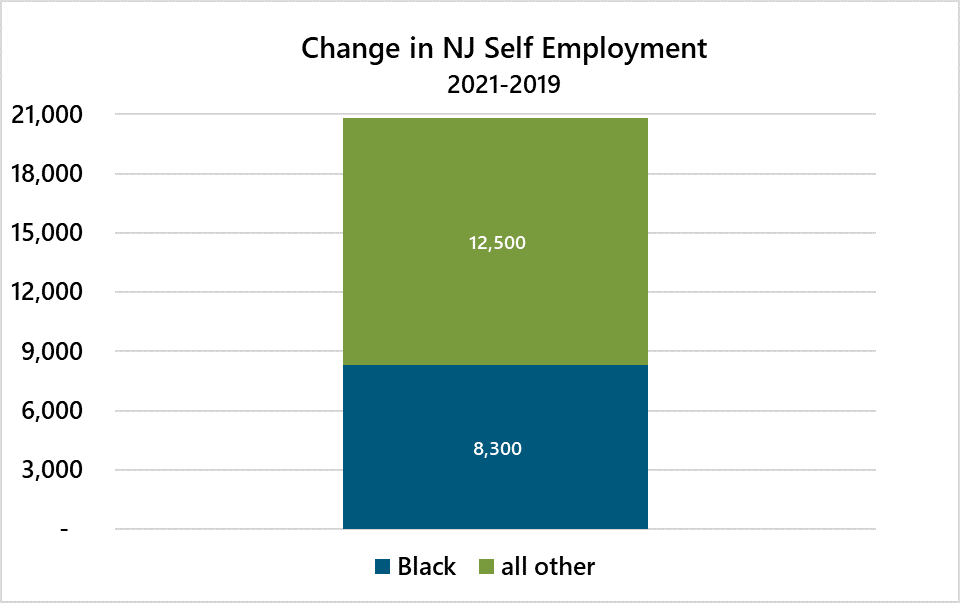
As the above chart shows, Black people were much more likely than the rest of the population to suffer a loss of small business at the start of the pandemic. But since that time, Black business ownership has surged. Relative to the 2019 level, Black business ownership is up approximately 25%. This compares to around 4% for the rest of the population. This comparison between Black and non-Black self-employment is further demonstrated in the chart below, which shows the change in self-employment in 2021 relative to 2019. Of the approximately 20,800 increase in self-employment, almost 40 percent is from Black residents. Given Black residents account for approximately 20 percent of New Jersey’s labor force, the 40 percent share of self-employment shows Black residents are taking up a surprisingly large share of recent new business creation.

The evidence of growing entrepreneurship in the Black community is a welcome sign. But, in order for this growth in entrepreneurship to yield long-term results, these small business owners often require outside sources of financial capital to invest in and grow their ventures. Small businesses are usually strapped for cash – most of the money earned goes into paying for the operating costs of the businesses, leaving little for investment. For instance, the Census Bureau’s Small Business Pulse[2] shows that, for New Jersey, the median business has less than three months of free cash on hand. This clearly isn’t enough to invest in and grow the business.

Unfortunately, access to credit is where the Black community has had one of its biggest challenges with entrepreneurship and business cultivation. The New Jersey Economic Development Authority (NJEDA) has been working with the Federal Reserve to understand gaps in credit access for minority small business owners. Our research shows Black people and other people of color are less likely to have access to credit. These disparities are about more than simply being banked or unbanked – there exists more of a middle ground impacted by the strength of relationships and availability of collateral. As part of this work, we will be meeting with credit organizations, such as community banks and community development financial institutions (CDFIs), to better understand how they approach business with minority small business owners and see where gaps in credit access might be closed.

Moreover, in an effort to close some of these gaps, the NJEDA provides credit and grants to small businesses that might not be able to secure traditional bank financing. Our small business products include improvement grants, lease assistance, direct loans and loan guarantees and participations, as well as direct loans to other credit providers such as CDFIs to help lever credit products. The NJEDA also partners with the African American Chamber of Commerce of New Jersey to offer a Small Business Bonding Readiness Assistance Program to help businesses position themselves to bid on government contracts. The NJEDA wants to ensure that all New Jersey businesses have the resources necessary to expand and that our communities have a healthy climate for growth. As the evidence shows a jump in Black entrepreneurship, our hope is that the work being done with the Federal Reserve and through our programs will support access to credit so these businesses can thrive.


[1] See Fairlie, R. (2020). The impact of COVID‐19 on small business owners: Evidence from the first three months after widespread social‐distancing restrictions. Journal of economics & management strategy, 29(4), 727-740.

[2] See January 9 results for New Jersey at https://portal.census.gov/pulse/data/

Please be advised that the Capital City Redevelopment Corporation Annual Board Meeting is scheduled for 11:00 am, Wednesday, February 23, 2022.  The Members will convene via conference call only.

Members of the public whom wish to speak during the public comment segment of the meeting, pertaining to agenda items, may call into the meeting by using the following conference number:
 
Teleconference #:
1-551-220-2262

Access Code: 831 295 326#

The agenda can be found 48 hours prior to the meeting at our website: www.njeda.gov/ccrc.

Thank you for reaching out.  Below are links for the New Jersey State Division of Taxation and your local office of the Internal Revenue Service.  These agencies should be able to answer questions you have related to the taxability of the funds received. 

The NJEDA does not provide tax guidance and would recommend you consult your tax professional as every business is structured differently.

Internal Revenue Service – CARES Act Coronavirus Relief Fund FAQs
https://www.irs.gov/help/contact-your-local-irs-office

New Jersey Division of Taxation
https://www.state.nj.us/treasury/taxation/contact.shtml

If you think you have been a victim of identity theft regarding an NJEDA program, please use the the form below to submit a report.

*To ensure confidentiality, we cannot provide you an update or final outcome of our review once you submit your report.

Please be advised that the New Jersey Commission on Science, Innovation, and Technology meeting scheduled for Friday, February 18, 2022 @ 10:00 AM is cancelled.

The next regularly scheduled meeting will be the Annual Meeting held on Friday, April 1, 2022 @ 10AM.  Members will meet to discuss and approve items via conference call only.

Members of the public whom wish to speak during the public comment segment of the meeting, pertaining to agenda items, may call into the meeting by using the following conference number:

________________________________________________________________________________

Microsoft Teams meeting

Join on your computer or mobile app
Click here to join the meeting
Or call in (audio only)
+1 551-220-2262,,133584975#   United States, Jersey City
Phone Conference ID: 133 584 975#
Find a local number | Reset PIN
Learn More | Meeting options

________________________________________________________________________________

The agenda can be found 48 hours prior to the meeting at our website: www.njeda.gov/csit.

Grants to Micro Lenders Will Fund Loans and Technical Assistance for Smallest Businesses and Non-Profits

TRENTON, N.J. (February 11, 2022) – The New Jersey Economic Development Authority (NJEDA) Board approved the creation of the Main Street Lenders Grant at its February Board meeting on Wednesday. This pilot product, funded with $15 million from the Main Street Recovery Program, will offer lending grants of up to $1 million to be used by eligible micro business lenders to create new or supplement existing micro business loan products.

The Main Street Lenders Grant is the third of several products the NJEDA is launching under the Main Street Recovery Program. Created under the Economic Recovery Act of 2020 (ERA), which was signed by Governor Phil Murphy in January 2020, the Main Street Recovery Program is a $100 million small business support program that will fund multiple financial assistance products aimed at supporting the growth and success of small businesses in New Jersey. More information is available at https://www.njeda.gov/main-street-recovery-fund/.

New Jersey-based Community Development Financial Institutions (CDFIs) serving New Jersey micro and small businesses, Minority Depository Institutions (MDIs), and other eligible lenders, as defined under the ERA, will be eligible to apply for the Main Street Lenders Grant.

In line with Governor Murphy’s commitment to equity, each approved entity must lend and disburse at least 40 percent of Main Street Lenders Grant funding to businesses and nonprofits in Opportunity Zone-eligible census tracts.

“Even before COVID-19, businesses in underserved communities faced struggles with accessing capital, and NJEDA’s lending partners have long helped to ensure that micro businesses, nonprofits, and other small businesses have access to the capital they need,” said NJEDA Chief Executive Officer Tim Sullivan. “Their role is more vital than ever as businesses continue their recovery from the pandemic. The Main Street Lenders Grant is an essential element of the comprehensive and intentional suite of small business solutions created by the legislature and being rolled out through the ERA under Governor Murphy’s leadership.”

The Main Street Lenders Grant will offer two types of grants to eligible entities. The first is a lending grant. This grant of up to $1 million will be used as funding for new micro business lending products or as supplemental funding for existing micro business lending products.

Recognizing that micro businesses not only need financing, but may also need assistance with applying and qualifying for such financing, the second type of grant that will be made available through this product is a technical assistance grant. This grant will support eligible entities with the costs associated with providing technical assistance to micro businesses to best prepare and position these micro businesses to qualify for micro business loans. The maximum technical assistance grant an eligible entity can receive is 50 percent of their lending grant amount (not to exceed $500,000). Only lenders that receive a lending grant are eligible for the technical assistance grant. The intent is for these grants to enable lenders to provide micro businesses with technical assistance, and then offer a loan product to the micro business upon completion of the technical assistance.

“The NJEDA works with its lending partners to improve access to capital for the smallest businesses, who often face struggles getting the funds they need to build their resilience and position themselves for growth,” said Christina Fuentes, NJEDA’s Managing Director of Community Development. “As we emerge from the pandemic, this grant will extend NJEDA’s reach by expanding the capacity of its lending partners to support more micro businesses by abating barriers to accessing capital.”

Any lender applying for the lending grant must have a demonstrated history of 10 years’ experience serving small and micro businesses, and any entity applying for the technical assistance grant must demonstrate two years’ experience providing technical assistance to micro businesses – either directly, or in collaboration with a technical assistance partner.

Among other requirements, products created by eligible entities using the Main Street Lenders Grant must provide loans of $10,000 to $100,000 for micro businesses that have fewer than 10 full time employees and less than $1.5 million in annual revenue at the time of application. The business must also have a commercial location in New Jersey, which can be a home-based business. Home-based businesses, non-profit organizations, for-profit entities, sole proprietors, and/or startups may be eligible to participate in the program that will be funded through the Main Street Lenders Grant. Complete eligibility requirements for the lending products that will be offered can be found at https://www.njeda.gov/financing-and-incentives/.

The Main Street Lenders Grant serves as a complement to direct funding provided under the Main Street Recovery Program through the recently-launched Small Business Lease Grant and Small Business Improvement Grant.

Signed in January 2021, the ERA creates a package of programs that includes tax credits to incentivize job creation, new construction, and revitalization of brownfields and historic properties; financial resources for small businesses; support for new supermarkets and healthy food retailers in food desert communities; new funding opportunities for early-stage companies in New Jersey; and support for the growing film and digital media industry.

About the New Jersey Economic Development Authority

The New Jersey Economic Development Authority (NJEDA) serves as the State’s principal agency for driving economic growth. The NJEDA is committed to making New Jersey a national model for inclusive and sustainable economic development by focusing on key strategies to help build strong and dynamic communities, create good jobs for New Jersey residents, and provide pathways to a stronger and fairer economy. Through partnerships with a diverse range of stakeholders, the NJEDA creates and implements initiatives to enhance the economic vitality and quality of life in the State and strengthen New Jersey’s long-term economic competitiveness.

To learn more about NJEDA resources for businesses call NJEDA Customer Care at 609-858-6767 or visit https://www.njeda.gov and follow @NewJerseyEDA on Facebook, Twitter, Instagram and LinkedIn.
 

###

Authority Adopts Final List of 50 Communities that May Be Eligible for $240M in Food Desert Relief Act Funding


Trenton, N.J. (February 10, 2022) – The New Jersey Economic Development Authority (NJEDA) today announced that it approved the final list of New Jersey’s 50 designated Food Desert Communities during its Board meeting yesterday. Over the next several years, up to $240 million in funding through the Food Desert Relief Act will be available to strengthen food security and combat food deserts in these communities.

The Food Desert Relief Act is part of the Economic Recovery Act (ERA), signed into law by Governor Phil Murphy in January 2021. The Act directs the NJEDA to address the food security needs of communities across New Jersey by providing up to $40 million per year for six years in tax credits, loans, grants, and/or technical assistance to increase access to nutritious foods and develop new approaches to alleviate food deserts. The NJEDA expects to issue regulations later this year, a critical step in the development of any Food Desert Relief Act-related programs.

“New Jersey has long been at the forefront in the fight against food insecurity,” said Lt. Governor Sheila Oliver, who serves as the Commissioner of the Department of Community Affairs. “We have a moral duty to reduce food insecurity within our state’s borders and the programs we create under the Food Desert Relief Act will strengthen our ability to connect New Jerseyans in the 50 designated Food Desert Communities with access to much-needed nutritious food.”  

A January 2022 U.S. Census Bureau survey found that nearly one in 13 New Jersey households reported not having enough to eat in the past seven days. The total population of New Jerseyans residing in Food Desert Communities exceeds 1.5 million individuals across a diverse range of communities in all 21 of New Jersey’s counties.

Assembly Speaker Craig Coughlin has been a vocal advocate of finding ways to eliminate food deserts and played a key role in the passage of the Food Desert Relief Act.

“The statistics surrounding food insecurity are sobering and unacceptable,” said Assembly Speaker Craig J. Coughlin. “By approving the designation of New Jersey’s Food Desert Communities, we are a crucial step closer to directly addressing the impact of food deserts on New Jersey communities and to securing access to fresh and nutritious foods, with real brick and mortar food retailers and neighborhood food service programs, so everyone feels the comfort of knowing where their next meal will come from.”  

The designation of Food Desert Communities approved yesterday includes consideration of factors such as: food retail environment, demographics, economic indicators, and health indicators. The NJEDA developed the list and accompanying methodology for designation of the Food Desert Communities in partnership with the New Jersey Department of Community Affairs (NJDCA) and the New Jersey Department of Agriculture (NJDA), along with input from the New Jersey Department of Human Services (NJDHS) and New Jersey Department of Health (NJDOH). The NJEDA issued a Request for Information (RFI) in March 2021 to solicit insight into food security challenges faced by communities across the Garden State, including specific obstacles and disparities within communities that are considered “food deserts.” The RFI also asked for feedback on specific criteria for the Food Desert Communities designation. The list was created based on feedback received through the RFI process and input compiled from research and from other public-sector organizations. The final list was revised to incorporate written and verbal input submitted by members of the public based on the draft list of Food Desert Communities released in January 2022.

“The level of engagement we saw throughout the public feedback process underscores the importance of bringing the issue of hunger out of the shadows,” said NJEDA Chief Executive Officer Tim Sullivan. “Under Governor Murphy’s leadership – and armed with one of the most comprehensive process and methodology for designating Food Desert Communities in the nation – we will continue to work with our sister agencies to create a robust suite of programs to address food insecurity in every county in our state.”

“Known the world over as the Garden State, New Jersey is currently home to over 10,000 farms,” said New Jersey Secretary of Agriculture Douglas H. Fisher. “We can, and must, leverage the ingenuity of our farmers and the resources made available through the Food Desert Relief Act to connect food insecure New Jerseyans with access to the fresh-grown fruits and vegetables produced at these farms.”   

Enrollment in nutrition assistance programs such as the Supplemental Nutrition Assistance Program (SNAP) and Special Supplemental Nutrition Program for Women, Infants, and Children (WIC) were among the factors considered in the designation of the Food Desert Communities. Overseen by NJDHS, NJ SNAP served more than 900,000 New Jerseyans in 2021 and has provided more than $2 billion in extra food assistance since March 2020. NJ WIC, administered by NJDOH, served over 140,000 women and children between October 2020 and September 2021.

“The Murphy Administration is committed to combating food insecurity throughout New Jersey, and these new designations are a big step toward ensuring all residents – no matter their zip code – have access to healthy food,” Human Services Acting Commissioner Sarah Adelman said. “Healthy food promotes healthy living, and we look forward to continuing to work with the NJEDA to promote access to nutritional meals across New Jersey. We also urge anyone facing food insecurity to visit njhelps.org to see if they qualify for assistance.”

“This once is a lifetime pandemic has greatly exacerbated the issues of food insecurity in our state,” said Health Commissioner Judith Persichilli. “The whole-of-government approach will help us to provide the resources and supports our communities need to assist families in leading long, healthy lives.”

Today’s announcement also follows action taken yesterday by the NJEDA Board to create Phase 3 of the Authority’s Sustain & Serve NJ program. Sustain & Serve NJ supports New Jersey nonprofits combatting food insecurity by providing grants to organizations to purchase meals from local restaurants and distribute them for free to residents throughout the state. To ensure the program benefits New Jersey’s small restaurants, participating establishments must have 50 or fewer employees. To date the program has supported the purchase of nearly 3.2 million meals from over 400 restaurants. The NJEDA expects to open applications for Phase 3 of the program in early March.

The Food Desert Relief Act is part of the New Jersey Economic Recovery Act of 2021 signed into law by Governor Murphy in early 2021. In addition to the Food Desert Relief Act, the ERA creates a suite of programs that includes tax credits to incentivize job creation, new construction, and revitalization of brownfield properties; financial resources for small businesses; historic property reinvestment; new funding opportunities for early-stage companies in New Jersey; and support for the growing film and digital media industry. The NJEDA will continue to engage the public as new programs and rules are developed.

About the New Jersey Economic Development Authority

The New Jersey Economic Development Authority (NJEDA) serves as the State’s principal agency for driving economic growth. The NJEDA is committed to making New Jersey a national model for inclusive and sustainable economic development by focusing on key strategies to help build strong and dynamic communities, create good jobs for New Jersey residents, and provide pathways to a stronger and fairer economy. Through partnerships with a diverse range of stakeholders, the NJEDA creates and implements initiatives to enhance the economic vitality and quality of life in the State and strengthen New Jersey’s long-term economic competitiveness.

To learn more about NJEDA resources for businesses call NJEDA Customer Care at 609-858-6767 or visit https://www.njeda.gov and follow @NewJerseyEDA on FacebookTwitter, Instagram, and LinkedIn.

###

Los cambios a la última fase mejorarán el programa que ya ha apoyado la compra de casi 3.3 millones de comidas a más de 400 restaurantes

TRENTON, N.J. (9 de febrero de 2022) – La Autoridad para el desarrollo económico de New Jersey (NJEDA, por sus siglas en inglés) anunció hoy que abrirá el proceso de aplicaciones para una nueva tanda de fondos del programa Sustain & Serve NJ a principios del mes que viene. El anuncio se da después de que la Junta de la NJEDA aprobara hoy las mejoras al programa.

El programa Sustain & Serve NJ de la NJEDA proporciona a entidades elegibles subsidios de hasta $2 millones para apoyar la compra de comidas a restaurantes de New Jersey que han sido afectados negativamente por la pandemia de COVID-19 y para apoyar la distribución de esas comidas sin costo alguno para los beneficiarios. Según lo previsto, el proceso de aplicaciones abrirá el 1 de marzo de 2022 y finalizará el 1 de abril de 2022. La aplicación estará disponible en https://www.njeda.gov/sustain-and-serve/.

Durante las dos primeras fases del programa Sustain & Serve, la NJEDA otorgó más de $34 millones a 31 organizaciones en todo el estado, lo que generó la compra de más de 3.3 millones de comidas a más de 400 restaurantes participantes desde marzo de 2021.  

“Sustain & Serve NJ ofrece muchísimos beneficios a las comunidades de New Jersey mientras trabajan para recuperarse equitativamente de la pandemia”, expresó el Gobernado Phil Murphy. “Además de apoyar a las organizaciones sin fines de lucro que desempeñan un rol fundamental en sus comunidades, el programa también ayuda a los restaurantes locales a mantener sus puertas abiertas y a que sus empleados reciban su salario a la vez que conecta a las personas que afrontan inseguridad alimentaria con las comidas que tanto necesitan. Creemos que Sustain & Serve NJ puede ser un modelo nacional para otros estados a medida que van saliendo del impacto económico de la pandemia”.

Esta última fase de Sustain & Serve NJ será financiada por $10 millones en fondos de la Ley del Plan de Rescate Estadounidense que estarán disponibles para organizaciones sin fines de lucro en New Jersey. Las organizaciones elegibles recibirán subsidios de entre $100,000 y $2 millones para realizar compras al mayor de comidas a restaurantes de New jersey. Luego, las entidades distribuirán las comidas sin costo.

“Bajo el liderazgo del Gobernador Murphy, New Jersey está adoptando un enfoque holístico, con múltiples agencias uniéndose para combatir el hambre, y Sustain & Serve NJ es una pieza fundamental de esa estrategia”, expresó el Director Ejecutivo de la NJEDA, Tim Sullivan. “Este programa no solo ayuda a incentivar la recuperación económica general de nuestro estado al permitir a los restaurantes contratar y conservar personal, sino que también apoya a las organizaciones que están proporcionando comidas nutritivas a personas en todo el estado que, de otra manera, no tendrían acceso a ellas”.

La NJEDA ofrecerá un seminario web informativo el 2 de marzo de 2022 a las 10:00 a.m. para compartir sugerencias y consejos útiles con los interesados en aplicar al programa para cuando vayan a completar su aplicación. El seminario web también incluirá una guía de la aplicación. Se puede acceder al seminario web aquí: https://tinyurl.com/SSNJPhase3. También habrá disponible una grabación del seminario web en https://www.njeda.gov/sustain-and-serve/.

La NJEDA realizó varias mejoras a los programas Sustain & Serve NJ entre la Fase 2 y la Fase 3 en función de los comentarios de los beneficiarios de Sustain & Serve NJ y la comunidad. Esto incluye aumentar el máximo que la NJEDA proporcionará por comida de $10 a $12 por comida, además de permitir a los beneficiarios usar una parte de su subsidio para apoyar la implementación organizacional y los costos operativos. También incluye limitar la elegibilidad a entidades sin fines de lucro con los siguientes códigos NAICS:

  • Código NAICS 611 (servicios educativos)
  • Código NAICS 62 (organizaciones de asistencia social y atención médica)
  • Código NAICS 813 (organizaciones religiosas, que otorgan subsidios, cívicas, profesionales y similares)
  • Código NAICS 92 (administración pública)

En la Fase 3, la NJEDA también está bajando el umbral de las compras anteriores que establece que los solicitantes deben presentarse para demostrar elegibilidad para el programa. Los solicitantes ahora deben demostrar un historial de compras de al menos 1,500 comidas por un costo de al menos $25,000 entre el 9 de marzo de 2020 y la fecha de inicio del proceso de aplicaciones; lo que se redujo de las 3,000 comidas y los $50,000, respectivamente, en fases anteriores. Hasta el 50% de las compras anteriores (esto es, hasta 750 comidas y $12,500) puede ser de comidas donadas de restaurantes si el solicitante puede presentar facturas de los restaurantes donantes que verifiquen la cantidad de comidas y el valor monetario de las comidas donadas. 

Los requisitos completos de elegibilidad y los cambios en el programa se pueden encontrar en: https://www.njeda.gov/sustain-and-serve/.

“Las mejoras anunciadas hoy para el programa Sustain & Serve NJ reflejan la demanda continua y en aumento de servicios que las organizaciones sin fines de lucro afrontan en la actualidad y el compromiso de la NJEDA para apoyar a estas organizaciones vitales que brindan servicios a los habitantes de New Jersey”, manifestó la Vicepresidenta de Seguridad Económica de la NJEDA, Tara Colton. “Estos cambios en el programa para la Fase 3 fortalecen nuestra capacidad de distribuir comidas en las diversas comunidades de New Jersey a medida que continuamos avanzando hacia la meta de crear una New Jersey más fuerte y más justa para todos sus residentes”.

Si bien los restaurantes no pueden presentar una solicitud directamente para los subsidios de Sustain & Serve NJ, aquellos que estén interesados en proporcionar comidas a través del programa pueden elegir que su información se anuncie de forma pública en el Centro de información comercial durante la pandemia de COVID-19 de New Jersey en https://forms.business.nj.gov/ssnj/restaurants/ ; o bien pueden completar el formulario de restaurante interesado en Sustain & Serve NJ en https://forms.business.nj.gov/ssnj/restaurants/interest/. Los restaurantes también pueden comunicarse con una entidad que ofrezca un programa establecido de compra y distribución de comidas al mayor para consultar sobre una posible participación. Los interesados en aplicar para los subsidios podrán consultar este registro y comunicarse con los restaurantes acerca de la participación en el programa Sustain & Serve NJ, aunque la inclusión en la lista no es un aval de la NJEDA con respecto a la elegibilidad para Sustain & Serve NJ.

Acerca de la Autoridad para el desarrollo económico de New Jersey

La Autoridad para el desarrollo económico de New Jersey (NJEDA) es la agencia principal del Estado para impulsar el desarrollo económico. La NJEDA tiene el compromiso de hacer del Estado de New Jersey un modelo nacional para el desarrollo económico inclusivo y sostenible al centrarse en estrategias claves para ayudar a construir comunidades fuertes y dinámicas, crear buenos trabajos para los residentes de New Jersey y ofrecer oportunidades para una economía más sólida y justa. Mediante asociaciones con diversas partes interesadas, la NJEDA crea e implementa iniciativas para mejorar la vitalidad económica y la calidad de vida en el Estado y para fortalecer la competitividad económica a largo plazo de New Jersey.

Para obtener más información acerca de los recursos de la NJEDA para empresas, llame a la línea de atención al cliente de NJEDA al 609-858-6767 o visite https://www.njeda.gov y siga a @NewJerseyEDA en Facebook, Twitter, Instagram y LinkedIn.
 

###

El lanzamiento del nuevo producto de subsidios está diseñado para apoyar la recuperación a largo plazo de las pequeñas empresas

Trenton, N.J. (9 de febrero de 2022) – La Autoridad para el desarrollo económico de New Jersey (NJEDA, por sus siglas en inglés) anunció que tiene previsto abrir el proceso de aplicaciones para su Subsidio para mejoras para pequeñas empresas el jueves 10 de febrero a las 10:00 a. m. El Subsidio para mejoras para pequeñas empresas es el segundo de varios productos que la NJEDA está lanzando en el marco del Programa para la recuperación Main Street, a fin de ayudar a que las pequeñas empresas se vuelvan más resilientes y se posicionen para el crecimiento.

Financiado con $15 millones, este producto les reembolsará a las pequeñas empresas y entidades sin fines de lucro elegibles hasta el 50% de los costos de proyectos elegibles asociados a mejoras edilicias o a la compra o instalación de nuevos muebles, accesorios y equipos (FFE, por sus siglas en inglés) que se hayan realizado desde el 9 de marzo de 2020, pero no más de dos años antes de la solicitud. El subsidio máximo a otorgar será de $50,000 por entidad comercial durante la vigencia de este programa.

“Las pequeñas empresas son el pilar de la economía de New Jersey”, expresó el Gobernador Phil Murphy. “Este programa permitirá a las pequeñas empresas y entidades sin fines de lucro en todo el estado hacer las inversiones necesarias para alcanzar el éxito y hacer mejoras en sus espacios. Desde el comienzo de nuestra administración, la NJEDA se ha centrado en hacer de New Jersey un estado más fuerte y más justo para todos sus habitantes, y el Subsidio para mejoras para pequeñas empresas es solo uno de los tantos ejemplos de lo que estamos haciendo para asegurarnos de que las pequeñas empresas se beneficien de la Ley de Recuperación Económica de 2020 (ERA, por sus siglas en inglés)”.

Creado en virtud de la ERA, el Programa para la recuperación Main Street es un programa de apoyo de $100 millones para pequeñas empresas que financiará diversos productos de asistencia financiera orientados a respaldar el crecimiento y el éxito de las pequeñas empresas de New Jersey. Puede encontrar más información en https://www.njeda.gov/main-street-recovery-fund/.

“El Programa para la recuperación Main Street refleja el compromiso del Gobernador Phil Murphy de proporcionar a las pequeñas empresas y organizaciones sin fines de lucro los recursos que necesitan para crear una mayor resiliencia frente a los desafíos económicos y alcanzar el éxito en el futuro”, manifestó el Director Ejecutivo de la NJEDA, Tim Sullivan. “Los productos creados por la ERA incluyen disposiciones para garantizar la equidad y la inclusión, y el Subsidio para mejoras para pequeñas empresas, combinado con los otros componentes del Programa para la recuperación Main Street, ofrece un enfoque integral para fomentar centros de ciudades más vibrantes”.

En línea con el compromiso de equidad del Gobernador Murphy, el 40% de los fondos del Subsidio para mejoras para pequeñas empresas se reservarán para empresas y entidades sin fines de lucro que se encuentren en las áreas censales elegibles como Zonas de oportunidad.

“La pandemia afectó enormemente a las pequeñas empresas, y el Subsidio para mejoras para pequeñas empresas ayudará a compensar los costos en los que tuvieron que incurrir para adaptarse a circunstancias nuevas y desafiantes”, expresó la Directora de Desarrollo Comunitario de la NJEDA, Christina Fuentes. “Recomendamos a los propietarios de pequeñas empresas que han invertido en sus establecimientos y operaciones para adaptarse a nuevas maneras de hacer negocios durante estos tiempos estresantes que soliciten este subsidio que les ayudará a recuperar sus costos y crear reservas para lo que sea que el futuro depare”.

Para ser elegibles, el trabajo debe haberse realizado a partir del 9 de marzo de 2020, pero no más de dos años antes de la fecha de solicitud. Los solicitantes deben presentar documentación que demuestre que se efectuó el pago del trabajo realizado (facturas, estados contables, pagos y/o cheques cancelados).

Los solicitantes también deben comprometerse a permanecer en el establecimiento y cumplir con los requisitos salariales durante hasta cuatro años tras el acuerdo de subsidio y según el monto del subsidio. Los subsidios mayores a $25,000 tendrán un período de cumplimiento de cuatro años, y los subsidios de menos de $25,000 tendrán un período de cumplimiento de dos años.

El primer ofrecimiento creado en virtud del Programa para la recuperación Main Street es el Subsidio de asistencia para el alquiler para pequeñas empresas. Ese subsidio proporciona el 20% del pago anual del alquiler durante los dos primeros años de un alquiler a pequeñas empresas y entidades sin fines de lucro que han acordado un nuevo alquiler no antes de los 12 meses previos a su fecha de solicitud, siempre que el nuevo alquiler incluya al menos 250 pies cuadrados de espacio a nivel de calle y tenga un plazo de al menos cinco años. Las empresas que hayan modificado o extendido su alquiler y hayan agregado al menos 250 pies cuadrados de espacio, también son elegibles. Las solicitudes para el subsidio se habilitaron el 20 de octubre de 2021. Puede encontrar más detalles sobre el subsidio, incluidos los criterios completos de elegibilidad, e información adicional, en https://www.njeda.gov/small-business-lease-grant-program/.

Se exigirá a las empresas y entidades sin fines de lucro que reciben fondos a través del Subsidio de asistencia para el alquiler para pequeñas empresas o el Subsidio para mejoras para pequeñas empresas que acepten pagar a los empleados, en adelante y durante el plazo del subsidio, $15 por hora o el 120% del salario mínimo, lo que sea mayor. A los empleados que reciben propina se les debe pagar al menos el 120% del salario mínimo. Para obtener más información sobre el cumplimiento de salarios para los productos Main Street, visite https://www.njeda.gov/small-business-improvement-grant/.

Aprobada en enero de 2021, la ERA crea un paquete de programas que incluye créditos fiscales para incentivar la creación de puestos de trabajo, nuevas construcciones y recuperación de áreas urbanas abandonadas y propiedades históricas; recursos financieros para pequeñas empresas; apoyo para nuevos supermercados y comerciantes minoristas de alimentos saludables en comunidades con escasez alimentaria; nuevas oportunidades de financiamiento para compañías de New Jersey que estén dando sus primeros pasos; y apoyo para la creciente industria del cine y los medios digitales.

Acerca de la Autoridad para el desarrollo económico de New Jersey

La Autoridad para el desarrollo económico de New Jersey (NJEDA) es la agencia principal del Estado para impulsar el desarrollo económico. La NJEDA tiene el compromiso de hacer del Estado de New Jersey un modelo nacional para el desarrollo económico inclusivo y sostenible al centrarse en estrategias claves para ayudar a construir comunidades fuertes y dinámicas, crear buenos trabajos para los residentes de New Jersey y ofrecer oportunidades para una economía más sólida y justa. Mediante asociaciones con diversas partes interesadas, la NJEDA crea e implementa iniciativas para mejorar la vitalidad económica y la calidad de vida en el Estado y para fortalecer la competitividad económica a largo plazo de New Jersey.

Para obtener más información acerca de los recursos de la NJEDA para empresas, llame a la línea de atención al cliente de NJEDA al 609-858-6767 o visite https://www.njeda.gov y siga a @NewJerseyEDA en Facebook, Twitter, Instagram y LinkedIn.
 

###

Changes to Latest Phase Will Enhance Program that has Already
Supported the Purchase of Nearly 3.3 Million Meals From 400+ Restaurants

TRENTON, N.J. (February 9, 2022) – The New Jersey Economic Development Authority (NJEDA) today announced that it will open applications for a new round of Sustain & Serve NJ funding early next month. The announcement follows approval of enhancements to the program today by the NJEDA’s Board. The NJEDA’s Sustain & Serve NJ program provides eligible entities with grants up to $2 million to support the purchase of meals from New Jersey restaurants that have been negatively impacted by COVID-19 and the distribution of those meals at no cost to recipients. Applications are expected to open March 1, 2022 & close April 1, 2022. The application will be available at https://www.njeda.gov/sustain-and-serve/.

Through the first two phases of Sustain & Serve NJ, the NJEDA awarded more than $34 million to 31 organizations across the state, resulting in the purchase of nearly 3.3 million meals from more than 400 participating restaurants since March 2021.  

“Sustain & Serve NJ offers a multitude of benefits to New Jersey communities as they work to equitably recover from COVID-19,” said Governor Phil Murphy. “In addition to supporting the nonprofit organizations that play a crucial role within their communities, the program also helps local restaurants keep their doors open and their employees paid, while connecting individuals facing food insecurity with much-needed meals. We believe that Sustain & Serve NJ can be a national model for other states as they emerge from the economic impact of the pandemic.”

This latest phase of Sustain & Serve NJ is funded by $10 million in American Rescue Plan funding that will be made available to non-profit organizations in New Jersey. Eligible organizations will receive grants of between $100,000 and $2 million for bulk purchases of meals from New Jersey restaurants. The entities will then distribute the meals at no cost.

“Under Governor Murphy’s leadership, New Jersey is taking a holistic, multi-agency approach to combating hunger and Sustain & Serve NJ is a vital piece of that strategy,” said NJEDA Chief Executive Officer Tim Sullivan. “Not only does this program help fuel our state’s overall economic recovery by enabling restaurants to hire and retain staff, but it also supports organizations that are providing nutritious meals to people statewide who may not otherwise have access to them.”

The NJEDA will hold an informational webinar on March 2, 2022 at 10:00 a.m. for potential applicants to learn tips and advice for applying. The webinar will also include a walk-through of the application. The webinar can be accessed here: https://tinyurl.com/SSNJPhase3. A recording of the webinar will be available at https://www.njeda.gov/sustain-and-serve/.

The NJEDA made several enhancements to the Sustain & Serve NJ programs between Phase 2 and Phase 3 based on feedback from Sustain & Serve NJ grantees and from the community. This includes raising the cap that the NJEDA will provide per meal from $10 per meal to $12 per meal, as well as allowing grantees to use a portion of their grant to support organizational implementation and operational costs. It also includes limiting eligibility to nonprofits with the following NAICS codes:

  • NAICS code 611 (Educational services)
  • NAICS code 62 (Social assistance and health care organizations)
  • NAICS code 813 (Religious, grantmaking, civic, professional, and similar organizations)
  • NAICS code 92 (Public administration)

In Phase 3, the NJEDA is also lowering the threshold of past purchases that applicants must show to demonstrate eligibility for the program. Applicants now must demonstrate a history of purchasing at least 1,500 meals costing at least $25,000 between March 9, 2020 and the date of the application launch—lowered from 3,000 meals and $50,000, respectively, in past phases. Up to 50 percent of past purchases (i.e., up to 750 meals and $12,500) can be from donated meals from restaurants if the applicant can produce invoices from restaurant donors verifying the number of meals and monetary value of the donated meals.  

Complete eligibility, as well as programmatic changes, can be found at: https://www.njeda.gov/sustain-and-serve/.

“The enhancements announced to the Sustain & Serve NJ program today reflect the increased and continued demand for services facing nonprofits today and the NJEDA’s commitment to supporting these vital organizations serving New Jerseyans,” said NJEDA Vice President of Economic Security Tara Colton. “These programmatic changes to Phase 3 strengthen our ability to get meals into New Jersey’s diverse communities as we advance the goal of creating a stronger and fairer New Jersey for all residents.”

While restaurants may not directly apply for Sustain & Serve NJ grants, those interested in providing meals through the program may opt to have their information posted publicly on the NJ COVID-19 Business Information Hub at https://forms.business.nj.gov/ssnj/restaurants/ or by completing the Sustain & Serve NJ Restaurant Interest Form available at https://forms.business.nj.gov/ssnj/restaurants/interest/. Restaurants may also contact an entity with an established bulk meal purchasing and distribution program to discuss potential participation. Potential grant applicants may choose to refer to this registry and contact restaurants about participating in the Sustain & Serve NJ program, though inclusion on the list is not an endorsement from the NJEDA as to eligibility for Sustain & Serve NJ.

About the New Jersey Economic Development Authority

The New Jersey Economic Development Authority (NJEDA) serves as the State’s principal agency for driving economic growth. The NJEDA is committed to making New Jersey a national model for inclusive and sustainable economic development by focusing on key strategies to help build strong and dynamic communities, create good jobs for New Jersey residents, and provide pathways to a stronger and fairer economy. Through partnerships with a diverse range of stakeholders, the NJEDA creates and implements initiatives to enhance the economic vitality and quality of life in the State and strengthen New Jersey’s long-term economic competitiveness.

To learn more about NJEDA resources for businesses call NJEDA Customer Care at 609-858-6767 or visit https://www.njeda.gov and follow @NewJerseyEDA on Facebook, Twitter, Instagram and LinkedIn.
 

###