Important Update (May 27, 2022)

  • The deadline to submit proposals has been extended to July 1, 2022.
  • The deadline for answers to the questions has been extended to June 16, 2022.

Trenton, N.J. (April 21, 2022) – The New Jersey Economic Development Authority (NJEDA) today announced that it has issued a Request for Information (RFI) to better understand the challenges faced by minority- and women-owned developer enterprises (“MWDE”) in New Jersey in accessing capital, particularly businesses that are engaged in the development of residential and commercial real estate. Governor Phil Murphy and the NJEDA are exploring a diverse developer fund to help grow existing MWDEs by addressing barriers to capital. The Governor’s proposed Fiscal Year 2023 budget invests $65 million in new real estate initiatives, including $20 million to capitalize a fund to support projects led by developers of color. The RFI can be found at https://www.njeda.gov/bidding/#rfi.


The NJEDA is specifically interested in receiving comments, questions, recommendations, facts, information, ideas, and responses that will help the Authority better understand the scope and variables related to access to capital and other forms of financing available to underserved real estate developers.

According to a Black Enterprise article citing Bank of America’s Black Business Owner Spotlight, 82 percent of entrepreneurs of color say they must work harder compared to their non-diverse peers. Another study found almost 60 percent of women entrepreneurs say they do not have the same access to capital as their male counterparts.

“New Jersey is among the most diverse states in the country and the resources we offer to developers and business owners must reflect that diversity,” said Lt. Governor Sheila Oliver, who serves as Commissioner of the Department of Community Affairs. “Over the past four years, we have established numerous programs that help make New Jersey a national model for inclusive and sustainable economic development. Feedback we receive through this RFI will help us continue to strengthen our commitment to small businesses statewide.”

Supporting small business and enhancing access to capital for minority- and women-owned business enterprises (MWBE) are central pillars of Governor Murphy’s comprehensive Economic Development Plan, The State of Innovation, Building a Stronger and Fairer Economy in New Jersey. Two of the five explicit goals of the plan are “Closing the racial and gender wage gaps” and “Encouraging thriving and inclusive New Jersey urban centers and downtowns, with a focus on reducing poverty.”

“Capital is essential for any business owner or developer looking to launch or scale operations, maintain cash flow or cover operating costs,” said NJEDA Chief Executive Officer Tim Sullivan. “Developing programs to support developers who often find themselves unable to access funding is paramount to our efforts of creating the stronger, fairer and more equitable New Jersey economy that Governor Murphy champions.”

The NJEDA is seeking information and ideas from qualified entities, including but not limited to MWDEs, Community Development Finance Institutions, community development lending units of medium and large banks, other mission-based lenders, community development organizations that work closely with MWDEs, state and local government entities, and other stakeholders with perspectives on structural barriers and disparities encountered by real estate developers owned by minorities and/or women in terms of access to capital. The NJEDA also seeks interest and ideas on solutions to address those obstacles, including but not limited to, existing programs that address the disparities in financing available for residential and commercial development.

“This RFI is an important vehicle in helping us break down the systemic barriers that often keep MWDEs from accessing the capital they need to succeed,” said NJEDA Chief Diversity and Inclusion Officer Michelle Bodden. “We encourage stakeholders statewide to send us input to help us create a program that closes the racial and gender disparities that have existed for far too long.”

The African American Chamber of Commerce of New Jersey (AACCNJ) and the Statewide Hispanic Chamber of Commerce of New Jersey (SHCCNJ) both welcomed the news of the RFI as an important step in connecting diverse developers with access to capital.

“We applaud the Murphy Administration for their intentionality in the establishment of a Diverse Developer Fund. By doing so it will enable black businesses to leverage resources that will enable them to bring their plans and ideas to fruition in a meaningful way,” said AACCNJ Founder, President & CEO John E. Harmon, Sr., IOM. “Moreover, if New Jersey stays committed to this type of strategy, it will chip away over time at the systematic economic disparities that persist and improve the competitiveness of our state.”

“The New Jersey census data revealed that the Hispanic community accounted for 21.6 percent of the state’s population in 2020, likely approaching a number closer to 25 percent with underreporting and changes from 2020 to 2022,” said Carlos Medina, SHCCNJ President & CEO. “Recognizing Hispanics’ vital role statewide, the Statewide Hispanic Chamber of Commerce of NJ supports any approach to knocking down barriers to equity in accessing capital, which is the number one challenge that the 120,000 NJ Hispanic-owned businesses powering the state’s economy face.”


All questions concerning this RFI must be submitted in writing no later than Friday, May 6, 2022, via e-mail to: MWDE-BarriersRFI@njeda.com. The subject line of the e-mail should state: “QUESTIONS-2022 RFI-DI-141 – MWDE RE BARRIERS.” Answers to questions submitted will be publicly posted on the Authority’s website under the RFIs section, on or about Friday, May 13, 2022.

All RFI responses must be submitted in writing no later than 11:59 PM EST, on Friday, May 27, 2022 via e-mail to: MWDE-BarriersRFI@njeda.com. The subject line of the e-mail should state: “RFI Response-2022-RFI-DI-141 – MWDE DEVELOPER BARRIERS.”


About the NJEDA

The New Jersey Economic Development Authority (NJEDA) serves as the State’s principal agency for driving economic growth. The NJEDA is committed to making New Jersey a national model for inclusive and sustainable economic development by focusing on key strategies to help build strong and dynamic communities, create good jobs for New Jersey residents, and provide pathways to a stronger and fairer economy. Through partnerships with a diverse range of stakeholders, the NJEDA creates and implements initiatives to enhance the economic vitality and quality of life in the State and strengthen New Jersey’s long-term economic competitiveness.

To learn more about state resources available to New Jersey entrepreneurs and early-stage companies, visit https://www.njeda.gov and follow @NewJerseyEDA on FacebookTwitterInstagram, and LinkedIn.

###

Agreement with Salem County Vocational Technical School will help prepare local workers for offshore wind opportunities

Trenton, N.J. (April 14, 2022) – The New Jersey Economic Development Authority (NJEDA) received approval from its Board yesterday to enter an agreement with Salem County Vocational Technical School (SCVTS) that will support the expansion of the school’s offshore wind-related painting and welding programs. Under the agreement, the NJEDA will provide up to $200,000 to support the expansion of programs that will prepare students and workers for jobs in heavy steel offshore wind component manufacturing.

“NJEDA’s support of offshore wind programs at SCVTS is part of our efforts to ensure New Jersey’s pipeline of skilled workers keeps pace with growing demand from the high-growth offshore wind industry,” said NJEDA Chief Executive Officer Tim Sullivan. “This focus on offshore wind education supports Governor Phil Murphy’s vision for New Jersey as a global leader in the industry, and also advances his goal of a stronger and fairer economy by creating equitable educational and career opportunities.”

The NJEDA will help to fund equipment, materials, instructor time, and other expenses required to train secondary and post-secondary students for the specific skills required for large scale steel component manufacturing. This agreement complements an similar agreement between NJEDA and Gloucester County Institute of Technology (GCIT) announced in December 2021.

“Since the beginning of this process, the NJEDA has been committed to making sure that Salem County residents are given the opportunity for employment at the Wind Port facility.” Said Salem County Commissioner Director, Ben Laury. “The Board of Commissioners is pleased to see that commitment manifest in an investment for SCVTS and its students.”

“NJEDA’s commitment to funding these growing programs is an investment in the future of our local workforce,” said SCVTS Superintendent John Swain. “Training and reskilling workers will prepare them for high-quality offshore wind career opportunities that will sustain our families and communities well into the future.”

“This agreement will result in opportunities for high school students and adult learners to gain the specialized skills needed for jobs in the offshore wind large-scale steel component manufacturing sector,” said Jen Becker, Managing Director of Wind Institute Development. “We’re really excited to launch these programs in the coming months.”

This agreement utilizes funding from memorandum of understanding between NJEDA and the NJ Board of Public Utilities to support offshore wind training and research initiatives.

About the NJEDA

The New Jersey Economic Development Authority (NJEDA) serves as the State’s principal agency for driving economic growth. The NJEDA is committed to making New Jersey a national model for inclusive and sustainable economic development by focusing on key strategies to help build strong and dynamic communities, create good jobs for New Jersey residents, and provide pathways to a stronger and fairer economy. Through partnerships with a diverse range of stakeholders, the NJEDA creates and implements initiatives to enhance the economic vitality and quality of life in the State and strengthen New Jersey’s long-term economic competitiveness.

To learn more about state resources available to New Jersey entrepreneurs and early-stage companies, visit https://www.njeda.gov and follow @NewJerseyEDA on FacebookTwitterInstagram, and LinkedIn.

###

Establishes a $400,000 Grant Program for the Preparation of Historic Property Surveys

Trenton, N.J. (April 14, 2022) – The New Jersey Economic Development Authority (NJEDA) Board yesterday approved the creation of the Historic Property Survey Grant Program, which will provide $400,000 in pilot funding to municipal governments, county governments, and/or non-profit entities for the preparation of historic property surveys. The Historic Property Survey Grant Program aims to increase the overall understanding of New Jersey’s existing historic structures while serving as a tool for future economic development.

Historic Property Surveys are an invaluable resource for identifying historic properties on both the state and local level. By providing planners and local officials with an inventory of historic properties in regions or themes, these surveys assist with creating future zoning and planning documents, as well as development projects. Established by the New Jersey Economic Recovery Act of 2020, the Historic Property Survey Grant Program provides up to $125,000 in grant funding per entity for surveys, which in turn, will drive transformative change in communities across New Jersey.

“Under Governor Phil Murphy’s leadership, New Jersey continues to prioritize the creation of programs that drive inclusive and equitable community development projects,” said NJEDA Chief Executive Officer Tim Sullivan. “By providing local government entities and non-profits with grant funding for historic property surveys, New Jersey is better equipped to renew iconic properties and plan for future projects that enrich our communities.”  

“A better understanding of historic resources is an essential component of economic development and is the key to ensuring the long-term impact of investment in revitalization of historic properties,” said NJEDA Director of Historic Preservation Aidita Milsted. “The Historic Property Survey Grant Program will serve as an important planning tool that will inform decisions to create the best outcome for our communities and historic resources throughout the state.”

Full details on the Historic Property Survey Grant Program can be found here.

About the NJEDA

The New Jersey Economic Development Authority (NJEDA) serves as the State’s principal agency for driving economic growth. The NJEDA is committed to making New Jersey a national model for inclusive and sustainable economic development by focusing on key strategies to help build strong and dynamic communities, create good jobs for New Jersey residents, and provide pathways to a stronger and fairer economy. Through partnerships with a diverse range of stakeholders, the NJEDA creates and implements initiatives to enhance the economic vitality and quality of life in the State and strengthen New Jersey’s long-term economic competitiveness.

To learn more about NJEDA resources for businesses, call NJEDA Customer Care at 844-965-1125 or visit http://www.njeda.gov and follow @NewJerseyEDA on FacebookTwitterInstagramLinkedIn and YouTube.

###

Establishes a Pilot Program to Provide up to $1.5 Million
to Improve Food Access and Food Security in New Jersey

Trenton, N.J. (April 13, 2022) – The New Jersey Economic Development Authority (NJEDA) Board today approved the creation of the Food Security Planning Grant Program, which will provide up to $1.5 million in grant funding to improve food access and food security in New Jersey. The program, which was established under the New Jersey Economic Recovery Act of 2020 (ERA), will competitively award grants of up to $125,000 to municipal governments, county governments, and/or redevelopment agencies that serve an area that includes a New Jersey Food Desert Community (FDC). The Food Security Planning Grant Program is NJEDA’s first pilot program designed to fund the development of plans to improve food access across the state’s FDCs.

Today, nearly one in 11 New Jersey households reports not having enough to eat within the seven-day week. Additionally, out of the nearly nine million people who reside in New Jersey, approximately one million live in an NJEDA-designated FDC. Ensuring access to nutritious, affordable, and culturally-relevant food is a key component in building a stronger and fairer New Jersey economy, as well as ensuring a sustainable local food system in every community. The Food Security Planning Grant Program is one tool that NJEDA will deploy to empower local government entities and redevelopment agencies to develop and submit plans to improve food access while transforming distressed assets that have presented a hindrance to economic growth.

“Reducing food insecurity serves as a critical component of building a stronger, fairer, and more equitable New Jersey economy,” said New Jersey Governor Phil Murphy. “Creative, methodical approaches such as this planning grant position New Jersey as a national leader in the fight to alleviate food insecurity. By investing in local communities and entrusting local leaders, this program will develop solution-driven and geographically-appropriate plans that will serve New Jerseyans for generations to come.”

“It is often taken for granted that so many of us never have to worry when and where our next meal will come from,” said Assembly Speaker Craig J. Coughlin. “By approving the Food Security Planning Grant Program, New Jersey is taking a crucial step forward to reduce the prevalence of food insecurity in our communities. By providing funding for place-based proposals, NJEDA is advocating for each municipality, zip code, and family currently located within a designated FDC.”

“Currently, approximately 10 percent of New Jersey households report not having enough food on a weekly basis,” said NJEDA Chief Executive Officer Tim Sullivan. “Under Governor Murphy’s leadership, New Jersey has taken a comprehensive approach to designate 50 FDCs. With this first step, we aim to design and deploy effective program, empower local communities, local government, anti-hunger advocates and others to begin thinking about place-based strategies which can lower the rates of food insecurity. Every New Jersey resident, regardless of zip code, should have access to healthy and nutritious foods, and today’s pilot program is a testament to our state’s commitment to ensuring that no community is left behind or forgotten.”

“NJEDA’s Food Security Planning Grant Program serves as a testament that in New Jersey, economic security is directly linked with the health and success of our communities,” said NJEDA’s Executive Vice President of Economic Security Tara Colton. “Access to healthy and nutritious food is not just a public health necessity, but is vital to community development. This program is an important step forward in the fight to reduce rates of food insecurity in New Jersey.”

Full details on the Food Security Planning Grant Program can be found here.

About the NJEDA

The New Jersey Economic Development Authority (NJEDA) serves as the State’s principal agency for driving economic growth. The NJEDA is committed to making New Jersey a national model for inclusive and sustainable economic development by focusing on key strategies to help build strong and dynamic communities, create good jobs for New Jersey residents, and provide pathways to a stronger and fairer economy. Through partnerships with a diverse range of stakeholders, the NJEDA creates and implements initiatives to enhance the economic vitality and quality of life in the State and strengthen New Jersey’s long-term economic competitiveness.

To learn more about state resources available to New Jersey entrepreneurs and early-stage companies, visit https://www.njeda.gov and follow @NewJerseyEDA on FacebookTwitterInstagram, and LinkedIn.

###

Fund Will Drive Investment and Cultivate Entrepreneurship

Trenton, N.J. (April 13, 2022) – The New Jersey Economic Development Authority (NJEDA) Board today approved the creation of the New Jersey Innovation Evergreen Fund (NJIEF), a groundbreaking new tool to increase access to strategic resources and venture capital in New Jersey. The NJIEF will create partnerships between the state and the private sector to collaboratively align New Jersey’s well-resourced corporations, and national investors to support entrepreneurs and grow the innovation economy in the state.

Under the NJIEF, the State will become an equity investor in startups deploying up to $600 million into companies alongside professional venture capital groups. This strategic investment will not only support New Jersey’s entrepreneurs, but will also ensure that more companies start, grow, and stay in state. Established by the New Jersey Economic Recovery Act of 2020, the NJIEF is an innovative tool designed to incentivize investment in emerging New Jersey companies while creating mentoring, networking, and educational opportunities to help position these companies for success.

The New Jersey Innovation Evergreen Fund is a groundbreaking public-private partnership that will fuel our innovation economy by attracting entrepreneurs and venture capital to the state,” said Governor Phil Murphy. “The NJIEF draws on the strengths of New Jersey’s world-class corporate leaders to create a steady stream of investment and expertise that will nurture the next generation of innovators. By fostering investments in entrepreneurship and start-up companies, we are driving job creation and economic growth for New Jersey.”

The concept for the NJIEF was first announced in October 2018 as part of Governor Murphy’s economic development strategic plan The State of Innovation: Building a Stronger and Fairer Economy in New Jersey.

“New Jersey has long served as fertile ground for inventions that changed our world – from Thomas Edison and the creation of the lightbulb to Beatrice Hicks and the development of a switch that helped land the Apollo spaceship on the moon,” said New Jersey State Senator Andrew Zwicker. “Our state has a long history of investing in entrepreneurs, and the NJIEF is a key component of reclaiming New Jersey’s leadership role in innovation by creating a vibrant culture of investment that is dedicated to growing the companies of the future.”

“When entrepreneurs think of leaders in innovation, New Jersey should be at the top of their list,” said NJEDA Chief Executive Officer Tim Sullivan. “The NJIEF will not only serve as a novel approach to investing in entrepreneurs, but also a key contributor for job creation and sustainable economic growth. Today’s announcement serves as a testament to Governor Murphy’s leadership in growing NJ’s innovation economy by investing in New Jersey companies and startups.”

“The NJIEF is a game-changing program that will catalyze venture capital investments into New Jersey startups,” said Kathleen Coviello, NJEDA’s Chief Economic Transformation Officer. “The state’s role as an equity investor will encourage established corporations to commit capital and knowledge-sharing resources, creating a dynamic cycle of innovation.”

The seed capital to launch the NJIEF will be raised by auctioning up to $300 million in transferrable tax credits — with an annual cap of $60 million during each of the first five years after program launch — to corporations registered to do business in New Jersey. Corporations seeking to purchase the tax credits must commit to supporting the state’s innovation economy through activities such as mentorship, internships, sales and distribution pipeline access, and availability to serve on the NJIEF Advisory Board for one year.

Auction bids will be evaluated according to price and the specific strategic commitments the bidding company makes to support NJIEF’s portfolio companies and the state’s broader innovation ecosystem, including networking and mentorship opportunities. Once the funding is raised, the NJEDA will partner with professional venture capital firms operating anywhere in the country to co-invest the funds in eligible high growth businesses in New Jersey.

Full details on the NJIEF are available at https://www.njeda.gov/economicrecoveryact/. The NJEDA expects to launch the NJIEF later this year.

About the NJEDA

The New Jersey Economic Development Authority (NJEDA) serves as the State’s principal agency for driving economic growth. The NJEDA is committed to making New Jersey a national model for inclusive and sustainable economic development by focusing on key strategies to help build strong and dynamic communities, create good jobs for New Jersey residents, and provide pathways to a stronger and fairer economy. Through partnerships with a diverse range of stakeholders, the NJEDA creates and implements initiatives to enhance the economic vitality and quality of life in the State and strengthen New Jersey’s long-term economic competitiveness.

To learn more about state resources available to New Jersey entrepreneurs and early-stage companies, visit https://www.njeda.gov and follow @NewJerseyEDA on FacebookTwitterInstagram, and LinkedIn.

###

Programs Connect NJ Startups with Amenities at NJ Universities & Federal Laboratories

TRENTON, N.J. (April 11, 2022) – The New Jersey Commission on Science, Innovation and Technology (CSIT) today announced plans to open applications for the newly-created Catalyst Research & Development (R&D) Voucher Pilot Program and Round 2 of the state’s Clean Tech R&D Voucher Program. The programs are designed to connect early-stage New Jersey technology companies with access to laboratory facilities and specialized equipment statewide. CSIT expects to open applications for both programs on May 2, 2022 at http://www.njeda.gov/csit. The programs were developed in partnership with the New Jersey Economic Development Authority and New Jersey Board of Public Utilities (NJBPU).

Both the Catalyst R&D and Clean Tech R&D Voucher programs will help the state’s startups accelerate development and transform new discoveries from research stage to commercially viable products and services. Eligible applicants can receive vouchers to defray the costs associated with the use of equipment and technicians for testing and development, and for training in preparation for independent use of the equipment from participating University Facilities or Government or non-profit labs.

“New Jersey’s universities and colleges are uniquely positioned to assist and support entrepreneurs that are developing innovative technologies,” said CSIT Executive Director Judith Sheft. “By harnessing the resources of these world-class higher education institutions and other facilities statewide, the programs announced today will help accelerate the growth of New Jersey startups and strengthen our innovation ecosystem as we continue to reclaim our status as a leader in innovation.”

CSIT will host an informational webinar on the programs on April 19 at 10:00 a.m. to offer tips and advice to potential applicants. Registration information can be found at http://tinyurl.com/CSIT-May2022. A recorded version of the webinar and copy of materials presented will be made available on the CSIT webpage following the event. Applications will be accepted beginning May 2 on a rolling basis until funding from both programs is allocated.

“New Jersey entrepreneurs are creating truly extraordinary things and developing technologies that will have a lasting impact,” said CSIT Acting Chair Debbie Hart. “The programs announced today will enable some of the best minds to leverage state resources as they continue to make their mark on their communities and the innovation ecosystem as a whole.”

Through the $275,000 in total funds provided by the Catalyst R&D Voucher Program, eligible applicants can apply for vouchers to defray the cost associated with eligible services or activities. The vouchers can also be used to hire technicians for testing and development as well as the use of participating facilities. A startup can apply for multiple vouchers, capped at $25,000, within any 12-month period. An approved voucher will be valid for a period of twelve months, starting from the date of the voucher reservation approval letter.

The following technology areas are eligible under the program: advanced manufacturing, advanced transportation and logistics, film and digital media, life sciences (therapeutic drug development and other), non-retail food and beverage, professional and financial services, and technology. Complete eligibility criteria and usage of funds can be found at https://www.njeda.gov/catalyst-voucher.

The Catalyst R&D Voucher Program is a complement to CSIT’s Catalyst R&D Seed Grant Program, which saw a high level of interest from New Jersey’s startup community. That program provided seed funding to approved applicants developing technologies in all industry sectors except clean tech (which has a separate dedicated funding pool).

CSIT also announced today that it will provide vouchers totaling up to $375,000 to eligible startups within the clean technology sector through Round 2 of the Clean Tech R&D Voucher Program. Eligible startups can apply for multiple vouchers up to a cap of $25,000 within any 12-month period. Each approved voucher will be valid for a period of six months, starting from the date of the voucher reservation approval.

The program is open to New Jersey companies with fewer than 25 full-time employees that are developing or testing clean technologies intended to avoid emissions of, or recapture, greenhouse gases and/or criteria pollutants, or to enable such avoidance or recapture in the following target areas: chemicals/advanced materials; energy distribution/storage; energy efficiency; energy generation; green buildings; transportation; waste processing; and water and agriculture. Complete eligibility criteria and usage of funds can be found at https://www.njeda.gov/cleantechvoucher.

Funding for the Clean Tech R&D Voucher Program is provided by NJBPU.

“Our support of these programs will help pave a path for New Jersey to reach Governor Murphy’s important goal of 100 percent clean energy by 2050,” said NJBPU President Joseph L. Fiordaliso. “Startups play an essential role in our state’s growth and success and supporting them will push us forward toward a sustainable future.”

About CSIT
In August 2018, Governor Murphy signed legislation re-establishing the former New Jersey Commission on Science and Technology as the CSIT. Comprised of representatives from the public and private sectors, as well as academia, the Commission is tasked with leading the way in promoting the state as a home for academic and technological research, development, and commercialization.

To learn more about state resources available to New Jersey entrepreneurs and early-stage companies,
visit http://www.njeda.gov/csit or follow @NewJerseyEDA on Twitter, Facebook, LinkedIn and Instagram.

###

NJEDA to Enter into Memorandum of Understanding with Kean University
to Facilitate Community Engagement for Center

TRENTON, N.J. (March 10, 2022) – The New Jersey Economic Development Authority (NJEDA) today announced that its Board has taken steps to further the development of a first-of-its-kind Maternal and Infant Health Innovation Center in Trenton. To ensure the success of the Center and its benefit to the Trenton community, the NJEDA’s Board yesterday authorized Authority staff to enter into a Memorandum of Understanding (MOU) with the John S. Watson Institute of Urban Policy and Research at Kean University (Watson Institute) to undertake an iterative community engagement process. This process is designed to build trust and support from Trenton residents and organizational stakeholders, as well as understand the services needed to improve maternal and infant health outcomes for Trenton’s new and expectant mothers and children.

The MOU stems from a Request for Information about the Center issued by NJEDA in May 2021, in which respondents strongly emphasized that planning for the Center needed to be community-driven, with ample opportunity for Trenton community members and stakeholders to offer their perspectives on the Center’s offerings, partnerships, and opportunities to leverage existing community assets in the City. The NJEDA Board also approved adding funds to its existing real estate services contract with Jones Lang LaSalle Americas, Inc. (JLL), with the intention of having JLL undertake the initial real estate planning for the Maternal and Infant Health Innovation Center.

“Because institutionalized racism has seeped its way into our maternal health outcomes, reaching our goal of ensuring that every mother and baby in New Jersey gets off to a healthy start will require a broad scope of work,” said First Lady Tammy Murphy. “The Maternal and Infant Health Innovation Center in Trenton will play a leading role in this effort, providing care not only equitably and with leading maternal care practices, but also, from the very beginning, will be shaped by the input of the community it serves. Ultimately, we hope to solve our Black maternal and infant health crisis here in New Jersey and serve as the benchmark for maternal care nationwide.”

“The Maternal and Infant Health Innovation Center will be an asset to Trenton even beyond its obvious healthcare implications,” said NJEDA Chief Executive Officer Tim Sullivan. “It will elevate the standard of care for local moms and newborns while catalyzing additional development. It will also revitalize the community by creating good jobs and generating economic activity. We thank Governor Phil Murphy, First Lady Murphy, and the Center’s many supporters for their advocacy for and commitment to the well-being of Trenton families.”

In 2019, First Lady Murphy launched Nurture NJ in response to New Jersey’s need to improve access to care for expectant mothers and babies, with a commitment to both reducing maternal and infant mortality and morbidity and ensuring equitable care among women and children of all races and ethnicities. This campaign focuses on improving collaboration and programming between all departments, agencies, and stakeholders to make New Jersey the safest and most equitable place in the nation to give birth and raise a baby.

New Jersey ranks 47th in the nation for maternal deaths and has one of the widest racial disparities for both maternal and infant mortality. A Black mother in New Jersey is over seven times more likely than a white mother to die from maternity-related complications, and a Black baby is over three times more likely than a white baby to die before his or her first birthday.

Nurture NJ is guided by a strategic plan, published in January 2021, which included nearly 100 recommendations and strategies across nine domains to tackle this generational challenge, including a recommendation to establish a Center in the State capital focused on innovation in maternal and infant health through partnerships with the state’s academic, funder, business, and faith communities. 

The Center is intended to catalyze new innovations to drive improved maternal and infant health outcomes and to serve as a central hub for New Jersey’s stakeholders dedicated to improving the health of New Jersey’s babies and mothers through equitable delivery of health care services.

The Watson Institute’s engagement will have a particular focus on what services are most needed, where the Center could be best located to serve the communities most in need, better understand the current landscape of service offerings for expectant parents and young children in Trenton, and opportunities to leverage existing community assets in the City. The Watson Institute will also partner with researchers at Stockton University as part of the community engagement effort.

“Saving the lives of the youngest and most vulnerable members of our community is critically important, and we wholeheartedly applaud First Lady Murphy and all those involved with Nurture NJ,” said Kean University President Lamont O. Repollet, Ed.D. “The Watson Institute has a long history of service to New Jersey’s urban centers. Our team looks forward to working with the stakeholders in the Trenton community to help bring this Center to fruition, leading to increased access to care for expectant mothers of color and their babies.”

“Maternal health is an important indicator as to whether we’re serving our citizens to the fullest,” Mayor Reed Gusciora said. “These clinics will serve a vital need in our community, helping to bridge gaps in our safety net and ensure the wellbeing of our lifeblood, our mothers. They are the most valuable resource in the Capital City, and I am proud to support their health and wellness.”

The New Jersey departments of Human Services and Health have played pivotal roles in the implementation of recommendations outlined in the Nurture NJ strategic plan and are key partners in the development of the Center.

“We are very excited to work with the First Lady and the NJEDA on this innovative new initiative for our capital city,” Human Services Acting Commissioner Sarah Adelman said. “The Maternal and Infant Health Innovation Center in Trenton will play a key role in our administration-wide efforts to improve and transform maternal and infant health across New Jersey, especially for women of color. We look forward to partnering to make this Center a reality and working with Trenton’s moms to enhance their wellness and the health of their babies.”

“We have a moral obligation to ensure equitable access to healthcare for mothers and infants and are proud to work with First Lady Murphy and our partner agencies to implement the recommendations stated in the Nurture NJ strategic plan,” said New Jersey Department of Health Commissioner Judith Persichilli said. “The Maternal and Infant Heath Innovation Center will be a game-changer for moms and babies, and one that takes into account the needs and wants of the community it serves.”

The NJEDA’s efforts surrounding Nurture NJ and the Center for Maternal and Infant Health are being spearheaded by the Authority’s Executive Vice President of Economic Security Tara Colton.

“Maintaining an open dialogue with community members about their needs is fundamental to dismantling systemic inequities that exist with respect to access to care for expectant mothers of color and their children,” Colton said. “Our Board took an important step today in ensuring that the lines of communication not only stay open but stay strong.”

About the New Jersey Economic Development Authority

The New Jersey Economic Development Authority (NJEDA) serves as the State’s principal agency for driving economic growth. The NJEDA is committed to making New Jersey a national model for inclusive and sustainable economic development by focusing on key strategies to help build strong and dynamic communities, create good jobs for New Jersey residents, and provide pathways to a stronger and fairer economy. Through partnerships with a diverse range of stakeholders, the NJEDA creates and implements initiatives to enhance the economic vitality and quality of life in the State and strengthen New Jersey’s long-term economic competitiveness.

To learn more about NJEDA resources for businesses call NJEDA Customer Care at 844-965-1125 or visit https://www.njeda.gov and follow @NewJerseyEDA on Facebook, Twitter, Instagram, LinkedIn, and YouTube.

###

NJ’s Venture Capital Deal Flow More Than Doubles to $5.5 Billion in 2021
as State’s Innovation Ecosystem Sees Flurry of Activity

Trenton, N.J. (March 4, 2022) – The New Jersey Economic Development Authority (NJEDA) today announced that New Jersey now ranks ninth in the nation based on venture capital (VC) dollars invested per state. According to PitchBook, innovation-focused companies in New Jersey secured $5.5 billion in 219 venture capital deals in 2021, up from $1.7 billion thorough 154 deals in 2020. This represents a significant improvement for New Jersey relative to 2017, when the state saw a total of $818 million in 143 venture capital deals. In this latest ranking, New Jersey jumped three spots from where it stood at #12 in 2020, and seven spots from #16 in 2013. New Jersey’s share of the Northeast market also grew, by 1.4 percentage points in 2021 to 5.5 percent.

“We’re very encouraged to see the VC community invest in New Jersey startups on a scale we haven’t seen in decades,” said Governor Phil Murphy. “It’s well known that New Jersey is the birthplace of innovation, but investors are clearly showing that our state is the future of innovation as well.”

Throughout his first term, Governor Murphy prioritized recapturing New Jersey’s role as a leader in innovation and creating the most diverse and inclusive innovation ecosystem in the nation. In January 2021, the Governor signed the New Jersey Economic Recovery Act of 2020 (ERA). In part, the ERA calls for the establishment the New Jersey Evergreen Fund (NJIEF), which is designed to create the ecosystem conditions necessary for entrepreneurs to succeed. Expected to launch this year, the NJIEF will create a platform for even greater investment opportunity in NJ businesses by leveraging public and private funds to invest in New Jersey-based companies. Details of the NJIEF, which is currently under development, can be found at https://www.njeda.gov/evergreen/.

The ERA also made enhancements to the state’s Angel Investor Tax Credit Program. Last summer, the NJEDA approved expanding the Angel Investor Tax Credit Program based on those enhancements as well as revisions made to the program through legislation signed by Governor Murphy in 2019. Examples of the enhancements include increasing the amount of tax credits available annually under the program from $25 million to $35 million. It also increased the amount of tax credits available per qualified investment in an emerging New Jersey technology business from 10 percent to 20 percent and adding five percent bonus credit for qualified investments made in a New Jersey certified minority-or women-owned technology business or a technology business that is located in a qualified Opportunity Zone or New Markets Tax Credit Census Tract.

Last year, the NJEDA approved a record-breaking 559 Angel Investor Tax Credit Program applications, a nearly 400 percent increase over 2020. These approved applications represented the injection of more than $100 million in 39 New Jersey businesses. This constitutes a more than threefold year-over-year increase in investment and tax credit totals.

“The Murphy Administration has taken numerous steps to bolster New Jersey’s innovation economy and the investment community is taking notice,” said NJEDA Chief Executive Officer Tim Sullivan. “In addition to our spot within the Top 10 spot for venture capital dollars, we are also seeing companies of all size choosing to benefit from all that New Jersey has to offer. This, in turn, will lead to the creation of thousands of jobs and bring in even more investment dollars in the coming years.”

As an example, Sullivan cited the commitment of the NJEDA and Princeton-based venture capital firm SOSV to bring SOSV’s acclaimed HAX hard tech startup development program to Newark. SOSV will also establish the U.S. headquarters of the HAX program at the Newark site. SOSV selected Newark as the location for the new HAX program through a competitive process that included locations across the country. SOSV intends to take 100 companies through the HAX program over the next five years and invest $25 million in these startups. The NJEDA has also committed $25 million toward this initiative.  Participating companies may receive up to $50 million from SOSV as follow-on financing to support the companies as they grow. With this support, companies participating in the HAX program are expected to create at least 2,500 new, high-paying jobs in the decade ahead as well as attract millions in new capital.

The NJEDA’s Angel/Venture Capital Funding website launched in early 2021 to showcase capital raises, along with mergers and acquisitions throughout the Garden State. Investors or founders interested in having their investments listed on the page should email njinvestments@njeda.com.

About NJEDA

The New Jersey Economic Development Authority (NJEDA) serves as the State’s principal agency for driving economic growth. The NJEDA is committed to making New Jersey a national model for inclusive and sustainable economic development by focusing on key strategies to help build strong and dynamic communities, create good jobs for New Jersey residents, and provide pathways to a stronger and fairer economy. Through partnerships with a diverse range of stakeholders, the NJEDA creates and implements initiatives to enhance the economic vitality and quality of life in the State and strengthen New Jersey’s long-term economic competitiveness.

To learn more about state resources available to New Jersey entrepreneurs and early-stage companies, visit https://www.njeda.gov and follow @NewJerseyEDA on FacebookTwitter, Instagram, and LinkedIn.

###
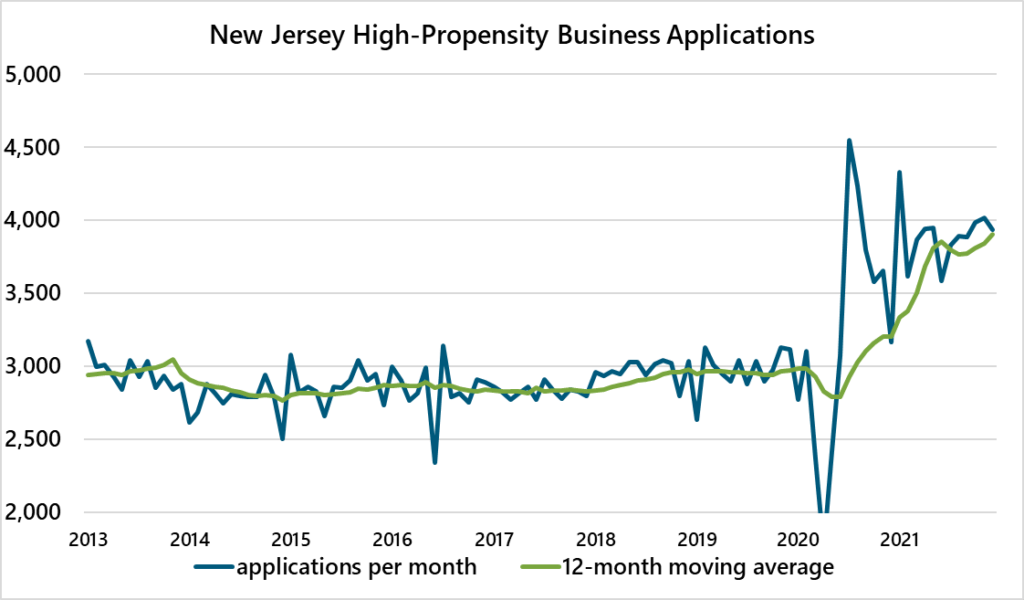
Sometimes, a shock as damaging as a pandemic has a beneficial underside for the economy. For example, we’ve seen a surge in entrepreneurship emerge from the COVID-19 economic shock, as evident in a proliferation of applications to start new businesses. The chart below shows the rate of “high-propensity” business applications filed in New Jersey. As the chart shows, the pace of these applications increased from a rate of approximately 3,000 per month pre-pandemic to near 4,000 now – up more than 30%. The high propensity distinction is important, as these are applications for new businesses likely to be incorporated and create positions for new workers, as separate from applications for businesses likely to be unincorporated sole proprietorships. In this way, these businesses are likely to provide the main sources of income for their owners and provide employment for others.

The cause of this jump in business creation is up for dispute. From our lens, a mix of jobs lost and abundant opportunities to innovate encouraged many people to venture out on their own instead of relying on the status quo. The benefit of this entrepreneurship wave is likely self-evident, but it’s worth noting that entrepreneurship benefits the economy as a whole as well as the individual entrepreneurs. For the economy, entrepreneurship drives the evolution necessary to keep an economy growing. For individuals, entrepreneurship and the value created therein generates economic opportunities and wealth.

So, who are all these new entrepreneurs? For New Jersey, the evidence suggests a growing share of these entrepreneurs in New Jersey are Black. There are few datasets that provide information on business ownership by race, and the ones that do exist tend to release data with a one-to-two-year lag. Thus, if we want to examine in real time what is happening to business ownership by race, we need to rely on proxies of business ownership.

To this end, we follow a method used by Dr. Robert Fairlie[1] with University of California, Santa Cruz, to estimate small business ownership by race using Current Population Survey (CPS) microdata on self-employment. The CPS is a monthly nationwide survey of individuals that includes questions on labor market status, such as employed or unemployed and, if employed, whether the individual is salaried worker or self-employed. As did Fairlie, we use data on self-employment as a proxy for small business ownership. Fairlie reasoned business ownership could be estimated this way because, if a person is a small business owner, that person is going to identify as self-employed. Moreover, we only include self-employment where it is indicated as the primary employment source. Many people are employed in a wage and salary position and own a business as a secondary source of income, and we do not wish to include these estimates in our dataset.

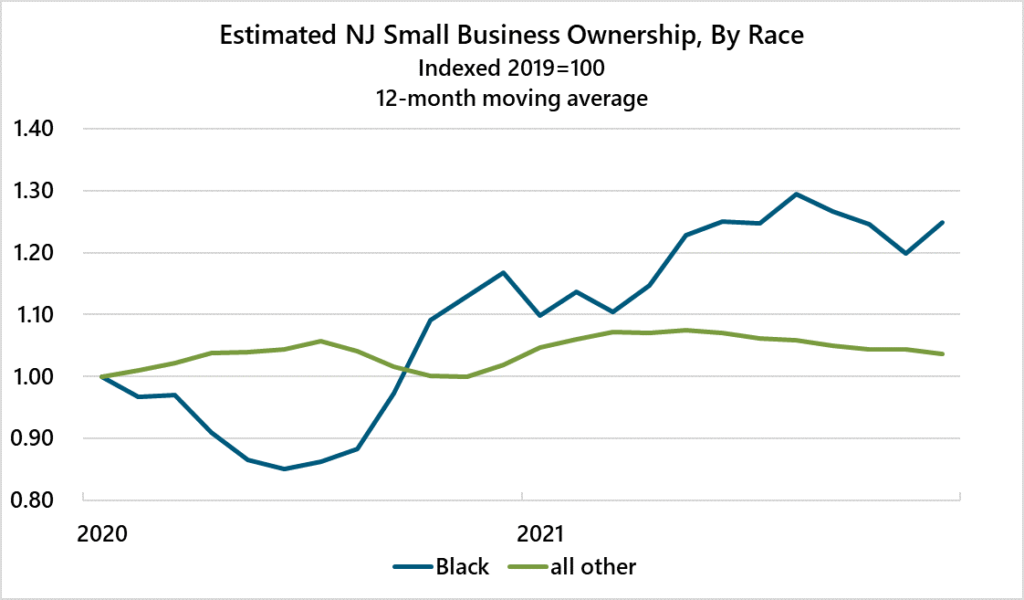
The chart below shows the growth of small business ownership by race, indexed at the 2019 level = 100. We are forced to smooth the data using 12-month moving averages as the data are not seasonally adjusted and are very volatile on a month-to-month basis.

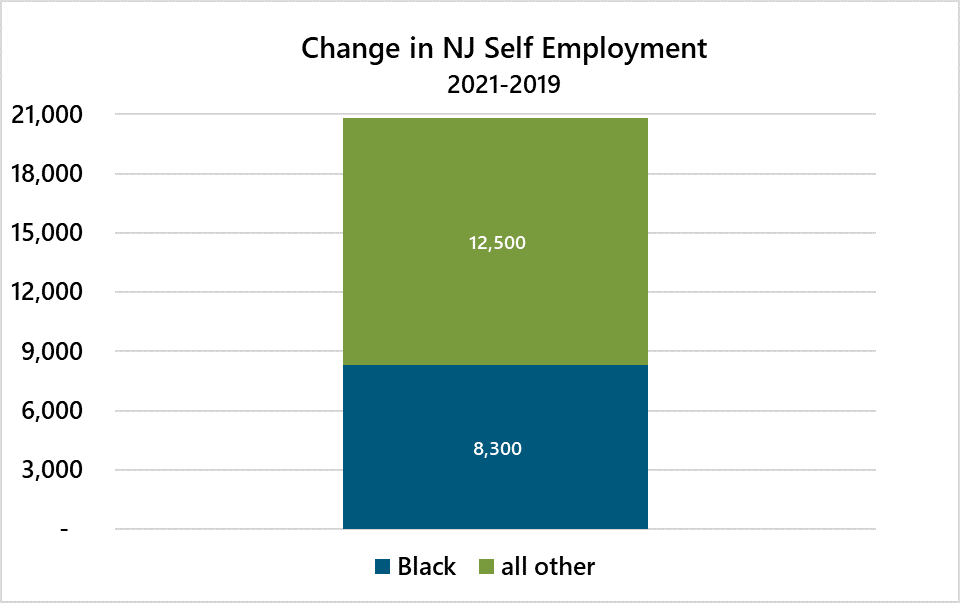
As the above chart shows, Black people were much more likely than the rest of the population to suffer a loss of small business at the start of the pandemic. But since that time, Black business ownership has surged. Relative to the 2019 level, Black business ownership is up approximately 25%. This compares to around 4% for the rest of the population. This comparison between Black and non-Black self-employment is further demonstrated in the chart below, which shows the change in self-employment in 2021 relative to 2019. Of the approximately 20,800 increase in self-employment, almost 40 percent is from Black residents. Given Black residents account for approximately 20 percent of New Jersey’s labor force, the 40 percent share of self-employment shows Black residents are taking up a surprisingly large share of recent new business creation.

The evidence of growing entrepreneurship in the Black community is a welcome sign. But, in order for this growth in entrepreneurship to yield long-term results, these small business owners often require outside sources of financial capital to invest in and grow their ventures. Small businesses are usually strapped for cash – most of the money earned goes into paying for the operating costs of the businesses, leaving little for investment. For instance, the Census Bureau’s Small Business Pulse[2] shows that, for New Jersey, the median business has less than three months of free cash on hand. This clearly isn’t enough to invest in and grow the business.

Unfortunately, access to credit is where the Black community has had one of its biggest challenges with entrepreneurship and business cultivation. The New Jersey Economic Development Authority (NJEDA) has been working with the Federal Reserve to understand gaps in credit access for minority small business owners. Our research shows Black people and other people of color are less likely to have access to credit. These disparities are about more than simply being banked or unbanked – there exists more of a middle ground impacted by the strength of relationships and availability of collateral. As part of this work, we will be meeting with credit organizations, such as community banks and community development financial institutions (CDFIs), to better understand how they approach business with minority small business owners and see where gaps in credit access might be closed.

Moreover, in an effort to close some of these gaps, the NJEDA provides credit and grants to small businesses that might not be able to secure traditional bank financing. Our small business products include improvement grants, lease assistance, direct loans and loan guarantees and participations, as well as direct loans to other credit providers such as CDFIs to help lever credit products. The NJEDA also partners with the African American Chamber of Commerce of New Jersey to offer a Small Business Bonding Readiness Assistance Program to help businesses position themselves to bid on government contracts. The NJEDA wants to ensure that all New Jersey businesses have the resources necessary to expand and that our communities have a healthy climate for growth. As the evidence shows a jump in Black entrepreneurship, our hope is that the work being done with the Federal Reserve and through our programs will support access to credit so these businesses can thrive.


[1] See Fairlie, R. (2020). The impact of COVID‐19 on small business owners: Evidence from the first three months after widespread social‐distancing restrictions. Journal of economics & management strategy, 29(4), 727-740.

[2] See January 9 results for New Jersey at https://portal.census.gov/pulse/data/

Grants to Micro Lenders Will Fund Loans and Technical Assistance for Smallest Businesses and Non-Profits

TRENTON, N.J. (February 11, 2022) – The New Jersey Economic Development Authority (NJEDA) Board approved the creation of the Main Street Lenders Grant at its February Board meeting on Wednesday. This pilot product, funded with $15 million from the Main Street Recovery Program, will offer lending grants of up to $1 million to be used by eligible micro business lenders to create new or supplement existing micro business loan products.

The Main Street Lenders Grant is the third of several products the NJEDA is launching under the Main Street Recovery Program. Created under the Economic Recovery Act of 2020 (ERA), which was signed by Governor Phil Murphy in January 2020, the Main Street Recovery Program is a $100 million small business support program that will fund multiple financial assistance products aimed at supporting the growth and success of small businesses in New Jersey. More information is available at https://www.njeda.gov/main-street-recovery-fund/.

New Jersey-based Community Development Financial Institutions (CDFIs) serving New Jersey micro and small businesses, Minority Depository Institutions (MDIs), and other eligible lenders, as defined under the ERA, will be eligible to apply for the Main Street Lenders Grant.

In line with Governor Murphy’s commitment to equity, each approved entity must lend and disburse at least 40 percent of Main Street Lenders Grant funding to businesses and nonprofits in Opportunity Zone-eligible census tracts.

“Even before COVID-19, businesses in underserved communities faced struggles with accessing capital, and NJEDA’s lending partners have long helped to ensure that micro businesses, nonprofits, and other small businesses have access to the capital they need,” said NJEDA Chief Executive Officer Tim Sullivan. “Their role is more vital than ever as businesses continue their recovery from the pandemic. The Main Street Lenders Grant is an essential element of the comprehensive and intentional suite of small business solutions created by the legislature and being rolled out through the ERA under Governor Murphy’s leadership.”

The Main Street Lenders Grant will offer two types of grants to eligible entities. The first is a lending grant. This grant of up to $1 million will be used as funding for new micro business lending products or as supplemental funding for existing micro business lending products.

Recognizing that micro businesses not only need financing, but may also need assistance with applying and qualifying for such financing, the second type of grant that will be made available through this product is a technical assistance grant. This grant will support eligible entities with the costs associated with providing technical assistance to micro businesses to best prepare and position these micro businesses to qualify for micro business loans. The maximum technical assistance grant an eligible entity can receive is 50 percent of their lending grant amount (not to exceed $500,000). Only lenders that receive a lending grant are eligible for the technical assistance grant. The intent is for these grants to enable lenders to provide micro businesses with technical assistance, and then offer a loan product to the micro business upon completion of the technical assistance.

“The NJEDA works with its lending partners to improve access to capital for the smallest businesses, who often face struggles getting the funds they need to build their resilience and position themselves for growth,” said Christina Fuentes, NJEDA’s Managing Director of Community Development. “As we emerge from the pandemic, this grant will extend NJEDA’s reach by expanding the capacity of its lending partners to support more micro businesses by abating barriers to accessing capital.”

Any lender applying for the lending grant must have a demonstrated history of 10 years’ experience serving small and micro businesses, and any entity applying for the technical assistance grant must demonstrate two years’ experience providing technical assistance to micro businesses – either directly, or in collaboration with a technical assistance partner.

Among other requirements, products created by eligible entities using the Main Street Lenders Grant must provide loans of $10,000 to $100,000 for micro businesses that have fewer than 10 full time employees and less than $1.5 million in annual revenue at the time of application. The business must also have a commercial location in New Jersey, which can be a home-based business. Home-based businesses, non-profit organizations, for-profit entities, sole proprietors, and/or startups may be eligible to participate in the program that will be funded through the Main Street Lenders Grant. Complete eligibility requirements for the lending products that will be offered can be found at https://www.njeda.gov/financing-and-incentives/.

The Main Street Lenders Grant serves as a complement to direct funding provided under the Main Street Recovery Program through the recently-launched Small Business Lease Grant and Small Business Improvement Grant.

Signed in January 2021, the ERA creates a package of programs that includes tax credits to incentivize job creation, new construction, and revitalization of brownfields and historic properties; financial resources for small businesses; support for new supermarkets and healthy food retailers in food desert communities; new funding opportunities for early-stage companies in New Jersey; and support for the growing film and digital media industry.

About the New Jersey Economic Development Authority

The New Jersey Economic Development Authority (NJEDA) serves as the State’s principal agency for driving economic growth. The NJEDA is committed to making New Jersey a national model for inclusive and sustainable economic development by focusing on key strategies to help build strong and dynamic communities, create good jobs for New Jersey residents, and provide pathways to a stronger and fairer economy. Through partnerships with a diverse range of stakeholders, the NJEDA creates and implements initiatives to enhance the economic vitality and quality of life in the State and strengthen New Jersey’s long-term economic competitiveness.

To learn more about NJEDA resources for businesses call NJEDA Customer Care at 609-858-6767 or visit https://www.njeda.gov and follow @NewJerseyEDA on Facebook, Twitter, Instagram and LinkedIn.
 

###