NJEDA.com contains a link to translation services provided by Google™ Translate, a free online translation service. Google™ Translate is subject to its own terms of service, which can be viewed at (https://policies.google.com/?hl=en). The link does not constitute affiliation, endorsement, support, or approval of Google™ Translate.
Neither the NJEDA nor the State of New Jersey (collectively, the “State”) reviews the services, information or content provided by Google™ Translate. Information translated by Google™ Translate may not be accurate or current and is used at the user's sole risk. The NJEDA has no obligation to offer translation, and this service could change or be discontinued at any time.
The State expressly and fully disavows and disclaims any responsibility or liability in respect to any cause, claim, or consequential or direct damage or loss, however described, arising from the use of Google™ Translate.
NJEDA.com is provided "AS-IS" with no warranties, express or implied, and its use confers no privileges or rights.
For additional language assistance, please click here to contact NJEDA to request assistance.
Program Connects Emerging Companies with Amenities at NJ Universities & Federal Laboratories
Through the Clean Tech R&D Voucher Program, eligible applicants will receive vouchers to subsidize the costs associated with one or more of the following services or activities in a participating New Jersey university or federal laboratory facility: use of facility equipment for testing and development, and training in preparation for independent use of the facility. Each eligible applicant can apply for multiple vouchers up to a cap of $15,000 within any 12-month period. An approved voucher will be valid for a period of three months. Specifically, the program will fund work on projects that are developing or testing clean technologies intended to recapture or avoid emissions of greenhouse gases and/or criteria pollutants, or to enable such avoidance or recapture. The following technology areas are eligible under the program: chemicals/advance materials, energy distribution/storage, energy efficiency, energy generation, green buildings, transportation, waste processing, and water and agriculture. A NJ clean tech asset map listing university and federal laboratory resources in NJ will also be available on the CSIT website.
To be eligible for the Clean Tech R&D Voucher Program, applicants must be registered to conduct business in New Jersey and must have no more than 50 full-time employees at the time of application. Additionally, 100 percent of the project work for which the voucher is being sought must be conducted in New Jersey. Full eligibility requirements can be found at https://www.njeda.gov/csit.
CSIT recently hosted an informational webinar for potential applicants to the Clean Tech R&D Voucher Program. A recording of that webinar can be found at https://www.youtube.com/watch?v=VrG9PJ3XVjc&t.
About CSIT In August 2018, Governor Murphy signed legislation re-establishing the former New Jersey Commission on Science and Technology as the CSIT. Comprised of representatives from the public and private sectors, as well as academia, the Commission is tasked with leading the way in promoting the state as a home for academic and technological research, development, and commercialization.
To learn more about state resources available to New Jersey entrepreneurs and early-stage companies, visit https://www.njeda.gov/csit or follow @NewJerseyEDA on Twitter, Facebook, LinkedIn and Instagram.
###
Viewers Also Heard an Overview of the Recently-Proposed Black and Latino Diversity Seed Fund
TRENTON, N.J. (April 8, 2021) – Members of New Jersey’s innovation community had the opportunity to learn about public and private resources available to entrepreneurs of color during a “Removing Barriers for Diverse Entrepreneurs” Instagram Live discussion last night featuring New Jersey Economic Development Authority (NJEDA) Chief Executive Officer (CEO) Tim Sullivan and digitalundivided CEO Lauren Maillian. The chat also spotlighted the recently-proposed Black and Latino Seed Fund, which the NJEDA intends to create to drive capital to Black- and Latino-owned enterprises.
The innovation economy is facing a nationwide diversity crisis. According to Crunchbase, American companies raised a record-setting $150 billion in venture capital funding in 2020, but less than one percent of this went to Black-owned companies. The numbers are even worse for women. According to digitalundivided’s ProjectDiane, Black and Latina women received just 0.64 percent of total venture capital investment between 2018 and 2019.
During the event, Sullivan and Maillian spoke about ways their organizations are working to increase access to capital for minority-owned businesses and discussed initiatives created to empower Black and Latino founders, foster equitable entrepreneurship, and create the most diverse innovation ecosystem in the country.
“Reclaiming New Jersey’s position as the nation’s leader in innovation hinges on welcoming all entrepreneurs with original ideas to pursue their dreams,” Sullivan said. “Under Governor Murphy’s leadership, we’re working with our partners in the public and private sectors to close funding gaps that exist for far too many entrepreneurs of color and ensure that founders have the resources they need to succeed.”
Sullivan gave an overview of New Jersey’s proposed Black and Latino Seed Fund, which will focus on driving capital to Black- and Latino-owned enterprises. Governor Phil Murphy has proposed a $10 million Fiscal Year 2022 budget allocation to create the Fund. Crafted with input from Black and Latino founders, investors, and policy experts, this seed fund is an important step toward tearing down the institutional barriers that hold Black and Latino entrepreneurs back and replacing them with accessible resources that respond to these innovators’ unique needs.
The concept for the Fund resulted from a Request for Information (RFI) issued by the NJEDA last year to solicit input on ways to increase access to capital for Black- and Latino-led startups. The RFI sought input from a diverse range of stakeholders, including fund managers, angel investors, venture capitalists, small-business owners, researchers and practitioners involved in entrepreneurship work, industry and trade groups, and other states’ governments.
Sullivan also outlined a comprehensive suite of initiatives advanced by Governor Murphy to foster equitable entrepreneurship and create the most diverse innovation ecosystem in the country. This includes adding new bonuses to:
The NJ Ignite program, to support startups led by women and entrepreneurs of color that are considering moving to a New Jersey collaborative workspace,
It also includes adding a diversity bonus to the NJEDA’s own venture investment plan, and an increased investment cap for investments in certified woman- or minority-owned businesses under the New Jersey Innovation Evergreen Fund, created under the Economic Recovery Act of 2020.
During the Instagram Live chat, Maillian highlighted digitalundivided’s mission and resources it offers Black and Latina women entrepreneurs. digitalundivided is a non-profit, social startup that leverages data and advocacy to catalyze economic growth for Black and Latina entrepreneurs in innovation and technology. Maillian spoke about the groundbreaking programs they offer including START 2021, a three-week virtual program for Black and Latina women founders at the idea stage of their entrepreneurial journey. She also talked about BIG Pre-Accelerator, a fast-paced pre-accelerator program for high-potential, pre-revenue Black and Latina women-led startups, as well as the Do You Fellowship, which positions high-potential, innovative Black & Latina founders for growth by providing them with funding, professional development, and access to exclusive mentorship and resources.
“Responsibility falls on all players in the innovation ecosystem to break down the barriers that far too often impede the path to success for entrepreneurs of color,” Maillian said. “It’s important to keep having conversations like we had last night and to continue connecting diverse entrepreneurs with critical resources like the programming spearheaded by NJEDA and digitalundivided. Working together, we will encourage innovation in NJ and have a lasting impact on the nation’s economy.”
About the New Jersey Economic Development Authority
The New Jersey Economic Development Authority (NJEDA) serves as the State’s principal agency for driving economic growth. The NJEDA is committed to making New Jersey a national model for inclusive and sustainable economic development by focusing on key strategies to help build strong and dynamic communities, create good jobs for New Jersey residents, and provide pathways to a stronger and fairer economy. Through partnerships with a diverse range of stakeholders, the NJEDA creates and implements initiatives to enhance the economic vitality and quality of life in the State and strengthen New Jersey’s long-term economic competitiveness.
About digitalundivided
digitalundivided is a non-profit, social startup that leverages data and advocacy to catalyze economic growth for Black and Latinx women entrepreneurs in innovation and technology. Our goal is to create a world in which all women of color own their work. digitalundivided merges data and heart to change the trajectories of women’s lives. We are a connector and a catalyst, supporting Black and Latinx women entrepreneurs through best-in-class programming, mentorship, training, resources and investment. We offer unparalleled thought leadership in the space. And we bring together the shared experiences of our community to produce ground-breaking authoritative research on Black and Latinx women entrepreneurs. For more information, visit: www.digitalundivided.com and follow us on Twitter (@digundiv) and on Instagram and Facebook (@digitalundivided).
Respondents Now Have Until May 17 to Provide Their Ideas
TRENTON, N.J. (April 8, 2021) – The New Jersey Economic Development Authority (NJEDA) today announced that it has extended the deadline for its Request for Information (RFI) soliciting insight into food security challenges faced by communities across the Garden State, including specific obstacles and disparities within communities that are considered “food deserts.” Responses are now due no later than 11:59 p.m. on May 17, 2021. The RFI can be found at https://www.njeda.gov/bidding/#OET.
The NJEDA issued the RFI on March 15 in conjunction with Governor Phil Murphy’s office and the New Jersey departments of Community Affairs (NJDCA) and Agriculture (NJDA), to gather information and ideas regarding the implementation of the Food Desert Relief Act, part of the NJ Economic Recovery Act of 2020 that Governor Murphy signed into law in January 2021.
The Food Desert Relief Act directs the NJEDA to address the food security needs of communities across New Jersey by providing up to $40 million per year for six years in tax credits, loans, grants, and/or technical assistance to increase access to nutritious foods and develop new approaches to alleviate food deserts. The information gathered from this RFI will help inform the creation of a New Jersey-specific definition of food deserts and offer potential solutions to increase the accessibility and affordability of healthy, nutritious foods for all NJ residents.
In addition to seeking information to better understand the short- and long-term food accessibility challenges faced by communities across New Jersey, this RFI also invites ideas for potential initiatives to increase accessibility and affordability of healthy foods and considerations for the NJEDA and its partner agencies in defining the state’s food desert communities.
The RFI seeks responses from such entities as municipalities and school districts; hunger relief organizations (e.g., food banks); food retailers, producers, processors and suppliers; advocacy organizations; social services providers; supermarket developers and operators; community stakeholders; policy and academic researchers; technical assistance providers; agricultural organizations and farm markets; developers of innovative anti-hunger and nutrition programs; and foundations and philanthropic initiatives that address hunger and food insecurity.
All RFI responses must be submitted in writing no later than 11:59 PM EST on May 17, 2021, via e-mail to: fooddesertrfi@njeda.com. The subject line of the e-mail should state: “RFI Response-2021-RFI-OET-COVID19-FoodDesert-125”.
The NJEDA is currently soliciting feedback on the New Jersey Economic Recovery Act, including the Food Desert Relief Act. Anyone who wishes provide your comment(s) on the implementation of the package of tax incentive, financing, & grant programs that will be created under the Act should visit https://www.njeda.gov/economicrecoveryact/.
About NJEDA
The New Jersey Economic Development Authority (NJEDA) serves as the State’s principal agency for driving economic growth. The NJEDA is committed to making New Jersey a national model for inclusive and sustainable economic development by focusing on key strategies to help build strong and dynamic communities, create good jobs for New Jersey residents, and provide pathways to a stronger and fairer economy. Through partnerships with a diverse range of stakeholders, the NJEDA creates and implements initiatives to enhance the economic vitality and quality of life in the State and strengthen New Jersey’s long-term economic competitiveness.
To learn more about NJEDA resources for businesses call NJEDA Customer Care at 609-858-6767 or visit https://www.njeda.govand follow @NewJerseyEDA on Facebook, Twitter, Instagram and LinkedIn.
###
TRENTON, N.J. (April 6, 2021) – The New Jersey Economic Development Authority (NJEDA) today announced that applications are now open for the New Jersey Zero Emission Incentive Program (NJ ZIP). The $15 million pilot program will provide vouchers for up to $100,000 to businesses and institutional organizations in the greater Newark and Camden areas to support the purchase of new, zero emission medium and heavy-duty vehicles (MHDVs) such as pickup trucks, vans, busses, and box trucks.
NJ ZIP is the first NJEDA initiative in New Jersey’s holistic, Regional Greenhouse Gas Initiative (RGGI)-funded effort to support the deployment of zero emission MHDVs. The pilot program allocates $15 million to provide vouchers to businesses and organizations purchasing new, class 2b to class 6 vehicles. The size of vouchers awarded through the program will vary depending on the class of vehicle being purchased, from a minimum of $25,000 for Class 2b vehicles to $100,000 for Class 6 vehicles. Bonuses will be available for small businesses; women-, minority-, and veteran-owned businesses; vehicles that are manufactured in New Jersey; small businesses that scrap their eligible gas- or diesel-powered MHDVs; and vendors that invest in driver education and training.
Vouchers will be awarded on a first-come, first-served basis to eligible buyers with $5 million set aside for micro and small businesses. The pilot program will only be available in the greater Newark and greater Camden areas, defined as the overburdened communities within or intersected by a circle with a 10-mile radius centered on Newark and Camden. More information, including a complete list of eligible municipalities, is available at https://www.njeda.gov/njzip.
The NJEDA recently hosted three informational webinars for potential NJ ZIP applicants and vendors. Recordings and copies of the slides that were presented are available at https://www.njeda.gov/njzip.
NJ ZIP is funded using proceeds from New Jersey’s participation in RGGI, a multi-state “cap-and-trade” program regulating carbon dioxide emissions. The State plans to deploy RGGI funds within four initiative categories identified in the RGGI Strategic Funding Plan: catalyzing clean, equitable transportation; promoting blue carbon in coastal habitats; enhancing forests and urban forests; and creating a New Jersey Green Fund. This Plan reflects the thoughtful public input that was collected through four public workshops and one webinar held during November and December of 2019. More than 200 individuals representing a diverse array of organizations and areas of interest, including municipalities, unions, environmental groups, environmental justice communities, transportation planning, energy use, and natural resources conservation and use, attended the four workshops or participated in the webinar event, and the agencies received additional public input via email. More information about New Jersey’s plans for using RGGI funding is available https://www.nj.gov/rggi/index.html.
About the New Jersey Economic Development Authority
Offers Virtual Listening Sessions and Online Feedback Submission Opportunities
TRENTON, N.J. (April 1, 2021) – The New Jersey Economic Development Authority (NJEDA)today released a draft of the rulesand targeted industry definitions under which the new Emerge business tax incentive program will be administered. Members of the public are encouraged to review the preliminary rules and industry definitions and provide feedback through one of three virtual Public Listening Sessions hosted by the Authority in April, or to submit written feedback through an online form available on the Economic Recovery Act website. The Emerge program is expected to begin accepting applications in late May.
Emerge is part of the suite of programs created under the Economic Recovery Act of 2020to address the ongoing economic impacts of the COVID-19 pandemic and build a stronger, fairer New Jersey economy. Emerge will drive job creation by making per-job tax credits available to projects that create good-paying jobs in the State’s priority sectors. To ensure a strong return on investment for taxpayers, projects that receive Emerge credits will need to demonstrate a net positive economic benefit of at least 400 percent in most cases.
“The New Jersey Economic Recovery Act of 2020 creates a suite of tools to create impactful, long-term, equitable economic growth. Incorporating public input is part of the robust engagement that will help ensure the Emerge program is created and implemented in a transparent manner that considers the needs of all stakeholders and communities and benefits all New Jerseyans,” said NJEDA Chief Executive Officer Tim Sullivan. “Everyone is encouraged to share their ideas and concerns on the rules that will govern programs administered under the Economic Recovery Act.”
Sessions are expected to last approximately two hours and can be accessed at tinyurl.com/xyr2k65r– Passcode: Emerge.
Members of the media interested in attending a session or submitting questions are asked to email media@njeda.com.
Members of the public can also submit written feedback on the Emerge Program through the webpage www.njeda.gov/EconomicRecoveryAct from April 5th through April 16th.
In addition to Emerge, the Economic Recovery Act creates a suite of programs that includes tax credits to incentivize job creation, new construction, and revitalization of brownfields and historic properties; financial resources for small businesses; support for new supermarkets and healthy food retailers in food desert communities; new funding opportunities for early-stage companies in New Jersey; and support for the growing film and digital media industry. The NJEDA plans to continue to engage the public as new programs as rules are developed. Members of the public are also encouraged to provide general written input on the new programs via the NJEDA’s online portal.
The New Jersey Economic Development Authority (NJEDA) serves as the State’s principal agency for driving economic growth. The NJEDA is committed to making New Jersey a national model for inclusive and sustainable economic development by focusing on key strategies to help build strong and dynamic communities, create good jobs for New Jersey residents, and provide pathways to a stronger and fairer economy. Through partnerships with a diverse range of stakeholders, the NJEDA creates and implements initiatives to enhance the economic vitality and quality of life in the State and strengthen New Jersey’s long-term economic competitiveness.
To learn more about NJEDA resources for businesses call NJEDA Customer Care at 609-858-6767 or visit https://www.njeda.gov and follow @NewJerseyEDA on Facebook, Twitter, Instagram and LinkedIn.
###
“Removing Barriers for Diverse Entrepreneurs” Will Include Overview of Recently-Proposed Black and Latino Seed Fund
TRENTON, N.J. (April 1, 2021) – The New Jersey Economic Development Authority (NJEDA) and Newark-based nonprofit digitalundivided today announced that they will hold an Instagram Live event on April 7, 2021 at 6:00 p.m. to highlight public and private resources available to entrepreneurs of color.
Nationwide, the innovation economy is facing a diversity crisis. According to Crunchbase, American companies raised a record-setting $150 billion in venture capital funding in 2020, but less than one percent of this went to Black-owned companies. The numbers are even worse for women. According to digitalundivided’s ProjectDiane, Black and Latino women received just 0.64 percent of total venture capital investment between 2018 and 2019.
During “Removing Barriers for Diverse Entrepreneurs,” NJEDA Chief Executive Officer Tim Sullivan and digitalundivided CEO Lauren Maillian will talk about ways their organizations are working to increase access to capital for minority-owned businesses and discuss initiatives created to empower Black and Latino founders, foster equitable entrepreneurship, and create the most diverse innovation ecosystem in the country.
Sullivan will also provide an overview of New Jersey’s proposed Black and Latino Seed Fund, which will focus on driving capital to Black- and Latino-owned enterprises. Governor Phil Murphy has proposed a $10 million Fiscal Year 2022 budget allocation to create the Fund.
Members of the innovation community are encouraged to tune into the Instagram Live event by logging on to digitalundivided’s Instagram page and clicking on the IGTV icon.
About the New Jersey Economic Development Authority
The New Jersey Economic Development Authority (NJEDA) serves as the State’s principal agency for driving economic growth. The NJEDA is committed to making New Jersey a national model for inclusive and sustainable economic development by focusing on key strategies to help build strong and dynamic communities, create good jobs for New Jersey residents, and provide pathways to a stronger and fairer economy. Through partnerships with a diverse range of stakeholders, the NJEDA creates and implements initiatives to enhance the economic vitality and quality of life in the State and strengthen New Jersey’s long-term economic competitiveness.
About digitalundivided
digitalundivided is a non-profit, social startup that leverages data and advocacy to catalyze economic growth for Black and Latinx women entrepreneurs in innovation and technology. Our goal is to create a world in which all women of color own their work. digitalundivided merges data and heart to change the trajectories of women’s lives. We are a connector and a catalyst, supporting Black and Latinx women entrepreneurs through best-in-class programming, mentorship, training, resources and investment. We offer unparalleled thought leadership in the space. And we bring together the shared experiences of our community to produce ground-breaking authoritative research on Black and Latinx women entrepreneurs. For more information, visit: www.digitalundivided.com and follow us on Twitter (@digundiv) and on Instagram and Facebook (@digitalundivided).
TRENTON, N.J. (31 de marzo de 2021) – La Autoridad para el desarrollo económico de New Jersey (NJEDA) anunció que las empresas de New Jersey con 100 empleados o menos equivalentes a tiempo completo (FTE) podrán recibir descuentos de aproximadamente el 70% en la compra de equipos de protección personal (PPE) a través del Programa de acceso a PPE para pequeñas empresas y microempresas de NJ hasta el viernes, 28 de mayo de 2021 o hasta que se agoten los fondos del programa.
Las pequeñas empresas y organizaciones interesadas en recibir estos descuentos deben presentar una solicitud en https://ppe.covid19.nj.gov/es. Las empresas que ya fueron aprobadas no necesitan volver a presentar una solicitud, pero los descuentos que ya hayan utilizado se descontarán del límite total del programa.
La NJEDA lanzó el Programa de acceso a PPE para pequeñas y microempresas de NJ a fines de 2020 en respuesta a las inquietudes constantes que surgían en la Comisión de reinicio y recuperación del gobernador, los comités de los nueve sectores del Consejo asesor en reinicio y recuperación del gobernador e información proveniente de diversas pequeñas y microempresas que indicaba que necesitaban PPE inmediatamente disponible a un precio asequible.
Durante la Fase 1 del programa, la NJEDA identificó y examinó a “proveedores designados”, incluidos Boxed, Office Depot y Staples, quienes se asociaron con la Autoridad para crear “micrositios” donde las empresas de New Jersey pueden comprar una selección aprobada de PPE con un descuento de al menos el 10%. La NJEDA también colaboró con el Departamento de Salud de New Jersey para crear una herramienta de planificación de PPE en línea que ayuda a las empresas a comprender los requisitos de PPE y estimar las necesidades de PPE a nivel de la organización. Puede encontrar enlaces a los micrositios de los proveedores designados y la herramienta de planificación de PPE en https://ppe.covid19.nj.gov/es.
Hay descuentos adicionales del 65% disponibles para las empresas y organizaciones sin fines de lucro con 100 empleados o menos que realicen compras en Staples o en Office Depot. Estos descuentos están disponibles además del 10% de descuento disponible para todas las empresas; por lo que las empresas pueden recibir aproximadamente un 70% de descuento en sus compras de PPE. Esta extensión de los descuentos tiene un límite de $800 para todas la empresas elegibles o $1,000 para las empresas ubicadas en una de las 715 áreas censales de New Jersey elegibles para ser designadas zonas de oportunidad. Hasta la fecha, más de 10,000 empresas han sido aprobadas para recibir más de $9 millones en descuentos.
Las pequeñas empresas y organizaciones interesadas en recibir estos descuentos adicionales deben presentar una solicitud en https://ppe.covid19.nj.gov/es. Una vez que la NJEDA confirma la elegibilidad de una empresa, el propietario de la empresa recibirá cupones para realizar compras a un proveedor designado de su preferencia. Las empresas que hayan presentado solicitudes anteriormente y hayan sido aprobadas para recibir descuentos a través del programa son elegibles y no necesitan volver a presentar una solicitud. Sin embargo, los descuentos que se hayan utilizado anteriormente se descontarán del límite del programa. Los cupones vencerán a las 11:59 p. m. del 28 de mayo de 2021, pero la NJEDA puede cerrar el programa con anterioridad si se agotan los fondos. Las empresas y organizaciones sin fines de lucro todavía podrán recibir descuentos del 10% en compras de PPE después de esta fecha.
Puede encontrar más información sobre el Programa de acceso a PPE y la solicitud de descuentos de hasta el 70% en https://ppe.covid19.nj.gov/es.
Acerca de la Autoridad para el desarrollo económico de New Jersey
Para obtener más información acerca de los recursos de la NJEDA para empresas, llame a la línea de atención al cliente de NJEDA al 609-858-6767 o visite https://www.njeda.gov y siga a @NewJerseyEDA en Facebook, Twitter, Instagramy LinkedIn.
###
Up to $75,000 Available Per Company to Further Clean Technology R&D
The Clean Tech Seed Grant Program, which is funded by the New Jersey Board of Public Utilities (NJBPU), provides grants for R&D activities to very early-stage, New Jersey-based clean technology companies. Specifically, the program will fund projects that are developing or testing clean technologies intended to recapture or avoid emissions of greenhouse gases and/or criteria pollutants, or to enable such avoidance or recapture. The following technology areas are eligible under the program: Chemicals/Advance Materials, Energy Distribution/Storage, Energy Efficiency, Energy Generation, Green Buildings, Transportation, Waste Processing, and Water and Agriculture. Complete program eligibility requirements can be found at https://www.njeda.gov/clean-tech-grant.
Qualified applicants can receive up to $75,000 in grants through the Clean Tech Seed Grant Program and the total funding for this initial pilot program is $750,000. Funding through the program will help businesses continue their work toward the proof of concept and prototyping stages, at which point they can more readily attract outside investors and, in some cases, begin to generate revenue. The funding is being provided through NJBPU’s Clean Energy Program.
CSIT previously hosted an informational webinar about the Clean Tech Seed Grant Program. During the webinar, CSIT Executive Director Judith Sheft offered tips and advice to entrepreneurs that were considering applying to the program. A recording of the webinar can be found here.
The application will be open until April 5, 2021 at 4:00 p.m. or until the program receives 50 completed applications, whichever comes first.
Applications from businesses located in an Opportunity Zone-eligible census tract, minority- or woman-owned businesses or businesses with technology coming out of New Jersey universities are all eligible for bonus points with respect to the scoring criteria.
About CSIT
In August 2018, Governor Murphy signed legislation re-establishing the former New Jersey Commission on Science and Technology as the CSIT. Comprised of representatives from the public and private sectors, as well as academia, the Commission is tasked with leading the way in promoting the state as a home for academic and technological research, development, and commercialization.
###
Women in the Pandemic Labor Market
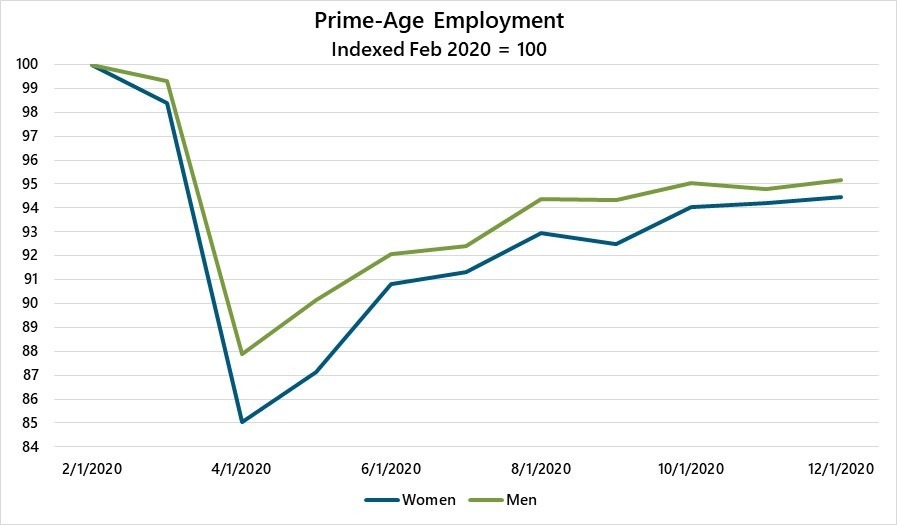
The pandemic has significantly decreased labor demand. From the outset of the pandemic through the end of 2020, prime-age employment (employment among people aged 25-54) fell by approximately five million jobs. The rate of job loss has had disproportionate impacts on women. In this age group, employment through December fell by 4.6 percent[1] for men and 5.7 percent for women. The chart below depicts the path of prime-age employment for men and women from February through December. It shows employment in the first two months of the pandemic fell much more for prime-age women (-15%) than men (-12%). Since then, the rate of employment growth for prime-age women has outpaced that of men, but the employment gender gap remains.
Source: Current Population Survey
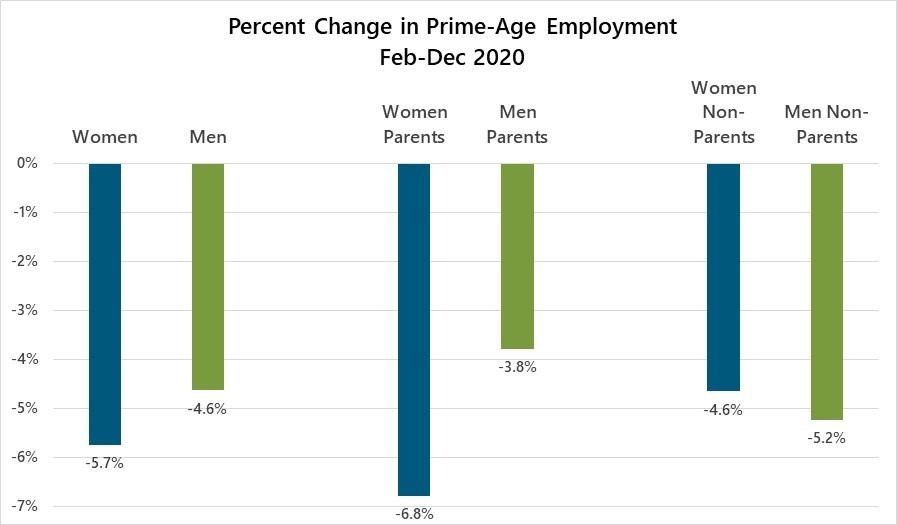
What is interesting about this gender gap is it’s less about gender alone and more about the intersection of gender and parenthood. To be more specific, for prime-age women and men who are not parents, the data show very similar rates of change in employment. If anything, employment of non-parent women fell less than that of men. It’s only for women and men who are parents – also known as moms and dads — that this gap is quite apparent. This reveals one of the ugly truths of the pandemic: it seems many more women than men had to choose between being the primary caregiver for their children and being employed.
The chart below depicts the evidence. It shows changes in employment from February to December for all prime-age women and men, and then separately based on parental status. As the chart shows, employment of moms fell 6.8 percent, a substantially more severe drop than the 3.8 percent decline in employment of dads. For non-parents, employment of women fell less than that of men.
Source: IPUMS, Current Population Survey, NJEDA[2]
Another way to look at these outcomes is, as a result of the pandemic, a mom is almost 1.8 times more likely than a dad to no longer be employed. Moreover, if moms had the same labor market outcomes as non-parent women or dads, approximately 600,000 more moms in the US would currently be employed. There are two likely reasons for these worse outcomes for mothers. One is obvious – as the pandemic caused schools and childcare services to shut down, generally speaking, more moms took on more of the primary responsibility of caring for children. Survey evidence supports this explanation[3]. The second reason is occupational mix – women are more likely to be employed in occupations requiring physical proximity[4] and less likely to be in occupations with ability to telecommute[5]. Occupations more dependent on physical proximity and less disposed to telecommuting were more likely to be cut during the pandemic.
The encouraging news is help is on the way via a mix of organic economic growth, continued monetary stimulus, and a new fiscal package aimed at providing support to both working and unemployed mothers. The State has undertaken a number of initiatives to support the childcare sector and families in need of childcare assistance in this critical moment, including increased investments in childcare, waiving parent co-pays in the State’s childcare subsidy program, offering grants to childcare providers and providing tuition support for school-aged supervision. And there are private sector initiatives, such as Golden Seeds, which seeks to support women entrepreneurship through pooling and distribution of financial and human capital. The help is sorely needed, not only to provide current economic relief but to keep this from becoming a long-term economic problem for mothers.
The fact is, the longer someone is out a job, the harder it can be to get another one or to make up for lost income, so time is of the essence. This phenomenon is due to what economists call labor “scarring.” From an economics point of view, the key concept at play is depreciation of human capital. In essence, the longer a person is out of work, the more that person’s skills and knowledge – the human capital – depreciate. If labor compensation is a return on human capital, depreciated human capital returns lower compensation. In other words, your lifetime wages are permanently set back by a scarring effect, and there have been many studies done to show this effect is real. In fact, even in the “women-friendly” labor market in Sweden, research shows the length of time out of the labor force for parental leave is associated with negative effects on labor market outcomes and career pathways[6]. Let’s hope the scarring is kept to a minimum and more women are quickly reabsorbed into the workforce.
Women-Owned Businesses in New Jersey – A Brief Look at the Landscape
This section provides a basic overview of the data on women-owned businesses in New Jersey. Based on the most recent data available, there are approximately 300,000 businesses in New Jersey owned by women.[7] This is the sum of women-owned businesses with and without employees (known as “employer”and“non-employer”firms,respectively).
The data show women-owned firms make up about 18 percent of all employer firms and about 38 percent of non-employer firms. Both shares have increased over the past 10 years. In 2007, 15 percent of all employer firms and 31 percent of all non-employer firms in New Jersey were women-owned.
Clearly, women ownership has a larger stake in the nonemployee landscape. And there are some standout industries. For example, as seen in Table 2, women own more than 50 percent of all non-employer firms in health care and social assistance, educational services, and administrative and support services. Within the employer firm landscape, women own the greatest share of firms in educational services (36 percent).
Table 1 – Women-owned Employer Firms
Industry
Number of Women-Owned Employer Firms
Women-Owner Share of Firms in the Industry
Total for all sectors
34,130
18.20%
Health care and social assistance
5,401
24.80%
Professional, scientific, and technical services
5,132
19.20%
Other services (except public administration)
4,582
30.90%
Retail trade
4,219
18.80%
Accommodation and food services
3,728
19.50%
Administrative and support and waste management and remediation services
1,874
16.20%
Construction
1,832
8.40%
Educational services
1,344
35.90%
Real estate and rental and leasing
923
12.60%
Manufacturing
912
13.00%
Transportation and warehousing
822
12.40%
Arts, entertainment, and recreation
743
22.40%
Finance and insurance
662
10.50%
Information
303
14.70%
Industries not classified
44
15.80%
Management of companies and enterprises
27
3.60%
Table 2 – Women-owned Non-employer Firms
Industry
Number of Women-Owned Non-Employer Firms
Women-Owner Share of Firms in the Industry
Total for all sectors
266,000
37.80%
Professional, scientific, and technical services
44,000
37.90%
Other services (except public administration)
39,000
51.00%
Health care and social assistance
37,500
70.80%
Real Estate and rental and leasing
29,000
29.00%
Retail Trade
25,000
49.50%
Administrative and support and waste management and remediation services
25,000
55.60%
Educational services
15,000
60.00%
Arts, entertainment, and recreation
14,500
37.70%
Transportation and warehousing
13,500
17.00%
Finance and Insurance
5,300
23.00%
Construction
4,700
8.60%
Accommodation and food services
4,700
44.80%
Wholesale Trade
3,500
26.90%
Information
3,300
31.40%
Manufacturing
2,000
31.30%
Agriculture, forestry, fishing, and hunting
400
20.00%
Utilities
70
17.50%
Key Indices for Gender Inequality Globally
Gender gaps manifest themselves in a wide range of measures well beyond those concerning economic inequality. Other ways to view such gaps include political representation, healthcare, education, and societal issues, to name a few. Dealing with such a wide array of variables can be somewhat overwhelming, which is why many institutions create indices to organize multiple factors and simplify them in the form of a single score. Here we are looking at the United Nation’s Global Inequality Index (GII) and the World Economic Forum’s Global Gender Gap Index (GGI) to see two examples of how gender inequality is measured and where the United States ranks.
United Nations Gender Inequality Index (GII)
US Metrics
U.S. Rank
(out of 162)
United States’ Overall Rank
46th
Maternal Mortality Ratio (deaths per 100,000 live births) (2017)
19
56th
Adolescent Birth Rate (2015-2020)
19.9
57th
Percent of Seats held by Women in Parliament (2019)
23.7
66th
Percent of prime-age population with at least some secondary education (2015-2019)
96.1
20th
Labor Force Participation Rate (%) (2019)
56.1
64th
World Economic Forums’
Gender Gap Index Factors (GGI)
U.S Rank
(out of 153)
Overall Rank
53rd
Economic Participation
26th
Educational Attainment
34th
Health and Survival
70th
Political Empowerment
86th
The UN’s GII ranks 162 countries on five distinct measures of gender equality: infant mortality, adolescent birth rate, seats held by women in parliament, the percentage of women with some secondary education, and the labor force participation rate. The United States has an overall ranking of 46th out of 162 countries. The US would fall lower were it not for the US’s secondary education rate ranking 20th. The World Economic Forum’s (WEF) GGI is designed to account for gender disparities in economic participation, educational attainment, health and survival, and political empowerment. On this measure, United States ranks 53rd out of 153 countries. Where the US shows considerable weakness is in health and survival, and political empowerment. Since the last time the GGI was published in 2018, the United States ranking fell by two places, caused primarily by a decline in labor force participation. The WEF emphasizes that the 21.7 percent non-male executive participation rate and the 23.7 percent non-male parliamentary participation rate are critical factors in improving the United States’ gender gap in the future.
It is evident through both of these indices that the United States is lagging on the global stage in multiple gender measures. A focus on economics, healthcare, and education is essential to acknowledging and solving the problem that women and non-binary individuals face in our country.
[1] Measured at a 3-month moving average to reduce month-to-month noise in the data
[2] Lofton, Olivia, Nicolas Petrosky-Nadeau, Lily Seitelman. “Parents in a Pandemic Labor Market,” Federal Reserve Bank of San Francisco Working Paper 2021-04. https://doi.org/10.24148/wp2021-04
[3] Zamarro, Gema and Maria Jose Prados, “Update on Gender Differences in the Impact of COVID-19,” CESR report, University of Southern California December 2020.
[4] Mongey, Simon, Laura Pilossoph, and Alex Weinberg, “Which Workers Bear the Burden of Social Distancing Policies?,” Working Paper 27085, National Bureau of Economic Research May 2020.
[5] Alon, Titan, Matthias Doepke, Jan Olmstead-Rumsey, and Michele Tertilt, “The Impact of COVID-19 on Gender Equality,” Covid Economics: Vetted and Real-Time Papers, 2020, 4.
[6] Aisenbrey, S., M. Evertsson, & D. Grunow. “Is There a Career Penalty for Mothers’ Time Out? A Comparison of Germany, Sweden and the United States.” Social Forces, 88(2), 573-605, 2009.
[7] 2018 Annual Business Survey; 2017 Nonemployer Statistics by Demographics.
TRENTON, N.J. (March 22, 2021) – The New Jersey Economic Development Authority (NJEDA) today announced that New Jersey businesses with 100 or fewer full-time equivalent employees (FTEs) will be able to receive discounts of nearly 70 percent off purchases of personal protective equipment (PPE) through the NJ Small and Micro Business PPE Access Program until Friday, May 28th, 2021 or until program funds are exhausted.
Small businesses and organizations interested in receiving these discounts must apply at https://ppe.covid19.nj.gov. Businesses that have already been approved do not need to reapply, but any discounts they have used previously will be counted toward the total program cap.
The NJEDA launched the NJ Small and Micro Business PPE Access Program in late 2020 in response to consistent concerns emerging from the Governor’s Restart and Recovery Commission, the nine sector-based committees of the Governor’s Restart and Recovery Advisory Council, and input from numerous small businesses indicating the need for readily available, fairly priced PPE.
During Phase 1 of the program, the NJEDA identified and vetted “Designated Vendors,” including Boxed, Office Depot, and Staples, who have partnered with the Authority to create “microsites” where New Jersey-based businesses can purchase a curated selection of PPE products with at least a 10 percent discount. The NJEDA also collaborated with the New Jersey Department of Health to create an online PPE Planning Tool that helps businesses understand PPE product requirements and estimate their organizational PPE needs. Links to the Designated Vendor microsites and the PPE Planning Tool are available at https://covid19.nj.gov/ppeaccess.
Additional discounts of 65 percent are available to businesses and nonprofits with 100 or fewer employees that make purchases from Staples or Office Depot. These discounts are available in addition to the 10 percent discounts available to all businesses, so businesses are able to receive nearly 70 percent off PPE purchases. Expanded discounts are capped at $800 for all eligible businesses or $1,000 for businesses located in one of New Jersey’s 715 census tracts that were eligible to be designated as Opportunity Zones. To date, more than 10,000 businesses have been approved for more than $9 million in discounts.
Small businesses and organizations interested in receiving these additional discounts must apply at https://ppe.covid19.nj.gov. Once the NJEDA has confirmed a business’s eligibility, the business owner will receive vouchers for purchases from a Designated Vendor of their choice. Businesses that have previously applied and been approved to receive discounts through the program are eligible and do not need to reapply. However, any discounts they have redeemed previously will be counted toward the program cap. Vouchers will expire at 11:59 PM on May 28th, 2021, but the NJEDA may close the program sooner if funds are exhausted. Businesses and nonprofits will still be able to receive 10 percent discounts on PPE purchases after this date.
More information about the PPE Access Program and the application for discounts up to 70 percent are available at https://ppe.covid19.nj.gov.
About the New Jersey Economic Development Authority