Authority Adopts Final List of 50 Communities that May Be Eligible for $240M in Food Desert Relief Act Funding


Trenton, N.J. (February 10, 2022) – The New Jersey Economic Development Authority (NJEDA) today announced that it approved the final list of New Jersey’s 50 designated Food Desert Communities during its Board meeting yesterday. Over the next several years, up to $240 million in funding through the Food Desert Relief Act will be available to strengthen food security and combat food deserts in these communities.

The Food Desert Relief Act is part of the Economic Recovery Act (ERA), signed into law by Governor Phil Murphy in January 2021. The Act directs the NJEDA to address the food security needs of communities across New Jersey by providing up to $40 million per year for six years in tax credits, loans, grants, and/or technical assistance to increase access to nutritious foods and develop new approaches to alleviate food deserts. The NJEDA expects to issue regulations later this year, a critical step in the development of any Food Desert Relief Act-related programs.

“New Jersey has long been at the forefront in the fight against food insecurity,” said Lt. Governor Sheila Oliver, who serves as the Commissioner of the Department of Community Affairs. “We have a moral duty to reduce food insecurity within our state’s borders and the programs we create under the Food Desert Relief Act will strengthen our ability to connect New Jerseyans in the 50 designated Food Desert Communities with access to much-needed nutritious food.”  

A January 2022 U.S. Census Bureau survey found that nearly one in 13 New Jersey households reported not having enough to eat in the past seven days. The total population of New Jerseyans residing in Food Desert Communities exceeds 1.5 million individuals across a diverse range of communities in all 21 of New Jersey’s counties.

Assembly Speaker Craig Coughlin has been a vocal advocate of finding ways to eliminate food deserts and played a key role in the passage of the Food Desert Relief Act.

“The statistics surrounding food insecurity are sobering and unacceptable,” said Assembly Speaker Craig J. Coughlin. “By approving the designation of New Jersey’s Food Desert Communities, we are a crucial step closer to directly addressing the impact of food deserts on New Jersey communities and to securing access to fresh and nutritious foods, with real brick and mortar food retailers and neighborhood food service programs, so everyone feels the comfort of knowing where their next meal will come from.”  

The designation of Food Desert Communities approved yesterday includes consideration of factors such as: food retail environment, demographics, economic indicators, and health indicators. The NJEDA developed the list and accompanying methodology for designation of the Food Desert Communities in partnership with the New Jersey Department of Community Affairs (NJDCA) and the New Jersey Department of Agriculture (NJDA), along with input from the New Jersey Department of Human Services (NJDHS) and New Jersey Department of Health (NJDOH). The NJEDA issued a Request for Information (RFI) in March 2021 to solicit insight into food security challenges faced by communities across the Garden State, including specific obstacles and disparities within communities that are considered “food deserts.” The RFI also asked for feedback on specific criteria for the Food Desert Communities designation. The list was created based on feedback received through the RFI process and input compiled from research and from other public-sector organizations. The final list was revised to incorporate written and verbal input submitted by members of the public based on the draft list of Food Desert Communities released in January 2022.

“The level of engagement we saw throughout the public feedback process underscores the importance of bringing the issue of hunger out of the shadows,” said NJEDA Chief Executive Officer Tim Sullivan. “Under Governor Murphy’s leadership – and armed with one of the most comprehensive process and methodology for designating Food Desert Communities in the nation – we will continue to work with our sister agencies to create a robust suite of programs to address food insecurity in every county in our state.”

“Known the world over as the Garden State, New Jersey is currently home to over 10,000 farms,” said New Jersey Secretary of Agriculture Douglas H. Fisher. “We can, and must, leverage the ingenuity of our farmers and the resources made available through the Food Desert Relief Act to connect food insecure New Jerseyans with access to the fresh-grown fruits and vegetables produced at these farms.”   

Enrollment in nutrition assistance programs such as the Supplemental Nutrition Assistance Program (SNAP) and Special Supplemental Nutrition Program for Women, Infants, and Children (WIC) were among the factors considered in the designation of the Food Desert Communities. Overseen by NJDHS, NJ SNAP served more than 900,000 New Jerseyans in 2021 and has provided more than $2 billion in extra food assistance since March 2020. NJ WIC, administered by NJDOH, served over 140,000 women and children between October 2020 and September 2021.

“The Murphy Administration is committed to combating food insecurity throughout New Jersey, and these new designations are a big step toward ensuring all residents – no matter their zip code – have access to healthy food,” Human Services Acting Commissioner Sarah Adelman said. “Healthy food promotes healthy living, and we look forward to continuing to work with the NJEDA to promote access to nutritional meals across New Jersey. We also urge anyone facing food insecurity to visit njhelps.org to see if they qualify for assistance.”

“This once is a lifetime pandemic has greatly exacerbated the issues of food insecurity in our state,” said Health Commissioner Judith Persichilli. “The whole-of-government approach will help us to provide the resources and supports our communities need to assist families in leading long, healthy lives.”

Today’s announcement also follows action taken yesterday by the NJEDA Board to create Phase 3 of the Authority’s Sustain & Serve NJ program. Sustain & Serve NJ supports New Jersey nonprofits combatting food insecurity by providing grants to organizations to purchase meals from local restaurants and distribute them for free to residents throughout the state. To ensure the program benefits New Jersey’s small restaurants, participating establishments must have 50 or fewer employees. To date the program has supported the purchase of nearly 3.2 million meals from over 400 restaurants. The NJEDA expects to open applications for Phase 3 of the program in early March.

The Food Desert Relief Act is part of the New Jersey Economic Recovery Act of 2021 signed into law by Governor Murphy in early 2021. In addition to the Food Desert Relief Act, the ERA creates a suite of programs that includes tax credits to incentivize job creation, new construction, and revitalization of brownfield properties; financial resources for small businesses; historic property reinvestment; new funding opportunities for early-stage companies in New Jersey; and support for the growing film and digital media industry. The NJEDA will continue to engage the public as new programs and rules are developed.

About the New Jersey Economic Development Authority

The New Jersey Economic Development Authority (NJEDA) serves as the State’s principal agency for driving economic growth. The NJEDA is committed to making New Jersey a national model for inclusive and sustainable economic development by focusing on key strategies to help build strong and dynamic communities, create good jobs for New Jersey residents, and provide pathways to a stronger and fairer economy. Through partnerships with a diverse range of stakeholders, the NJEDA creates and implements initiatives to enhance the economic vitality and quality of life in the State and strengthen New Jersey’s long-term economic competitiveness.

To learn more about NJEDA resources for businesses call NJEDA Customer Care at 609-858-6767 or visit https://www.njeda.gov and follow @NewJerseyEDA on FacebookTwitter, Instagram, and LinkedIn.

###
Changes to Latest Phase Will Enhance Program that has Already
Supported the Purchase of Nearly 3.3 Million Meals From 400+ Restaurants

TRENTON, N.J. (February 9, 2022) – The New Jersey Economic Development Authority (NJEDA) today announced that it will open applications for a new round of Sustain & Serve NJ funding early next month. The announcement follows approval of enhancements to the program today by the NJEDA’s Board. The NJEDA’s Sustain & Serve NJ program provides eligible entities with grants up to $2 million to support the purchase of meals from New Jersey restaurants that have been negatively impacted by COVID-19 and the distribution of those meals at no cost to recipients. Applications are expected to open March 1, 2022 & close April 1, 2022. The application will be available at https://www.njeda.gov/sustain-and-serve/.

Through the first two phases of Sustain & Serve NJ, the NJEDA awarded more than $34 million to 31 organizations across the state, resulting in the purchase of nearly 3.3 million meals from more than 400 participating restaurants since March 2021.  

“Sustain & Serve NJ offers a multitude of benefits to New Jersey communities as they work to equitably recover from COVID-19,” said Governor Phil Murphy. “In addition to supporting the nonprofit organizations that play a crucial role within their communities, the program also helps local restaurants keep their doors open and their employees paid, while connecting individuals facing food insecurity with much-needed meals. We believe that Sustain & Serve NJ can be a national model for other states as they emerge from the economic impact of the pandemic.”

This latest phase of Sustain & Serve NJ is funded by $10 million in American Rescue Plan funding that will be made available to non-profit organizations in New Jersey. Eligible organizations will receive grants of between $100,000 and $2 million for bulk purchases of meals from New Jersey restaurants. The entities will then distribute the meals at no cost.

“Under Governor Murphy’s leadership, New Jersey is taking a holistic, multi-agency approach to combating hunger and Sustain & Serve NJ is a vital piece of that strategy,” said NJEDA Chief Executive Officer Tim Sullivan. “Not only does this program help fuel our state’s overall economic recovery by enabling restaurants to hire and retain staff, but it also supports organizations that are providing nutritious meals to people statewide who may not otherwise have access to them.”

The NJEDA will hold an informational webinar on March 2, 2022 at 10:00 a.m. for potential applicants to learn tips and advice for applying. The webinar will also include a walk-through of the application. The webinar can be accessed here: https://tinyurl.com/SSNJPhase3. A recording of the webinar will be available at https://www.njeda.gov/sustain-and-serve/.

The NJEDA made several enhancements to the Sustain & Serve NJ programs between Phase 2 and Phase 3 based on feedback from Sustain & Serve NJ grantees and from the community. This includes raising the cap that the NJEDA will provide per meal from $10 per meal to $12 per meal, as well as allowing grantees to use a portion of their grant to support organizational implementation and operational costs. It also includes limiting eligibility to nonprofits with the following NAICS codes:

  • NAICS code 611 (Educational services)
  • NAICS code 62 (Social assistance and health care organizations)
  • NAICS code 813 (Religious, grantmaking, civic, professional, and similar organizations)
  • NAICS code 92 (Public administration)

In Phase 3, the NJEDA is also lowering the threshold of past purchases that applicants must show to demonstrate eligibility for the program. Applicants now must demonstrate a history of purchasing at least 1,500 meals costing at least $25,000 between March 9, 2020 and the date of the application launch—lowered from 3,000 meals and $50,000, respectively, in past phases. Up to 50 percent of past purchases (i.e., up to 750 meals and $12,500) can be from donated meals from restaurants if the applicant can produce invoices from restaurant donors verifying the number of meals and monetary value of the donated meals.  

Complete eligibility, as well as programmatic changes, can be found at: https://www.njeda.gov/sustain-and-serve/.

“The enhancements announced to the Sustain & Serve NJ program today reflect the increased and continued demand for services facing nonprofits today and the NJEDA’s commitment to supporting these vital organizations serving New Jerseyans,” said NJEDA Vice President of Economic Security Tara Colton. “These programmatic changes to Phase 3 strengthen our ability to get meals into New Jersey’s diverse communities as we advance the goal of creating a stronger and fairer New Jersey for all residents.”

While restaurants may not directly apply for Sustain & Serve NJ grants, those interested in providing meals through the program may opt to have their information posted publicly on the NJ COVID-19 Business Information Hub at https://forms.business.nj.gov/ssnj/restaurants/ or by completing the Sustain & Serve NJ Restaurant Interest Form available at https://forms.business.nj.gov/ssnj/restaurants/interest/. Restaurants may also contact an entity with an established bulk meal purchasing and distribution program to discuss potential participation. Potential grant applicants may choose to refer to this registry and contact restaurants about participating in the Sustain & Serve NJ program, though inclusion on the list is not an endorsement from the NJEDA as to eligibility for Sustain & Serve NJ.

About the New Jersey Economic Development Authority

The New Jersey Economic Development Authority (NJEDA) serves as the State’s principal agency for driving economic growth. The NJEDA is committed to making New Jersey a national model for inclusive and sustainable economic development by focusing on key strategies to help build strong and dynamic communities, create good jobs for New Jersey residents, and provide pathways to a stronger and fairer economy. Through partnerships with a diverse range of stakeholders, the NJEDA creates and implements initiatives to enhance the economic vitality and quality of life in the State and strengthen New Jersey’s long-term economic competitiveness.

To learn more about NJEDA resources for businesses call NJEDA Customer Care at 609-858-6767 or visit https://www.njeda.gov and follow @NewJerseyEDA on Facebook, Twitter, Instagram and LinkedIn.
 

###

Program Provides Up to $75,000 to NJ Startups Furthering Clean Tech R&D in NJ

TRENTON, N.J. (January 24, 2022) – The New Jersey Commission on Science, Innovation and Technology (CSIT) opened applications today for the $1.5 million Round 2 of its Clean Tech Seed Grant Pilot Program. The program is designed to help accelerate development and innovation of clean technologies by furthering research and development (R&D) within the Garden State’s clean technology startup community. CSIT developed the program in coordination with the New Jersey Board of Public Utilities (NJBPU) and the New Jersey Economic Development Authority (NJEDA).  

The application for Round 2 of the Clean Tech Seed Grant Pilot Program can be found at: https://www.njeda.gov/clean-tech-grant/. Applications will be accepted through March 21, 2022 at 5:00 p.m.

Similar to the inaugural round of the program, Round 2 of the Clean Tech Seed Grant Pilot Program will provide grants of up to $75,000 for R&D activities to very early-stage, New Jersey-based clean technology companies. These grants will help clean technology-focused businesses create proof-of-concepts and prototypes so the companies can more readily attract outside investors and, in some cases, begin to generate revenue. Specifically, the program will fund projects that are developing or testing clean technologies intended to recapture or avoid emissions of greenhouse gases and/or criteria pollutants, or to enable such avoidance or recapture. The following technology areas are eligible under the program: Chemicals/Advance Materials, Energy Distribution/Storage, Energy Efficiency, Energy Generation, Green Buildings, Transportation, Waste Processing, and Water and Agriculture.

CSIT will host an informational webinar, including a walk-through of the Clean Tech Seed Grant Program – Round 2 application on Wednesday, January 26, 2022.  Registration information can be found here. A recorded version of the webinar and copy of materials presented will be made available on the CSIT webpage following the event

This latest round offers double the amount of funding that was available in the initial round of the Clean Tech Seed Grant Pilot Program. CSIT awarded a total of nearly $750,000 to 10 companies statewide through the program’s first round last year. 

All applicants for the Clean Tech Seed Grant Program should be between a minimum technology development level of Technology Readiness Level (TRL) 2 (applied research) and maximum of TRL 7 (full-scale, similar (prototypical) system demonstrated in relevant environment), based on the Department of Energy definitions. Applicants should use the tool included in the Technical Proposal attachment on the application portal to determine TRL score.

Additional eligibility criteria require that applicants:

  • Be authorized and in good standing to conduct business in New Jersey as evidenced by a New Jersey current New Jersey tax clearance certificate;
  • Have a minimum of one full-time equivalent employee (working 35 hrs. per week) including founders, with at least one employee working 50% of their time on the project being proposed;
  • Have 50 percent or more of the work of its employees, including founders and contractors conducted in NJ (calculated on a full-time equivalent basis – 35 hours per week);
  • Have 50 percent or more of employees including founders/contractors live or pay withholding taxes in NJ;
  • Have less than two million dollars ($2,000,000) in prior third-party funding over its lifetime (excluding government grants);
  • Have less than five hundred thousand dollars ($500,000) in previous calendar year sales revenue.

Applications from businesses located in an Opportunity Zone-eligible census tract, minority- or woman-owned businesses or businesses with technology coming out of New Jersey universities are all eligible for bonus points with respect to the scoring criteria. At least one award will be reserved for an applicant that is a women-owned company as certified by the State of NJ and one award will be reserved for an applicant that is minority-owned as certified by the state of NJ.

About CSIT

In August 2018, Governor Murphy signed legislation re-establishing the former New Jersey Commission on Science and Technology as the CSIT. Comprised of representatives from the public and private sectors, as well as academia, the Commission is tasked with leading the way in promoting the state as a home for academic and technological research, development, and commercialization.


To learn more about state resources available to New Jersey entrepreneurs and early-stage companies, visit http://www.njeda.gov/csit or follow @NewJerseyEDA on Twitter, Facebook, LinkedIn and Instagram.

###

Latest Funding Round Will Make up to $75,000 Available
to Companies Furthering Clean Tech R&D in NJ


TRENTON, N.J. (January 10, 2022) – The New Jersey Commission on Science, Innovation and Technology (CSIT) today announced that it will launch a $1.5 million Round 2 of its Clean Tech Seed Grant Pilot Program later this month. Funding awarded through the program helps accelerate development and innovation of clean technologies by furthering research and development (R&D) within the state’s clean technology startup community. CSIT developed the program in coordination with the New Jersey Board of Public Utilities (NJBPU) and the New Jersey Economic Development Authority (NJEDA).  The application will be available at http://www.njeda.gov/csit beginning on January 24, 2022.  

The Clean Tech Seed Grant Pilot Program provides grants for R&D activities to very early-stage, New Jersey-based clean technology companies. These grants will help clean technology-focused businesses continue their work toward the proof of concept and prototyping stages, at which point they can more readily attract outside investors and, in some cases, begin to generate revenue. Specifically, the program will fund projects that are developing or testing clean technologies intended to recapture or avoid emissions of greenhouse gases and/or criteria pollutants, or to enable such avoidance or recapture. The following technology areas are eligible under the program: Chemicals/Advance Materials, Energy Distribution/Storage, Energy Efficiency, Energy Generation, Green Buildings, Transportation, Waste Processing, and Water and Agriculture.

This latest round offers double the amount of funding that was available in the initial round of the Clean Tech Seed Grant Pilot Program. CSIT awarded a total of nearly $750,000 to 10 companies statewide through the program’s first round last year. 

“Startups within New Jersey’s clean technology industry are impacting the world in immeasurable ways,” said CSIT Executive Director Judith Sheft. “During the last round, we received applications from a broad range of companies throughout this crucial sector and we look forward to supporting even more young companies as they work toward commercialization and enter the global marketplace.”

CSIT will host an informational webinar, including a walk-through of the Clean Tech Seed Grant Program – Round 2 application, on January 26, 2022.  Registration information can be found on the CSIT webpage. A recorded version of the webinar and copy of materials presented will be made available on the CSIT webpage following the event

Applications can be submitted starting on January 24, 2022 at 10:00 a.m. and will be accepted through March 21, 2022 at 5:00 p.m. Similar to the inaugural round of the program, qualified applicants can receive up to $75,000 in grants through Round 2 Clean Tech Seed Grant Pilot Program. The funding is being provided through NJBPU’s Clean Energy Program.

“NJBPU is proud to work with our partners at CSIT and the NJEDA to place money into the hands of the small businesses statewide helping to pave the way toward a clean energy future,” said NJBPU President Joseph L. Fiordaliso. “By providing this very early-stage funding, we are setting the foundation for these companies to flourish in the Garden State and to help us meet Governor Murphy’s goal of 100 percent clean energy by 2050.”

All applicants for the Clean Tech Seed Grant Program should be between a minimum technology development level of Technology Readiness Level (TRL) 2 (applied research) and maximum of TRL 7 (full-scale, similar (prototypical) system demonstrated in relevant environment), based on the Department of Energy definitions. Applicants should use the tool included in the Technical Proposal attachment on the application portal to determine TRL score.

Additional eligibility criteria require that applicants:

  • Be authorized and in good standing to conduct business in New Jersey as evidenced by a New Jersey current New Jersey tax clearance certificate;
  • Have a minimum of one full-time equivalent employee (working 35 hrs. per week) including founders, with at least one employee working 50% of their time on the project being proposed;
  • Have 50 percent or more of the work of its employees, including founders and contractors conducted in NJ (calculated on a full-time equivalent basis – 35 hours per week);
  • Have 50 percent or more of employees including founders/contractors live or pay withholding taxes in NJ;
  • Have less than two million dollars ($2,000,000) in prior third-party funding over its lifetime (excluding government grants);
  • Have less than five hundred thousand dollars ($500,000) in previous calendar year sales revenue.

Applications from businesses located in an Opportunity Zone-eligible census tract, minority- or woman-owned businesses or businesses with technology coming out of New Jersey universities are all eligible for bonus points with respect to the scoring criteria. At least one award will be reserved for an applicant that is a women-owned company as certified by the State of NJ and one award will be reserved for an applicant that is minority-owned as certified by the State of NJ.

Seventy percent of the awardees in the first round of the Clean Tech Seed Grant Program were businesses located in an Opportunity Zone-eligible census tract, minority- or woman-owned businesses, and/or businesses with technology coming out of New Jersey universities.

“Under Governor Murphy’s leadership, the state is taking a whole-of-government approach to creating an equitable green economy as we work toward his goal of making New Jersey 100 percent clean energy by 2050,” said NJEDA Chief Executive Officer Tim Sullivan. “Our robust suite of programs positions us to cultivate the growing number of clean technology companies within our state.”

In addition to the Clean Tech Seed Grant Program, Sullivan also cited New Jersey’s forthcoming Green Fund, the New Jersey Zero-Emission Incentive Program (NJZIP), and the Clean Tech R&D Voucher Program as initiatives designed to support early-stage companies in the clean technology sector.

In January 2020, Governor Murphy unveiled the state’s Energy Master Plan, which outlines key strategies to reach the Administration’s goal of 100 percent clean energy by 2050. In May 2018, Governor Murphy’s Executive Order No. 28 directed the NJBPU, in partnership with other state agencies, to develop this statewide clean energy plan and shift away from energy production that contributes to climate change. The Energy Master Plan laid out ways to fuel the clean technology economy through workforce training, investments in developing clean energy knowledge, and the growth of world-class R&D.

About CSIT

In August 2018, Governor Murphy signed legislation re-establishing the former New Jersey Commission on Science and Technology as the CSIT. Comprised of representatives from the public and private sectors, as well as academia, the Commission is tasked with leading the way in promoting the state as a home for academic and technological research, development, and commercialization.


About NJEDA

The New Jersey Economic Development Authority (NJEDA) serves as the State’s principal agency for driving economic growth. The NJEDA is committed to making New Jersey a national model for inclusive and sustainable economic development by focusing on key strategies to help build strong and dynamic communities, create good jobs for New Jersey residents, and provide pathways to a stronger and fairer economy. Through partnerships with a diverse range of stakeholders, the NJEDA creates and implements initiatives to enhance the economic vitality and quality of life in the State and strengthen New Jersey’s long-term economic competitiveness.

About NJBPU

NJBPU is a state agency and regulatory authority mandated to ensure safe, adequate and proper utility services at reasonable rates for New Jersey customers. Critical services regulated by NJBPU include natural gas, electricity, water, wastewater, telecommunications and cable television. The Board has general oversight and responsibility for monitoring utility service, responding to consumer complaints, and investigating utility accidents. To find out more about NJBPU, visit our website at www.nj.gov/bpu.


To learn more about state resources available to New Jersey entrepreneurs and early-stage companies, visit http://www.njeda.gov/csit or follow @NewJerseyEDA on Twitter, Facebook, LinkedIn and Instagram.

###

Trenton, N.J. (January 4, 2022) – The New Jersey Economic Development Authority (NJEDA) today released a draft list of New Jersey’s 50 designated Food Desert Communities for public feedback. Over the next several years, up to $240 million in funding through the Food Desert Relief Act, part of the Economic Recovery Act (ERA) signed into law by Governor Phil Murphy in January 2021, will be available to the designated communities. The draft Food Desert Community designations were developed in partnership with the New Jersey Department of Community Affairs (NJDCA) and the New Jersey Department of Agriculture (NJDA), along with input from the New Jersey Department of Human Services (NJDHS) and New Jersey Department of Health (NJDOH). Anyone wishing to provide feedback can visit https://www.njeda.gov/program-specific-feedback to offer input before February 4, 2022. The NJEDA will host listening sessions on January 12 (register here) and January 13, 2022 (register here) to solicit stakeholder input.

The Food Desert Relief Act directs the NJEDA to address the food security needs of communities across New Jersey by providing up to $40 million per year for six years in tax credits, loans, grants, and/or technical assistance to increase access to nutritious foods and develop new approaches to alleviate food deserts. The Act strives to facilitate development, construction, and sustainable operations of new supermarkets and grocery stores within designated Food Desert Communities. It also aims to strengthen existing community assets by arming them with the necessary equipment and infrastructure to provide healthier food options. Additionally, it is designed to help food retailers respond to the shift to e-commerce, including for the Supplemental Nutrition Assistance Program (SNAP) and the Special Supplemental Nutrition Program for Women, Infants and Children (WIC).

“We have an obligation as state leaders, and as human beings, to ensure that no New Jerseyan goes to bed hungry, regardless of their socioeconomic status,” said Lt. Governor Sheila Oliver. “By crafting one of the most comprehensive food desert designations in the country, we are leading the nation in taking necessary steps to eradicate food deserts and remove the barriers keeping our state’s residents from accessing nutritious food.”

According to recent data from the  Community Food Bank of New Jersey, 800,000 New Jersey residents face hunger every day. Feeding America noted that 192,580 New Jersey children – one in 10 – face hunger. The number of individuals receiving NJ SNAP (formerly known as food stamps) benefits rose more than 15 percent, from 769,331 in September 2020 to 887,467 in September 2021, according to data from the NJDHS.

“Far too often, hunger hides in plain sight.  It is incumbent upon us to shine a spotlight on this all-too-prevalent issue while also bringing much-needed relief to the hundreds of thousands of New Jerseyans that are affected by food insecurity,” said Assembly Speaker Craig Coughlin “The NJEDA’s comprehensive designation of New Jersey’s food desert communities is an important step in this process.” 

Together with its partner agencies, the NJEDA issued a Request for Information (RFI) in March 2021 to solicit insight into food security challenges faced by communities across the Garden State, including specific obstacles and disparities within communities that are considered “food deserts.” The RFI also asked for feedback on specific criteria for the Food Desert Communities designation. The recommendations announced today included feedback received through the RFI process and input compiled from research and from other public-sector organizations. The comprehensive designation includes consideration of factors such as: food retail environment, demographics, economic indicators, and health indicators.

The draft 50 Food Desert Communities include a diverse range of communities in every county across the state.

“We are proud to unveil a robust definition of a Food Desert Community that is both reflective of the unique context of New Jersey and supportive of the hundreds of thousands of individuals affected by hunger every day,” said NJEDA Chief Executive Officer Tim Sullivan. “Today’s action to share the draft Food Desert Community designations with the public is the latest in a series of steps Governor Murphy’s administration is taking to eliminate hunger within the Garden State.”

Sullivan noted that, under Governor Murphy’s leadership, the NJEDA launched the innovative Sustain & Serve NJ program early last year. Sustain & Serve NJ grew from a $2 million pilot program designed to support New Jersey’s restaurant industry and strengthen food security into a $45 million initiative on track to support the purchase of 4.5 million nutritious meals from over 400 restaurants in all 21 counties. The meals are purchased, then distributed for free to residents throughout the state. To ensure the program benefits New Jersey’s small restaurants, participating establishments must have 50 or fewer employees.

In November, the NJDA announced that $10 million in American Rescue Funds were being provided to community food banks throughout the state.

“Food insecurity is an ongoing crisis and gathering public input to solidify the Food Desert Communities designations will help connect residents facing hunger with fresh farm products grown and produced at many of New Jersey’s 10,000 farms,” NJDA Secretary Douglas Fisher said.

The NJEDA encourages members of the public that have questions about the Food Desert Community designations, or who would like to provide input, to provide feedback at https://www.njeda.gov/program-specific-feedback or email fooddesertrelief@njeda.com.

The Food Desert Relief Act is part of the New Jersey Economic Recovery Act of 2021 signed into law by Governor Murphy in early 2021. In addition to the Food Desert Relief Act, the ERA creates a suite of programs that includes tax credits to incentivize job creation, new construction, and revitalization of brownfield properties; financial resources for small businesses; historic property reinvestment; new funding opportunities for early-stage companies in New Jersey; and support for the growing film and digital media industry. The NJEDA will continue to engage the public as new programs and rules are developed.

About the New Jersey Economic Development Authority

The New Jersey Economic Development Authority (NJEDA) serves as the State’s principal agency for driving economic growth. The NJEDA is committed to making New Jersey a national model for inclusive and sustainable economic development by focusing on key strategies to help build strong and dynamic communities, create good jobs for New Jersey residents, and provide pathways to a stronger and fairer economy. Through partnerships with a diverse range of stakeholders, the NJEDA creates and implements initiatives to enhance the economic vitality and quality of life in the State and strengthen New Jersey’s long-term economic competitiveness.

To learn more about NJEDA resources for businesses call NJEDA Customer Care at 609-858-6767 or visit https://www.njeda.gov and follow @NewJerseyEDA on FacebookTwitter, Instagram, and LinkedIn.

###

Program will promote equity by improving access to financial resources for small contractors


TRENTON, N.J. (January 3, 2022) – The New Jersey Economic Development Authority (NJEDA) today announced that it has issued a Request for Information (RFI) seeking answers to questions about the financing challenges faced by local energy efficiency contractors. The NJEDA plans to launch the New Jersey Green Fund (Green Fund) in the coming months, part of the Murphy Administration’s comprehensive approach to accelerating the growth of an equitable clean energy economy in the Garden State. The RFI seeks specific insights on financing availability and cost of capital challenges faced by New Jersey’s energy efficiency contractors to inform a potential new Green Fund bridge financing loan program. The RFI can be found at https://www.njeda.gov/bidding/#gfbridgerfi. Responses to the RFI are due by January 21, 2022.

The NJEDA is launching the Green Fund as outlined in the State’s 2019 Energy Master Plan and current three-year Regional Greenhouse Gas Initiative Strategic Funding Plan. The Fund will reduce greenhouse gas emissions and promote an inclusive clean energy economy by accelerating the deployment of proven clean energy technologies. Similar to green banks across the country, the Green Fund will specifically work on projects that are cost effective and leverage private capital. This approach helps ensure that private financing markets for similar projects will develop over time.

New Jersey Office of Climate Action and the Green Economy Executive Director Jane Cohen noted that the new bridge financing loan program will make it easier for small contractors to access the resources they need to compete for projects in New Jersey’s clean energy space.

“Due to initiatives and policies put in place during Governor Phil Murphy’s first term, we anticipate seeing a significant increase in energy efficiency contracting activity over the next three years,” Cohen said. “Having a go-to resource that small contractors can draw from to help fund projects helps our state accelerate plans to reduce its reliance on fossil fuels and grow an equitable green economy.”

The Green Fund’s initial program is expected to help more commercial energy efficiency projects happen in New Jersey. Currently, many commercial energy efficiency projects utilize incentives provided to business facility owners by utility companies and the New Jersey Board of Public Utilities. The facility owners, in turn, assign these incentives to energy efficiency contractors to undertake the physical retrofit work. Because cash for many of these incentives is paid out only after a “performance period” of proven energy efficiency savings, the local contractors’ working capital is often tied up in projects they have already completed. The Green Fund is exploring programmatic options to ensure these contractors have access to sufficient capital, allowing them to take on more projects, grow their businesses, and create more clean energy jobs.

The RFI announced today seeks input on a “loan-to-lender” approach to solve this challenge.  The program would make loans available to qualified lending intermediaries who will, in turn, use the funding to make incentive bridge working capital loans to energy efficiency contractors operating in New Jersey.

The NJEDA is seeking responses from qualified entities including, but not limited to, capital providers, energy efficiency contractors, New Jersey natural gas and electric investor-owned utilities, non-profit organizations, researchers, and other industry/trade groups.

“The Green Fund will be a phenomenal tool to connect members of the clean energy sector with the tools to propel New Jersey away from dependence on fossil fuel and toward achieving Governor Murphy’s goal of 100 percent clean energy by 2050,” said NJEDA Executive Officer Tim Sullivan. “First-hand input from clean energy stakeholders will help us to assess models for bridge financing that can support energy-efficiency contractors.”

All RFI responses must be submitted in writing no later than 11:59 PM EST, on Friday, January 21, 2022 via e-mail to: NJGreenFundRFI@njeda.com. The subject line of the e-mail should state: RFI Response-2021-RFI-CE-139: Bridge Financing for NJ Energy Efficiency Contractors.

All questions concerning this RFI must be submitted in writing no later than 11:59 PM EST, on Friday, January 7, 2022 via e-mail to: NJGreenFundRFI@njeda.com. The subject line of the e-mail should state: “QUESTIONS-2021-RFI-CE-139.” Answers to questions submitted will be publicly posted on the Authority’s website on or about January 11, 2022 at: https://www.njeda.gov/bidding/#gfbridgerfi as Addendum.


About NJEDA

The New Jersey Economic Development Authority (NJEDA) serves as the State’s principal agency for driving economic growth. The NJEDA is committed to making New Jersey a national model for inclusive and sustainable economic development by focusing on key strategies to help build strong and dynamic communities, create good jobs for New Jersey residents, and provide pathways to a stronger and fairer economy. Through partnerships with a diverse range of stakeholders, the NJEDA creates and implements initiatives to enhance the economic vitality and quality of life in the State and strengthen New Jersey’s long-term economic competitiveness.


To learn more about NJEDA resources for businesses call NJEDA Customer Care at 609-858-6767 or visit https://www.njeda.gov and follow @NewJerseyEDA on Facebook, Twitter, Instagram and LinkedIn.
 

###

Updated Plan Will Guide Trenton’s Economic Development

TRENTON, N.J. (December 21, 2021) – The Capital City Redevelopment Corporation (CCRC) today adopted a new Renaissance Plan that is intended to fuel economic development within Trenton’s Capital District. The Renaissance Plan was originally adopted in 1989 to spur economic opportunities and to make the Capital City an attractive place to live, work, play and conduct business. The new Renaissance Plan reflects a multi-year effort by Trenton stakeholders to assess changes to the city’s social, economic, and natural environment factors in order to shape the way the city will be developed in the years to come.

CCRC was created in 1988 to assist with the planning, coordination, and promotion of development within the Capital District, which consists of those portions of the City of Trenton that serve as its commercial center, and in which public buildings and historic sites are located. CCRC’s Renaissance Plan guides public and private investment decisions within the district through goals, policies, and specific recommendations.

The new Renaissance Plan identifies seven key objectives: making downtown Trenton more attractive, inviting, and safe; improving access in and around downtown; restoring traditional linkages to waterways; promoting a diversity of uses; improving the circulation and parking network downtown; expanding and enhancing the historical value of Trenton; and enhancing the social environment. It also includes individual recommendations and priority actions to achieve these goals within each of the six planning areas within the Capital District: The Canal, the State Capital, the Central Business District, Mill Hill, the Riverfront, and the Transit Center. Additionally, the Renaissance Plan provides clear and predictable guidance for land use and development that considers, and is aligned with, both the long-term and aspirational goals of both the State as well as the City of Trenton and addresses existing transportation systems and ways to manage and meet transportation demands.

“Today’s adoption of the Renaissance Plan update establishes a clear blueprint to guide public and private development and redevelopment in the Capital District,” said CCRC Chairman Peter A. Inverso. “A 21st century Trenton needs a 21st century plan. We are grateful to the many agencies, organizations, stakeholders, and members of the public who helped shape this plan into one that is both representative of the current community and adaptable for the Trenton of tomorrow.”

Newark-based Topology, a real estate and planning firm, oversaw and assisted with updating the Renaissance Plan in coordination with the City of Trenton’s recent update to its Master Plan, known as Trenton 250, as well as other relevant plans for areas within the CCRC Boundary.

“‘Trenton Makes and the World Takes’ is more than just a slogan, and this updated community-based plan will help us recapture our once-prominent role as a hub of economic activity,” said Trenton Mayor W. Reed Gusciora. “This plan has the best of both worlds: It preserves the historical, cultural, architectural and environmental assets of the Capital District, while also engendering significant new development opportunities.”

A draft of the update to the Renaissance Plan was released to the New Jersey State Building Authority, the Planning Board of the City of Trenton, and the Mercer County Planning Board for their input. CCRC also posted the draft plan to its website, and held public hearings in August, followed by a 30-day public comment period.

###

Trenton, N.J. (December 20, 2021) – The New Jersey Economic Development Authority (NJEDA) and the Gloucester County Institute of Technology (GCIT) today announced plans to enter a Memorandum of Understanding (MOU) to support the expansion of the GCIT’s welding and painting programs. Through the MOU, the NJEDA will provide up to $75,000 for programs that prepare students and workers for jobs in heavy steel offshore wind component manufacturing. Supported by funding from the New Jersey Board of Public Utilities (NJBPU), this MOU is aligned with the creation of the Wind Institute which will accelerate offshore wind workforce development and innovation in New Jersey.

“Job creation in the high-growth offshore wind industry has been a priority for Governor Phil Murphy and cultivating a pipeline of skilled workers is vital to achieving that goal,” said NJEDA Chief Executive Officer Tim Sullivan. “This MOU is latest in a series of bold steps the NJEDA is taking to establish New Jersey as a hub for offshore wind manufacturing.”

“Investing in the future of the offshore wind industry is just as important as investing in the education to create skilled employees,” said Senate President Steve Sweeney. “The partnership with NJEDA allows the school to tailor their program to fit the skills necessary to work in this industry. The goal is to educate our students so they can find employment at Paulsboro Marine Terminal, located only 20 minutes from their high school.”

GCIT, a four-year vocational-technical public high school in Sewell, New Jersey is collaborating with EEW American Offshore Structures (EEW), a leading manufacturer of offshore wind monopile foundations, to expand and tailor its welding and painting programs. GCIT students will learn the specific job skills required by EEW and other large scale offshore wind turbine component manufacturers.

In December 2020, EEW announced a $250 million investment in a state-of-the-art manufacturing facility to build steel components, known as monopiles. These monopile will be used as foundations for offshore wind turbines across the Eastern Seaboard. The facility, which is located at the Paulsboro Marine Terminal in Gloucester County, is the largest industrial offshore wind investment in the United States to date. Construction on the facility broke ground earlier this year and hiring of specialized welders and painters will begin by the end of next year.

“Gloucester County is a leader in job innovation and prioritizes creating opportunity for individuals to learn the skills necessary to excel in their future careers,” said Robert M. Damminger, Director of the Gloucester County Board of Commissioners. “Strong partnerships between the County, GCIT, Rowan College of South Jersey and Rowan University is the reason Gloucester County is the fastest growing county in New Jersey and will continue to add talented, hard-working and successful applicants into the career pool.”

“MOUs provide critical access to funding and opportunity which allows programs like GCIT’s to create incredible future employees,” said Commissioner Lyman Barnes, Gloucester County Liaison to the Department of Education. “Our welding and painting programs at GCIT were already impressive, but this will create another level of professional enhancement for our students.”

“We are excited to enter into this partnership and look forward to providing this training to current and future secondary and post-secondary students,” said GCIT Superintendent Michael C. Dicken. “This MOU, coupled with our centralized location near the Port of Paulsboro, will enable us to enhance our partnership with Rowan College of South Jersey, Rowan University, and other vocational technical schools in our region to build capacity and develop programs related to the wind sector.”

EEW anticipates hiring hundreds of workers for the project, the majority of which will be welders and painters. Job skills learned through the expansion of GCIT’s welding and painting programs will position GCIT graduates as attractive candidates for jobs at the Paulsboro Marine Terminal as well as other large scale component manufacturing facilities as the industry grows in New Jersey.

“Workforce development and skills training are critical, as we look to staff our new offshore wind factory in Paulsboro,” EEW CEO Lee Laurendeau said. “The collaboration with industry, education and government is necessary to realize the hundreds of clean energy manufacturing jobs in South Jersey. EEW would like to thank their partners, knowing that this is the beginning of an entirely new industry being brought to the State of New Jersey.”

EEW and GCIT have already made commitments to support the expansion of these programs, including securing donated welding equipment from welding manufacturer Lincoln Electric that will be used in production. Welding for these offshore wind tower foundations occurs onshore in fabrication facilities using specialized machines and welding consumables. To support these technical needs of this project, Lincoln Electric will also be conducting a “Train the Trainer” program for GCIT and other regional vocational school welding instructors focused on the primary welding processes and materials used in production. The training program offered will focus on theory and will provide hands-on experience using Lincoln Electric’s equipment and welding consumables used to weld these large foundations together. This training program will expose local students to the technology necessary to be productive employees in the offshore wind industry. 

The NJEDA’s financial support will help GCIT secure additional specialized equipment and materials, fund instructor time for additional evening/weekend classes that will train adults, and market and promote these programs to attract a diverse array of participants.

Congressman Donald Norcross, who has been a strong proponent of New Jersey’s burgeoning offshore wind industry, welcomed the news of the MOU and applauded the impact it will have on the South Jersey’s economy.

“The offshore wind industry will provide long-term, family-sustaining careers for a new generation of workers in South Jersey,” Congressman Norcross said. “As the product of a registered apprenticeship, I know firsthand how valuable these educational opportunities are. This partnership will fill a demand for highly-skilled welders and painters in the offshore wind industry, which is quickly establishing itself as a powerful force for economic growth in South Jersey. This is another example of how renewable energy and jobs go hand-in-hand.”

Paulsboro Mayor Gary Stevenson echoed Congressman Norcross’s sentiments and noted that positive impact the expansion of GCIT’s welding and painting programs will have on Paulsboro residents.

“As Mayor of Paulsboro, and on behalf of the governing officials and our residents, we are very excited to hear about the progress being made on the beginning of the process to hire and train people, especially local residents, to work at the Port of Paulsboro,” Mayor Stevenson said. “There is much anticipation throughout on hearing the news. This is a huge step in getting folks good paying jobs, and hopefully buying homes and living in Paulsboro. This will have a huge POSITIVE impact on which our community and other local business’s will benefit greatly. This day has been a long time coming and we stand ready to assist in any way. I look forward to working with EEW, NJEDA, & GCIT officials in their efforts to begin the process of hiring and training of workers.”

These efforts complement awards earlier this year by the NJEDA to Rowan College of South Jersey to establish an offshore wind turbine technician training program and to Atlantic Cape Community College to establish an industry-recognized Global Wind Organization (GWO) safety training program and facility.  The GWO facility will prepare New Jersey workers for jobs in the state’s growing offshore wind industry. Like the MOU announced today, these initiatives were funded by the NJBPU.

“New Jersey is emerging as a leader in offshore wind supply chain thanks to both the leadership of Governor Murphy and the collective efforts of industry leaders and other stakeholders working to put the Garden State at the forefront of this vital sector,” said NJBPU President Joseph L. Fiordaliso. “Funding critical programs such as the one GCIT is creating strengthens our ability to ensure New Jerseyans have the tools they need compete for the jobs of tomorrow.”

About the New Jersey Economic Development Authority

The New Jersey Economic Development Authority (NJEDA) serves as the State’s principal agency for driving economic growth. The NJEDA is committed to making New Jersey a national model for inclusive and sustainable economic development by focusing on key strategies to help build strong and dynamic communities, create good jobs for New Jersey residents, and provide pathways to a stronger and fairer economy. Through partnerships with a diverse range of stakeholders, the NJEDA creates and implements initiatives to enhance the economic vitality and quality of life in the State and strengthen New Jersey’s long-term economic competitiveness.


About GCIT

The Gloucester County Institute of Technology (GCIT) offers educational opportunities for Gloucester County high school students with a focus on becoming college and career ready. The school is a full-time, four-year comprehensive high school. The programs afford students a well-rounded experience with a full complement of extracurricular activities and athletics. 
 
To learn more about NJEDA resources for businesses call NJEDA Customer Care at 609-858-6767 or visit https://www.njeda.gov and follow @NewJerseyEDA on FacebookTwitter, Instagram, and LinkedIn.

###
This latest version of The Economist’s Corner focuses on trends in New Jersey’s manufacturing sector. The report shows manufacturing in recent years is gaining an increased share of New Jersey’s economy following years of contraction. Moreover, recent trends towards job reshoring provide further impetus behind New Jersey’s manufacturing sector continuing to increase share of New Jersey’s dynamic economy.

New Jersey’s Manufacturing Sector: Industrial Vigor, as Viewed Through Four Charts

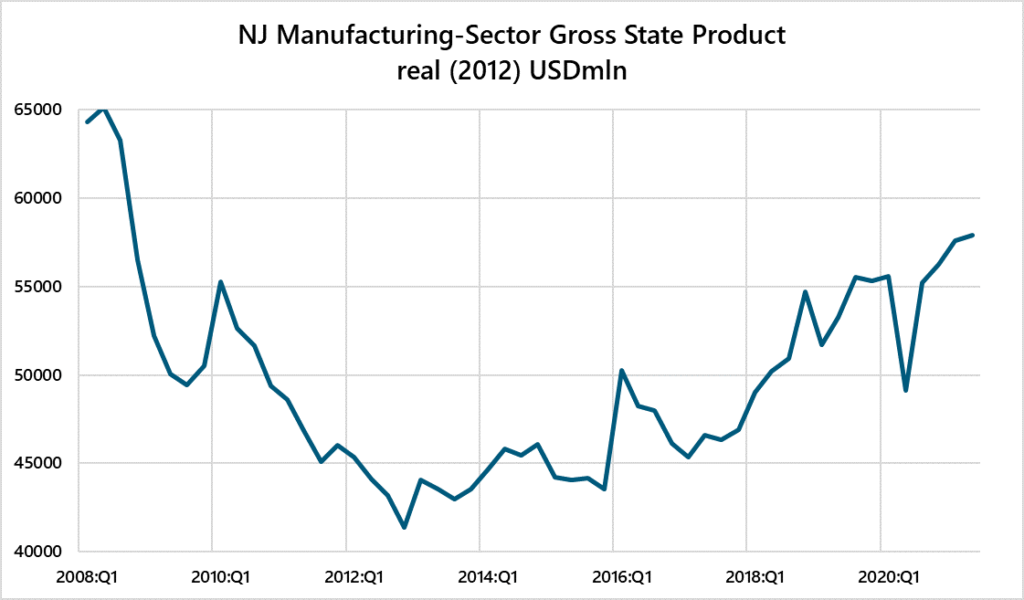
Manufacturing industry Gross State Product – Trending upward since 2018

Over the past four years, manufacturing has been one of New Jersey’s fastest expanding industries, growing at a 5.6 percent annualized pace. The strength has been concentrated in non-durable manufacturing – areas such as food and chemical products. This recent strength in manufacturing is quite a contrast to what the experience was in the aftermath of the 2008-09 recession, when manufacturing contracted at a 3.0% annualized rate through 2016.


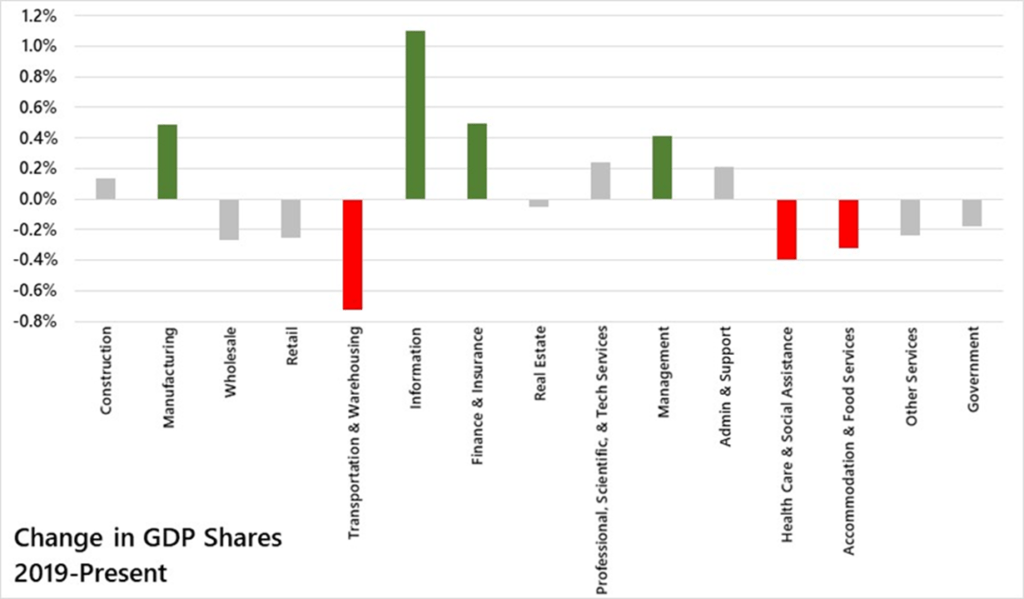
Manufacturing, along with some other high value-added industries,
is increasing as a share of New Jersey’s economy

Not only is manufacturing expanding at a solid clip, but it is becoming an increasing share of New Jersey’s overall economy. This chart looks at how shares of GDP have changed since the period right before the pandemic to today. As the chart shows, manufacturing as a share of the economy has increased by approximately 0.5 percentage points. Manufacturing currently accounts for around 11.3 percent of private-sector GDP.


Labor market indicators and Federal Reserve surveys point to continued solid growth

Economists are always on the lookout for leading indicators that provide information on how economic activity is performing now and into the future. These next two charts do just that.

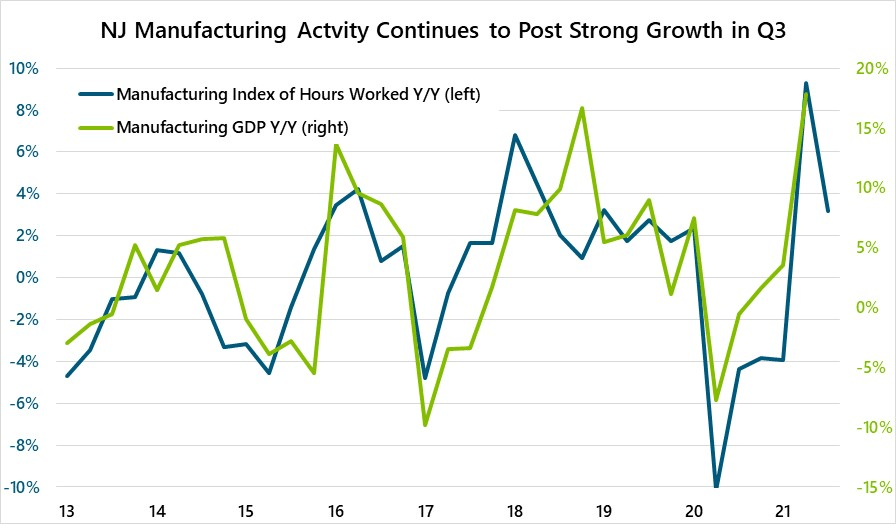
This is a chart of year-over-year changes in both the manufacturing index of hours worked and manufacturing GDP for New Jersey. The manufacturing index of hours worked is the product of the number of manufacturing employees and the hours they have worked. Essentially, it provides a measure of the amount of labor input in a given quarter. Given labor is a significant input in the manufacturing process, tracking labor output can tell us about manufacturing output. Here we see, through Q3, that manufacturing labor input continued to grow at very strong rate in line with manufacturing GDP near 10 percent year over year growth. Thus, manufacturing output continued to grow at a solid clip in Q3.

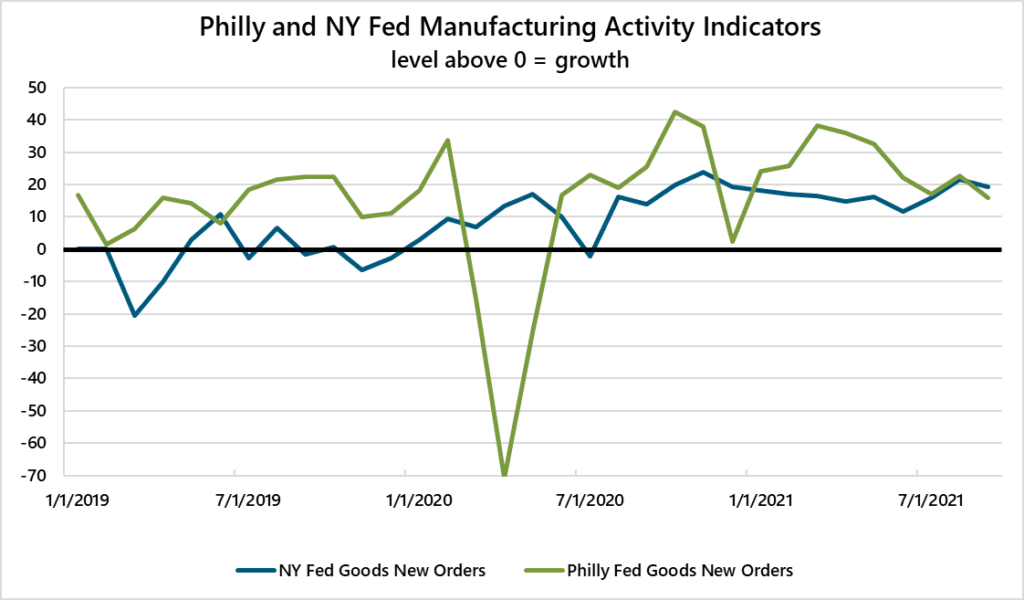
This chart shows data from two very useful surveys of manufacturing activity run by the Federal Reserve Banks of New York and Philadelphia. Here we are focused on indices for new orders, which is extremely helpful data for understanding near-term manufacturing activity because today’s orders become tomorrow’s production. Thus, when new orders are growing at a strong pace, it is a clear sign future production will, in turn, be strong.

In this context, anything above 0 indicates growth, so current levels near 20 signal double-digit growth. The one disclaimer is that it depends on whether demand is being filled by new production or previously produced inventories. However, given that inventories are stretched fairly thin currently, the ongoing growth of new orders signals a solid pace of manufacturing sector activity in Q4 and, likely, beyond.


A New Jersey Geography of Manufacturing Jobs, 2010-2019

This section provides an analysis of New Jersey residents who are manufacturing industry workers, as reported by the United States Census Bureau. The data presented here pertains to New Jersey residents and where they live, in contrast to where the manufacturing jobs or employers are located.

In the nine years just prior to the COVID-19 pandemic (2019 vs. 2010), New Jerseyans employed in manufacturing decreased from 396,000 (8.6 percent of the work force) in 2010 to 361,000 (7.7 percent of the work force) in 2019 — a 9.9 percent decrease in residents employed in manufacturing. However, there are some interesting trends throughout the state, including some places where the number of residents employed in manufacturing has increased. Moreover, as the analysis above shows, manufacturing in New Jersey in recent years is growing at a solid clip, which may reverse the shifts of the past nine years.

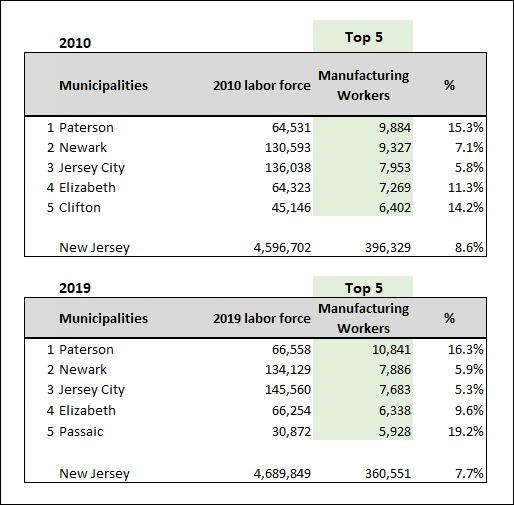
Top five municipalities in manufacturing worker residents in New Jersey,
by percentage of workforce, 2019 vs 2010

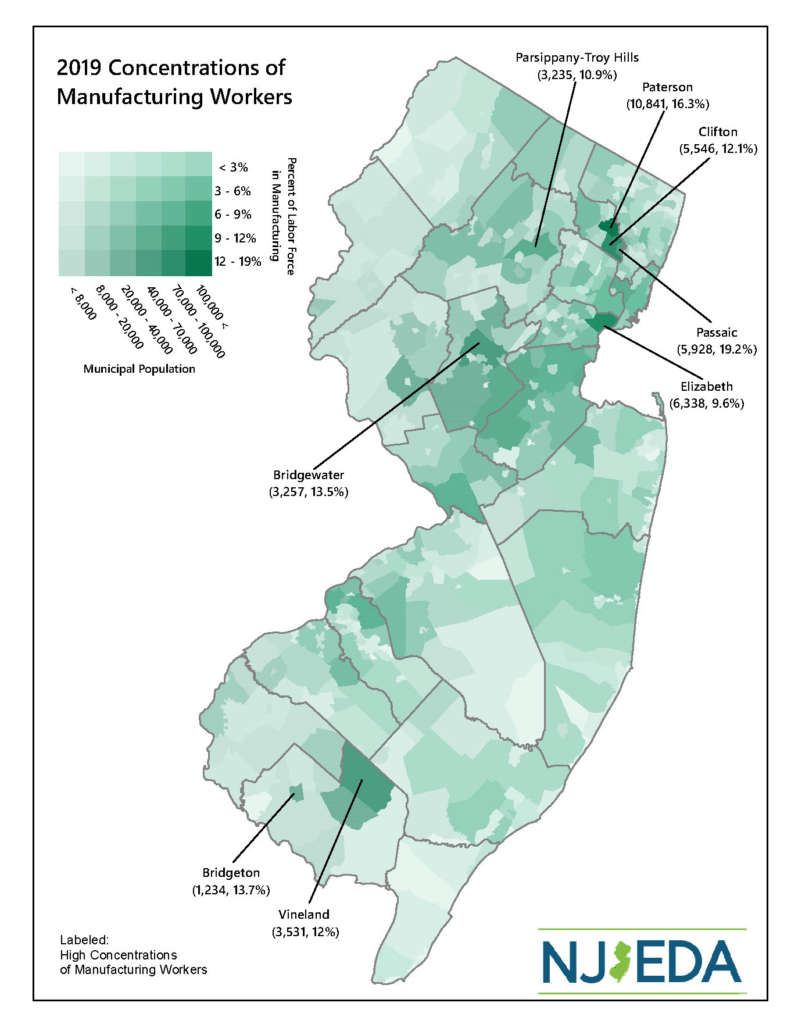
Looking at the raw numbers of residents in each municipality, the most populous cities unsurprisingly have the largest numbers of residents employed in manufacturing. The top five municipalities for manufacturing worker residents in 2010 included Paterson (9,884), Newark (9,327), Jersey City (7,953), Elizabeth (7,269), and Clifton (6,402). These rankings stayed mostly the same through 2019, except for the fifth spot, which switched from Clifton to neighboring Passaic. Clearly, the center of New Jersey manufacturing workers remains the northeast urban areas near New York City. The following map shows manufacturing worker density by municipality, both in levels and as a percent of labor force.


Map of manufacturing worker residents in New Jersey, levels and share of work force, 2019

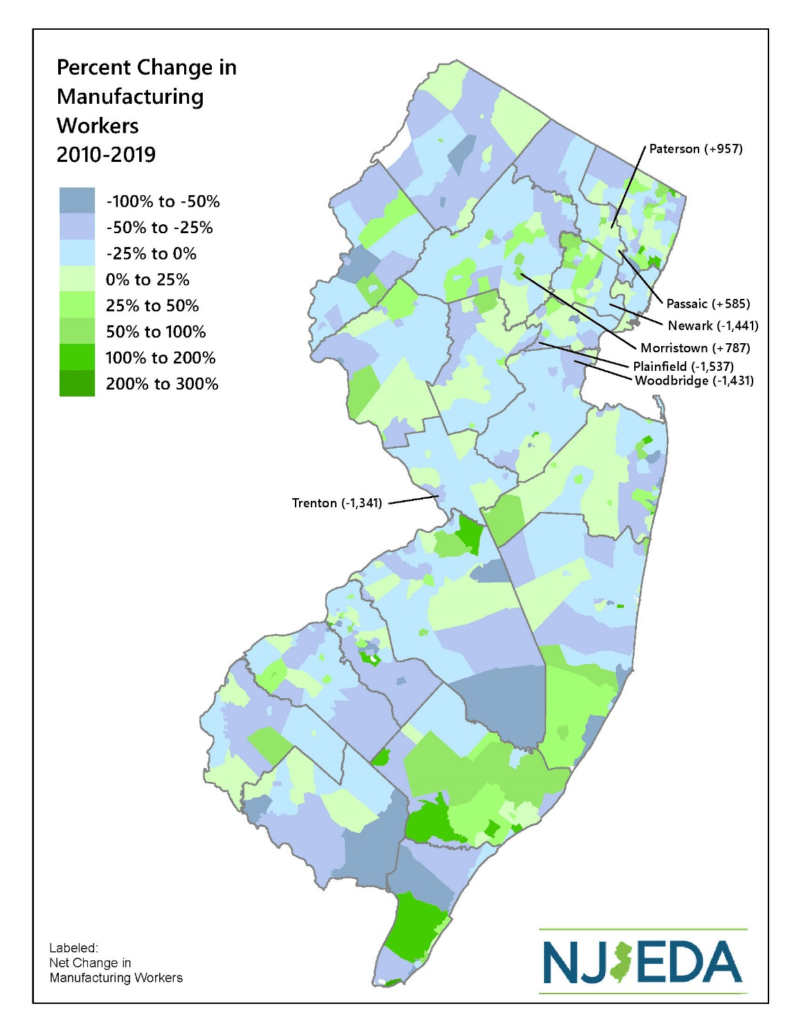
Looking at the following map related to changes across the state, rural areas generally saw decreases in manufacturing employees. Whether this is caused by changes in manufacturing locations, movement of residents, or a combination of factors would need further study support. However, there is evidence from the 2020 Census that indicates rural communities are losing population.

Map of percent change in manufacturing worker
residents in New Jersey, 2019 vs 2010

Outside of the northeastern manufacturing area, there is a notable increase in manufacturing employees in Atlantic County and Southern Ocean County. It will be of interest to follow how New Jersey’s new wind port, which is being built in Salem County, supports further manufacturing sector employment in and around the region.

The towns that saw the biggest decreases in residents employed in manufacturing from 2010-2019 share some similarities to those above. Plainfield (-1,537), Newark (-1,441), Woodbridge (-1,431), and Linden (-1,265) are also in this concentrated northeast urban area, while Trenton (-1,341), which has the fourth most manufacturing residents in the state, is not.


Reshoring Jobs: a Pre-COVID Trend Accelerated by the Pandemic

Among the many lessons the world has learned from the COVID-19 pandemic is the is the vulnerability of the global supply chain. Estimates suggest the pandemic affected 98 percent of global supply chains.[1] Companies that had previously prioritized a lean supply chain model that prioritized cost reduction and just-in-time production were not well prepared for major worldwide disruptions.[2]

As a result of the pandemic, some firms started to consider “reshoring” – the practice of bringing manufacturing and services back to the United States from overseas.[3] A May/June 2020 survey of 750 North American manufacturing firms found that 69 percent were either “likely” or “extremely likely” to reshore their overseas operations.[4] It is worth noting that the pandemic did not seem to cause the sudden interest in reshoring – rather, it accelerated an existing trend.[5] Evidence shows, over the past decade, China has lost the most reshored U.S. jobs (40 percent), followed by Mexico (23 percent) and Canada (10 percent). Over the past several years, the number of jobs cumulatively reshored to the United States has increased from about 100,000 in 2013 to over 500,000 in 2020.[6] In 2020, reshoring logged a record high 109,000 jobs announced.

The pandemic was the main driver of this recent surge, but analysts also view this landmark development as a combination of other factors, including greater U.S. competitiveness due to corporate tax and regulatory cuts, and rising concern over China’s competitiveness.[7] In general, a number of variables unrelated to the pandemic factor into a company’s decision to reshore. Rising wages in hosting countries are one of the most frequently cited reasons. Other reasons include protection of intellectual property, shorter supply chains, and the value of the “Made in USA” label as factors in decisions resulting in reshoring.[8] Despite the impact of COVID-19 and some promising developments in recent years, it’s important not to assume that reshoring is inevitable. Decisions on supply chains are made based on business fundamentals such as production costs and access to large markets. COVID-19 will likely not significantly affect those factors.


[1] https://www.supplychaindive.com/news/supply-chains-reshoring-decisions-sourcing-manufacturing-china/597596/

[2] https://www.brookings.edu/research/reshoring-advanced-manufacturing-supply-chains-to-generate-good-jobs/

[3] https://www.brookings.edu/research/reshoring-advanced-manufacturing-supply-chains-to-generate-good-jobs/

[4] https://www.areadevelopment.com/BusinessGlobalization/Q1-2021/job-creation-through-reshoring.shtml

[5] https://www.areadevelopment.com/BusinessGlobalization/Q1-2021/job-creation-through-reshoring.shtml

[6] Reshoring Initiative 2020 Data Report

[7] Ibid

[8] https://www.areadevelopment.com/BusinessGlobalization/Q1-2021/job-creation-through-reshoring.shtml; https://www.supplychaindive.com/news/supply-chains-reshoring-decisions-sourcing-manufacturing-china/597596/

 $20M Expansion to Pilot Program Helps Jersey Shore Businesses &
Organizations Purchase Zero-Emission Medium-Duty Vehicles

TRENTON, N.J. (December 1, 2021) – The New Jersey Economic Development Authority today opened applications for its popular New Jersey Zero Emission Incentive Program (NJ ZIP) pilot to businesses and organizations in the Greater Shore Area to help them offset the cost of purchasing new, zero-emission medium-duty vehicles (MDVs). Last month, the NJEDA Board approved a $20 million expansion of the program funding pool, which builds on momentum generated since the launch of the clean energy initiative. NJ ZIP is also available to entities in the greater Newark, Camden, and New Brunswick areas.

With this expansion, nearly $45 million has been allocated to the voucher pool. Applications are being accepted on a rolling basis and can found at http://www.njeda.gov/njzip. The website also includes links to useful resources for potential program applicants, including: webinars for vendors and purchasers, eligibility requirements, frequently asked questions, accounting of remaining funds, and a link to email the NJ ZIP program manager directly.

Businesses and organizations in the four designated greater community areas can apply for vouchers to purchase new, Class 2b to Class 6 zero-emission MDVs. The size of vouchers awarded through the program varies depending on the class of vehicle being purchased, from a minimum of $25,000 for Class 2b vehicles to $100,000 for Class 6 vehicles. Bonuses are available for small businesses (fewer than 25 staff or less than $5 million in annual revenues); women-, minority-, and veteran-owned businesses; vehicles that are manufactured in New Jersey; and small businesses that scrap their eligible MHDVs. More information on eligibility and processes is available at https://www.njeda.gov/njzip.

“Our shore communities have repeatedly experienced the long-term impacts of climate change over the last decade and it is incumbent upon us to continue to create and leverage innovative solutions to blunt these effects,” NJEDA Chief Executive Officer Tim Sullivan said. “NJ ZIP sits at the intersection of clean energy and environmental justice and is a vital part of Governor Phil Murphy’s whole-of-government approach to combating climate change and spurring economic opportunities in historically overburdened communities.”

For the purposes of this pilot expansion, the Greater Shore Area is defined as the overburdened communities within or intersected by a line set at a 10-mile distance from New Jersey’s eastern Atlantic shore, spanning approximately from Sandy Hook Bay to Delaware Bay. This includes the following municipalities:

Absecon, Asbury Park, Atlantic City, Barnegat Township, Berkeley Township, Bradley Beach Borough, Brick Township, Brigantine, Cape May, Colts Neck Township, Eatontown Borough, Egg Harbor City, Egg Harbor Township, Farmingdale Borough, Galloway Township, Highlands Borough, Holmdel Township, Howell Township, Keansburg Borough, Keyport Borough, Lacey Township, Lakewood Township, Little Egg Harbor Township, Long Branch, Lower Township, Manchester Township, Middle Township, Middletown Township, Neptune City Borough, Neptune Township, North Wildwood, Northfield, Ocean City, Ocean Gate Borough, Ocean Township, Pleasantville, Point Pleasant Beach Borough, Red Bank Borough, Seaside Heights Borough, Shrewsbury Township, Somers Point, South Toms River Borough, Stafford Township, Tinton Falls Borough, Toms River Township, Tuckerton Borough, Union Beach Borough, Ventnor City, Wildwood, Woodbine Borough

Vouchers are available on a first-come, first-served basis, with set-asides for the Greater Shore Areas, small- and micro-businesses, and passenger transportation. Based on the continued positive results of this expansion of the pilot program, additional expansions or a longer-term program with expanded eligibility may be proposed.

This latest NJ ZIP expansion is being funded using proceeds from New Jersey’s participation in the Regional Greenhouse Gas Initiative (RGGI), a multi-state “cap-and-trade” program regulating carbon dioxide emissions, that New Jersey was rejoined by Executive Order of Governor Murphy in 2019. More information about New Jersey’s plans for using RGGI funding is available https://www.nj.gov/rggi/index.html.


About the New Jersey Economic Development Authority

The New Jersey Economic Development Authority (NJEDA) serves as the State’s principal agency for driving economic growth. The NJEDA is committed to making New Jersey a national model for inclusive and sustainable economic development by focusing on key strategies to help build strong and dynamic communities, create good jobs for New Jersey residents, and provide pathways to a stronger and fairer economy. Through partnerships with a diverse range of stakeholders, the NJEDA creates and implements initiatives to enhance the economic vitality and quality of life in the State and strengthen New Jersey’s long-term economic competitiveness.

To learn more about NJEDA resources for businesses call NJEDA Customer Care at 609-858-6767 or visit https://www.njeda.gov and follow @NewJerseyEDA on FacebookTwitterInstagramand LinkedIn.

###