NJEDA.com contains a link to translation services provided by Google™ Translate, a free online translation service. Google™ Translate is subject to its own terms of service, which can be viewed at (https://policies.google.com/?hl=en). The link does not constitute affiliation, endorsement, support, or approval of Google™ Translate.
Neither the NJEDA nor the State of New Jersey (collectively, the “State”) reviews the services, information or content provided by Google™ Translate. Information translated by Google™ Translate may not be accurate or current and is used at the user's sole risk. The NJEDA has no obligation to offer translation, and this service could change or be discontinued at any time.
The State expressly and fully disavows and disclaims any responsibility or liability in respect to any cause, claim, or consequential or direct damage or loss, however described, arising from the use of Google™ Translate.
NJEDA.com is provided "AS-IS" with no warranties, express or implied, and its use confers no privileges or rights.
For additional language assistance, please click here to contact NJEDA to request assistance.
Respondents Encouraged to Submit Feedback About New Center to Address Racial Disparities and Inequities in Care & Outcomes for Mothers and Infants
TRENTON, N.J. (June 1, 2021) – The New Jersey Economic Development Authority (NJEDA) and First Lady Tammy Snyder Murphy today announced that they have extended the deadline for their Request for Information (RFI) seeking input to inform the establishment of a Center for Maternal and Infant Health in Trenton. The Center will be dedicated to innovation and research, with an emphasis on addressing racial disparities and ensuring equity in care and outcomes for mothers and infants. The creation of the Center is a key recommendation from First Lady Murphy’s recently released Nurture NJ’s Maternal and Infant Health Strategic Plan. The RFI can be found at https://www.njeda.gov/bidding/#OET. Responses to the RFI are now due no later than 11:59 p.m. on Wednesday, June 25, 2021.
The RFI, which was issued in late April in conjunction with Governor Phil Murphy and First Lady Tammy Murphy’s offices, the Nurture NJ campaign, and NJEDA’s state agency partners at the Department of Health, Department of Human Services, and Office of the Secretary of Higher Education (OSHE), is the latest in a series of steps the State of New Jersey is taking to reduce maternal and infant mortality, particularly among mothers and infants of color.
In 2019, First Lady Murphy launched Nurture NJ, a statewide, multi-agency campaign committed to both reducing maternal and infant mortality and morbidity and ensuring equitable care among women and children of all races and ethnicities. In January 2021, the First Lady unveiled the Nurture NJ Maternal and Infant Health Strategic Plan, which aims to make New Jersey the safest and most equitable place in the nation to deliver and raise a baby through more than 70 specific, actionable recommendations. The establishment of a Center in the state capital that “focuses on innovation and research in maternal and infant health through partnerships with the state’s academic, funder, business, and faith communities” is among those recommendations.
New Jersey currently ranks 47th in the nation for maternal deaths and has one of the widest racial disparities for both maternal and infant mortality. A Black mother in New Jersey is seven times more likely than a white mother to die from maternity-related complications, and a Black baby is over three times more likely than a white baby to die before his or her first birthday.
The NJEDA is seeking responses from qualified entities including, but not limited to: mothers and caregivers; members of communities most affected by disparities in maternal and infant health outcomes; healthcare providers; hospitals and hospital systems; midwives and doulas; health organizations; universities; advocacy organizations; social services providers; municipalities, government agencies and school districts; community stakeholders; policy and academic researchers; real estate developers; business leaders, employers and entrepreneurs; technical assistance providers; and foundations and philanthropic organizations that address infant and maternal health. The NJEDA is seeking responses from entities based within New Jersey as well as those located outside of the state.
All RFI responses must be submitted in writing no later than 11:59 PM EST on Wednesday June 25, 2021, via e-mail to: MaternalHealthRFI@njeda.com
The subject line of the e-mail should state: “RFI Response-2021-RFI-127”.
About NJEDA
The New Jersey Economic Development Authority (NJEDA) serves as the State’s principal agency for driving economic growth. The NJEDA is committed to making New Jersey a national model for inclusive and sustainable economic development by focusing on key strategies to help build strong and dynamic communities, create good jobs for New Jersey residents, and provide pathways to a stronger and fairer economy. Through partnerships with a diverse range of stakeholders, the NJEDA creates and implements initiatives to enhance the economic vitality and quality of life in the State and strengthen New Jersey’s long-term economic competitiveness.
To learn more about NJEDA resources for businesses call NJEDA Customer Care at 609-858-6767 or visit https://www.njeda.gov and follow @NewJerseyEDA on Facebook, Twitter, Instagram and LinkedIn.
Follow Nurture NJ and First Lady Tammy Murphy on Twitter (@FirstLadyNJ), Facebook (@FirstLadyNJ), and Instagram (@firstladynewjersey).
###
TRENTON, N.J. (June 1, 2021) – The New Jersey Economic Development Authority (NJEDA) today announced that it is now accepting applications for the residential component of the Economic Redevelopment and Growth (ERG) Program. The ERG program, which was originally created to address project financing gaps in development projects, previously stopped accepting new applications in June 2019 because its enabling legislation ended. The Authority first announced the re-opening of the program, enabled by $50 million in tax credits designated in the Economic Recovery Act of 2020 (ERA), in March.
“Thanks to the foresight of Governor Murphy and the Legislature in reopening the ERG program, essential housing projects throughout New Jersey that have been on hold will be able to move forward while the new programs created by the Economic Recovery Act are under development,” said NJEDA Chief Executive Officer Tim Sullivan. “This will not only provide much-needed new housing in our state, but it will also drive economic growth by creating construction jobs and attracting more workers to New Jersey. This is always important, but it is especially crucial now as we begin recovering from the economic impacts of COVID-19.”
The ERA was signed by Governor Phil Murphy on January 7, 2021 to address the ongoing economic impacts of the COVID-19 pandemic and build a stronger, fairer New Jersey economy. Under the ERA, residential ERG projects can receive tax credits of up to 30 percent of total eligible project costs. Projects in Atlantic City, Camden, Paterson, Passaic, and Trenton can receive tax credits of up to 40 percent of eligible project costs. ERG tax credits are not meant to be a substitute for conventional debt and equity financing, and applicants should generally have their primary debt financing in place before applying.
The new phase of the ERG program will be administered based on pre-existing ERG regulations and statutes, as amended by the ERA, which added new prevailing wage and minimum wage requirements. For additional information and detailed eligibility requirements, including a clarifying document outlining all requirements and application review protocols for interested parties, visit https://www.njeda.gov/erg/. Specific questions can be directed to ergextension@njeda.com.
About the New Jersey Economic Development Authority
The New Jersey Economic Development Authority (NJEDA) serves as the State’s principal agency for driving economic growth. The NJEDA is committed to making New Jersey a national model for inclusive and sustainable economic development by focusing on key strategies to help build strong and dynamic communities, create good jobs for New Jersey residents, and provide pathways to a stronger and fairer economy. Through partnerships with a diverse range of stakeholders, the NJEDA creates and implements initiatives to enhance the economic vitality and quality of life in the State and strengthen New Jersey’s long-term economic competitiveness.
TRENTON, N.J. (May 27, 2021) – Applications are now open for the Emerge program, a new jobs-based tax credit program created under the New Jersey Economic Recovery Act (ERA) of 2020 and administered by the New Jersey Economic Development Authority (NJEDA). The Emerge program will drive economic development in New Jersey by making tax credits available to projects that invest private capital into the state and create good-paying jobs, with a focus on the State’s priority sectors.
The Emerge program application, as well as complete rules, eligibility requirements, award sizes, and other information, are available at https://www.njeda.gov/emerge.
“Creating good jobs for New Jerseyans has always been central to my administration’s efforts to build a stronger, fairer New Jersey and has become even more important as we begin our recovery from the economic devastation of the COVID-19 pandemic,” said Governor Phil Murphy. “The Emerge program is a well-crafted, targeted tax incentive program that will drive job creation and equitable economic growth throughout New Jersey.”
“Supporting projects that bring good jobs to New Jersey is crucial to recovering from the COVID-19 pandemic and achieving Governor Murphy’s vision for a stronger, fairer New Jersey,” said NJEDA Chief Executive Officer Tim Sullivan. “Launching the application for the Emerge program is a major step forward that will open the door to exciting new economic development projects while also remaining true to our commitments to equity, transparency, and accountability. This will set New Jersey on the path to long-term, sustainable, and fair economic success.”
“New Jersey’s recovery from COVID-19 hinges in large part on our ability to attract and retain businesses to the state and create good jobs for New Jersey residents,” said Senator Paul A. Sarlo, who serves as Chairman of the Senate Budget and Appropriations Committee. “The Emerge Program is a critical economic development tool that will bring successful businesses to New Jersey, incentivize them to create jobs for New Jersey residents, and promote expanded economic opportunities.”
“As we begin the process of recovering from the COVID-19 pandemic, we have an important opportunity to build a more prosperous and equitable employment landscape in New Jersey,” said Senator M. Teresa Ruiz. “The Emerge program will play a key role in our economic recovery by driving job creation and economic growth in impacted communities throughout the state.”
“The only way for New Jersey to fully recover from the COVID-19 pandemic and the associated economic impacts is to drive job creation and economic growth in communities throughout the state,” said Assembly Speaker Craig Coughlin. “The Emerge program is a thoughtfully-crafted incentive that will effectively support business growth in New Jersey while also creating a more fair and equitable economy where all New Jerseyans can succeed.”
“The launch of the Emerge program application is an important step in the process of moving from short-term responses to the immediate COVID-19 crisis to long-term, forward looking programs that will drive recovery and economic growth,” said Assemblywoman Eliana Pintor Marin. “By focusing on job creation, this program responds directly to the need to get New Jerseyans back to work while also attracting successful, growing companies that will serve as engines of economic growth for years to come.”
The Emerge program is part of the suite of programs created under the ERA to address the ongoing economic impacts of the COVID-19 pandemic and build a stronger, fairer New Jersey economy. Through the Emerge program, small and large businesses, as well as non-profits, can apply for tax credits to support projects that meet minimum capital investment, job creation or retention, and other requirements. Projects can qualify to receive tax credits over a seven-year eligibility period, starting after the NJEDA confirms the applicant has completed its investment, employment, and other eligibility requirements.
To be eligible for tax credits under the Emerge program, projects must create or retain a minimum number of jobs. The job creation requirement is lower if a business is primarily engaged in a targeted industry or if a business is a “small business” as defined in the program rules. Additionally, at least 80 percent of incented employees’ work time must be spent in New Jersey, and the business must commit to stay in the qualified business facility for at least 1.5 times the duration of the eligibility period. A minimum capital investment in the qualified business facility is required based on the use. Businesses may make an equivalent donation to a Recovery Infrastructure Fund in place of investing in their project facilities. Small businesses are not required to make capital investments.
All projects that receive tax credits under the Emerge program must meet minimum environmental standards, meet prevailing wage obligations for all construction workers and building service workers, and provide health care for employees. Projects that have a total cost of $10 million or more are also required to enter into a Community Benefits Agreement with the NJEDA and the municipality or county in which the project is located. These agreements will create a Community Advisory Committee to monitor compliance with the respective agreement.
To ensure a strong return on investment for New Jersey taxpayers, projects that receive tax credits under the Emerge program must yield a minimum net positive economic benefit to the state of 200 to 400 percent depending on project location and the nature of the project. Applicants must also demonstrate that they are considering a viable out-of-state location, and awards will be limited to the amount the NJEDA determines is necessary to induce the project to locate or remain in New Jersey. The NJEDA will also review detailed financial information about the project to verify the award of tax credits is a “material factor” in the business’s decision to create or retain jobs in New Jersey.
In addition to the Emerge program, the ERA creates a suite of programs that includes tax credits to incentivize job creation, new construction, and revitalization of brownfields and historic properties; financial resources for small businesses; support for new supermarkets and healthy food retailers in food desert communities; new funding opportunities for early-stage companies in New Jersey; and support for the growing film and digital media industry. More information about these programs is available at https://njeda.com/economicrecoveryact.
About the New Jersey Economic Development Authority
Small businesses and non-profits that missed previous deadlines to apply have another chance
TRENTON, N.J. (May 26, 2021) – The New Jersey Economic Development Authority (NJEDA) today announced that it reopened pre-registration for Phase 4 of its Small Business Emergency Assistance Grant Program this morning, at 9:00 a.m. In line with his commitment to a stronger and fairer economic recovery, Governor Phil Murphy recently announced the allocation of $200 million in additional funds to help fulfill Phase 4 grant applications. Small business owners and non-profits that have not previously applied for Phase 4 grants may pre-register as a preliminary step toward applying for grants of up to $20,000.
The $200 million in additional funds will continue to support the most adversely affected businesses in New Jersey, including $20 million for bars and restaurants, $120 million for micro-businesses, $10 million for child care providers, as well as $50 million for other small businesses and non-profits with up to 50 full-time equivalent employees. Since the initial launch of the Small Business Emergency Assistance Grant Program back in April of 2020, the NJEDA has distributed more than $259 million in aid to some 55,000 businesses across the state.
“We’ve seen tens-of-thousands of small business owners in New Jersey benefit from this Grant Program offered by the NJEDA since it was initially launched in April of last year, so we’re very grateful to receive this additional funding that will help us fulfill many more requests for financial assistance,” said NJEDA Chief Executive Officer Tim Sullivan. “Reopening Phase 4 will allow eligible small businesses and non-profits in New Jersey apply for grants of up to $20,000 aimed to help them replace lost revenue during the pandemic and keep their doors open for business.”
Phase 4 funding is supporting restaurants, micro-businesses, and child care providers, as well as other small businesses. To ensure grants reach businesses in the hardest hit communities, including communities of color, the NJEDA has assigned one-third of funding to businesses with a primary business location within the 715 census tracts designated as eligible to be selected as an Opportunity Zone.
Interested business owners and non-profits will need to pre-register here to access the application. Pre-registration reopened today, Wednesday, May 26th, 2021, at 9:00 a.m. EDT, and will remain open for five weeks, until Wednesday, June 30th, at 5:00 p.m. EDT. Applications will become available following the pre-registration period, as pre-registered applicants will be asked to return to https://programs.njeda.com/en-US/to complete an application based on the following schedule:
Restaurants (Food Services and Drinking Places, NAICS begins with 722), Child Care Providers (NAICS code 624410) and Small Business (6 more Full Time Equivalent Employees): July 7, 2021, 9:00 a.m. EDT.
Micro Business (5 or Less Full Time Equivalent Employees): July 8, 2021, 9:00 a.m. EDT.
Applications will remain open through July 15, 2021, 5:00 pm EDT and will be accepted on a first-come, first-served basis, based upon the date and time the Authority receives a completed application submission. Applicants must complete the full application to be considered for grant funding.
Grant awards will be calculated based on the number of full-time equivalent employees (FTEs) businesses employ: Micro-businesses with five or fewer FTEs and sole proprietorships will receive up to $10,000; businesses with six to 25 FTEs will receive up to $15,000; and businesses with 26 to 50 FTEs will receive up to $20,000. A grant size estimator is available here.
Small businesses and non-profits will need to show they have been negatively impacted during the declared state of emergency to be eligible for this grant. This includes businesses that have been temporarily shut down, have been required to reduce hours, have had at least a 20 percent drop in revenue, have been materially impacted by employees who cannot work due to the outbreak, or have a supply chain that has materially been disrupted and therefore slowed firm-level production during the pandemic.
The NJEDA continues to work with the Legislative leadership in Trenton to assess the enduring need for financial assistance and pursue additional funding to fulfill all eligible applications during the Phase 4 deadline extension.
Furthermore, the NJEDA will continue to provide the online pre-registration and application in English and Spanish, offering applicants access to interpretation services to support speakers of ten additional languages –Arabic, Chinese (Mandarin and Cantonese), Gujarati, Hindi, Italian, Korean, Polish, Portuguese, and Tagalog.
In addition to the Small Business Emergency Assistance Grant Program, the NJEDA administers a variety of technical assistance and low-cost financing programs for small and mid-sized businesses impacted by COVID-19. Businesses and nonprofits can use the Eligibility Wizardto identify which emergency assistance programs they may want to consider for their business’s specific needs. More information about these programs and other State support is available at https://business.nj.gov/covid or call 844-965-1125.
About the New Jersey Economic Development Authority
The New Jersey Economic Development Authority (NJEDA) serves as the State’s principal agency for driving economic growth. The NJEDA is committed to making New Jersey a national model for inclusive and sustainable economic development by focusing on key strategies to help build strong and dynamic communities, create good jobs for New Jersey residents, and provide pathways to a stronger and fairer economy. Through partnerships with a diverse range of stakeholders, the NJEDA creates and implements initiatives to enhance the economic vitality and quality of life in the State and strengthen New Jersey’s long-term economic competitiveness.
TRENTON, N.J. (May 24, 2021) – The New Jersey Economic Development Authority (NJEDA) today announced applications have reopened for the 21st Century Redevelopment Program, which had been put on hold in April 2020 due to the COVID-19 pandemic. The program makes grants up to $50,000 available to communities to help them redevelop, repurpose, or regreen vacant and underutilized retail or office park properties. Municipalities, counties, and redevelopment agencies have 45 days to apply.
The 21st Century Redevelopment Program was created in October 2018 in response to a number of demographic and economic trends that resulted in suburban offices and shopping malls emptying out, leaving communities stuck with the costs of maintaining infrastructure and roads around these facilities and a lack of resources to do so. In response to stakeholder feedback, the NJEDA adjusted the eligibility criteria for the program in 2019 to make more properties eligible while ensuring that properties of significant scope and scale remain prioritized. To accommodate the significant business disruptions resulting from the COVD-19 pandemic and work-from-home directives, the NJEDA put the program on hold in April 2020.
Beginning today, municipalities have 45 days to apply for funding through the program. The NJEDA will administer the program in accordance with the updated parameters approved in 2019, meaning grants of up to $50,000 are available to help municipalities, counties, and redevelopment agencies develop plans to repurpose vacant properties into productive economic assets. Potential uses of the grant funding include, but are not limited to:
Legal analysis to explore designating one or more relevant properties in the community as an “area in need of redevelopment.”
Stakeholder engagement and facilitation to identify community desires and needs.
Identification of appropriate funding sources to support community led re-use of one or more properties.
Cataloging relevant retail and office properties in a community and identifying priority sites when considering community needs.
Economic analysis relating to the feasibility of various redevelopment and/or reuse scenarios.
Land-use planning identifying the most suitable re-use scenarios.
Once all applications are received, staff will evaluate and score them competitively, with the fifteen highest scoring applications recommended to the Board for grants. In addition to receiving funding, grant recipients will be required to participate in at least two events hosted by the NJEDA to foster a dynamic discussion about repurposing stranded assets and provide guidance to communities facing similar challenges.
More information about the 21st Century Redevelopment Program, including detailed eligibility and application scoring criteria, is available at https://www.njeda.gov/21stcentury/.
About the New Jersey Economic Development Authority
TRENTON, N.J. (May 20, 2021) – The New Jersey Economic Development Authority (NJEDA) and New Jersey Housing and Mortgage Finance Agency (NJHMFA) have announced their approval of support for a project at the historic Argus Mill site in the Great Falls Historic District of Paterson. The Argus Ellison Development project will create 74 housing units and associated parking for residents. It will also provide program space for Grandparents Relatives Care Resource Center (GRCRC), a Paterson-based nonprofit that provides family services, and office space for Winn Residential, the project’s property manager.
“Driving investment in communities is one of the key tenets of Governor Phil Murphy’s plan for a stronger, fairer New Jersey Economy. The Argus Ellison Development project will advance this goal by supporting the well-being of Paterson residents in several ways,” said NJEDA Chief Executive Officer Tim Sullivan. “The project offers attractive and affordable housing options and will provide a permanent, welcoming home for GRCRC staff and the families they support. All of this will be achieved in a manner that will make the iconic Argus Mill an asset to the Great Falls community once again.”
The Argus Ellison Development project will revitalize the historic Argus Mill, which was built in the late 1800s, to create six two-bedroom apartments, and office and programming space for GRCRC. At the same time, the project will undertake new construction of a second, six-story building comprised of 68 one-, two-, and three-bedroom apartments. Most of these apartments will be supported by housing vouchers from the Paterson Housing Authority. A minimum of 40 percent of the units in this mixed-income development will average 60 percent or less of area median income (AMI). Two small existing office buildings on the site, the Daniel Thompson and John Ryles Houses, will remain in place and serve as management office and nonprofit office space.
The project also includes office and programming space for GRCRC, which will provide social services to tenants and other Paterson residents. GRCRC offers grandparents and other relative caregivers and the children they are raising with a range of support services, resources, programs, benefits, and information on laws and policies available to help them successfully fulfill their caregiving role.
“We are extremely excited about the Argus development project and are profoundly grateful for the state’s assistance in achieving equitable housing and quality infill development,” said Paterson Mayor Andre Sayegh. “Grandparents raising grandchildren is a growing portion of our city, so we are very supportive of filling this niche need, while also serving as beacon for other communities to serve their citizens in creative ways.”
“Redevelopment of the Argus Mill and related new construction preserves local history while enhancing the quality of life in this vibrant community,” said NJHMFA Executive Director Melanie R. Walter. “The Argus Mills property provides a model for inclusive and equitable development by offering financially sustainable, quality housing for Paterson families near the City’s beautiful and historic national park.”
“We are thrilled to return to the Paterson community and to work with the administration in serving a very targeted population. We also are very pleased to be able to serve a genuine community need, especially during these challenging times,” said Owen Tonkins, Partner, Argus Ellison Associates LLC.
On May 12, 2021, the NJEDA Board approved Mixed Use Parking Economic Redevelopment and Growth (ERG) tax credits not to exceed $17 million to support the project. The award approximates 100 percent of actual eligible parking costs and 40 percent of the total actual eligible project costs related to residential housing uses. Financing of this project also includes $20.2 million in permanent financing through NJHMFA’s Conduit Bond Program, which was approved at today’s NJHMFA Board meeting.
The project is being developed by Argus Ellison Associates LLC, which is a partnership between Lagos Partners and Winn Development, and Grandparents AE, LLC. Grandparents AE is affiliated with GRCRC and was created for the sole purpose of advancing this project. Construction is expected to begin in July 2021. The anticipated completion of the project is September 2022.
To support more projects like the Argus Ellison development, in January, Governor Murphy committed an additional $50 million to the Residential ERG program through the New Jersey Economic Recovery Act of 2020 (ERA), a comprehensive package of economic development legislation to address the ongoing economic impacts of the COVID-19 pandemic and build a stronger, fairer New Jersey economy. This new commitment of funding will enable projects that are ready to advance to do so while new ERA programs are under development.
The application for the residential ERG program is expected to reopen on June 1 and will be administered based on pre-existing ERG regulations and statutes, as amended by the ERA, which added new prevailing wage and minimum wage requirements. For additional information and detailed eligibility requirements, including a clarifying document outlining all requirements and application review protocols for interested parties, visit https://www.njeda.gov/economicrecoveryact/. Specific questions can be directed to ergextension@njeda.com.
For more information about the extension of the ERG program and other programs created by the Economic Recovery Act, please visit https://www.njeda.gov/economicrecoveryact/.
About the New Jersey Economic Development Authority
The New Jersey Economic Development Authority (NJEDA) serves as the State’s principal agency for driving economic growth. The NJEDA is committed to making New Jersey a national model for inclusive and sustainable economic development by focusing on key strategies to help build strong and dynamic communities, create good jobs for New Jersey residents, and provide pathways to a stronger and fairer economy. Through partnerships with a diverse range of stakeholders, the NJEDA creates and implements initiatives to enhance the economic vitality and quality of life in the State and strengthen New Jersey’s long-term economic competitiveness.
About New Jersey Housing and Mortgage Finance Agency New Jersey Housing and Mortgage Finance Agency, an affiliate of DCA, is a statewide and national leader in providing and advocating for affordable housing and homeownership. The Agency provides financing to developers to create quality homes and provides mortgage loans and down payment and closing cost assistance to help homebuyers achieve their dream of homeownership. For more information about NJHMFA programs, visit https://www.njhousing.gov.
###
TRENTON, N.J. (May 19, 2021) – The New Jersey Economic Development Authority (NJEDA) today announced that it is accepting public feedback on the proposed rules for the expanded Angel Investor Tax Credit Program. Members of the public can read the draft rules and provide written feedback at www.njeda.gov/program-specific-feedback.
Originally established in 2013, the Angel Investor Tax Credit Program was expanded under the New Jersey Economic Recovery Act of 2020 (ERA). The rule proposal aligns with changes made to the program pursuant to P.L. 2019 c. 145 and implements changes in the ERA. This includes: an increase to the amount of tax credits available each year, an increase in the amount of tax credits available per qualified investment, the availability of bonus credits for qualified investments in targeted locations or in certified minority or women-owned businesses, and the ability for investors to receive a tax credit for investments made in qualified venture funds.
“Ensuring early-stage companies have access to the financial resources they need to launch and grow is crucial to reestablishing New Jersey as the State of Innovation and achieving Governor Phil Murphy’s vision for a stronger, fairer recovery from COVID-19,” said NJEDA Chief Executive Officer Tim Sullivan. “By incentivizing angel investors to support New Jersey-based companies and providing bonuses for investments in minority- and woman-owned companies, the expanded Angel Investor Tax Credit Program will move us closer to our goal of building the most diverse, inclusive innovation ecosystem in the nation and driving long-term, equitable economic growth.”
The New Jersey Angel Investor Tax Credit Program incentivizes angel investment into emerging New Jersey technology businesses by authorizing the NJEDA to provide tax credits to investors based on percentage of a qualified investment made in a New Jersey business conducting research or engaged in pilot-scale manufacturing or technology commercialization in advanced computing, advanced materials, biotechnology, carbon footprint reduction technology, electronic device technology, information technology, life sciences, medical device technology, mobile communications technology, or renewable energy technology. In addition to being engaged in one of these eligible industries, the business receiving the investment must employ fewer than 225 employees, at least 75 percent of whom work in New Jersey.
In 2019, Governor Phil Murphy expanded the Angel Investor Tax Credit Program to increase the available tax credits on qualified investments and provide bonuses for investments in businesses located in targeted locations or certified minority or women-owned businesses.
Since inception of the Angel Investor Tax Credit Program, the NJEDA has approved more than 1,600 applications from investors representing more than $615 million in total qualified investment into emerging New Jersey technology companies.
The draft rule proposal reflects the 2019 legislative changes to the Angel Investor Tax Credit Program including an increase of the amount of the allowed tax credit from ten percent to twenty percent of an investor’s qualified investment in an emerging New Jersey technology business, as well as a five percent bonus tax credit for qualified investments in businesses located in a qualified Opportunity Zone or New Markets Tax Credit census tract or businesses that are New Jersey certified minority- or woman-owned. The maximum allowed tax credit amount will remain $500,000 for the tax credit vintage year for each qualified investment.
Pursuant to the ERA, the draft rules for the expanded Angel Investor Tax Credit Program also implement the ERA’s expansion of the program. This includes expanding the definition of a qualified investment to include an irrevocable contractual commitment to invest in a qualified venture fund. As defined in the draft rules, a qualified venture fund is a partnership, corporation, trust, or limited liability company that invests cash in a business during the early or expansion stages of a business in exchange for an equity stake in the business. This may include a venture capital fund, a family office fund, or a corporate investor fund; however, the fund must be administered by a professional manager and the qualified investment must be non-refundable and non-transferrable. In addition, the fund must commit to invest at least 50 percent of its committed funds in New Jersey-based businesses. Furthermore, a bonus of 5 percent is available if the fund invests 50 percent of its funds in New Jersey diverse entrepreneurs.
In addition to the expanded Angel Investor Tax Credit program, the ERA creates a suite of programs that includes tax credits to incentivize job creation, new construction, and revitalization of brownfields and historic properties; financial resources for small businesses; support for new supermarkets and healthy food retailers in food desert communities; new funding opportunities for early-stage companies in New Jersey; and support for the growing film and digital media industry. More information about these programs is available at https://njeda.com/economicrecoveryact.
About the New Jersey Economic Development Authority
TRENTON, N.J. (May 18, 2021) – The New Jersey Economic Development Authority (NJEDA) Board approved the creation of the NJ Wind Turbine Tech Training Challenge during its May 12, 2021 Board meeting. Supported by funding from the New Jersey Board of Public Utilities (NJBPU) and aligned with Governor Phil Murphy’s WIND Council recommendations, the NJ Wind Turbine Tech Training Challenge is a competitive grant program that will award a grant of up to $1 million to a New Jersey community college that collaborates with union trade organizations and industry partners to establish an offshore wind turbine technician training program. The training program must result in an industry-recognized, credit-bearing certificate program that is part of a pathway to an Associate degree or higher.
“As New Jersey transitions to 100 percent clean energy through initiatives like offshore wind, it is imperative that we cultivate a workforce prepared to meet the emerging opportunities building and operating clean energy infrastructure offers,” said Joseph Fiordaliso, President of the New Jersey Board of Public Utilities. “This grant opportunity demonstrates the State’s commitment to ensuring that the workforce of tomorrow has a place in our innovation economy and is grown right here in one of New Jersey’s community colleges.”
“A critical step toward ensuring the state’s future success in offshore wind is strengthening our investment in workforce training and education today,” said Department of Labor Commissioner Robert Asaro-Angelo. “Offshore wind will create thousands of good-paying, permanent jobs. The state’s community colleges are well-positioned to equip our workforce with the skills and knowledge they need to fill these family sustaining positions.”
“Through this challenge, we are helping to ensure that New Jersey’s talent pipeline remains strong and our economic rebound prioritizes workforce opportunities for students to hone their skills and obtain necessary credentials,” said NJ Secretary of Higher Education Dr. Brian Bridges. “The program created as a result of this challenge will fuel a diverse and inclusive pipeline of talented workers and propel the state’s rapidly-growing clean energy sector to the forefront of the global stage.”
Offshore wind is a rapidly expanding international industry that Governor Murphy has prioritized as a target sector for driving long-term, sustainable economic growth. To ensure equitable access to the economic opportunities offshore wind creates, Governor Murphy established the WIND Council in 2019 to engage industry and local stakeholder groups to evaluate New Jersey’s existing workforce development assets and identify gaps that must be addressed to strengthen the state’s leadership position in offshore wind. On April 22, 2020, the WIND Council released a reportsummarizing its recommendations. Both the WIND Council report and the NJBPU’s New Jersey Offshore Wind Strategic Plan noted that there are currently no offshore wind turbine technician training programs in New Jersey and stressed the need to establish a program as soon as possible.
The NJ Wind Turbine Tech Training Challenge will address this gap in New Jersey’s offshore wind ecosystem by providing an up to $1 million grant to a New Jersey community college to collaborate with labor organizations and industry stakeholders to design and implement a curriculum that meets industry standards for wind turbine technician training. The NJEDA chose to focus on community colleges because these institutions are uniquely positioned to provide a holistic program with a stackable credential such as an Associate Degree, serve a diverse population, offer a wide range of support services, and engage industry and labor partners as needed. Working with community colleges also increases accessibility to the programs created using Challenge funding by creating the opportunity for participating students to benefit from Governor Murphy’s free community college program.
Applicants for the NJ Wind Turbine Tech Training Challenge must submit a plan to develop and operate an industry-recognized offshore wind turbine technician training program that includes a credit-bearing certificate that is part of a pathway to an Associate degree or higher; incorporates collaborations with with labor unions and industry stakeholders; targets and supports a diverse and inclusive pool of training participants; and creates clear and inclusive career pathways for students to enter and grow in the offshore wind industry. Applicants must plan to launch the program described in the application by the first quarter of 2023.
Recognizing the importance of collaborating with labor unions and industry when establishing a turbine technician training program, the NJEDA has required community colleges that apply for the grant to include plans to collaborate with labor union groups and representatives of potential employers to ensure the curriculum is aligned with industry needs. Community colleges will also be encouraged to submit applications that include collaborations with other entities as needed to meet program goals.
Over the coming months, the NJEDA, Office of the Secretary of Higher Education, and Department of Labor will jointly administer and evaluate applications for the Offshore Wind Turbine Tech Training Challenge as part of the ongoing cross-agency collaboration to engage diverse stakeholders and build a strong offshore wind industry in New Jersey with equitable access to opportunity for all New Jerseyans.
The NJEDA will be hosting an informational webinar on the NJ Wind Turbine Tech Training Challenge on June 2, 2021. More information and a link to register for the webinar are available at https://www.njeda.gov/wind-turbine-training/.
About the New Jersey Economic Development Authority
Economists love their data, and for good reason. Data enables us to understand important issues such as what factors support economic growth, impact price inflation, and alter labor flows. Right now, many people are struggling to use data to answer one very important question: is overgenerous government support for unemployed workers hindering businesses from recruiting the employees they need to recover from the COVID-19 pandemic? Today’s Economist’s Corner examines what the data has to say about this, and shows why this common, seemingly-intuitive explanation for why businesses are struggling to recruit workers likely doesn’t tell the real story.
There is a persistent narrative that unemployment insurance benefits are too generous, which is lowering the incentive of people to seek employment. At first glance, this could make intuitive sense. Currently, we are seeing a surge in job openings, most notably for jobs requiring relatively low levels of education. But at the same time small businesses are having an historically hard time filing open positions. Normally, with such high unemployment, small businesses would be having a relatively easy time finding willing workers. After all, a high unemployment rate means there is a considerably higher supply of people willing to work then there is demand for those workers. Thus, the evidence would seem to suggest the need to reduce unemployment insurance in order to get people back to work.
However, this simple explanation misses a few key pieces of data. This article addresses the problems with this narrative and suggests some alternative explanations that better fit the data and offer reasons for optimism, but before we can get into that, we need to get on the same page regarding the data that we’ll be examining.
The main way macroeconomists measure economic growth is GDP, which measures the income generated by the mix of land, labor, capital, materials, and technological progress. As for the labor markets, there are many ways to measure it. Probably most often used is the unemployment rate, which estimates the share of people in the labor market looking for a job but currently without one.
Macroeconomists also use data to examine the relationships between concepts, such as how economic growth impacts inflation and supply and demand for workers. One of the key relationships is that between economic growth and the state of the labor market. The idea that there should be a relationship between economic growth and the labor market is easy to understand – labor is a key input to economic production, so as pressure grows on the economy to expand, demand for labor should increase.
One of the best ways we have to examine this relationship is comparing the unemployment rate to what is known as the GDP gap, which estimates the difference between where GDP is and where it could be if it were running at its full potential. Think of it this way – imagine a factory running at 70% of its capacity. It has enough unused machine time to produce 30% more than what it is actually doing without having to hire more people or invest in more machinery, which is a gap between actual and potential output. Just apply that concept to the economy and you have a basic understanding of the GDP gap.
Furthermore, it makes sense that this gap would be related to the unemployment rate – an unemployment rate is, essentially, a gap in labor utilization. If the unemployment rate is at 10 percent, it means 10 percent of people who would like to be employed are not – that’s a gap. And a gap in the economy should be reflected in a gap in labor supply versus demand.
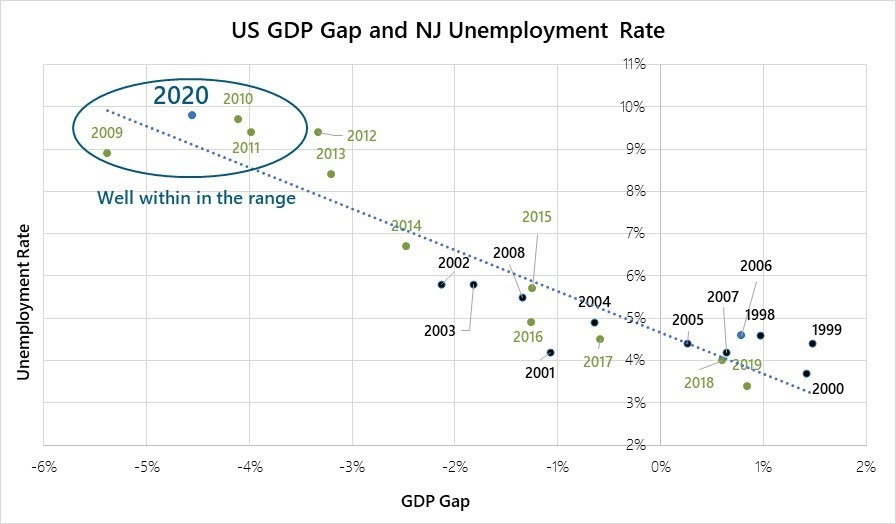
The following chart shows the relationship between the unemployment rate and the US GDP gap for New Jersey. On the chart, the unemployment rate is tracked on the y-axis and the GDP gap is tracked on the x-axis (the bottom axis). The chart shows two main things. For one, every point indicates where the unemployment rate and GDP gap were for that year. For example, in 2011, the NJ unemployment rate was 9.4 percent and the US GDP gap was -4.0 percent. The chart shows another thing – the relationship between the unemployment rate and the GDP gap. A larger (more negative) gap is associated with a higher unemployment rate. The dotted line shows the line that is the best fit for all the points. As can be seen, the data for 2020 was very close to what would be expected given the linear model fit. In sum, there is nothing strange about the 2020 level of the unemployment rate given the level of the GDP gap.
Now you might be thinking, “OK, that’s great mister economist, the unemployment rate is in line with where the GDP gap says it should be, but why are you telling me all of this?” Well, there is a reason, and it has to do with unemployment insurance.
Contrary to the argument that unemployment insurance is keeping people from taking available jobs, this chart suggests unemployment insurance is not the driving factor keeping people out of jobs. When a person is collecting unemployment insurance, that person should be officially classified as unemployed. Thus, if there were an extraordinary amount of people who were choosing to remain unemployed because of the incentive to do so, the unemployment rate would be considerably higher than what you would expect given the GDP gap. And that is not the case – the unemployment rate is right where it should be. Thus, there is no good evidence to suggest that unemployment insurance is incentivizing people to remain unemployed.
Ok, so unemployment insurance isn’t the problem. Then what is? Evidence suggests there are other disincentives aside from unemployment insurance keeping people from taking available jobs right now. Two immediately come to mind:
A lack of child care remains an intractable issue.
We are still in a pandemic.
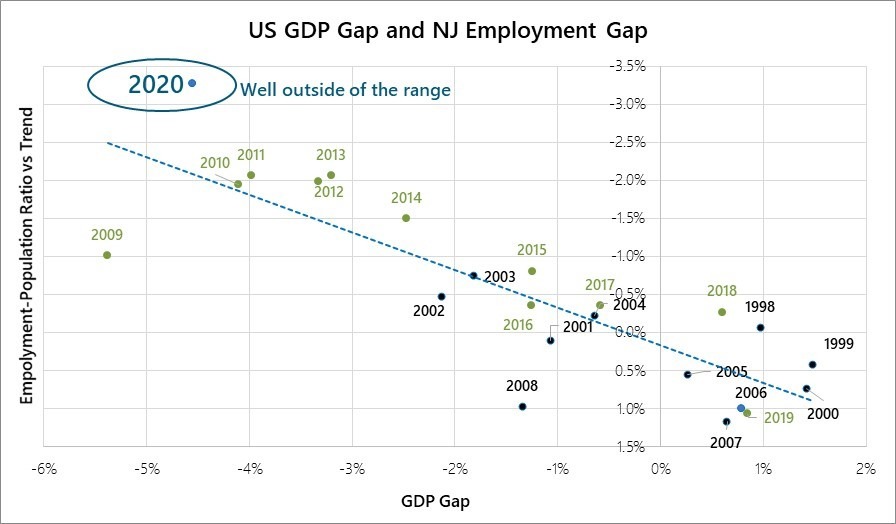
To start examining these issues, it is worthwhile to look at a measure of the labor market gap that is more comprehensive than just unemployment, because one thing the unemployment rate does not capture is people who are not employed and not actively looking for employment. These are people who are out of the labor market, and as it turns out there has been a huge surge of people in 2020 who left the labor market. To capture this dynamic, a better measure of the labor market gap is the difference in employment-to-population ratio versus its trend. Employment-to-population is the share of the adult population that is employed. If a person leaves New Jersey’s labor market but remains a resident of New Jersey, that person is still counted in the denominator – population – so it better reflects all changes in labor market supply and demand. This labor market gap measure is depicted in the chart below relative to the GDP Gap.
As the chart shows, this measure of the labor market gap is beyond what would be expected given the GDP gap. Thus, there is evidence to suggest more people left the labor market in 2020 than would be expected.
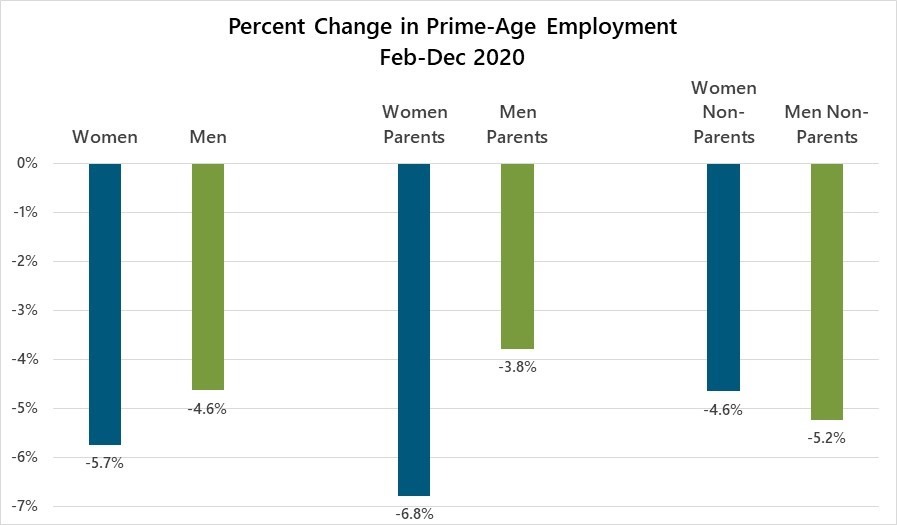
So, why would so many people have chosen to outright leave the labor market? A conceivable driver is that a lack of child care is holding people – especially women – back from reentering the labor market. The following chart was produced for our previous issue of the Economist’s Corner. It shows prime-age women’s employment has dropped considerably more that of men.
Further delving into the data shows that the intersection of gender and parenthood is where the dichotomy occurs. Female parent employment fell 6.8 percent through December, 2020, which is a much larger decline than the 3.8 percent drop recorded for male parent employment. The evidence suggests that this dichotomy results from female parents shouldering a larger share of child care responsibility than male parents. Thus, when child care, including education, essentially shut down, so did female parent labor market participation.
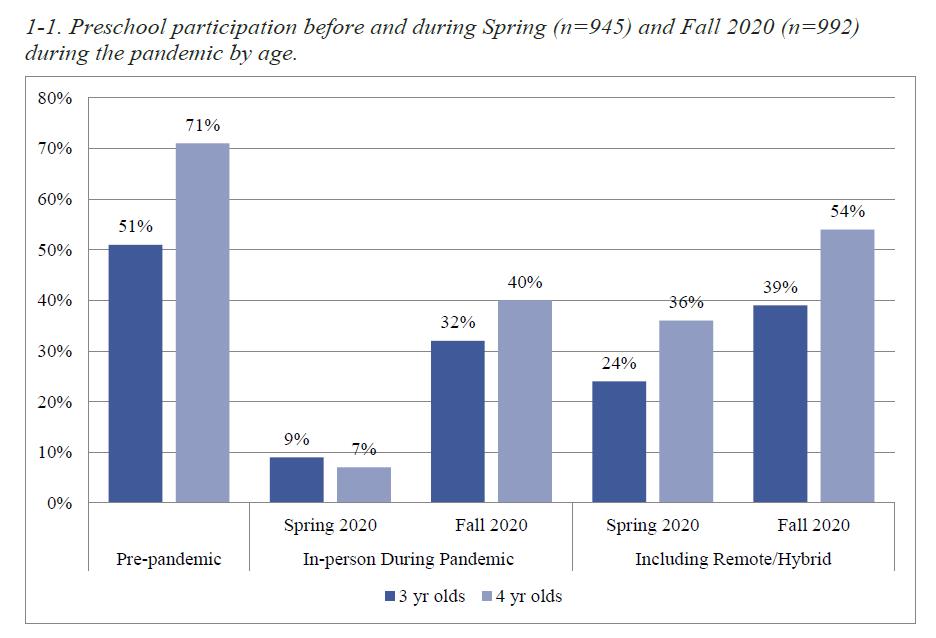
This next chart is a reproduction from a recent National Institute of Early Education Research publication showing preschool participation rates before the pandemic, in spring 2020, and in fall 2020. Whereas 71 percent of four-year-old children were enrolled in preschool pre-pandemic, that share plummeted to 7 percent in spring and recovered somewhat to 40 percent by fall. Drops of similar magnitude were reported for three-year-old children.
Applying absolute numbers to those percentage changes, as of 2018 there were 4.4 million three- and four-year-old children enrolled in preschool. A drop of 30 percentage points in enrollment share of population would mean approximately 1.8 million fewer three- and four-year-old children enrolled. Apply New Jersey’s share of the US population to those numbers, and we have approximately 55,000 fewer New Jersey three- and four-year-old children enrolled in preschool. If each of those children at home yielded a mother out of the labor force, that alone could account for 1/3 of the drop in New Jersey’s participation rate. And that’s not even considering other child care and educational sources for other age children.
The bottom line – child care has likely been a big reason why labor supply is so slow to recover, even as demand for workers is surging.
Source: Barnett, W.S., & Jung, K. (2021). Seven Impacts of the Pandemic on Young Children and their Parents: Initial Findings from NIEER’s December 2020 Preschool Learning Activities Survey. New Brunswick, NJ: National Institute for Early Education Research.
In addition to child care keeping parents, and especially mothers and other female caregivers, out of the labor force, labor force participation is also certainly down due to the simple fact that we remain in the midst of a deadly pandemic. At this point, approximately 51 percent of New Jersey’s population has received one or two vaccine doses, but that is not near the threshold necessary for herd immunity and many people are understandably hesitant to return to work in this context, especially in jobs that require in-person interaction.
Taken together, this evidence suggests that, even with no change to unemployment insurance, as more people receive vaccines and schools and daycares reopen to full capacity, it will become easier for businesses to fill open positions. However, there remains the underlying risk that structural damage has occurred in the child care industry with child care centers and home-based businesses closing due to the pandemic, lowering the supply of child care.
It is encouraging that help is on the way via a mix of organic economic growth, continued monetary stimulus, and a new fiscal package aimed at providing support to both working and unemployed mothers. The State has undertaken a number of initiatives to support the child care sector and families in need of child care assistance in this critical moment, including increased investments in child care, waiving parent co-pays in the State’s child care subsidy program, offering grants to child care providers, and providing tuition support for school-aged supervision. For its part, the NJEDA currently has $20 million in grants to provide to small child care businesses (with fewer than 50 full-time equivalent employees). Furthermore, the federal government’s American Rescue Plan will provide New Jersey approximately $267 million in child care assistance to parents and caregivers and approximately $428 million in funds to child care providers. Thus, a substantial amount of resources is being focused on supporting the child care industry. But until these issues are remedied, it is likely businesses will continue finding it hard to recruit the labor they so sorely need.
TRENTON, N.J. (May 14, 2021) – The New Jersey Economic Development Authority (NJEDA) Board recently approved a memorandum of understanding (MOU) with New Jersey City University (NJCU) in Jersey City that will help advance New Jersey’s leadership in the online sports wagering technology and financial technology (fintech) sectors. The MOU with NJCU will support the creation of a Sports Wagering and Financial Technology Workforce Development and Innovation Center.
This MOU is part of a broader NJEDA strategic initiative to support Governor Phil Murphy’s vision for a stronger, fairer New Jersey economy by establishing innovation centers throughout the state that bring together academic, industry, and government stakeholders to grow key industry sectors.
The emergence of legalized and regulated sports wagering in New Jersey represents a unique opportunity to position the state as the epicenter of this growing, rapidly-innovating industry. In the three years since legalizing sports betting, New Jersey has become one of the largest sports wagering markets in the United States, routinely surpassing Nevada in monthly handle, with nearly $1 billion per month wagered toward the end of 2020.
Moreover, New Jersey leads the country in customer adoption of mobile and online sports wagering. And with over 90 percent of wagers in the state placed online or via mobile platforms, New Jersey has positioned itself as the optimal jurisdiction for scaling tech-centric product innovations within this industry.
Under the terms of the MOU approved today, the NJEDA will provide $200,000 in funding and staff resources to support technological and product innovation as well as workforce development in sports wagering and fintech at the Sports Wagering and Financial Technology Workforce Development and Innovation Center at NJCU. This support will bolster the Center’s goals of providing an incubator for the sports wagering and fintech industries and acting as a connector between industry, academia, and relevant State agencies to grow and support innovation in sports wagering technology and fintech.
“We are so excited and honored to partner with NJEDA to establish this new center for sports wagering and financial technology,” said NJCU President Sue Henderson. “NJCU has long been an academic innovator for launching new programs in emerging fields. This is a wonderful opportunity to build upon our expertise in sports management, financial technology, and data analytics to put our students and our state at the forefront of this exciting new field.”
With the NJEDA’s backing, NJCU believes the Center will cement New Jersey’s position as a leader in the sports wagering and fintech industries, positioning the Garden State as not just a top consumer market for these innovative products but also a productive engineof leading industry innovations and workforce development programs.
Supporting the Sports Wagering and Financial Technology Workforce Development and Innovation Center is part of a wider NJEDA strategic effort to grow New Jersey’s innovation, sports wagering, and fintech ecosystems. In addition to the MOU with New Jersey City University, the NJEDA concurrently approved a separate agreement with Stockton University to support the establishment of an esports Innovation Center at the university’s Atlantic City Campus, which is expected to contribute to establishing Atlantic City as a hub for the rapidly growing esports industry.
To learn more about NJEDA resources for businesses call NJEDA Customer Care at 609-858-6767 or visit https://www.njeda.gov and follow @NewJerseyEDA onFacebook, Twitter, and LinkedIn.