TRENTON, N.J. (February 26, 2021) – Throughout her entire career, one word has defined Lieutenant Governor Sheila Oliver – trailblazer. As New Jersey’s first Black Lt. Governor, Oliver is forging a new path and working daily to ensure that those who have been historically underrepresented know they have a voice – and an advocate – at the highest levels of state government.

Lt. Governor Oliver has worked side-by-side with Governor Phil Murphy over the past three years to create a stronger, fairer, and more equitable New Jersey economy. Under their leadership, New Jersey has taken a whole-of-government approach to transforming struggling communities into thriving centers of employment and economic growth. As the Commissioner of the New Jersey Department of Community Affairs (NJDCA), Lt. Governor Oliver plays a key role in these efforts.

The New Jersey Economic Development Authority (NJEDA) works closely with its partners at NJDCA, the New Jersey Redevelopment Authority (NJRA), and the New Jersey Housing & Mortgage Finance Agency (NHHMFA) to roll out initiatives for local communities, developers, businesses and investors to improve the quality of life for New Jersey residents. Through this collaboration, the agencies have created programs designed to bolster investment in Opportunity Zones in 75 municipalities spread across New Jersey’s 21 counties, increase access to capital for small businesses, and foster the revitalization of the state’s distressed neighborhoods.

Throughout COVID-19, NJDCA, NJEDA, NJRA and NJHMFA have been at the forefront of helping small businesses weather the economic effects of the pandemic. COVID-19 has had a disproportionate impact on minority-owned businesses and businesses in historically disadvantaged communities. The State’s response includes a particular focus on supporting the recovery of these businesses.

“The Lt. Governor’s commitment to bolstering opportunities for small businesses, particularly those owned by people of color, has been unwavering and a tremendous asset to the economy,” said NJEDA Chief Executive Officer Tim Sullivan. “COVID-19 has shone a spotlight on the inequities that exist in the Garden State and we could not ask for a better champion as we work to rebuild New Jersey’s economy in an inclusive manner.”

Late last year, Lt. Governor Oliver joined with Sullivan, NJRA President and CEO Leslie Anderson and now-retired NJHMFA Executive Director Charles Richman during a podcast to discuss the State’s comprehensive response to the pandemic. A recording of that podcast can be found here.

Prior to becoming Lt. Governor, Oliver served in the New Jersey Legislature for 14 years and was the Speaker of the New Jersey Assembly from 2010 to 2014. She was the first Black woman in state history to serve as Assembly Speaker. Last year, Lt. Governor Oliver was honored with the Black Excellence Award by the New Jersey Black Legislative Caucus (NJLBC) for her continued work in promoting public policy by encouraging the interaction of the community with legislators and members of the government at all levels.

Lt. Governor Oliver is a proud alumna of the Newark public school system and has lived in East Orange for more than 40 years. She graduated cum laude from Lincoln University and received her Master of Science Degree in Community Organization, Planning and Administration from Columbia University. She has received honorary doctorates of humane letters from the New Jersey Institute of Technology, Lincoln University, Montclair University, and Berkeley and Essex County Colleges.


Q&A with Lt. Governor Oliver


Of all the programs the State has launched while you have been Lt. Governor, which do you see as the most impactful for small business owners, and particularly those in historically underrepresented communities?

It is hard to select just one! New Jersey has produced a wide array of successful programs that are targeted at helping small businesses in underrepresented communities. I have been particularly impressed by the NJEDA’s partnerships with Community Development Financial Institutions (CDFI), which routinely work with micro-enterprises and small businesses that may not qualify for traditional banking. Through its CDFI Loans to Lenders Program, the NJEDA provides financing to CDFIs to administer term loans or lines of credit to qualified micro-enterprises and small businesses. During COVID-19, the NJEDA has partnered with six New Jersey-based CDFIs to support pandemic-impacted micro- and small businesses and nonprofits. Since the start of the pandemic, the six partner CDFIs have provided 301 loans worth a total of more than $7.6 million. Nearly two-thirds of the loans went to women-, minority- and veteran- owned businesses.

I’m also a big fan of New Jersey’s Set Aside Program, which mandates that the State set aside 25 percent of its purchase order dollars for Registered Small Business Enterprises that can help small businesses compete for government contracts. This program also helps create equal contracting opportunities for socially and economically disadvantaged firms that seek to do business with the State, including women-, minority- and veteran-owned businesses.

What advice do you have for the next generation of Black and Brown business owners and entrepreneurs starting out in business today?

To young aspiring Black and Brown business owners embarking on a new entrepreneurial journey, I would say make it your business to first and foremost know your strengths and weaknesses. Then use those strengths to grow your business by capitalizing on your craft.

I would also impart that as a business owner you must be willing to embrace new and emerging technologies to build up your infrastructure and capacity. Many businesses will often miss opportunities because they aren’t willing to learn the technologies that are needed to thrive in the market. We live in a digital era and you must be able to respond to customers quickly. You also need to be in the know and prepared to apply for programs that the State or other entities may offer to help you succeed. Don’t be afraid to apply for help!


On a personal note, who have you looked to for inspiration throughout your career?

I have always followed closely the life and career of the first African American Congresswoman in the United States Congress, Shirley Chisholm. I often quote and live by her adage, “If they don’t give you a seat at the table, bring a folding chair.” She was never afraid to voice her opinion and her tenacity drives many of the decisions I make in my career and life. As a woman of color there are many issues that would never have been addressed in the state legislature or in state government if I hadn’t been in the room.

About the New Jersey Economic Development Authority

The New Jersey Economic Development Authority (NJEDA) serves as the State’s principal agency for driving economic growth. The NJEDA is committed to making New Jersey a national model for inclusive and sustainable economic development by focusing on key strategies to help build strong and dynamic communities, create good jobs for New Jersey residents, and provide pathways to a stronger and fairer economy. Through partnerships with a diverse range of stakeholders, the NJEDA creates and implements initiatives to enhance the economic vitality and quality of life in the State and strengthen New Jersey’s long-term economic competitiveness.

To learn more about NJEDA resources for businesses call NJEDA Customer Care at 609-858-6767 or visit https://www.njeda.gov and follow @NewJerseyEDA on FacebookTwitterInstagram, and LinkedIn.

###

Se prevé que el financiamiento respalde la compra de 1.5 millones de comidas por lo menos 160 restaurantes de NJ

TRENTON, N.J. (26 de febrero de 2021) – La Autoridad para el Desarrollo Económico de NJ (NJEDA, por sus siglas en inglés) anunciaron que prevé destinar $14 millones en subsidios a 27 organizaciones a través de su programa Sustain & Serve NJ. La NJEDA lanzo solicitudes para Sustain & Serve NJ a fines de 2020 para apoyar a los restaurantes que han sido afectados por la pandemia de COVID-19. La NJEDA prevé que los fondos anunciados hoy respalden la compra de más de 1.5 millones de comidas por lo menos 160 restaurantes de NJ en al menos 69 ciudades en 12 condados. 

“Los restaurantes de New Jersey se vieron especialmente afectados por la pandemia de COVID-19, y el enorme interés en Sustain & Serve NJ acentúa el deseo de la comunidad de ayudar a los restaurantes locales y a los vecindarios donde brindan sus servicios”, dijo el gobernador Phil Murphy. “El impacto económico positivo de este programa para la industria de los restaurantes, combinado con su propio impacto positivo en la comunidad, hacen de Sustain & Serve NJ un jonrón”.

A través de Sustain & Serve NJ, la NJEDA prevé proporcionar $14 millones en fondos de subsidio a entidades alrededor del Estado Jardín para ayudar con gastos directamente relacionados con compras de comidas a granel a restaurantes de New Jersey. Cada beneficiario recibirá un subsidio de entre $100,000 y $2 millones para financiar estas compras. Luego, las entidades distribuirán las comidas sin costo.

La NJEDA anunció Sustain & Serve NJ en diciembre como un programa piloto de $2 millones. Sin embargo, debido al creciente interés de organizaciones y restaurantes de todo el estado, la NJEDA anticipa dedicar $12.4 millones adicionales en dinero de la Ley de Ayuda, Alivio y Seguridad Económica por Coronavirus (CARES, por sus siglas en inglés) para financiar todas las solicitudes elegibles.

“Los restaurantes de New Jersey son fundamentales para la economía del estado, y el gobernador Murphy ha hecho de apuntalar esta industria un punto central de nuestro plan de recuperación de la pandemia de COVID-19”, expresó el Director ejecutivo de la NJEDA, Tim Sullivan. “La increíble respuesta a nuestro programa Sustain & Serve NJ muestra la disposición de organizaciones de todo el estado para apoyar a establecimientos locales dentro de sus comunidades”.

La NJEDA está completando revisiones de solicitantes adicionales y puede proporcionar premios adicionales en un futuro próximo.

Encontrará una lista completa de las organizaciones participantes al final de este comunicado de prensa.

La reacción al programa en todo el estado ha sido contundentemente positiva.

SoupKitchen411, una organización sin fines de lucro fundada en 2015 para crear conciencia sobre la epidemia de hambre, lanzó su iniciativa FeedNJ en abril de 2020 para erradicar el hambre y estimular las economías locales al comprar comidas preparadas por restaurantes y donarlas a los comedores comunitarios locales. Hasta la fecha, la iniciativa entregó más de 35,000 comidas a personas en 11 condados alrededor de New Jersey.

“La COVID-19 dio lugar a desafíos sin precedentes para la industria de los restaurantes y, al mismo tiempo, presenta dificultades inigualables para los comedores comunitarios locales que se asocian a SoupKitchen411 mientras trabajan para abastecer la demanda”, expresó Kenneth DeRoberts, director y cofundador de SoupKitchen411. Ningún hombre, ninguna mujer y ningún niño deben irse a la cama con hambre, y estamos trabajando con nuestros socios alrededor de New Jersey para terminar con la inseguridad alimentaria. Agradecemos a la NJEDA por este programa innovador y nos estimula saber que se distribuirán miles de comidas a personas necesitadas como resultado de este subsidio a través de Sustain and Serve”.

Our Community Dinner Table es una organización de ayuda en situaciones de crisis ubicada en Palisades Park, que se fundó al principio de la pandemia de COVID-19 para proporcionar comidas completas a la comunidad a la vez que apoya a los restaurantes locales. La organización se ha concentrado en comprar comidas de restaurantes que dependen se clientes sentados y/o eventos.   

“El desplome económico provocado por la pandemia de COVID-19 afectó a familias y negocios locales en todo el país, y los vecindarios del norte de New Jersey ciertamente no han sido inmunes a esta devastación”, afirmó el fundador de Our Community Dinner Table, Samuel Chong. “El programa Sustain & Serve NJ nos permitirá ampliar simultáneamente nuestro alcance a la vez que seguimos apoyando a los restaurantes de nuestra área que reflejan la diversidad de nuestra comunidad”.

La fundación AtlantiCare Foundation se fundó en 1977 para proporcionar apoyo benéfico significativo con el fin de llevar a cabo la visión de AtlantiCare de promover comunidades saludables dentro del área sudeste de New Jersey. AtlantiCare está ubicada en Atlantic City.

“El concepto de Sustain & Serve NJ y su capacidad para que organizaciones como la nuestra provoquen un efecto positivo en la comunidad al comprar comidas a restaurantes locales es brillante”. Se alinea perfectamente con nuestra misión”, comentó la directora ejecutiva de la fundación AtlantiCare Foundation, Samantha Kiley. “Este programa es una forma maravillosa de que nuestra organización colabore con los establecimientos locales que tan generosamente han apoyado a nuestros equipos de primera línea durante toda la pandemia. También aborda en amplio impacto económico que ha tenido la COVID en nuestra comunidad”.

Organización

Sede

Ubicación de los restaurantes participantes
Municipalidad(es)

Ubicación de los restaurantes participantes
Condado(s)

Toms River

Farmingdale Borough, Lakehurst Borough, Manahawkin, Seaside Heights, Seaside Park, Toms River 

Monmouth, Ocean

Hightstown

Belford, Belleville, Brick Camden, East Brunswick, Elizabeth, Englewood, Englishtown, Hamilton, Hightstown, Hoboken, Lawrenceville, Metuchen, Montclair, Morristown, New Brunswick, Newark, Parsippany-Troy Hills, Perth Amboy, Pine Brook, Princeton, Princeton Junction, Red Bank, Rockaway, Tinton Falls, Toms River

Bergen, Camden, Essex, Hudson, Mercer, Middlesex, Monmouth, Morris, Ocean, Union

Asbury Park

Asbury Park

Monmouth

Egg Harbor

Egg Harbor, Galloway, Ventnor

Atlantic

Pine Beach

Manasquan, Toms River

Monmouth, Ocean

Jersey City

Jersey City

Hudson

Jersey City

Multiple

Essex

Elizabeth

Elizabeth

Union

Cranford

Cranford, West Orange

Essex, Union

Neptune

Asbury Park, Atlantic Highlands, Brick, Holmdel Long Branch, Manasquan, Neptune, New Brunswick, Ocean, Red Bank, Spring Lake, Toms River

Middlesex, Monmouth, Ocean

Chatham

Chatham, Florham Park, Green Village, Madison

Morris

Short Hills

Millburn

Essex

HealthBarn Foundation

Ridgewood

Ridgewood, Village

Bergen

Holy Name Medical Center Foundation

Teaneck

Teaneck
Washington Township

Bergen

Livingston

Livingston

Essex

Ewing

Ewing, Lawrenceville

Mercer

Morristown

Morristown, Verona

Essex, Morris

Newark

Newark

Essex

Cape May

West Cape May

Cape May

South Hackensack

Fort Lee, Palisades Park

Bergen

Trenton

Ewing, Trenton

Mercer

Princeton

Princeton

Mercer

Montclair

Caldwell, Monclair

Essex

Trenton

East Windsor, Hamilton

Mercer

The Cliffside Park Hall of Fame Foundation

Cliffside Park

Cliffside Park, Hillsdale, River Vale, South Hackensack

Bergen

Newark

Belleville, Newark, Rutherford

Bergen, Essex

Summit

Summit

Union

Puede encontrar información completa sobre la respuesta de New Jersey al coronavirus en https://cv.business.nj.gov.

Acerca de la Autoridad para el desarrollo económico de New Jersey

La Autoridad para el desarrollo económico de New Jersey (NJEDA) es la agencia principal del Estado para impulsar el desarrollo económico. La NJEDA tiene el compromiso de hacer del Estado de New Jersey un modelo nacional para el desarrollo económico inclusivo y sostenible al centrarse en estrategias claves para ayudar a construir comunidades fuertes y dinámicas, crear buenos trabajos para los residentes de New Jersey y ofrecer oportunidades para una economía más sólida y justa. Mediante asociaciones con diversas partes interesadas, la NJEDA crea e implementa iniciativas para mejorar la vitalidad económica y la calidad de vida en el Estado y para fortalecer la competitividad económica a largo plazo de New Jersey.

Para obtener más información acerca de los recursos de la NJEDA para empresas, llame a la línea de atención al cliente de NJEDA al 609-858-6767 o visite https://www.njeda.gov y siga a @NewJerseyEDA en Facebook, Twitter, Instagram y LinkedIn.

###

TRENTON, N.J. (February 25, 2021) – The New Jersey Commission on Science, Innovation and Technology (CSIT) today announced that it has awarded a total of $450,000 to 16 early-stage companies through the state’s Small Business Innovation Research (SBIR) and Small Business Technology Transfer Program (STTR) Direct Financial Assistance Program. Each of the awardees is currently engaged in the federal SBIR and/or STTR programs. The awards will enhance the state’s innovation economy by strengthening the competitiveness of Garden State businesses participating in the federal programs. To date, CSIT has awarded a total of $825,000 to 29 New Jersey companies during the program’s two funding rounds.

The federal SBIR and STTR grant programs provide more than $3 billion each year to small businesses in a variety of technology and life sciences areas that propose innovative ideas that meet specific federal research and development (R&D) needs. The SBIR program enables small businesses to explore their technological potential and provides the incentive to profit from its commercialization. The STTR program funds cooperative R&D partnerships between small businesses and research institutions such as universities, federal R&D centers, or non-profits. The programs are open to U.S.-based, for-profit small businesses with fewer than 500 employees.

“New Jersey’s emerging businesses are generating an abundance of innovation and supporting them as they tap into the federal SBIR/STTR programs will have lasting economic effects at both local and global levels,” said CSIT Chairman Gunjan Doshi.

CSIT Executive Director Judith Sheft noted that nearly a third of the 16 awardees for this round of funding are NJ state certified as women- owned businesses. Awardees hail from 10 different counties within the Garden State and more than two-thirds of companies have an affiliation with New Jersey universities.

“The combination of our state’s highly-talented workforce and our world-class research universities make New Jersey the ideal spot for innovative companies to succeed,” said Sheft. “We are very encouraged to see such a high percentage of applicants benefiting from partnership opportunities with these universities as they work toward commercialization.”

Fourteen companies that have received federal SBIR/STTR Phase I, Fast-Track or Direct to Phase II awards/contracts were each awarded a grant of $25,000. The selected companies include:

  1. Atux Iskay Group LLC – Plainsboro
  2. BRISEA Group Inc. Parsippany (NJ State Certified Woman/Minority-owned)
  3. DMK Pharmaceuticals Inc. – Gladstone
  4. Drone Go Home, LLC  – Oceanport (NJ State Certified Woman-owned)
  5. Innovations Unlimited, LLC – Pennsauken (NJ State Certified Woman-owned)
  6. Mgenuity Corporation – Lincroft
  7. MRIMATH, LLC – Voorhees
  8. Neutroelectric, LLC – Williamstown (NJ State Certified Woman-owned)
  9. RenewCO2, LLC – Cranford
  10. Rizlab Health, Inc. – Princeton Junction
  11. SAPHTx Inc. – Newark
  12. ShockTech – Mahwah
  13. SunRay Scientific, LLC – Eatontown (NJ State Certified Woman/Minority-owned)
  14. Telluric Labs, LLC – Red Bank

Additionally, the following two New Jersey small businesses will each receive $50,000 bridge funding grants. They have successfully completed Phase I and have applied for Phase II of the federal SBIR/STTR program.

  1. Andluca Technologies Inc. – Princeton
  2. BioInvenu – East Hanover

These funds can be utilized to maintain project activities and cover general operating costs.

The awardee’s focus areas fell into the following categories, all of which were identified in Governor Phil Murphy’s economic development strategic plan as high-wage, high growth sectors: technology, life sciences, clean energy, and advanced manufacturing.

“Participants in this program run the gamut from drug-discovery companies to a business creating a drone detection system to one that develops an augmented/mixed-reality medical and surgical assist system for astronauts of exploration-class space missions,” said Assemblyman Christopher DePhillips. “The work they are doing is both critical and far reaching. We are proud to support them in their endeavors.”

State Senator Paul Sarlo sees the awards announced today as critical to recapturing New Jersey’s role as a leader in innovation.

“The strength of our innovation ecosystem is directly correlated to the economic vibrancy of our state,” Senator Sarlo said. “Resources like the NJ SBIR/STTR Direct Financial Assistance Program are useful tools as we seek to attract businesses to locate to, and grow within, the Garden State.”

In June, CSIT awarded $375,000 in matching grants to 13 New Jersey small businesses that were engaged in the federal SBIR/STTR program.


About CSIT

In August 2018, Governor Murphy signed legislation re-establishing the former New Jersey Commission on Science and Technology as the CSIT. Comprised of representatives from the public and private sectors, as well as academia, the Commission is tasked with leading the way in promoting the state as a home for academic and technological research, development, and commercialization.

###


Funding Expected to Result in the Purchase of Approximately 1.5M Meals From At Least 160 NJ Restaurants

TRENTON, N.J. (February 25, 2021) – The New Jersey Economic Development Authority (NJEDA) today announced that it anticipates awarding $14 million in grants to 27 organizations through its Sustain & Serve NJ program. The NJEDA launched applications for Sustain & Serve NJ in late 2020 to support restaurants that have been negatively impacted by the COVID-19 pandemic. The NJEDA expects that the funding announced today will result in the purchase of 1.5 million meals from at least 160 New Jersey restaurants in at least 69 cities in 12 counties.  

“New Jersey’s restaurants were hit particularly hard by the COVID-19 pandemic, and the outpouring of interest in Sustain & Serve NJ underscores the community’s desire to help local restaurants and the neighborhoods they serve,” Governor Phil Murphy said. “The positive economic impact of this program for the restaurant industry, combined with the good it will do in the community, makes Sustain & Serve NJ a home run.”

Through Sustain & Serve NJ, the NJEDA anticipates providing $14 million in grant funding to entities throughout the Garden State to support expenses directly tied to bulk purchasing of meals from New Jersey-based restaurants. Each awardee will receive a grant of between $100,000 and $2 million to fund these purchases. The entities will then distribute the meals at no cost.

The NJEDA announced Sustain & Serve NJ in December as a $2 million pilot program. However, due to the enormous interest from organizations and restaurants throughout the state, NJEDA anticipates dedicating an additional $12.4 million in Coronavirus Aid, Relief and Economic Security (CARES) Act monies to fund all eligible applications.

“New Jersey’s restaurants are paramount to our state’s economy and Governor Murphy has made bolstering this industry a focal point of our recovery from the COVID-19 pandemic,” said NJEDA Chief Executive Officer Tim Sullivan. “The tremendous response to our Sustain & Serve NJ program showcases the eagerness from organizations statewide to support local establishments within their communities.”

The NJEDA is completing reviews of additional applicants and may provide additional awards in the near future.

A full list of participating organizations can be found at the end of this news release.

Reaction to the program from around the state has been overwhelmingly positive.

SoupKitchen411, a non-profit founded in 2015 to raise awareness about the epidemic of hunger, launched its FeedNJ initiative in April 2020 to eradicate hunger and stimulate local economies by purchasing restaurant-prepared meals to be donated to local soup kitchens. To date, the initiative has served more than 35,000 meals to people in 11 counties throughout New Jersey.

“COVID-19 brought about unprecedented challenges to the restaurant industry and at the same time put unmatched strains on local soup kitchens that partner with SoupKitchen411 as they work to keep up with demand,” said Ken DeRoberts, SoupKitchen411 Chairman and Co-Founder. “No man, woman or child should go to bed hungry and we are working with our partners around New Jersey to abolish food insecurity. We are grateful to the NJEDA for this innovative program and are heartened that hundreds of thousands of New Jersey-restaurant-prepared meals will be distributed to people in need as a result of this Sustain and Serve grant.”

Our Community Dinner Table is a food crisis relief organization based in Palisades Park that was established in the wake of COVID-19 to provide well-rounded meals to the community while also supporting local restaurants. The organization has focused on purchasing meals from restaurants that rely on sit-down customers and/or catering events. 

“The economic downfall caused by the COVID-19 pandemic has impacted families and local businesses all across the country, and neighborhoods in northern New Jersey are certainly not immune from this devastation,” said Our Community Dinner Table Founder Samuel Chong. “The Sustain & Serve NJ program will allow us to simultaneously broaden our reach while continuing to support restaurants in our area that are reflective of the diversity of our community.”

The AtlantiCare Foundation was founded in 1977 to generate significant charitable support to ensure AtlantiCare’s vision of building healthy communities within southeastern New Jersey. AtlantiCare is based in Atlantic City.

“The concept of Sustain and Serve NJ and its ability for organizations like ours to impact our local community while purchasing meals from local restaurants is brilliant. It aligns perfectly with our mission,” said AtlantiCare Foundation Executive Director Samantha Kiley. “This program is a wonderful way for our organization to give back to local establishments that so generously supported our frontline teams throughout the pandemic. It also addresses the broad economic impact COVID has had on our community.”

Organization

Headquarters

Participating Restaurant'(s) Location(s) Municipality(ies)

Participating Restaurant'(s) Location(s) County(ies)

Toms River

Farmingdale Borough, Lakehurst Borough, Manahawkin, Seaside Heights, Seaside Park, Toms River 

Monmouth, Ocean

Hightstown

Belford, Belleville, Brick Camden, East Brunswick, Elizabeth, Englewood, Englishtown, Hamilton, Hightstown, Hoboken, Lawrenceville, Metuchen, Montclair, Morristown, New Brunswick, Newark, Parsippany-Troy Hills, Perth Amboy, Pine Brook, Princeton, Princeton Junction, Red Bank, Rockaway, Tinton Falls, Toms River

Bergen, Camden, Essex, Hudson, Mercer, Middlesex, Monmouth, Morris, Ocean, Union

Asbury Park

Asbury Park

Monmouth

Egg Harbor

Egg Harbor, Galloway, Ventnor

Atlantic

Pine Beach

Manasquan, Toms River

Monmouth, Ocean

Jersey City

Jersey City

Hudson

Jersey City

Multiple

Essex

Elizabeth

Elizabeth

Union

Cranford

Cranford, West Orange

Essex, Union

Neptune

Asbury Park, Atlantic Highlands, Brick, Holmdel Long Branch, Manasquan, Neptune, New Brunswick, Ocean, Red Bank, Spring Lake, Toms River

Middlesex, Monmouth, Ocean

Chatham

Chatham, Florham Park, Green Village, Madison

Morris

Short Hills

Millburn

Essex

HealthBarn Foundation

Ridgewood

Ridgewood, Village

Bergen

Holy Name Medical Center Foundation

Teaneck

Teaneck
Washington Township

Bergen

Livingston

Livingston

Essex

Ewing

Ewing, Lawrenceville

Mercer

Morristown

Morristown, Verona

Essex, Morris

Newark

Newark

Essex

Cape May

West Cape May

Cape May

South Hackensack

Fort Lee, Palisades Park

Bergen

Trenton

Ewing, Trenton

Mercer

Princeton

Princeton

Mercer

Montclair

Caldwell, Monclair

Essex

Trenton

East Windsor, Hamilton

Mercer

The Cliffside Park Hall of Fame Foundation

Cliffside Park

Cliffside Park, Hillsdale, River Vale, South Hackensack

Bergen

Newark

Belleville, Newark, Rutherford

Bergen, Essex

Summit

Summit

Union

Comprehensive information about New Jersey’s coronavirus response is available at https://cv.business.nj.gov.

About the New Jersey Economic Development Authority

The New Jersey Economic Development Authority (NJEDA) serves as the State’s principal agency for driving economic growth. The NJEDA is committed to making New Jersey a national model for inclusive and sustainable economic development by focusing on key strategies to help build strong and dynamic communities, create good jobs for New Jersey residents, and provide pathways to a stronger and fairer economy. Through partnerships with a diverse range of stakeholders, the NJEDA creates and implements initiatives to enhance the economic vitality and quality of life in the State and strengthen New Jersey’s long-term economic competitiveness.

To learn more about NJEDA resources for businesses, call NJEDA Customer Care at 609-858-6767 or visit https://www.njeda.gov and follow @NewJerseyEDA on Facebook, Twitter, Instagram and LinkedIn.

###


Selected Applicant will Receive $225,000 to Help Emerging Companies Apply to SBIR/STTR Program

TRENTON, N.J. (February 24, 2021) – The New Jersey Commission on Science, Innovation and Technology (CSIT) today announced that it will begin accepting applications next month for a competitive matching grant that will provide $225,000 to a New Jersey technical assistance provider vying for participation in the Federal and State Technology (FAST) Partnership Program. CSIT plans to award the grant to one organization seeking to execute state/regional programs that bolster the number of proposals submitted to the federal Small Business Innovation Research (SBIR) and Small Business Technology Transfer Program (STTR) Support programs. The application for the grant opens March 22 and will be available at https://www.njeda.gov/csit.  

The FAST Partnership Program provides federal financial assistance to local organizations for outreach, technical assistance, and financial assistance initiatives that are designed to increase the number of SBIR/STTR applications. The FAST Program requires a state-level match to receive any federal funding. Technical assistance to be offered by the selected organization will include informational and technical seminars on SBIR/STTR, one-on-one support for proposal preparation, specialized reviews, webinars, online assistance, critiques and suggestions on how to create competitive applications and submission guidance.

The highly-competitive, three-phase federal SBIR and STTR grant programs provide qualified small businesses opportunities to propose innovative ideas that meet specific research and development (R&D) needs of the federal government. The SBIR enables small businesses to explore their technological potential and provides the incentive to profit from its commercialization. The STTR program funds cooperative R&D partnerships between a small business and a research institution such as a university, federal R&D center, or a non-profit research institution. Eligibility requirements for both SBIR and STTR include that a company must be a U.S.-based, for-profit small business with fewer than 500 employees.

“Our top priority at CSIT is ensuring that young, innovative companies have the resources they need to succeed in the global economy,” said CSIT Chairman Gunjan Doshi. “Identifying and funding a technical assistance provider that can help businesses build a more comprehensive and robust SBIR/STTR application is imperative to increasing the success rate of emerging New Jersey businesses engaged with these federal programs.”

In addition to the $225,000 matching grant, CSIT will also work with Governor Phil Murphy’s office to provide the required corresponding supporting letter necessary for the organization to apply to the Federal FAST grant. This will allow the New Jersey applicant to submit a competitive application while also leveraging 1-to-1 matching CSIT funds if they are selected for the FAST Partnership Program. The funds will be made available to the NJ organization regardless of whether they receive the federal FAST Partnership Program award.

“This competitive grant is intended to harness the expertise of a seasoned technical assistance provider to propel New Jersey companies toward success within the SBIR/STTR programs while simultaneously supporting the provider’s own FAST Partnership Program application,” said CSIT Executive Director Judith Sheft. “We have a strong base of innovation in New Jersey, yet the Garden State ranks fifth regionally in total awards received through the SBIR/STTR programs, behind Massachusetts, New York, Maryland and Pennsylvania. We see the program announced today as an excellent opportunity to leverage one of our state’s greatest resources – its people – to move up in the ranking and showcase the breadth of innovation stemming from the Garden State.”  

CSIT will host an informational webinar on the FAST Grant Program on March 2. Registration information can be found on the CSIT webpage. A recorded version of the webinar and copy of materials presented will be made available on the CSIT webpage following the event. Please note that applications can be submitted March 22, 2021 through April 5, 2021.  

To be eligible for the FAST Grant Program, applicants must be New Jersey-based organizations and must have at least three years of experience administering technical assistance programs including outreach activities and financial support activities. Full eligibility requirements and application details can be found at https://www.njeda.gov/csit.

This FAST Grant Program technical assistance grant is part of the NJ SBIR/STTR Program, which was originally announced in 2019. The NJ SBIR/STTR Support Program has two components, technical assistance and direct financial assistance. CSIT anticipates announcing the awardees of the latest round of direct financial support in the coming days.

About CSIT

In August 2018, Governor Murphy signed legislation re-establishing the former New Jersey Commission on Science and Technology as the CSIT. Comprised of representatives from the public and private sectors, as well as academia, the Commission is tasked with leading the way in promoting the state as a home for academic and technological research, development, and commercialization.

###

Indicator 1 – NJ Housing Market – A Surge in Sales Leads Jump in Prices

Source: New Jersey Association of Realtors (NJAR)

To an economist, housing is like any other market: it’s about supply and demand. And while demand for New Jersey homes has swelled, supply has done quite the opposite. And, as a result, prices have surged higher.

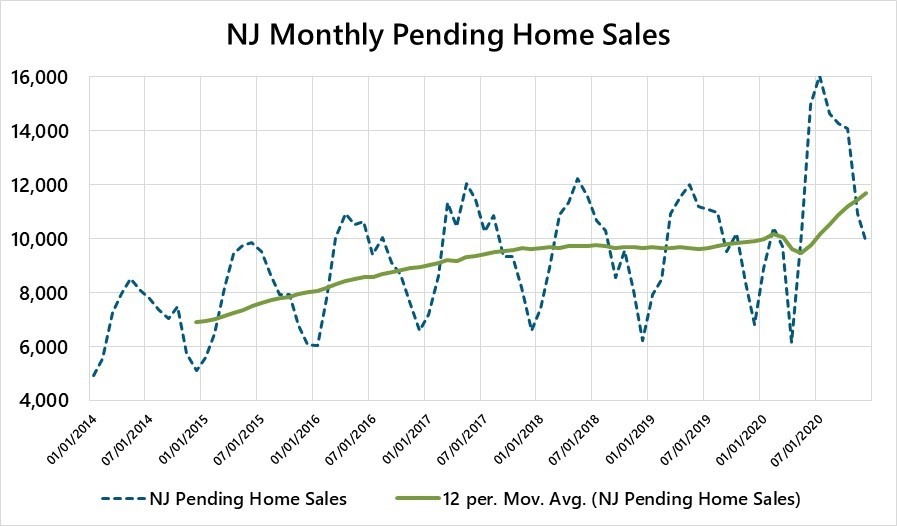
Pending sales is the best leading indicator of housing demand. Pending sales track home sale contract signings, which generally occur one to two months before the sale is officially recorded. Pending home sales surged during the second half of 2020, up approximately 40 percent compared to 2019.

Why has demand surged? The sharp drop in mortgage rates, which increased buying power in the housing market, is a probable factor. But there were also some clear behavioral changes produced by COVID-19, including more households relocating from nearby urban areas into New Jersey.

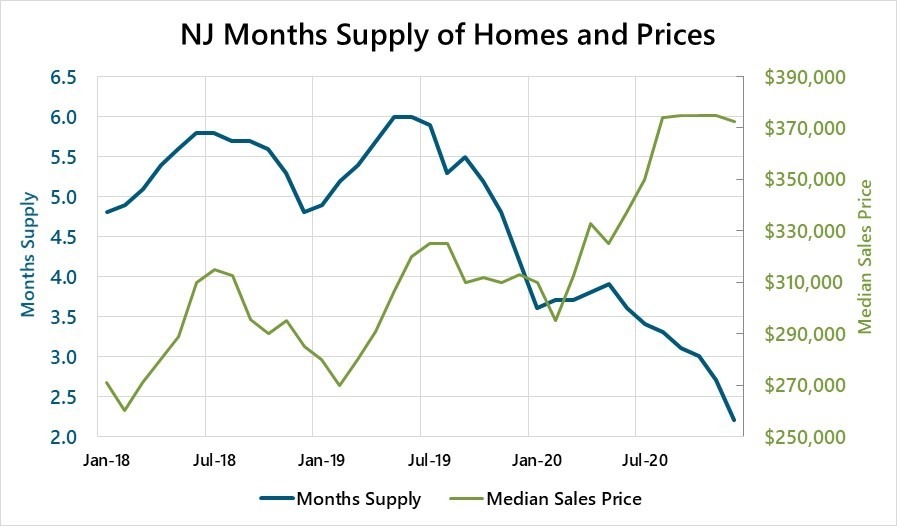
With increasing demand and no commensurate rise in supply, house prices increased a lot. According to the New Jersey Association of Realtors (NJAR), the median sale price in 2020Q4 was around $375,000, up 20 percent from approximately $310,000 in 2019Q4. It is important to note that this data only reflects the prices of homes that were sold, meaning the value of all homes may not have increased that much. However, the data shows median prices rose across all New Jersey counties, suggesting there has been an actual increase in home prices.

It is possible these price increases will encourage more people to sell their homes because prices are signals to the market. We saw an example of this early in the pandemic, when increased demand for masks drove up the price and many clothing companies began producing their own cloth facemasks. In the housing market, a rise in prices clearing the market might induce someone who was not otherwise thinking of selling their house – someone on the “margin” — to put it up for sale.

But what if homeowners now value their homes more highly than they did before? In that case, the rise in prices might not induce many more people to put their homes up for sale because the price hasn’t risen enough. In essence, the margin has shifted. One can make a good argument that this is exactly what is happening now in New Jersey, as the supply of homes for sale remains exceptionally low relative to demand. A good indicator of the balance between supply and demand is depicted in the chart on the right, which shows Months Supply of Inventory (MSI), which indicates of how many months it would take to clear all supply given the current pace of home sales. In December, new listings in 2020 were down 8.6 percent versus 2019, and the MSI of homes was at an all-time low of 2.2. This suggests prices might need to increase even more before we will see more homes put up for sale.

Of course, there is another obvious way to increase the housing supply: building more homes! It is certainly conceivable the rise in prices will induce home builders to produce more homes, and in recent months there has been a jump in the level of housing building permits issued.

In sum, demand for housing remains strong even as home prices have risen significantly. In order for the demand jump to induce a supply response, prices will have to rise more than they already have. At some point, construction of new homes will likely help fill that gap.

Indicator 2 – Estimated Jobs Created in NJ by Greenfield Foreign Direct Investment

Throughout 2020, nearly every aspect of the international markets took a hit, and Foreign Direct Investment (FDI) was no exception. With so much uncertainty surrounding a post-pandemic economy, it was clear the pace of FDI would slip. Still, many foreign companies announced Greenfield[1] Projects in New Jersey throughout 2020.

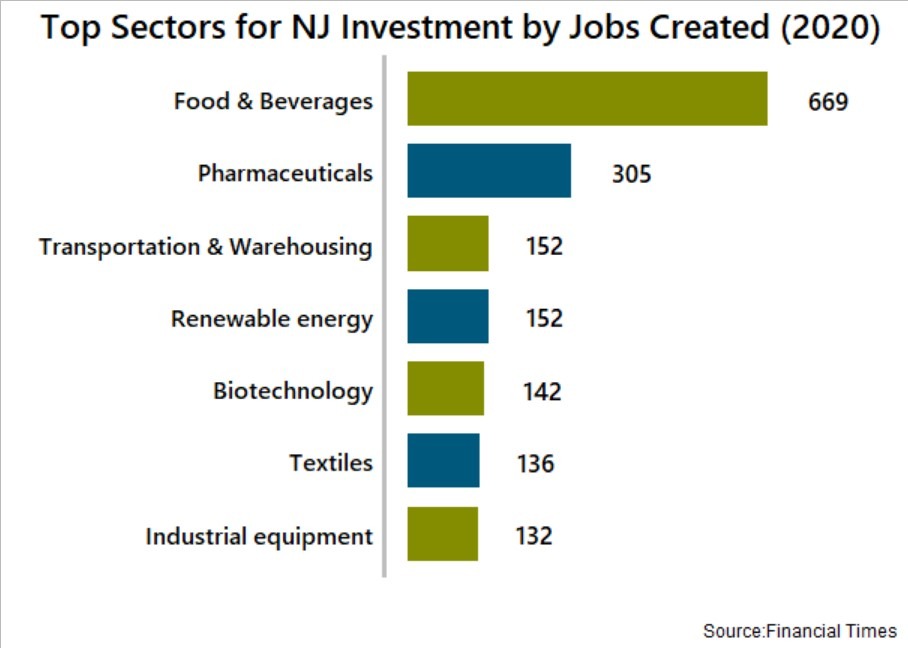
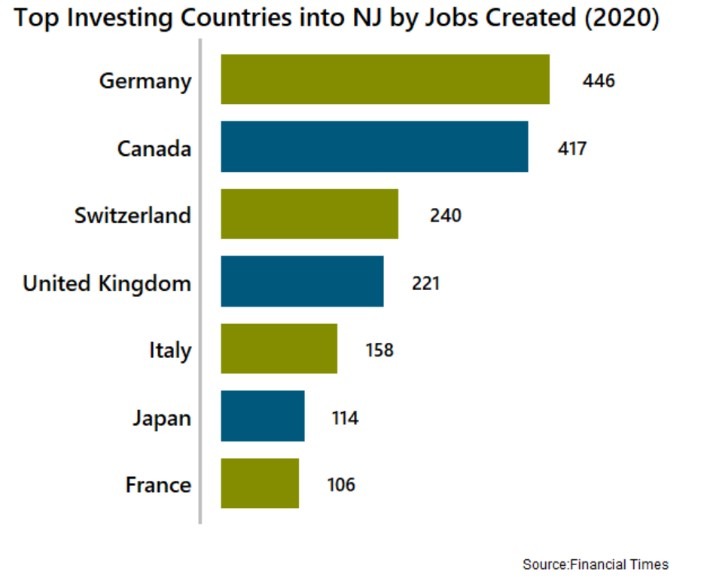
According to fDi Markets, foreign investors in 2020 announced 32 projects in New Jersey, which will result in an estimated $1.5 billion  in capital expenditures and an estimated 2,120 jobs. A total of 15 countries announced New Jersey projects in 2020, with Canada and the United Kingdom tying for most projects created at six, and Germany topping the rankings for most jobs at an estimated 446. Many of Germany’s projects were in the food & beverage sector, which makes up a considerable portion of jobs created. This amount of jobs stemming from retail indicates many international organizations are confident enough in New Jersey’s broad consumer market to keep expanding brick and mortar stores in the face of a pandemic. 

Investments went into a variety of sectors, including pharmaceuticals, renewable energy, and biotechnology. One of the largest investing companies for 2020 announced two solar plants in Woodbine and another in South Brunswick, resulting in an estimated $643 million in capital expenditures. These investment projects show a definitive sign that many international organizations see New Jersey as a go-to hub for commercial and consumer investment, even during times of global economic and public health uncertainty.

Indicator 3 – Gross Domestic Product by County

The Bureau of Economic Analysis releases figures on Gross Domestic Product (GDP) by county every year. Most recently, data was released for 2019. Following is a brief analysis of county GDP in New Jersey from 2006 – 2019  focused on real GDP, which is adjusted for inflation.

The largest industry statewide and in many counties in 2019 was finance, insurance, and real estate (20 percent statewide). Other industries topping the list in individual counties included professional and business services (18 percent), manufacturing (9 percent), and government (10 percent). As can be seen in Table 1, a majority of the largest industries in 2006 remained the largest contributors to county GDP in 2019. In addition, for the counties where the largest industry remained the same from 2006-2019, those industries saw minimal change in their contribution to county GDP. One exception was Hudson County, which saw a 10 percentage point drop in the share of GDP contributed by finance, insurance, and real estate. This drop was filled by a nine percentage point increase in professional and business services – an industry group that thrived in Hudson County.

Table 2 reports the industries that grew the most in New Jersey’s counties between 2006 and 2019 for which the industry accounts for at least two percent of the county’s GDP. Fastest statewide growth rates were recorded by information and professional and business services. Overall, there was a wide array of industries posting strong growth rates, including transportation and warehousing, utilities, educational services, health care, and social assistance. Some of NJ’s counties did see dramatic growth in industries such as Agriculture, Forestry, Fishing, and Hunting and also Mining, Quarrying, and Oil and Gas extraction. However, generally those industries make up a very small contribution to county GDP across the state and therefore are not included in the below table.

Table 1: Largest Major Industry Share of GDP

NJ County

2006 Largest Industry Share

2019 Largest Industry Share

Statewide

Finance, Insurance, Real estate (23%)

Finance, Insurance, Real estate (20%)

Atlantic

Arts, entertainment, recreation, accommodation, and food services (31%)

Finance, Insurance, Real estate (20%)

Bergen

Finance, Insurance, Real estate (21%)

Finance, Insurance, Real estate (17%)

Burlington

Finance, Insurance, Real estate (25%)

Finance, Insurance, Real estate (21%)

Camden

Finance, Insurance, Real estate (23%)

Finance, Insurance, Real estate (21%)

Cape May

Finance, Insurance, Real estate (36%)

Finance, Insurance, Real estate (37%)

Cumberland

Government (20%)

Government (18%)

Essex

Finance, Insurance, Real estate (26%)

Finance, Insurance, Real estate (24%)

Gloucester

Manufacturing (22%)

Manufacturing (21%)

Hudson

Finance, Insurance, Real estate (43%)

Finance, Insurance, Real estate (33%)

Hunterdon

Professional & Business Services (20%)

Finance, Insurance, Real estate (23%)

Mercer

Finance, Insurance, Real estate (20%)

Professional & Business Services (22%)

Middlesex

Finance, Insurance, Real estate (20%)

Professional & Business Services (22%)

Monmouth

Finance, Insurance, Real estate (22%)

Finance, Insurance, Real estate (20%)

Morris

Finance, Insurance, Real estate (21%)

Professional & Business Services (30%)

Ocean

Finance, Insurance, Real estate (27%)

Finance, Insurance, Real estate (25%)

Passaic

Finance, Insurance, Real estate (23%)

Finance, Insurance, Real estate (21%)

Salem

Utilities (49%)

Utilities (54%)

Somerset

Manufacturing (24%)

Professional & Business Services (25%)

Sussex

Finance, Insurance, Real estate (23%)

Finance, Insurance, Real estate (23%)

Union

Manufacturing (21%)

Manufacturing (19%)

Warren

Manufacturing (27%)

Finance, Insurance, Real estate (19%)

Table 2: Industry Growth for industries at least 2% of regional GDP (state & county)

Area

Most Growth

(Percent growth between 2006-2019)

2nd Most Growth

(Percent growth between 2006-2019)

New Jersey

Information (46%)

Professional & Business Services (42%)

Atlantic

Professional & Business Services (31%)

Educational services, health care, and social assistance (25%)

Bergen

Information (38%)

Educational services, health care, and social assistance (29%)

Burlington

Information (168%)

Educational services, health care, and social assistance (48%)

Camden

Arts, entertainment, recreation, accommodation, and food services (31.5%)

Educational services, health care, and social assistance (31%)

Cape May

Manufacturing (96%)

Wholesale Trade (27%)

Cumberland

Agriculture, forestry, fishing and hunting (68%)

Wholesale Trade (40%)

Essex

Utilities (129%)

Transportation & Warehousing (48%)

Gloucester

Utilities (155%)

Transportation & Warehousing (99%)

Hudson

Professional & Business Services (140%)

Information (112%)

Hunterdon

Information (105%)

Educational services, health care, and social assistance (27%)

Mercer

Transportation & Warehousing (107%)

Wholesale Trade (82%)

Middlesex

Utilities (267%)

Transportation & Warehousing (60%)

Monmouth

Information (41%)

Educational services, health care, and social assistance (37%)

Morris

Professional & Business Services (75%)

Educational services, health care, and social assistance (42%)

Ocean

Professional & Business Services (64%)

Educational services, health care, and social assistance (30%)

Passaic

Educational services, health care, and social assistance (22%)

NA

Salem

Transportation & Warehousing (73%)

Educational services, health care, and social assistance (6%)

Somerset

Information (85%)

Professional & Business Services (57%)

Sussex

Manufacturing (107%)

Transportation & Warehousing (5%)

Union

Utilities (48%)

Professional & Business Services (38%)

Warren

Professional & Business Services (126.3%)

Information (16%)


[1] Greenfield FDI is an investment that occurs when a foreign company invests in a brand-new foreign project, versus something like M&A.

New website provides opportunity for input on new incentives package

TRENTON, N.J. (February 17, 2021) – The New Jersey Economic Development Authority (NJEDA) announced today that it has launched a website to provide information on the recently-signed Economic Recovery Act of 2020 and collect input from the public on the implementation of the package of tax incentive, financing, and grant programs that will be created under the Act.

Governor Phil Murphy signed the Economic Recovery Act into law on January 7, 2021 to address the ongoing economic impacts of the COVID-19 pandemic and build a stronger, fairer New Jersey economy. Programs outlined in the law include tax credits to incentivize job creation, new construction, and revitalization of brownfields and historic properties; financial resources for small businesses; support for new supermarkets and healthy food retailers in food desert communities; new funding opportunities for early-stage companies in New Jersey; and support for the growing film and digital media industry.

“The New Jersey Economic Recovery Act of 2020 signed by Governor Murphy is critical legislation that creates valuable new tools for driving long-term, equitable economic growth. As we develop these important new programs, we will to do so with a commitment to transparency, equity, and faithful stewardship of taxpayer dollars at the center of this effort,” said NJEDA Chief Executive Officer Tim Sullivan. “We welcome all New Jerseyans to be part of this process by submitting constructive input on how to ensure new programs created through the Economic Recovery Act are structured and administered in a manner that drives opportunities for all residents and communities.”

The portal will allow any member of the public to provide input on how the Authority will operationalize various aspects of the new programs, such program eligibility requirements, net benefit and cost benefit analyses, and community benefit agreements. The site will also allow members of the public to share their thoughts on how NJEDA can make the programs more transparent. This process precedes and is separate from the NJEDA’s formal procedure to adopt short-term rules, which will be effective immediately as authorized under the Economic Recovery Act, and the procedure for long-term rules which will provide another opportunity for comment on rules and regulations for each new program in accordance with the Administrative Procedures Act.

All comments submitted through this portal are subject to New Jersey’s Open Public Records Act.  Visit www.njeda.gov/economicrecoveryact for more information and to submit comments.

About the New Jersey Economic Development Authority

The New Jersey Economic Development Authority (NJEDA) serves as the State’s principal agency for driving economic growth. The NJEDA is committed to making New Jersey a national model for inclusive and sustainable economic development by focusing on key strategies to help build strong and dynamic communities, create good jobs for New Jersey residents, and provide pathways to a stronger and fairer economy. Through partnerships with a diverse range of stakeholders, the NJEDA creates and implements initiatives to enhance the economic vitality and quality of life in the State and strengthen New Jersey’s long-term economic competitiveness.

To learn more about NJEDA resources for businesses call NJEDA Customer Care at 609-858-6767 or visit https://www.njeda.gov and follow @NewJerseyEDA on FacebookTwitter, Instagram, and LinkedIn.

###
 TRENTON, N.J. (12 de febrero de 2021) – La Autoridad para el desarrollo económico de New Jersey (NJEDA) anunció hoy que tiene planeado volver a ofrecer descuentos de aproximadamente el 70% en el precio de equipos de protección personal (PPE) que se adquieran a través del Programa de acceso a PPE para pequeñas empresas y microempresas de NJ implementado por la Autoridad. La extensión de los descuentos estará disponible para empresas de New Jersey con 100 empleados o menos a partir del martes, 16 de febrero a las 9:00 a. m. Las pequeñas empresas y las organizaciones interesadas en recibir esos descuentos deben presentar una solicitud en https://ppe.covid19.nj.gov. Las empresas que fueron aprobadas antes del 17 de diciembre de 2020 no necesitan volver a presentar una solicitud.

“Garantizar que las empresas tengan acceso a los equipos de protección personal que necesitan para llevar a cabo sus actividades mientras protegen a sus empleados y clientes es fundamental para mitigar el impacto económico continuo de la pandemia de COVID-19 y preparar el terreno para una recuperación sólida”, expresó el Director ejecutivo de la NJEDA, Tim Sullivan. “El exitoso programa de acceso a PPE en 2020 desempeñó un rol importante al ayudar a las empresas de New Jersey a permanecer a salvo durante el invierno, y nos complace seguir proporcionando este recurso para pequeñas empresas en el nuevo año”.

La NJEDA lanzó el Programa de acceso a PPE para pequeñas y microempresas de NJ a fines de 2020 en respuesta a las inquietudes constantes que surgían en la Comisión de reinicio y recuperación del gobernador, los comités de los nueve sectores del Consejo asesor en reinicio y recuperación del gobernador e información proveniente de diversas pequeñas y microempresas que indicaba que necesitaban PPE inmediatamente disponible a un precio asequible.

Durante la Fase 1 del programa, la NJEDA identificó y examinó a “proveedores designados”, incluidos Boxed, Office Depot y Staples, quienes se asociaron con la Autoridad para crear “micrositios” donde las empresas de New Jersey pueden comprar una selección aprobada de PPE con un descuento del 10%. La NJEDA también colaboró con el Departamento de Salud de New Jersey para crear una herramienta de planificación de PPE en línea que ayuda a las empresas a comprender los requisitos de PPE y estimar las necesidades de PPE a nivel de la organización. Puede encontrar enlaces a los micrositios de los proveedores designados y la herramienta de planificación de PPE en https://covid19.nj.gov/ppeaccess.

Además del descuento del 10% disponible para todas las empresas, la NJEDA también habilitó descuentos adicionales del 65% para las empresas y organizaciones sin fines de lucro con 100 empleados o menos que realicen compras en Staples o en Office Depot. Esos descuentos estuvieron disponibles hasta el 17 de diciembre de 2020. Durante ese tiempo, la NJEDA aprobó descuentos para alrededor de 9,000 pequeñas empresas por un total de más de $7.6 millones.

Debido al éxito del programa, la NJEDA destinó otros $2.5 millones para ampliar los descuentos para pequeñas empresas. Estos descuentos estarán disponibles además del 10% de descuento disponible para todas las empresas; lo que significa que las empresas podrán recibir aproximadamente un 70% de descuento en sus compras de PPE. Esta extensión de los descuentos solo estará disponible para empresas con 100 empleados o menos y estará sujeta a los mismos límites establecidos por el programa en 2020: $800 para todas la empresas elegibles o $1,000 para las empresas ubicadas en una de las 715 áreas censales elegibles para ser designadas zonas de oportunidad.

Las pequeñas empresas y organizaciones interesadas en recibir estos descuentos adicionales deben presentar una solicitud en https://ppe.covid19.nj.gov. Una vez que la NJEDA confirma la elegibilidad de una empresa, el propietario de la empresa recibirá cupones para realizar compras a un proveedor designado de su preferencia. Las empresas que hayan presentado solicitudes anteriormente y hayan sido aprobadas para recibir descuentos a través del programa son elegibles y no necesitan volver a presentar una solicitud. Sin embargo, los descuentos que hayan utilizado anteriormente se descontarán del límite del programa (es decir, una empresa fuera de una Zona de oportunidad que usó $200 en descuentos en diciembre de 2020, ahora solo tendrá acceso a descuentos de hasta $600). Los cupones caducarán a las 11:59 p. m. del 24 de marzo de 2021. Las empresas y organizaciones sin fines de lucro todavía podrán recibir descuentos del 10% en compras de PPE después de esta fecha.

Puede encontrar más información sobre el Programa de acceso a PPE y la solicitud de descuentos de hasta el 70% en https://ppe.covid19.nj.gov.

Acerca de la Autoridad para el desarrollo económico de New Jersey

La Autoridad para el desarrollo económico de New Jersey (NJEDA) es la agencia principal del Estado para impulsar el desarrollo económico. La NJEDA tiene el compromiso de hacer del Estado de New Jersey un modelo nacional para el desarrollo económico inclusivo y sostenible al centrarse en estrategias claves para ayudar a construir comunidades fuertes y dinámicas, crear buenos trabajos para los residentes de New Jersey y ofrecer oportunidades para una economía más sólida y justa. Mediante asociaciones con diversas partes interesadas, la NJEDA crea e implementa iniciativas para mejorar la vitalidad económica y la calidad de vida en el Estado y para fortalecer la competitividad económica a largo plazo de New Jersey.

Para obtener más información acerca de los recursos de la NJEDA para empresas, llame a la línea de atención al cliente de NJEDA al 609-858-6767 o visite https://www.njeda.gov y siga a @NewJerseyEDA en FacebookTwitter, Instagram LinkedIn.

###

TRENTON, NJ (February 11, 2021) – The New Jersey Economic Development Authority (NJEDA) announced today that interest in its Angel Investor Tax Credit Program saw record levels in 2020, as investors submitted more than 700 applications, nearly three times the average of previous program years. Applications also hit the legislative cap of $25 million in late October, marking the first time the program cap had ever been reached.

The Angel Investor Tax Credit Program offers investors refundable tax credits against qualified investments for New Jersey businesses. The program supports technology businesses with a physical presence in New Jersey that conduct research, manufacturing, or technology commercialization in the state. Seen as a means to not only invest in emerging companies but also attract capital into the New Jersey, the Angel Investor Tax Credit Program is open to investors throughout the world, not just those located in the Garden State. Investors have six months from the time of investment to apply to the program.

2020 was the first year that investors could benefit from the program’s expansion, which was signed into law by Governor Phil Murphy in the summer of 2019. Under enhancements to the program, which took effect January 1, 2020, investors can receive an increase in the tax credit from 10 percent to 20 percent on a qualified investment. The expansion also added a five-percent bonus for investments in businesses located in a qualified opportunity zone, low-income community, or a business that is certified by the State as minority- or women-owned. 

Today’s announcement comes a month after Governor Murphy signed the New Jersey Economic Recovery Act of 2020, part of which increases the legislative cap on this program from $25 million to $35 million for the 2021 program year and going forward.

“The expanded Angel Investor Tax Credit Program has been heralded throughout New Jersey’s innovation community as an enormous asset to our state,” said NJEDA Chief Executive Officer Tim Sullivan. “The combination of increased funding allocation and program enhancements, including adding a bonus to encourage investment in women- and minority-owned businesses, has a double benefit to the entire ecosystem. These tools help emerging companies attract capital, which will fuel their growth, and encourage new businesses to establish themselves in our state. We thank Governor Murphy and the legislature for bolstering this critical resource.”

The NJEDA approved 142 applications through the Angel Investor Tax Credit Program in 2020, representing an injection of $35.8 million into 21 New Jersey companies and support of 348 jobs in total. The $35.8 million figure is a $2.7 million increase from 2019.

Sullivan noted that NJEDA staff is continuing to review applications and that applications submitted to the NJEDA up to November 1, 2020 (up to the $25 million program cap), will be considered for the 2020 Program Year. Applications that were submitted after that date will be considered for the 2021 Program Year.

In the fourth quarter of 2020 alone, the NJEDA approved 72 Angel Tax Credit Program applications. This represents nearly $18.4 in private investments into 14 unique technology and life science companies, employing more than 265 full-time personnel.

The Angel Investor Tax Credit Program had one first-time participant in the fourth quarter of 2020. Bionex Pharmaceuticals benefited from a $200,000 investment in October and the investor qualified to receive the additional five-percent bonus for investing in a certified woman owned business. Bionex is a tenant at the NJEDA’s Bioscience Center – Step-Out Labs in North Brunswick. The Step-Out Labs is an intermediate space designed for Incubator graduates or other life sciences companies that have outgrown their incubation space.

The Angel Investor Tax Credit Program is administered by the NJEDA, with the assistance of the Department of the Treasury’s Division of Taxation.


About the New Jersey Economic Development Authority

The New Jersey Economic Development Authority (NJEDA) serves as the State’s principal agency for driving economic growth. The NJEDA is committed to making New Jersey a national model for inclusive and sustainable economic development by focusing on key strategies to help build strong and dynamic communities, create good jobs for New Jersey residents, and provide pathways to a stronger and fairer economy. Through partnerships with a diverse range of stakeholders, the NJEDA creates and implements initiatives to enhance the economic vitality and quality of life in the State and strengthen New Jersey’s long-term economic competitiveness.


To learn more about NJEDA resources for businesses call NJEDA Customer Care at 609-858-6767 or visit https://www.njeda.gov and follow @NewJerseyEDA on FacebookTwitter, Instagram, and LinkedIn.

###