NJEDA.com contains a link to translation services provided by Google™ Translate, a free online translation service. Google™ Translate is subject to its own terms of service, which can be viewed at (https://policies.google.com/?hl=en). The link does not constitute affiliation, endorsement, support, or approval of Google™ Translate.
Neither the NJEDA nor the State of New Jersey (collectively, the “State”) reviews the services, information or content provided by Google™ Translate. Information translated by Google™ Translate may not be accurate or current and is used at the user's sole risk. The NJEDA has no obligation to offer translation, and this service could change or be discontinued at any time.
The State expressly and fully disavows and disclaims any responsibility or liability in respect to any cause, claim, or consequential or direct damage or loss, however described, arising from the use of Google™ Translate.
NJEDA.com is provided "AS-IS" with no warranties, express or implied, and its use confers no privileges or rights.
For additional language assistance, please click here to contact NJEDA to request assistance.
TRENTON, N.J. (August 6, 2021) – Applications for the New Jersey Economic Development Authority (NJEDA) New Jersey Community Stage Relief Grant Program will open at 9:00 a.m. EDT on Tuesday, August 17, 2021. Venues, businesses, and sole proprietors that host, organize, promote, produce, or manage live events or performances can receive grants up to $300,000 through the program.
To help potential applicants prepare to apply, the NJEDA is hosting an informational webinar about the program at 12:00 p.m. EDT on Wednesday, August 11, 2021. Register for the webinar at bit.ly/NJEDA_StageGrantWebinar. A recording of the webinar will be available at https://business.nj.gov/covid/community-stage.
Program Overview:
The New Jersey Community Stage Relief Grant Program provides grants of up to 30 percent of an eligible venue, business, or sole proprietor’s decline in operating revenue from 2019 to 2020, up to a maximum grant award of $300,000.
The program is open to for-profit venues, businesses, and sole proprietors that have an eligible NAICS Code or make 50 percent or more of their operating revenue from the organization, hosting, promotion, production, or management of performances. Applicants must also be able to demonstrate a 25 percent or greater operating loss between Q2 2019 and Q2 2020 as well as involvement in at least 26 live performances where performers were paid and tickets were sold or admissions fees were charged over any consecutive 13-week period beginning January 1, 2019.
Nonprofit organizations are not eligible for the New Jersey Community Stage Relief Grant Program. A separate program for nonprofit establishments is being administered by the New Jersey State Council on the Arts.
Please be advised that a telephonic meeting of the New Jersey Economic Development Authority is scheduled for 10:00 AM, Wednesday, August 11, 2021.
The Members will convene to via conference call only. Members of the public may participate in the meeting by calling in on the conference line. Members of the public will have an opportunity to speak during the public comment segment of the meeting.
The following conference number is being provided:
Members of the public are encouraged to call in prior to the time the meeting is scheduled to begin to avoid any delays.
The agenda can be found 48 hours prior to the meeting on our website: https://www.njeda.gov. The meeting will also be recorded and posted to the NJEDA website shortly after the conclusion of the meeting.
TRENTON, N.J. (July 29, 2021) – The New Jersey Economic Development Authority (NJEDA) today announced a $75 million extension of the commercial component of the Economic Redevelopment and Growth (ERG) Program. The Authority also announced that the extended Residential ERG Program, which began accepting applications in June, has been expanded from $50 million to $125 million. More information about the ERG Program is available at https://www.njeda.gov/erg.
Not have commenced any construction at the site of a proposed redevelopment project prior to submitting an application or demonstrate to the NJEDA that the project would not be completed otherwise or is to be undertaken in phases.
Demonstrate that a project financing gap exists.
Demonstrate the tax revenues the State will realize from the project will be greater than the incentive being provided.
Comprehensive information on eligibility for the extended Commercial ERG Program is available at https://www.njeda.gov/erg.
The NJEDA will begin accepting applications for the extended Commercial ERG Program at 12:00 p.m. EDT on Monday, August 16, 2021. All applicants will be required to submit an application via the NJEDA’s online application at https://application.njeda.com/. Applications will be accepted on a first-come, first-served basis until funds are exhausted or Thursday, December 30, 2021. More information about the application process is available at https://www.njeda.gov/erg.
Potential applicants can submit questions about the Commercial ERG Program and application to ERGextension@njeda.comuntil 11:59 p.m. EDT on Sunday, August 8, 2021. Responses to these questions will be posted to a Frequently Asked Questions (FAQ) section on https://www.njeda.gov/erg.
In addition to the expanded ERG Program, the ERA creates and expands a suite of programs that includes tax credits to incentivize job creation, new construction, and revitalization of brownfields and historic properties; financial resources for small businesses; support for new supermarkets and healthy food retailers in food desert communities; new funding opportunities for early-stage companies in New Jersey; and support for the growing film and digital media industry. The NJEDA will continue to engage the public as new programs and rules are developed. For more information, visit https://www.njeda.gov/economicrecoveryact/.
About the New Jersey Economic Development Authority
TRENTON, N.J. (July 23, 2021) – The New Jersey Economic Development Authority (NJEDA) today announced that ten lenders have been selected to receive grants through the Micro Lender Support Grant Program. This $2 million pilot program provides grants to Community Development Financial Institutions (CDFIs), Minority Depository Institutions (MDIs), and other organizations that lend to New Jersey small and micro businesses to support the costs associated with scaling up their operations and offering direct assistance to more New Jersey-based businesses.
“Supporting small businesses is central to Governor Phil Murphy’s vision for a stronger, fairer recovery from COVID-19,” said NJEDA Chief Executive Officer Tim Sullivan. “Throughout the pandemic, lenders that specifically support micro businesses have been crucial to helping the most at-risk small businesses keep the lights on, but the ongoing challenges of the pandemic have strained these organizations. The Micro Lender Support Grant Program awards announced today will provide much needed resources to help CDFIs and other lenders continue supporting micro and small businesses that need help while increasing their capacity to serve even more businesses in need.”
The following organizations have been selected to receive grants through the Micro Lender Support Grant Program:
The ten grant recipients will each receive a $200,000 grant. These funds will be used to support operating expenses associated with servicing micro and small businesses, such as hiring additional staff or opening new offices, and the buying down of interest rates of loans offered to small and micro businesses.
TRENTON, N.J. (July 21, 2021) – The New Jersey Economic Development Authority (NJEDA) today announced the New Jersey Community Stage Relief Grant Program. The $17.5 million program will provide grants of up to $300,000 to eligible for-profit establishments that host at least two regularly occurring live performances or events per week. More information about the program is available at https://business.nj.gov/covid/covid-relief-venues.
“From Count Basie and Springsteen to Sinatra and Queen Latifah, New Jersey has a long and rich history of supporting performing artists and the venues where they connect with their fans. The COVID-19 pandemic hit performing arts businesses particularly hard, and now that we are able to begin safely reopening it is critical that we help them get back on their feet,” said NJEDA Chief Executive Officer Tim Sullivan. “The New Jersey Community Stage Relief Grant Program, along with the New Jersey Council on the Arts program for nonprofit establishments, will provide much-needed funding to help performing arts venues recover from the impact of COVID-19 and get back to hosting the shows that help make New Jersey such a vibrant, exciting place to live.”
The arts and culture industry has seen major disruption as a result of the pandemic. This includes venues that host live performances or events and the businesses that organize, promote, produce, and manage these live events. To address this impact, Governor Phil Murphy allocated $17.5 million of Coronavirus Relief Fund (CRF) and American Rescue Plan (ARP) funding to the NJEDA to support arts and culture organizations. This is in addition to $7.5 million in grant funding for nonprofit arts venues awarded by the New Jersey State Council on the Arts.
The New Jersey Community Stage Relief Grant Program announced today will use the $17.5 million allocated to the NJEDA to provide grants equal to 30 percent of a qualified establishment’s decline in operating revenue from 2019 to 2020, up to a maximum grant award of $300,000.
The New Jersey Community Stage Relief Grant Program is only open to for-profit establishments with arts focused NAICS Codes or businesses that make 50 percent or more of their operating revenue from the organization, hosting, promotion, production, or management of live music or performances.
In order to focus funding on hard hit community-based arts and culture businesses and work towards Governor Murphy and Lieutenant Governor Sheila Y. Oliver’s goals of investment in New Jersey’s diverse communities, establishments that meet one of the baseline eligibility criteria must also be able to demonstrate that they:
Have a venue capacity of 2,500 or less;
Host at least two live performances per week;
Collect admission fees or sell tickets for events;
Pay artists for performing at their events; and
Experienced a 25 percent or greater operating loss between Q2 2019 and Q2 2020.
The NJEDA anticipates opening applications for the New Jersey Community Stage Relief Grant Program in August. Applications will be accepted on a first-come, first-served basis, based on the date and time at which the Authority receives the application.
In line with Governor Murphy’s commitment to a stronger, fairer recovery from the COVID-19 pandemic, 33 percent of total funding available for the New Jersey Community Stage Relief Grant Program will be set aside to support establishments that have a commercial business address in a census tract that was eligible to be selected as a New Jersey Opportunity Zone.
Comprehensive information about the eligibility and document requirements for the New Jersey Community Stage Relief Grant Program is available at https://business.nj.gov/covid/covid-relief-venues.
Learn more about New Jersey’s COVID-19 response and other programs for businesses impacted by COVID-19 at https://business.nj.gov/covid.
About the New Jersey Economic Development Authority
TRENTON, N.J. (July 20, 2021) – Today at 9:00 a.m. EDT, the New Jersey Economic Development Authority (NJEDA) will open pre-registration for Phase 2 of the Small Business Emergency Assistance Loan Program as part of Governor Phil Murphy’s ongoing COVID-19 relief and recovery efforts. This loan program provides financing of up to $100,000 at 0% interest to eligible New Jersey small businesses and nonprofits. All entities must pre-register before 5:00 p.m. EDT on Friday, July 30, 2021 to be eligible to apply for the loan. Pre-registration is not first come, first served.
The NJEDA created the Small Business Emergency Assistance Loan Program in March of 2020 to make financing available to small businesses impacted by the COVID-19 pandemic. To date, the NJEDA has approved 145 loans for a combined total of more than $10 million.
Funded by a United States Economic Development Administration (USEDA) Coronavirus Aid, Relief, and Economic Security (CARES) Act appropriation, Phase 2 of the Small Business Emergency Assistance Loan Program makes additional financing available to New Jersey businesses and nonprofits, with a particular focus on entities that have taken on new space in 2021. Businesses with $10 million or less in annual revenue that have executed a new lease, leased additional space, or acquired an owner-occupied commercial space of at least 500 square feet on or after January 1, 2021, will be prioritized as “Stage 1” applicants and have exclusive, early access to the application. Entities that meet all other eligibility criteria but do not meet the new lease, additional leased space, or acquired owner-occupied commercial space criteria will be eligible to apply as “Stage 2” applicants.
Pre-registration for Phase 2 of the Small Business Emergency Assistance Loan Program will be open from 9:00 a.m. EDT today, Tuesday, July 20, 2021, to 5:00 p.m. EDT on Friday, July 30, 2021. All businesses and nonprofits must pre-register during this window to be eligible to apply for loans. Pre-registration is not first-come, first-served.
Following the pre-registration period, applications will open for “Stage 1” applicants at 9:00 a.m. EDT on Tuesday, August 3, 2021. Applications will remain open for Stage 1 applicants only for 10 days. If the NJEDA does not receive sufficient applications from Stage 1 applicants during this time period to exhaust the available funding, the Authority will open applications to all other qualified “Stage 2” entities at 3:00 p.m. EDT on Friday, August 13, 2021.
The Small Business Emergency Assistance Loan Program is part of New Jersey’s suite of COVID-19 relief programs. Comprehensive information about New Jersey’s coronavirus response is available at https://business.nj.gov/covid.
About the New Jersey Economic Development Authority
Trenton, N.J. (July 14, 2021) – The New Jersey Economic Development Authority (NJEDA) Board today approved proposed amendments to the state’s Angel Investor Tax Credit Program rules that will help fuel investments into early-stage New Jersey technology companies and bolster New Jersey’s innovation economy. The amendments were based on expansions and revisions made to the program by both the Economic Recovery Act of 2020, which was enacted in January 2021, and legislation signed into law by Governor Phil Murphy in 2019. Concurrently, the NJEDA Board also approved publishing the proposed amendments in the New Jersey Register for a 60-day public comment period.
The New Jersey Angel Investor Tax Credit Program, which is open to both in-state and out-of-state investors, was created in 2013 to incentivize investment into emerging New Jersey technology businesses. An investor can receive a refundable tax credit equal to a percentage of their qualified investment made in a New Jersey early-stage company. This company’s primary business must be an eligible technology which are advanced computing, advanced materials, biotechnology, carbon footprint reduction technology, electronic device technology, information technology, life sciences, medical device technology, mobile communications technology, or renewable energy technology. In addition to commercializing one of these eligible technologies, the business receiving the investment must employ fewer than 225 employees, at least 75 percent of whom work in New Jersey. An investment in a New Jersey emerging technology business holding company may also meet the requirements for a qualified investment.
Since the program’s inception, the NJEDA has approved 1,671 applications totaling more than $616 million invested in 102 eligible New Jersey businesses. In the first quarter of 2021 alone, 207 Angel Tax Credit Program applications were approved for a total of $5.2 million in tax credits, representing the injection of nearly $33 million into 17 emerging companies.
“Under Governor Murphy’s leadership, we have prioritized recapturing New Jersey’s role as a leader in innovation in an equitable and inclusive manner,” said NJEDA Chief Executive Officer Tim Sullivan. “The amendments approved today will ensure that we continue to help early-stage companies attract the capital they need to further their research and development or to manufacture or commercialize their technology. This, in turn, will lead to the creation of highly-skilled jobs that are necessary to support new business growth.”
Examples of proposed rule amendments approved today stemming from the Economic Recovery Act include:
Increasing the amount of tax credits available annually under the program from $25 million to $35 million.
Expanding the definition of a qualified investment to include investment commitments made into qualified venture funds. “Venture fund” means a partnership, corporation, trust, or limited liability company that invests cash in a business during the early or expansion stages of a business in exchange for an equity stake in the business in which the investment is made. “Venture fund” may include a venture capital fund, a family office fund, or a corporate investor fund, provided that a professional manager administers the venture fund.
For an investment commitment to a venture fund be eligible as a qualified investment, the venture fund must be a “qualified venture fund” investing a minimum of 50 percent of the venture fund’s committed capital in New Jersey based businesses. In addition, a five percent bonus is available if the fund invests 50 percent of its funds in New Jersey diverse entrepreneurs.
The following additions were also made to the Angel Investor Tax Credit Program rules. These updates are associated to legislative actions from 2019 which have already been implemented into the current Program:
Increasing the amount of tax credits available per qualified investment in an emerging New Jersey technology business from 10 percent to 20 percent.
Adding a five percent bonus credit for qualified investments made in a New Jersey certified minority-or women-owned technology business or a technology business that is located in a qualified Opportunity Zone or New Markets Tax Credit Census Tract.
These amendments approved today will be published in the New Jersey Register on September 7 for a 60-day public comment period.
In addition to the expanded Angel Investor Tax Credit program, the Economic Recovery Act creates and/or enhances a suite of programs that includes tax credits to incentivize job creation, new construction, and revitalization of brownfields and historic properties; financial resources for small businesses; support for new supermarkets and healthy food retailers in food desert communities; new funding opportunities for early-stage companies in New Jersey; and support for the growing film and digital media industry. More information about these programs is available at https://www.njeda.gov/economicrecoveryact.
About the New Jersey Economic Development Authority
The New Jersey Economic Development Authority (NJEDA) serves as the State’s principal agency for driving economic growth. The NJEDA is committed to making New Jersey a national model for inclusive and sustainable economic development by focusing on key strategies to help build strong and dynamic communities, create good jobs for New Jersey residents, and provide pathways to a stronger and fairer economy. Through partnerships with a diverse range of stakeholders, the NJEDA creates and implements initiatives to enhance the economic vitality and quality of life in the State and strengthen New Jersey’s long-term economic competitiveness.
91 Previous Program Participants Have Already Qualified for $33 Million in Surety Bonds
Trenton, N.J. (July 13, 2021) – The New Jersey Economic Development Authority (NJEDA) and the African American Chamber of Commerce of New Jersey (AACCNJ) today announced that 23 participants have fully completed the class work that kicked off earlier this year and are ready to graduate from the Small Business Bonding Readiness Assistance Program. This round of participants completed the program with ten small businesses qualifying for surety bonding, which totals more than $11.5M at this time. This will help these small business owners compete for city, county, and state contracts and expand their portfolios of projects, which in turn helps them grow their business.
“Under Governor Murphy’s leadership, we have prioritized connecting small-, minority-, and women-owned businesses with the resources they need to succeed and the Small Business Bonding Readiness Assistance Program is a tremendous asset in achieving that goal,” said NJEDA Chief Executive Officer Tim Sullivan. “We applaud the perseverance and determination these business owners have shown throughout this Program, as they obtain the tools and knowledge necessary to help them remove the obstacles that once would have kept them from bidding on state and federal contracts.”
The Small Business Bonding Readiness Assistance Program provides a comprehensive series of classes, workshops, and strategic counseling sessions covering a variety of topics relevant to small businesses in all sectors, including bonding and insurance, business development, financial presentation, construction and contract law, construction management, estimating, and credit. At the end of the program, all participating businesses receive a Bonding Readiness Segment Report, which provides an in-depth assessment of their strengths and weaknesses to help them plan for the future. The Fall 2021 class is slated to begin in early September. Anyone interested in participating in this free program should submit an application, which can be found at https://www.aaccnj.com/bonding-program—sbbrap.html. A representative from the African American Chamber will follow-up with you to discuss the review process to be accepted into the program.
“Empowering businesses owned by blacks, women and people of color to vie for state and federal contracts is key to re-opening our post-COVID economy in an equitable and inclusive manner,” said John E. Harmon, Sr., IOM, AACCNJ, Founder, President and CEO. “We congratulate the most recent class of graduating students and we encourage other small business owners interested in furthering their growth to take advantage of these invaluable resources available through the Small Business Bonding Readiness Assistance Program.”
About the New Jersey Economic Development Authority
The New Jersey Economic Development Authority (NJEDA) serves as the State’s principal agency for driving economic growth. The NJEDA is committed to making New Jersey a national model for inclusive and sustainable economic development by focusing on key strategies to help build strong and dynamic communities, create good jobs for New Jersey residents, and provide pathways to a stronger and fairer economy. Through partnerships with a diverse range of stakeholders, the NJEDA creates and implements initiatives to enhance the economic vitality and quality of life in the State and strengthen New Jersey’s long-term economic competitiveness.
About the African American Chamber of Commerce of New Jersey
The AACCNJ performs an essential role in the economic viability of New Jersey. While providing a platform for New Jersey’s African American business leaders, to speak with a collective voice, the AACCNJ advocates and promotes economic diversity fostering a climate of business growth through major initiatives centering on education and public policy. The Chamber serves as a proactive advocacy group with a 501(c) 3 tax exemption, which is shared by the National Black Chamber of Commerce.
If you spend some time reading the popular press on the state of the economy, you’ll likely come away with a simple story: the economy is booming as everything re-opens and pent-up demand from the past year gets filled, but constraining economic growth are shortages of goods and labor, which is causing prices to spike. Thus, the economy is running too hot for supply to keep up, and the Federal Reserve needs to raise interest rates to slow the economy and the rate of inflation.
Oh, if it were all so easy. In this story, it’s all about supply not being able to keep up with demand, so we just need some recalibration. The ongoing strength of demand is given.
The full story is, like usual, much more complex. This economic recovery is far from complete, and if policy makers do not continue to focus on supporting demand, the rebound could falter at a time when labor demand remains uneven. Policymakers in New Jersey understand this, which is why we continue to roll out programs that focus funds and other supports to areas of the economy still in need, such as the Main Street Recovery Finance Program, which is launching later this year.
To see how the economic recovery remains incomplete, it’s important to understand that a principle reason the economy is currently booming is an unprecedented and ephemeral surge in fiscal stimulus to households. Once this fiscal stimulus and its effects start to wane, the economy will slow markedly.
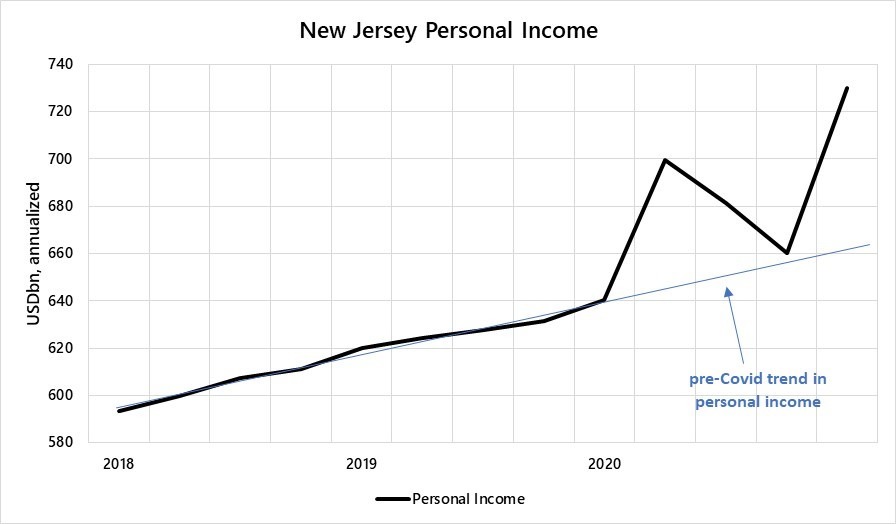
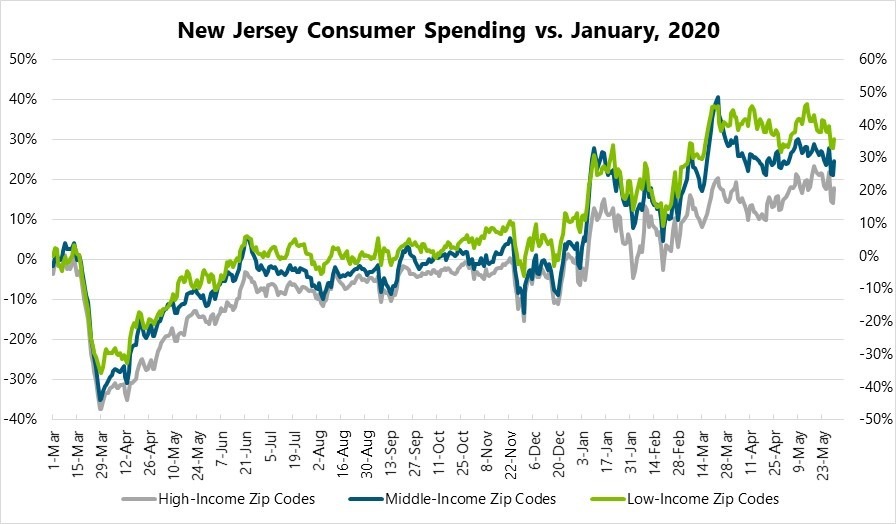
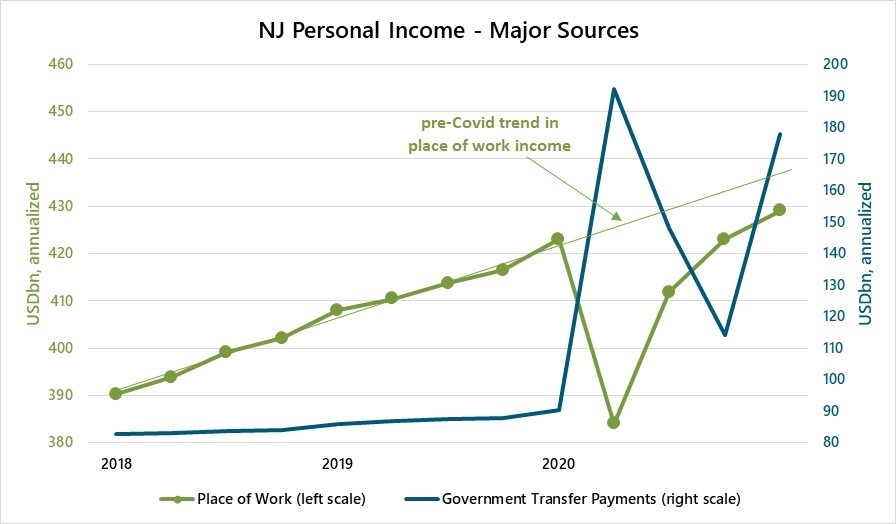
The following three charts demonstrate this outlook. Figure 1 shows the level of personal income in New Jersey. It has spiked in recent quarters, leading to a surge in consumer spending, as depicted in Figure 2. The reason for these spikes, as depicted in Figure 3, is largely about fiscal stimulus — money transferred from the federal government to households. As this chart shows, place of work income, which is income coming from jobs or business ownership, has rebounded smartly from its COVID low, but remains well below its pre-COVID trend. Federal government transfer payments – things like unemployment insurance and direct payments from the federal government to households (stimulus checks) – have spiked. Whereas government transfers to the New Jersey household sector averaged around $87 billion in 2019, they have averaged $158 billion in the four quarters through 2021:Q1. That’s an 11 percent jolt to the average New Jersey pre-tax income. In sum, COVID has been a boon to many households’ incomes.
Fig 1 – New Jersey Personal Income Through Q1 of 2021
Source: Bureau of Economic Analysis
Fig 2 – Consumer Spending in New Jersey, by Zip Code Groups
Source: Affinity, Opportunity Insight
s
Fig 3 – Major Sources of New Jersey Personal Income Through Q1 of 2021
Source: Bureau of Economic Analysis
Given these surges in stimulus-led NJ household income, it’s no wonder consumer spending and GDP have shot up, putting stress on supply. But fiscal surges like these do not make for a complete economic recovery. The reason why is easy to see: unless the surge in stimulus continues unabated or income rises to offset the drop in stimulus flow, demand will likely slow once the stimulus retracts. And one thing we know – the stimulus flow to households is now retracting as unemployment insurance benefits and stimulus payments to households are stopping.
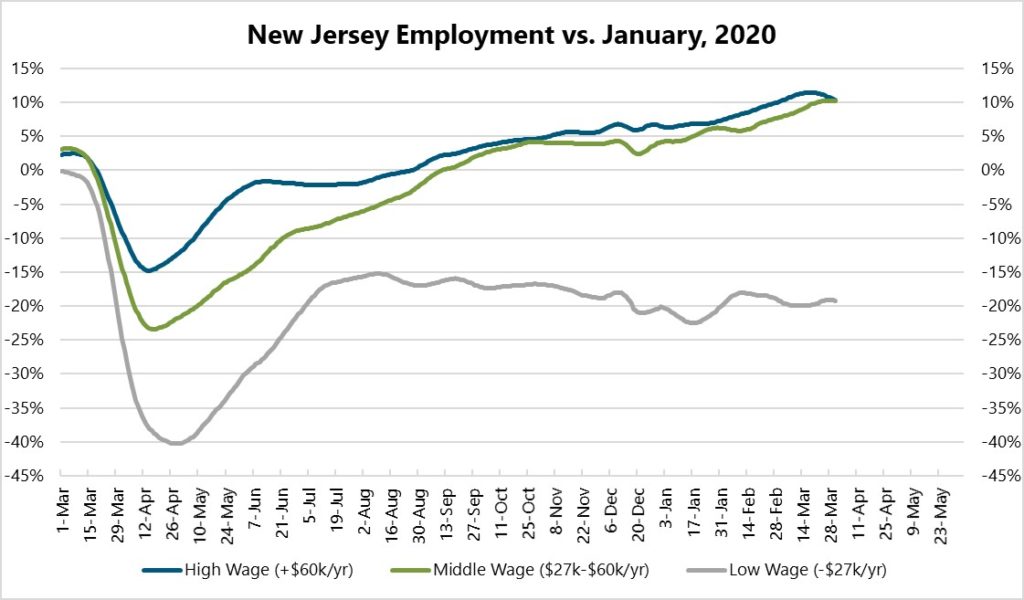
Although household income from place of work is rising, it remains below its pre-COVID trend. There are two reasons for weaker income level we’d like to highlight. One, as depicted in Figure 4, is the level of employment for low-wage jobs remains depressed. The ex-stimulus economy looks very tenuous for these workers.
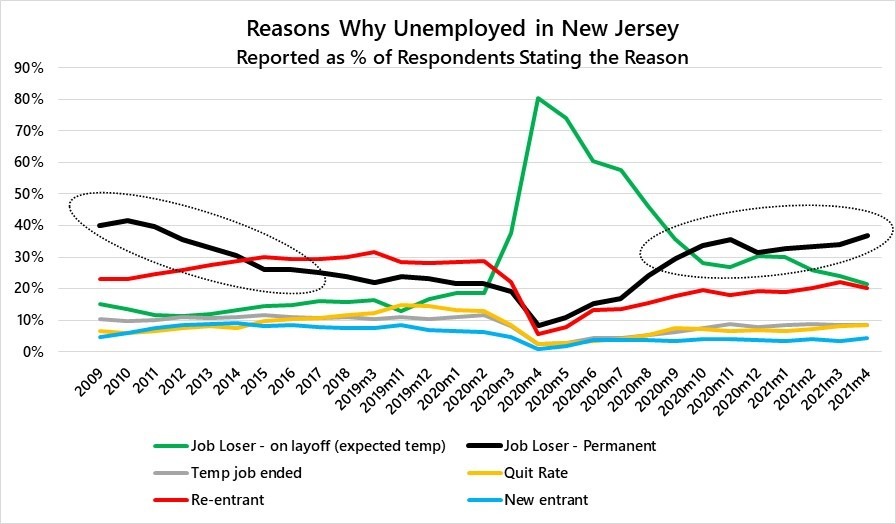
The other is, despite the jump in job openings signaling increased demand for labor, the level of layoffs remains relatively high. This is shown in Figure 5, which depicts microdata for New Jersey households detailing the reasons why people state they are unemployed.
There are a host of reasons a person would be classified as unemployed; it’s not just about being laid off from a job. Anyone who is not currently employed but is looking to be employed is considered unemployed. This includes new entrants into the labor market, such as a recent college grad or a person who had left the labor market and now is re-entering the market, and job quitters – people who chose to leave a job in search of a new one. Even job losses differ by whether they are the results of temporary layoffs or permanent layoffs. An example of a temporary layoff is a manufacturer who closes a factory for a month to re-tool that factory. The workers in that factory would be considered temporarily laid off and would likely reclaim their positions once the factory reopens.
A look at Figure 5 reveals a somewhat concerning trend – at a high and increasing rate, New Jersey residents cite permanent layoffs as the reason for being unemployed. This is unusual for an economic rebound. Normally, when the US economy is growing out of a recession, a rising share of unemployment is for re-entrants to the labor market and a falling share of unemployment is for permanent layoffs, as we can see in the period from 2010 through 2014. Although the re-entrant share is currently rising, it is doing so at a very slow clip. Meanwhile, the share of layoffs is still rising. This suggests net labor demand is not as strong as the standard press story would have us believe.
Fig 5 – Reasons for Being Unemployed
Source: IPUMS-CPS, University of Minnesota, www.ipums.org, NJEDA Calculations
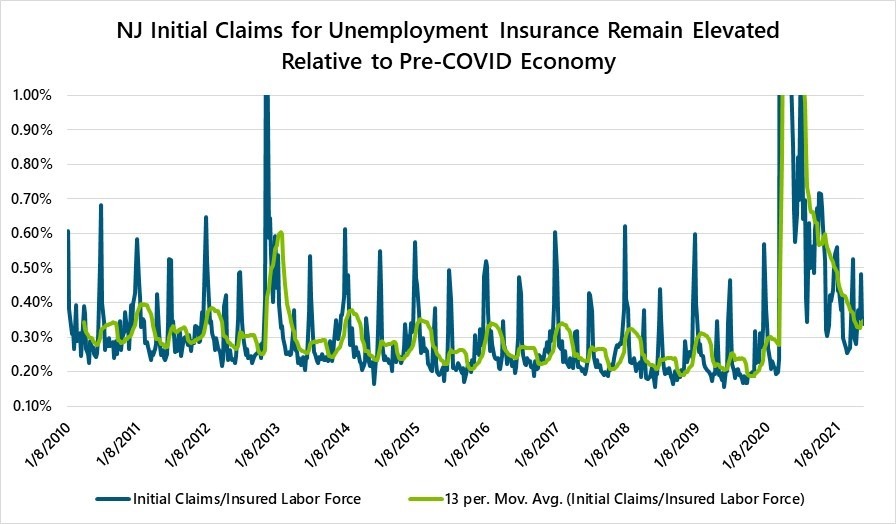
This picture of the labor market is further supported by the current level of initial claims for unemployment insurance. As shown in Figure 6, the level of claims remains around 1.5 times higher than it was pre-pandemic, which signals that, despite the surge in economic activity, the rate of layoffs remains elevated.
Fig 6 – Initial Claims for Unemployment Insurance Remain Elevated
Source: Bureau of Labor Statistics, NJEDA Calculations
In sum, despite the recent surge in economic activity and jump in job openings, the economic outlook for many households remains unclear. This is why New Jersey’s government continues to focus on policies that will provide support to households and small businesses and enable the state’s economy to keep growing as it continues to adjust to the COVID shock.
NJ Commercial Real Estate Update
Industrial CRE
The industrial market in New Jersey proved itself nearly invulnerable to the economic shock from COVID. In Northern New Jersey, Q3 of 2020 saw the highest quarterly net absorption figure in more than a decade,[1] and Southern New Jersey saw the highest leasing activity within the Philadelphia MSA over the past 12 months.[2]
At the beginning of 2020, statewide vacancy was an extremely low 3.7 percent, and during 2020, vacancy increased at most just 0.2 percent. Currently, the statewide vacancy rate rests at 3.6 percent.
Rents increased as well, indicating increased demand relative to limited supply for industrial space. In Q1 2020, overall triple-net average rent was $7.65 per sq. ft. By the end of 2020, it increased to $8.00 per sq. ft, and it currently stands at over $9 per sq. ft.
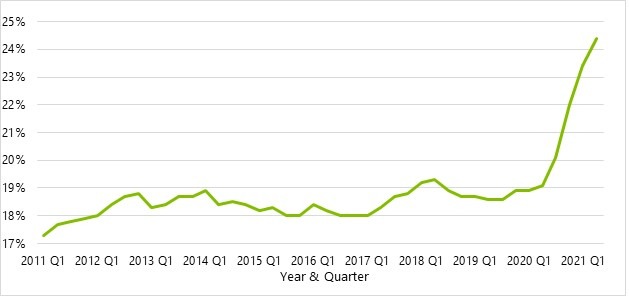
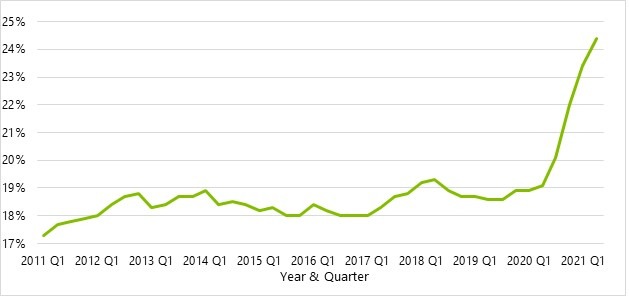
The pandemic has not been kind to office markets across the world, and New Jersey is no exception. As seen in the graph below, vacancy increased to a level not seen since CoStar started tracking the market in New Jersey.
NJ Office Vacancy Rate
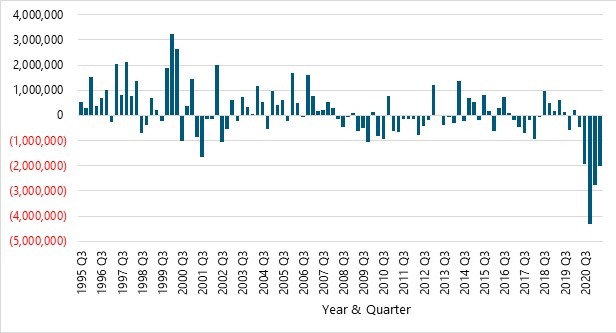
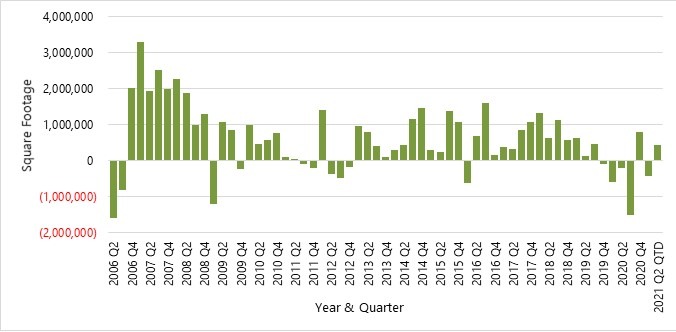
Net absorption[3] also saw a historic decline. Fourth quarter 2020 brought the lowest net absorption on record, and net absorption in every quarter from Q3 2020 to YTD 2021 has been sharply negative.
NJ Office Net Absorption
A rebound in the office sector will depend on a number of factors, such as vaccination rates and school re-openings. But the sector will have to contend with more companies allowing more work-from-home, which may cause a permanent contraction of office space leasing. However, a number of recent surveys indicate many employees are looking forward to being back in the office, which is good news for the sector in New Jersey. Most likely, many office tenants will adopt a hybrid work model that will dictate future square footage requirements for office tenants.
Along with office, New Jersey’s retail market was certainly negatively impacted by the COVID pandemic. Net absorption for retail space statewide in Q3 2020 declined to the second lowest level ever in CoStar’s history. However, net absorption rebounded solidly in the fourth quarter of 2020, and CoStar’s analysts are forecasting net absorption will be positive starting in 2022 after seeing minimal negative absorption through 2021.
In addition, vacancy rates increased but perhaps not as drastically as initially feared. From Q2 2020 to now, statewide vacancy increased from around 4.3 percent to 5.3 percent. This reversed the trend of the previous two years, but the ills befalling retail establishments in New Jersey were not as drastic as those for office. This is likely due to people’s desire to continue visiting brick and mortar establishments, especially in light of increased vaccination rates, falling case rates, and the resultant elimination of state restrictions.
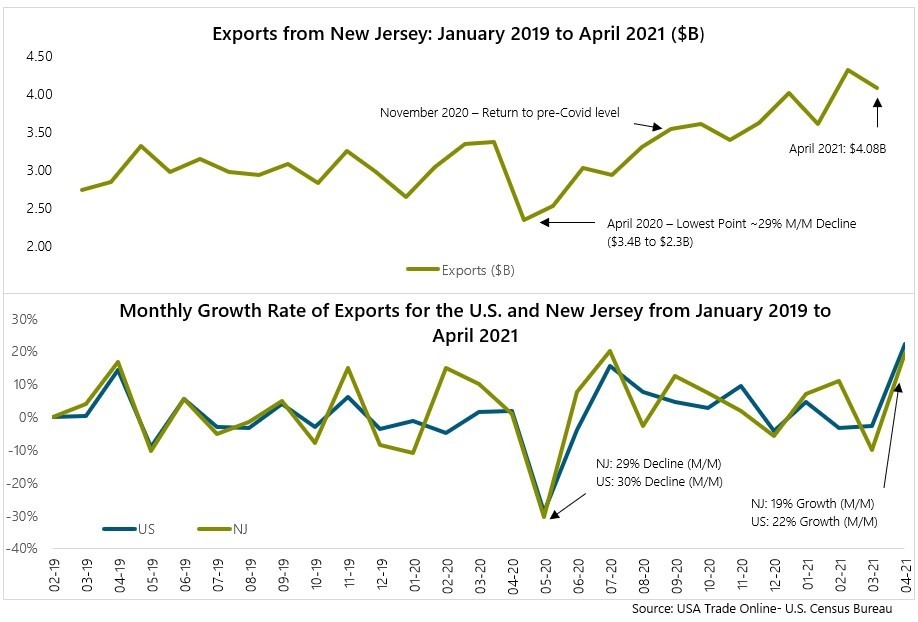
With New Jersey’s economy moving closer to being fully re-opened, now is a good time to examine how international trade flows are faring in the aftermath of the COVID shock. At the beginning of the month, U.S.A Trade Online published trade figures through April, 2021, which marks one year from the lowest point of total exports during the pandemic when exports from New Jersey fell 29%.
It wasn’t until November 2020 that exports returned to its previous value of $3.4 billion. Since that time, exports in New Jersey have been posting consistently strong growth, with an average monthly growth rate of 2.6 percent, which is considerably stronger than the 0.1 percent m/m rate in 2019.
In fact, Not only are we seeing a consistent increase in exports, but New Jersey is also outperforming the United States, which is averaging 1.9 percent m/m since November, 2020. Thus, New Jersey’s ranking has increased post-pandemic, from 14th largest exporting state in 2019 to 8th largest exporting state so far in 2021.
While there are still many uncertainties in the long run, the newest figures for trade prove to be optimistic for New Jersey’s future in the international landscape.
[1] CoStar_Northern New Jersey – NJ Industrial market report 2021