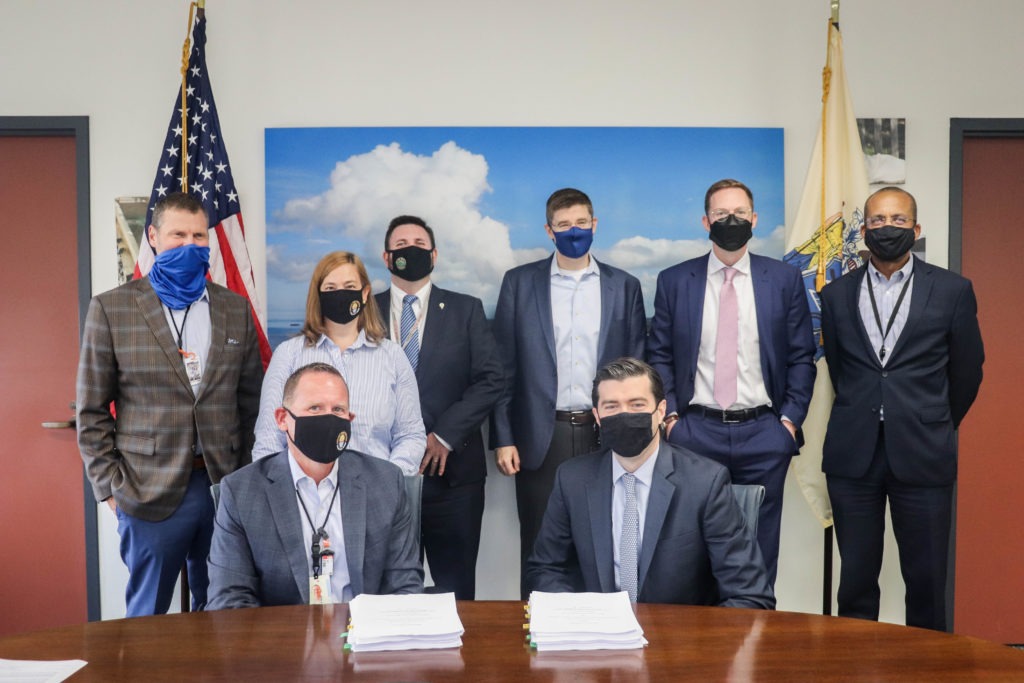
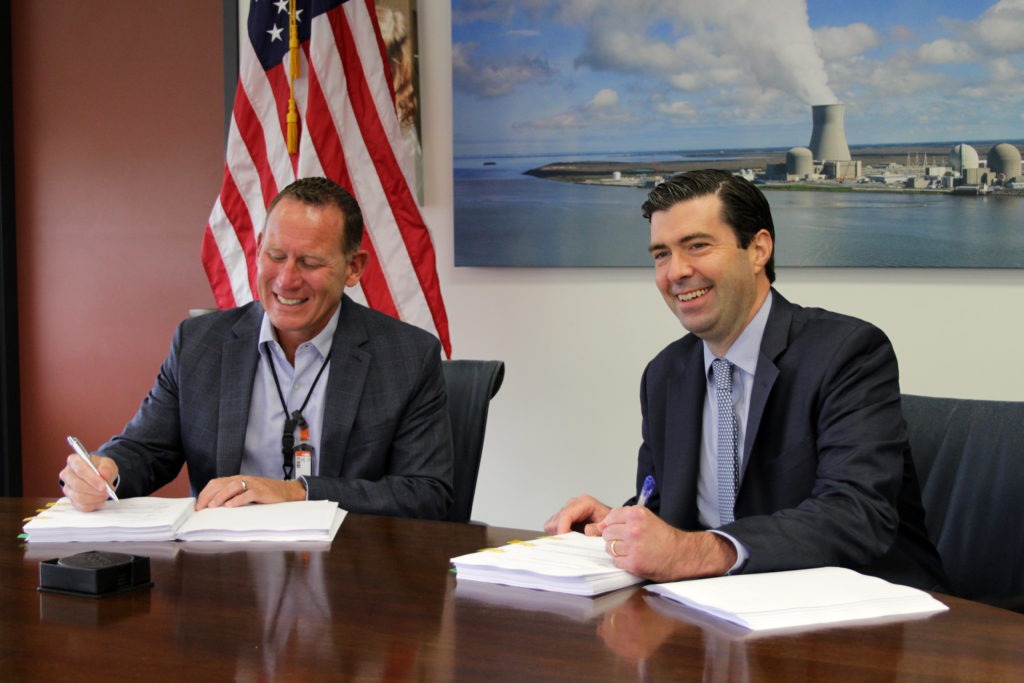
LOWER ALLOWAYS CREEK, N.J. (September 14, 2021) – The New Jersey Economic Development Authority (NJEDA) and PSEG have signed a lease allowing for a term of up to 78-years on land that will be home to the New Jersey Wind Port in Salem County, New Jersey, further positioning the state as a hub for clean energy and the U.S. offshore wind industry. The port will provide a location for essential staging, assembly, and manufacturing activities related to offshore wind along the East Coast. The Wind Port is located adjacent to PSEG’s nuclear generating site, which today provides more than 90% of New Jersey’s carbon-free electricity, and together, offshore wind and nuclear energy will deliver powerful support for our state and national clean energy ambitions.

“The New Jersey Wind Port is a transformational investment that will create hundreds of good jobs and drive billions of dollars of economic activity in South Jersey and throughout the State,” said NJEDA Chief Executive Officer Tim Sullivan. “This is a vital project that will help communities recover from the devastating impacts of the COVID-19 pandemic and move us closer to Governor Murphy’s vision for a stronger, fairer New Jersey economy. The NJEDA is proud to partner with PSEG to bring this valuable new infrastructure asset to life.”

“The lease signing with the NJEDA is cause for celebration as the New Jersey Wind Port will provide a foundation for even more carbon-free energy in our region,” PSEG Chief Operating Officer Ralph LaRossa said. “Alongside PSEG’s nuclear plants, the New Jersey Wind Port will establish South Jersey as the heart of New Jersey’s clean energy economy. By supporting the development of renewable offshore wind power, this lease and the facility to come will establish New Jersey as the destination for clean energy development, operations, training, skills, and innovation.”

“Salem County and South Jersey are already home to exceptional innovation, operations, and a workforce skilled in generating clean energy for millions of customers. And now, with the addition of the New Jersey Wind Port, PSEG is proud to support the state as we become the hub for development of carbon-free resources for the East Coast,” PSEG Nuclear President and Chief Nuclear Officer Eric Carr said. “PSEG and PSEG Nuclear welcome broad partnerships such as ours with the NJEDA and we look forward to continuing to drive innovation, growth, and investment in the clean energy economy.”

Offshore wind is a central component of Governor Phil Murphy’s Energy Master Plan to achieve 100 percent clean energy by 2050. As part of that plan, New Jersey has committed to producing 7,500 megawatts of offshore wind energy by 2035. Up and down the East Coast, offshore wind investment through 2035 is anticipated to exceed $150 billion. The U.S. offshore wind industry is expected to create 83,000 new (direct) jobs by 2030, most of which will be in the Northeast and Mid-Atlantic. Through strategic investments and development, New Jersey can become a national leader in numerous portions of the offshore wind supply chain and become central to the clean energy economy.

The New Jersey Wind Port is located on an artificial island on the eastern shores of the Delaware River, southwest of the City of Salem. With its expansive footprint, lack of height restrictions, and easy access to the Atlantic Ocean’s wind farm lease areas, the Wind Port is one of a select few ports on the East Coast that can house offshore wind turbine marshalling and manufacturing. A key component of offshore wind turbine marshalling is the vertical assembly of turbine towers, which are hundreds of feet tall and cannot fit beneath bridges, power lines, and other naturally-occurring barriers that would impose height restrictions. No other port in the region is able to support the marshalling and manufacturing operations that will take place at the Wind Port.

Job Creation

The New Jersey Wind Port has the potential to create more than 1,500 manufacturing, assembly and operations jobs, as well as hundreds of construction jobs. Many positions at the Wind Port will be trade jobs and require skill certifications, like welding or an electrician’s license, but will not require a college degree. The construction phase of the Wind Port also will create hundreds of union jobs. Last week, Construction Manager (CM) AECOM-Tishman signed a project labor agreement (PLA) with the United Building Trades Council of Southern New Jersey AFL-CIO. The NJEDA is also working with AECOM-Tishman to ensure at least 25 percent of subcontractors for the port construction are small businesses and at least 15 percent are women-, minority-, or veteran- owned. The Wind Port project also includes worker diversity goals of 18 percent people of color and 6.9 percent women.

The New Jersey Wind Port site was selected in June 2020 after a 22-month assessment process, including engagement with industry, government, and environmental stakeholders. The NJEDA has been preparing the site and finalizing design since summer 2020. It is more than five miles from the nearest New Jersey residential area and provides ample space to grow operations over time.

About the New Jersey Economic Development Authority

The New Jersey Economic Development Authority (NJEDA) serves as the State’s principal agency for driving economic growth. The NJEDA is committed to making New Jersey a national model for inclusive and sustainable economic development by focusing on key strategies to help build strong and dynamic communities, create good jobs for New Jersey residents, and provide pathways to a stronger and fairer economy. Through partnerships with a diverse range of stakeholders, the NJEDA creates and implements initiatives to enhance the economic vitality and quality of life in the State and strengthen New Jersey’s long-term economic competitiveness.

To learn more about NJEDA resources for businesses call NJEDA Customer Care at 609-858-6767 or visit https://www.njeda.gov and follow @NewJerseyEDA on FacebookTwitter, Instagram, and LinkedIn.

About PSEG

Public Service Enterprise Group Inc. (PSEG) (NYSE: PEG) is a publicly traded diversified energy company with approximately 13,000 employees. Headquartered in Newark, N.J., PSEG’s principal operating subsidiaries are: Public Service Electric and Gas Co. (PSE&G), PSEG Power and PSEG Long Island. PSEG is a Fortune 500 company included in the S&P 500 Index and has been named to the Dow Jones Sustainability Index for North America for 13 consecutive years (https://corporate.pseg.com).

Visit PSEG at:

www.pseg.com

PSEG on Facebook

PSEG on Twitter

PSEG on LinkedIn

PSEG Energize!

###

TRENTON, N.J. (September 10, 2021) – The New Jersey Economic Development Authority (NJEDA) and New Jersey Business and Industry Association (NJBIA) are hosting an informational webinar for businesses and nonprofits interested in applying for the new $10.5 million Henri/Ida Business Assistance Grant Program. The webinar is being offered in partnership with the Chamber of Commerce of Southern New Jersey, New Jersey Chamber of Commerce, Commerce and Industry Association of New Jersey, Statewide Hispanic Chamber of Commerce of New Jersey, and the African American Chamber of Commerce of New Jersey.

The webinar will take place at 9:00 a.m. on Tuesday, September 14th, 2021. Businesses interested in the program can register here.

The application for the Henri/Ida Business Assistance Grant Program will open at 9:00 a.m. on Friday, September 17th, 2021. More information and materials to help small businesses and nonprofits prepare to apply are available at https://www.njeda.gov/henri-ida-relief.

Program Overview

The Henri/Ida Assistance Grant Program is designed to assist businesses and non-profits impacted by the remnants of Hurricanes Henri and Ida. 

The Program will provide grants from $1,000 up to $5,000 in the form of reimbursement of August rent or mortgage.

The Program is open to New Jersey-based small businesses and non-profits that have up to 50 full-time equivalent employees as reported on their last WR-30 form (Q2 2021) with the NJ Department of Labor and Workforce Development (DOL) and have a commercial location in the State that suffered physical damage as a result of the remnants of Hurricanes Henri and/or Ida. Landlords and home-based businesses are not eligible for grant funding through this program. 

The NJEDA will launch an online application for the program at 9:00 a.m. on Friday, September 17th at https://www.njeda.gov/henri-ida-relief/. Applications will be reviewed on a first come, first served basis.

For more information on the Henri/Ida Assistance Grant Program, visit https://www.njeda.gov/henri-ida-relief/.


About the New Jersey Economic Development Authority
The New Jersey Economic Development Authority (NJEDA) serves as the State’s principal agency for driving economic growth. The NJEDA is committed to making New Jersey a national model for inclusive and sustainable economic development by focusing on key strategies to help build strong and dynamic communities, create good jobs for New Jersey residents, and provide pathways to a stronger and fairer economy. Through partnerships with a diverse range of stakeholders, the NJEDA creates and implements initiatives to enhance the economic vitality and quality of life in the State and strengthen New Jersey’s long-term economic competitiveness.

To learn more about NJEDA resources for businesses call NJEDA Customer Care at 609-858-6767 or visit https://www.njeda.gov and follow @NewJerseyEDA on FacebookTwitter, Instagram, and LinkedIn.

###

TRENTON, N.J. (September 10, 2021) – The New Jersey Economic Development Authority (NJEDA) today released for public feedback a draft rule proposal for the Aspire Program, as established under the New Jersey Economic Recovery Act of 2020 (ERA). The Aspire Program is a gap financing tool to support commercial, mixed use, and residential real estate development projects.

Members of the public are encouraged to review the preliminary rules and submit written feedback through an online form available on the Economic Recovery Act website. The NJEDA will also be hosting two listening sessions for public input on the draft rules.

“As we recover from the COVID-19 pandemic, it is crucial that we support new investments in our communities,” said NJEDA Chief Executive Officer Tim Sullivan. “The Aspire Program will facilitate equitable, community-supported residential and commercial development projects that make our communities vibrant live, work, play destinations that better serve residents and help attract successful companies and top-notch talent.”

Draft Aspire Program rules are available now for review at https://www.njeda.gov/economicrecoveryact/program-specific-feedback/.

Members of the public can also provide input during the NJEDA’s public listening sessions, which are scheduled for the following times:

  • Friday, September 17th at 3:00 p.m.
  • Monday, September 20th at 3:00 p.m.

Members of the public can access the listening sessions at https://us02web.zoom.us/j/83755290991?pwd=M1lzWWdaaGwrdi85MDhuRk4vUVdRUT09; Passcode: Aspire.

Members of the media interested in attending the session or submitting questions are asked to email media@njeda.com.  

In addition to the Aspire Program, the ERA creates a suite of programs that includes tax credits to incentivize job creation, new construction, and revitalization of brownfields and historic properties; financial resources for small businesses; support for new supermarkets and healthy food retailers in food desert communities; new funding opportunities for early-stage companies in New Jersey; and support for the growing film and digital media industry. The NJEDA will continue to engage the public as new programs and rules are developed.

For more information and to provide written input on the design and implementation of Economic Recovery Act programs, visihttps://www.njeda.gov/economicrecoveryact/.

About the New Jersey Economic Development Authority

The New Jersey Economic Development Authority (NJEDA) serves as the State’s principal agency for driving economic growth. The NJEDA is committed to making New Jersey a national model for inclusive and sustainable economic development by focusing on key strategies to help build strong and dynamic communities, create good jobs for New Jersey residents, and provide pathways to a stronger and fairer economy. Through partnerships with a diverse range of stakeholders, the NJEDA creates and implements initiatives to enhance the economic vitality and quality of life in the State and strengthen New Jersey’s long-term economic competitiveness.

To learn more about NJEDA resources for businesses call NJEDA Customer Care at 609-858-6767 or visit https://www.njeda.gov and follow @NewJerseyEDA on FacebookTwitter, Instagram, and LinkedIn.

###

TRENTON, N.J. (September 8, 2021) – The New Jersey Economic Development Authority (NJEDA) announced the approval of the Henri/Ida Business Assistance Grant Program at a special meeting of its Board held earlier today.  The $10.5 million program will provide grants of $1,000 to $5,000 for businesses and non-profits that suffered physical damage from the effects of recent tropical storms Henri and Ida.

The approval follows Governor Phil Murphy’s announcement of preliminary details of the program last week. The NJEDA has been tasked with creating and administering the program, which will provide short-term, immediate rent/mortgage reimbursement support to New Jersey businesses and non-profits with up to 50 full-time equivalent employees that suffered physical damage from Tropical Storm Henri on August 22nd and 23rd, or from Tropical Storm Ida on September 1st, 2nd and 3rd, 2021.

More information about the Henri/Ida Business Assistance Grant Program is available at https://www.njeda.gov/henri-ida-relief/.

“Countless New Jersey businesses endured the wrath of Tropical Storms Henri and Ida in recent weeks, and today’s action by the NJEDA’s Board will allow us to move swiftly to help those businesses in need,” said Governor Murphy. “Time is clearly of the essence and we are determined to get funds out to businesses and non-profits as quickly as possible.”

The Henri/Ida Grant Program is designed to assist businesses and non-profits impacted by tropical storms Henri and Ida. The Program will provide grants from $1,000 up to $5,000 to New Jersey-based small businesses and non-profits that have up to 50 full-time equivalent employees as reported on their last WR-30 form (Q2 2021) with the NJ Department of Labor and Workforce Development (DOL) and have a commercial location in the State that suffered physical damage as a result of tropical storms Henri and Ida. Of the $10.5 million available for the program, $10 million will be available for grants for businesses and non-profits impacted by Ida and $500,000 will be set aside for businesses and non-profits impacted by Henri.

Landlords and home-based businesses are not eligible for grant funding through this program. To be eligible, the applying entity must:

  • Provide certification of an unmet need due to damage and/or business interruption.
    • This includes, but is not limited to, flooding, interior or exterior damage to the building structure, roof damage, and siding damage, all of which are directly related to tropical storm Henri and Ida. Loss of power alone will not be considered physical damage.
  • Provide documentation of physical damage to the applicant’s physical commercial location.
  • Have been in operation on August 1, 2021.
  • Present a valid Employer Identification Number (EIN).
  • Submit recent wage reporting form (WR30), if applicable.
  • Submit evidence of an August rent/mortgage payment of at least $1,000 as well as have a need that is greater than $1,000.
  • Be registered to do business in the State of New Jersey, as evidenced by a valid Business Registration Certificate.
  • Be in good standing with the Department of Taxation and DOL, and if applicable, the Division of Alcoholic Beverage Control, the Department of Children and Families, and/or the Department of Human Services.
  • Complete an affidavit identifying all funding sources related to recovery from tropical storms Henri and Ida, including prior grants, insurance, and Small Business Administration loans and grants.
  • Comply with any additional requirements that may apply.

Grants will be provided in the form of reimbursement of August rent or mortgage ($1,000 minimum rent eligibility). To ensure grants reach businesses in the hardest hit communities, including communities of color, one-third of the $10 million in funding available through the program will be targeted to businesses with a primary business location within the 715 census tracts designated as eligible to be selected as an Opportunity Zone.

“The NJEDA shares Governor Murphy’s sense of urgency as we work to provide support to small businesses and non-profits dealing with the impact of Henri and Ida,” said NJEDA CEO Tim Sullivan. “The need for assistance is particularly dire, as these storms occurred just as New Jersey was emerging from the impact of the COVID-19 pandemic. It’s more critical than ever that we do our best to help impacted entities return to normal operations so they may continue their role as the economic drivers of New Jersey’s communities.”

The NJEDA has stressed to business owners and non-profit leaders the importance of thoroughly documenting all physical damage as they prepare to apply for assistance through this and any future programs, including taking clear photographs and saving receipts for repairs and associated materials.

Comprehensive information about the Henri/Ida Business Assistance Grant Program is available at https://www.njeda.gov/henri-ida-relief/. The NJEDA expects to launch an online application for the program at 9:00 a.m. on Friday, September 17th at https://www.njeda.gov/henri-ida-relief/. Applications will be reviewed on a first come, first served basis.

About the New Jersey Economic Development Authority

The New Jersey Economic Development Authority (NJEDA) serves as the State’s principal agency for driving economic growth. The NJEDA is committed to making New Jersey a national model for inclusive and sustainable economic development by focusing on key strategies to help build strong and dynamic communities, create good jobs for New Jersey residents, and provide pathways to a stronger and fairer economy. Through partnerships with a diverse range of stakeholders, the NJEDA creates and implements initiatives to enhance the economic vitality and quality of life in the State and strengthen New Jersey’s long-term economic competitiveness.

To learn more about NJEDA resources for businesses call NJEDA Customer Care at 609-858-6767 or visit https://www.njeda.gov and follow @NewJerseyEDA on FacebookTwitter, Instagram, and LinkedIn.

###

Latest Phase Brings Total Program Allocation to Nearly $35 Million, Resulting in
the Purchase of 3.5 Million Meals from More Than 350 Restaurants  

TRENTON, N.J. (August 24, 2021) – The New Jersey Economic Development Authority (NJEDA) today announced that an additional $11 million has been allocated to Phase 2 of the successful Sustain and Serve NJ program, bringing the total for this round of grant funding to $20 million. The NJEDA anticipates awarding grants to 29 organizations statewide through Phase 2 of the program. This funding is expected to support the purchase of two million meals from nearly 300 New Jersey restaurants in more than 120 municipalities statewide. Through Phase 1 of the program, over the past five months, the program has supported the purchase of 1.5 million meals from over 350 restaurants with grants totaling over $14 million.

“The overwhelming and heartfelt response from organizations stepping up to support their local restaurants and their neighbors truly embodies the Jersey spirit,” said Governor Phil Murphy. “Restaurants are an essential part of our economy and their success is essential to our state’s recovery from the pandemic. Having so many entities leverage Sustain and Serve NJ funds to not only inject cash into restaurants but also partner with those restaurants to feed members of their community is an absolute grand slam.”

With Phase 2 of Sustain & Serve NJ, the NJEDA will provide $20 million in grant funding to entities throughout the state to support expenses directly tied to bulk purchasing of meals from New Jersey-based restaurants. Each awardee will receive a grant of between $100,000 and $2 million to fund these purchases. The entities will then distribute the meals at no cost to the recipients of the meals.

Governor Murphy signed legislation in June 2021 that, in part, allocated funding for Sustain and Serve NJ, enabling the NJEDA to open Phase 2 of the program. Due to the enormous interest from organizations and restaurants throughout the state, NJEDA is dedicating an additional $11 million in federal monies.

“From the outset of COVID-19, Governor Murphy has driven innovative programs to help New Jersey residents and businesses weather the economic effects of the pandemic,” said NJEDA Chief Executive Officer Tim Sullivan. “We are grateful to the Governor for strengthening New Jersey’s vital restaurant industry through initiatives like Sustain and Serve NJ. Bolstering this sector will help fuel our recovery efforts and propel our economy forward.”

In addition to Governor Murphy, Sullivan also thanked New Jersey Senate President Steve Sweeney and Assembly Speaker Craig Coughlin for their support.

Community leaders and legislators throughout New Jersey are applauding the Sustain and Serve NJ Program as a win-win for the state.

“Restaurants are among the small businesses hit hardest by the pandemic, and supporting their recovery is key to restoring the vibrance of our communities,” said Senator Dawn Addiego. “I can’t think of a better way to rally around the restaurant community while helping those in need than the funding model created by Sustain and Serve NJ.”

“The Sustain and Serve program is an innovative way to bolster the restaurant industry while supporting community members who need a helping hand during this difficult time,” said Assemblyman John Armato. “This funding will help countless restaurants in Atlantic City and beyond keep their employees on the payroll and continue to serve both residents and visitors alike. Our communities will be better off as a result of the ongoing implementation of this critical program.”

“The structure of Sustain and Serve NJ is smart and proactive in terms of the dual benefits it provides,” said New Jersey Restaurant and Hospitality Association President and CEO Dana Lancellotti. “In addition to helping restaurants keep their lights on and their workers employed, the program provides an opportunity for them to make a positive difference for their communities.”

“Community policing supports safer, stronger neighborhoods and the State Policemen’s Benevolent Association (PBA) is grateful to for the opportunity to distribute food purchased from local restaurants by FeedNJ to people in need,” said NJ State PBA President Pat Colligan. “The pandemic laid bare how many New Jerseyans are on the verge of food insecurity and being able to share meals is a wonderful way to build trust in our communities. The Sustain and Serve NJ program isn’t just helping to support restaurants and put food on some otherwise empty tables – it’s helping to preserve the dignity of some of our most vulnerable citizens.”

Newark-based Audible launched Newark Working Kitchens in April 2020 and has already distributed over one million meals within the community.

“The Sustain and Serve NJ Program has made a measurable impact on Newark’s local restaurants and residents most in need of support,” said Don Katz, Audible Founder and Executive Chairman. “The added grant funding announced today will provide more vital support for community members without enough food and independent small businesses, which have been able to stay open throughout the pandemic by cooking meals for Newark Working Kitchens.”

A full list of participating organizations can be found at the end of this news release. Organizations marked with an asterisk (*) are new to the Sustain and Serve NJ Program for Phase 2.

The Coalition for Food and Health Equity in Hudson County works with small businesses and organizations in its community to accelerate food, health, and economic equity within Black and brown communities. A $450,000 grant from Phase 1 of the Sustain and Serve NJ Program supported the purchase of 45,000 meals from local restaurants that the nonprofit distributed to food-insecure residents in Hudson County. 

“We founded the Coalition as a direct result of the needs we were seeing from community members affected by the economic upheaval of the pandemic,” said Dr. Leeja Carter, Founder and Executive Director of the Coalition for Food and Health Equity. “Our meals have been described as ‘truly a Godsend’ and ‘a blessing to families’. We are grateful that the Sustain and Serve NJ program will enable us to give tens of thousands more ‘blessings’ in the coming months.”

In Mercer County, the Rescue Mission of Trenton provides a safe, clean, and warm refuge for people within its community. It also offers healthcare, housing assistance, addiction treatment and job training to its clients. The organization provided nearly 76,000 meals in the past year. The Rescue Mission’s efforts were supported by a $100,000 grant during Phase 1 of Sustain and Serve NJ.

“The Rescue Mission has been part of the greater Trenton area for over a century and this year we have seen a significant uptick in demands we must address as a result of the COVID-19 pandemic,” said Trenton Rescue Mission Chief Executive Officer Barrett T. Young, MA, CADC. “The Sustain & Serve NJ program allows us to simultaneously broaden our reach while supporting restaurants in our neighborhood.”

Mid-Atlantic States Career and Education Center* is participating in Sustain and Serve NJ for the first time in Phase 2. The Salem County-based nonprofit focuses on building effective community partnerships, improving the health and well-being of its clients, providing hands-on career and job skill development for disadvantaged and disabled workers, and creating a sustainable, stable community.

“We have spent the past 25 years guided by the mission ‘We Grow PeopleTM,’ and that means taking a holistic approach to nourishing not just the mind, but the body as well,” said H. Glen Donelson, President & Chief Executive Officer of Mid-Atlantic States Career and Education. “We’re thrilled for the opportunity to partner with restaurants within our community to provide thousands of free meals thanks to the grant we are receiving from the Sustain and Serve NJ Program.”

Pending the outcome of final reviews, the NJEDA anticipates making awards to the following entities to participate in Phase 2 of the Sustain & Serve NJ program:

Organization

Locations of Participating Restaurants

Name

Headquarters

Municipality(ies)

County(ies)

A Need We Feed Inc.

Toms River

Farmingdale Borough

Lakehurst Borough

Manahawkin

Seaside Heights

Seaside Park

Toms River

Monmouth

Ocean

Asbury Park Dinner Table

Asbury Park

Asbury Park

Monmouth

AtlantiCare Foundation

Egg Harbor

Atlantic City

Egg Harbor

Galloway

Ventnor

Atlantic

Chef Lou’s Army

Pine Beach

Manasquan

Sea Girt

Shrewsbury

Toms River

Monmouth

Ocean

Coalition for Food and Health Equity

Jersey City

Jersey City

Newark

Essex

Hudson

Congregation Bnos Devorah*

Lakewood

Lakewood

Ocean

Elizabeth Education Association

Elizabeth

Elizabeth

Union

FLAG for Cranford

Cranford

Cranford

West Orange

Essex

Union

FoodBank of Monmouth and Ocean Counties (Fulfill)

Neptune

Asbury Park

Atlantic Highlands

Belmar

Brick

Freehold

Holmdel

Long Branch

Manasquan

Neptune

New Brunswick

Ocean

Red Bank

Spring Lake

Toms River

Middlesex

Monmouth

Ocean

Front Line Appreciation Group of Millburn Short Hills

Short Hills

Millburn

Short Hills

Essex

HealthBarn Foundation

Ridgewood

Ridgewood

Bergen

Holy Name Medical Center Foundation

Teaneck

Bergenfield

Cliffside Park

Clifton

Garfield

Hackensack

Mahwah

Maywood

New Milford

Palisades Park

Paramus

Park Ridge

Teaneck

Washington Township

Wyckoff

Bergen

Gloucester

Passaic

Joseph Kushner Hebrew Academy Inc.

Livingston

Livingston

Essex

Meals on Wheels of Mercer County

Ewing

Ewing

Trenton

Mercer

Mid-Atlantic States Career and Education Center*

Pennsville

Pennsville

Salem

Morristown Rotary Club

Morristown

Morristown

Verona

Essex

Morris

Newark Working Kitchens (Community Foundation of New Jersey)

Newark

Newark

Essex

New Jersey Farmers Cooperative

Cape May

Cape May

West Cape May

Cape May

Our Community Dinner Table

South Hackensack

Bergenfield

Englewood

Fort Lee

Palisades Park

Bergen

Power Changes Lives*

Morris Plains

Elizabeth

Morristown

Morris

Union

Rescue Mission of Trenton

Trenton

Ewing

Trenton

Mercer

Share My Meals Inc

Princeton

Princeton

Skillman

Mercer

Somerset

Soup Kitchen 411 (FeedNJ)

Hightstown

Asbury Park

Bayonne

Belford

Belleville

Bogota

Bradley Beach

Branchville

Brick

Bridgewater Township

Camden

Cranford

East Brunswick

East Cranford

Eatontown

Elizabeth

Englewood

Englishtown

Fairview

Freehold

Glassboro

Hamilton

Harrison

Hightstown

Hoboken

Jersey City

Lawrenceville

Leonardo

Little Falls

Long Branch

Manalapan

Medford

Middletown

Millville

Monroe

Montclair

Morristown

Neptune

Netcong

New Brunswick

Newark

Parsippany-Troy Hills

Perth Amboy

Pine Brook

Princeton

Princeton Junction

Red Bank

Ridgewood

Rochelle Park

Rockaway

Roselle

Sayreville

Scotch Plains

Shrewsbury

South Amboy

South River

Summit

Tinton Falls

Toms River

Vineland

Wanaque

Washington Township

West Long Branch

West Windsor

Westfield

Wharton

Bergen

Burlington

Camden

Cumberland

Essex

Gloucester

Hudson

Mercer

Middlesex

Monmouth

Morris

Ocean

Passaic

Somerset

Union

TASK Inc (Trenton Area Soup Kitchen)

Trenton

East Windsor

Ewing

Hamilton

Pennington

Princeton

West Windsor

Mercer

The Cliffside Park Hall of Fame Foundation

Cliffside Park

Cliffside Park

Hillsdale

Northvale

River Vale

South Hackensack

Washington Township

Westwood

Bergen

The Foundation for University Hospital

Newark

Belleville

Newark

Rutherford

Bergen

Essex

The Summit Foundation

Summit

Summit

Union

Toni’s Kitchen, a food ministry of St. Luke’s Church

Montclair

Montclair

Essex

Tri-Arc Community Development Corporation*

Hackensack

Bergenfield

Bergen

TRENTON, N.J. (August 16, 2021) – The New Jersey Economic Development Authority (NJEDA) is now accepting applications for commercial projects under the Economic Redevelopment and Growth (ERG) Program. A link to the application and more information is available at https://www.njeda.gov/erg.

The ERG program, which was originally created to address project financing gaps in development projects, previously stopped accepting new applications in June 2019 because its enabling legislation ended. The commercial component of the program reopened for applications this morning with an allocation of $75 million under the Economic Recovery Act of 2020 (ERA).  The residential component began accepting applications in June with a $125 million allocation.

The Commercial ERG Program is an incentive to help developers and businesses address project financing gaps in development or redevelopment projects, including below market development margins or rates of return. Qualified projects can receive an incentive grant reimbursement of up to 30 percent of total eligible project costs. Projects in Atlantic City, Camden, Paterson, Passaic, and Trenton can receive reimbursements up to 40 percent of eligible project costs. Subsidies awarded through the ERG Program are not meant to be a substitute for conventional debt and equity financing. Before applying, applicants must have the balance of their funding identified or in place or be able to demonstrate that any terms of other financing are reasonable.

The new phase of the Commercial ERG Program is subject to the existing ERG regulations and statutes, as amended by the New Jersey Economic Recovery Act of 2020 (ERA) (L. 2021, c. 156) and subsequently by L. 2021, c. 160. Among other requirements, projects must:

  • Be predominantly commercial and contain 100,000 or more square feet of retail, office, and/or industrial uses for purchase or lease.
  • Be located in a qualifying incentive area.
  • Not have commenced any construction at the site of a proposed redevelopment project prior to submitting an application or demonstrate to the NJEDA that the project would not be completed otherwise or is to be undertaken in phases.
  • Demonstrate that a project financing gap exists.
  • Demonstrate the tax revenues the State will realize from the project will be greater than the incentive being provided.

For comprehensive information on eligibility for the extended Commercial ERG Program download the 2021 Commercial Extension Clarification Document at  https://www.njeda.gov/erg.

 All applicants are required to submit an application via the NJEDA’s online application at https://application.njeda.com/. Applications will be accepted on a first-come, first-served basis until funds are exhausted or Thursday, December 30, 2021. More information about the application process is available at https://www.njeda.gov/erg.  

In addition to the expanded ERG Program, the ERA creates and expands a suite of programs that includes tax credits to incentivize job creation, new construction, and revitalization of brownfields and historic properties; financial resources for small businesses; support for new supermarkets and healthy food retailers in food desert communities; new funding opportunities for early-stage companies in New Jersey; and support for the growing film and digital media industry. The NJEDA will continue to engage the public as new programs and rules are developed. For more information, visit https://www.njeda.gov/economicrecoveryact/.

About the New Jersey Economic Development Authority

The New Jersey Economic Development Authority (NJEDA) serves as the State’s principal agency for driving economic growth. The NJEDA is committed to making New Jersey a national model for inclusive and sustainable economic development by focusing on key strategies to help build strong and dynamic communities, create good jobs for New Jersey residents, and provide pathways to a stronger and fairer economy. Through partnerships with a diverse range of stakeholders, the NJEDA creates and implements initiatives to enhance the economic vitality and quality of life in the State and strengthen New Jersey’s long-term economic competitiveness.

To learn more about NJEDA resources for businesses call NJEDA Customer Care at 609-858-6767 or visit https://www.njeda.gov and follow @NewJerseyEDA on Facebook, Twitter, Instagram, and LinkedIn.

###

Update (9/15/21): Members of the community now have until September 25, 2021 to submit feedback on the Capital City Redevelopment Corp.’s draft update to its Renaissance Plan.

TRENTON, N.J. (August 13, 2021) – The Capital City Redevelopment Corporation (CCRC) today issued a reminder of its upcoming virtual public hearings for the community to provide feedback on the proposed draft update to the CCRC Renaissance Plan. A copy of the draft plan is currently available at https://www.njeda.gov/ccrc-renaissance-plan.

The Renaissance Plan was first adopted in 1989 to fuel economic development within Trenton’s Capital District and to make the area a more attractive place to live, work, play, and conduct business. The update is designed to reflect changes in the social, economic, and natural environment over the last 30 years and to provide a guide for the Capital District into the future.

CCRC encourages members of the public to attend one of the following virtual Renaissance Plan public hearings next week, during which attendees can provide comment:

  • Tuesday, August 17 at 2:00 p.m.
  • Thursday, August 19 at 6:00 p.m.

Links to attend the hearings virtually can be found at https://www.njeda.gov/ccrc-renaissance-plan.  This site also includes a public comment submission form for anyone interested in commenting on the draft plan. The public comment period for the draft update to the Renaissance Plan is scheduled to conclude on September 18, 2021.

CCRC’s planning consultant will also provide a presentation on the update to the Renaissance Plan at a meeting of the City of Trenton’s Planning Board on Thursday, August 26 at 6:00 p.m.. This virtual meeting can be accessed at https://www.njeda.gov/ccrc-renaissance-plan.

CCRC was statutorily created in 1988 to assist with the planning, coordination, and promotion of development within the Capital District, which consists of those portions of the City of Trenton that serve as its commercial center, and in which public buildings and historic sites are located.

CCRC’s Renaissance Plan guides public and private investment decisions within the district through goals, policies, and specific recommendations. In 2019, the CCRC Board hired Newark-based Topology,  a real estate and planning firm, to oversee and assist with updating the Renaissance Plan in coordination with the City of Trenton’s recent update to its Master Plan, known as Trenton 250, as well as other relevant plans for areas within the CCRC Boundary.

A news release with additional details of CCRC’s Renaissance Plan can be found here.

###

TRENTON, N.J. (August 11, 2021) – The New Jersey Economic Development Authority (NJEDA) Board today approved rules for the Main Street Recovery Program. Created under the Economic Recovery Act of 2020 (ERA), the Main Street Recovery Program is a $100 million small business support program that will fund multiple financial assistance products aimed at supporting the growth and success of small businesses in New Jersey. More information is available at https://www.njeda.gov/main-street-recovery-fund/.

“Supporting small businesses is the centerpiece of Governor Phil Murphy’s plan for a stronger, fairer recovery from the COVID-19 pandemic,” said NJEDA Chief Executive Officer Tim Sullivan. “The Main Street Recovery Program approved today will build on the NJEDA’s successful COVID-19 relief programs to provide new resources tailored specifically to help business owners recover from the impacts of the pandemic and prepare for long-term success.”  

The rules approved today create two grant products funded by the Main Street Recovery Program: the Small Business Lease Assistance Grant and the Small Business Improvement Grant.

The Small Business Lease Assistance Grant is a $10 million program that will provide grants to businesses entering new or amended leases with at least five-year terms that include at least 250 square feet of street-level space. This grant funding will offset a portion of annual lease payments for two years.

The Small Business Improvement Grant is a $15 million program that will provide grants up to $50,000 to reimburse businesses for a portion of costs associated with improvements and/or the purchase or installation of furniture, fixtures, and equipment since March 9, 2020.  

Applications for these programs are currently under development. The NJEDA will announce the application timeline for both programs soon.

In addition to the Small Business Lease Assistance Grant and the Small Business Improvement Grant, the NJEDA intends to pilot additional products to be funded through the Main Street Recovery Program. The Authority anticipates these pilot programs will include financing to help microbusiness lenders provide more low-cost loans and technical assistance for microbusinesses and an expansion of the NJEDA’s existing Micro Business Loan Program through which the Authority will provide low-cost financing directly to eligible microbusinesses.

In line with Governor Murphy’s commitment to a stronger, fairer recovery from the COVID-19 pandemic, 40 percent of all Main Street Recovery Program funds are reserved for businesses located in census tracts that were eligible to be designated as Opportunity Zones. Providing dedicated funding for these census tracts helps to ensure equitable access to resources for communities and businesses that have historically struggled to access resources.

The Main Street Recovery Program is part of a suite of programs created or expanded under the ERA that includes tax credits to incentivize job creation, new construction, and revitalization of brownfields and historic properties; financial resources for small businesses; support for new supermarkets and healthy food retailers in food desert communities; new funding opportunities for early-stage companies in New Jersey; and support for the growing film and digital media industry. The NJEDA will continue to engage the public as new programs and rules are developed.

About the New Jersey Economic Development Authority

The New Jersey Economic Development Authority (NJEDA) serves as the State’s principal agency for driving economic growth. The NJEDA is committed to making New Jersey a national model for inclusive and sustainable economic development by focusing on key strategies to help build strong and dynamic communities, create good jobs for New Jersey residents, and provide pathways to a stronger and fairer economy. Through partnerships with a diverse range of stakeholders, the NJEDA creates and implements initiatives to enhance the economic vitality and quality of life in the State and strengthen New Jersey’s long-term economic competitiveness.

To learn more about NJEDA resources for businesses call NJEDA Customer Care at 609-858-6767 or visit https://www.njeda.gov and follow @NewJerseyEDA on FacebookTwitter, Instagram, and LinkedIn.

###

$1.25 Million Available to Support Startups Engaged with Federal SBIR/STTR Programs
 

TRENTON, N.J. (August 10, 2021) – The New Jersey Commission on Science, Innovation and Technology today announced that it will open applications for a $1.25 million round of grant funding through its New Jersey Small Business Innovation Research (SBIR) and Small Business Technology Transfer Program (STTR) Direct Financial Assistance Program on Monday, August 16, 2021. New Jersey startups can apply online at https://www.njeda.gov/csit. The program provides a $25,000 to $50,000 funding match to New Jersey-based companies that have received federal SBIR/STTR grants.  

The federal SBIR and STTR grant programs provide more than $3 billion each year to small businesses in a variety of technology and life sciences areas that propose innovative ideas that meet specific federal research and development (R&D) needs. The SBIR program enables small businesses to explore their technological potential and provides the incentive to profit from its commercialization. The STTR program funds cooperative R&D partnerships between small businesses and research institutions such as universities, federal R&D centers, or non-profits. The programs are open to U.S.-based, for-profit small businesses with fewer than 500 employees.

“Under Governor Phil Murphy’s leadership, New Jersey is quickly recapturing its role as a leader in innovation thanks to startups such as those involved with the federal SBIR/STTR programs,” said CSIT Chairman Gunjan Doshi. “CSIT is committed to ensuring that our state’s entrepreneurs have access to every available resource to best position themselves for success. The New Jersey SBIR/STTR Direct Financial Support Program has a proven track record of doing just that.”

Doshi noted that, through two prior rounds of the New Jersey SBIR/STTR Direct Financial Assistance Program, CSIT has awarded a total of $825,000 to 29 New Jersey companies.

This third round of the program will offer $1.25 million in grants to New Jersey small businesses in two program components. The first component (Direct funding) will provide $25,000 grants to up to 30 small businesses that have received a federal SBIR/STTR Phase I, Fast-Track or Direct to Phase II award/contract. The grant is aimed at helping awardees increase intensity of research, strengthen commercialization plans, cover operational expenses, and become more competitive for Phase II funding. The second component (Bridge funding) will provide $50,000 grants to up to ten NJ small businesses that have successfully completed Phase I and have applied for Phase II of the federal SBIR/STTR program. The grant will enable the awardees to maintain operations while waiting on Phase II awards and cover general operational expenses directly related to the project/product for which a Federal Phase II award is being sought.

“We are pleased to be able to significantly increase the amount of funding we are providing through this latest round and look forward to welcoming new startups into the program as a result,” said CSIT Executive Director Judith Sheft.

Sheft encouraged entrepreneurs that are interested in applying to the New Jersey SBIR/STTR Direct Financial Assistance Program to attend an August 19 information webinar to learn about the application process. A link to the webinar can be found at ttps://www.njeda.gov/event/csit-round-3-sbir-sttr-grant-assistance-program/. A recording of the webinar will also be available on CSIT’s website.

The application, which will be available at https://application.njeda.com/CSIT, will be open until October 8, 2021 at 4:00 p.m. EST.

“Startups within the innovation ecosystem are important drivers of job creation and employment and their success is absolutely essential to the vibrancy of New Jersey’s economy,” said State Senator Paul Sarlo. “Funding these early-stage companies through programs like the New Jersey SBIR/STTR Direct Financial Assistance Program will not only benefit the individual entities, but also their communities, the state, and the global marketplace at large.”

In keeping with the Governor’s vision for inclusive economic growth, applications from businesses located in an Opportunity Zone-eligible census tract, minority- or woman-owned businesses or businesses with technology coming out of New Jersey universities are all eligible for bonus points with respect to the scoring criteria. Additionally, applicants who are winning a federal award for the first time will also receive a scoring bonus.

“New Jersey offers startups the full package when it comes to reasons to grow here – close proximity to numerous world-class universities, a diverse and highly-educated pool of talented workers, and an innovation ecosystem that supports them from the earliest stages through valuable programs such as this one,” said Assemblyman Christopher DePhillips.

About CSIT
In August 2018, Governor Murphy signed legislation re-establishing the former New Jersey Commission on Science and Technology as the CSIT. Comprised of representatives from the public and private sectors, as well as academia, the Commission is tasked with leading the way in promoting the state as a home for academic and technological research, development, and commercialization.

To learn more about state resources available to New Jersey entrepreneurs and early-stage companies,
visit https://www.njeda.gov/csit or follow @NewJerseyEDA on Twitter, Facebook, LinkedIn and Instagram.

###