JudithSheft2019.jpg
Judith A. Sheft, Executive Director, Commission on Science, Innovation and Technology

TRENTON, N.J. (December 18, 2019) – The New Jersey Commission on Science, Innovation and Technology (CSIT) today announced that it has named Judith A. Sheft as its Executive Director. Sheft, who has an extensive background in fostering opportunities for early-stage New Jersey companies and for the next generation of New Jersey entrepreneurs, will officially take the helm of the CSIT beginning January 13, 2020.

In August 2018, Governor Murphy signed legislation re-establishing the former New Jersey Commission on Science and Technology as the CSIT. Comprised of representatives from the public and private sectors, as well as academia, the Commission is tasked with leading the way in promoting the state as a home for academic and technological research, development, and commercialization.

Sheft brings nearly two decades of expertise in New Jersey’s innovation ecosystem to her new position. She spent the past 18 years as an Associate Vice President at NJIT.

“New Jersey already has the resources necessary to restore its innovation ecosystem to preeminence, including globally-recognized academic institutions and a highly talented workforce,” Sheft said. “I am honored to accept the Executive Director position and am excited to work with the Commission members and our partners throughout the Garden State to ensure that entrepreneurs worldwide know all that the state has to offer.”

At NJIT, Judith oversaw the Enterprise Development Center (EDC) (now known as Venturelink), the university’s high-tech accelerator/incubator, which falls under the auspices of the New Jersey Innovation Institute at NJIT. She was also responsible for managing the university’s Office of Technology Development and creating programs and policies focused on patent creation, intellectual property (IP) valuation, and the strategic use and protection of IP assets — elements that are crucial to emerging technology companies. In recent years, Sheft focused her efforts on helping further strengthen the health information technology (HealthIT) cluster in the state through the HealthIT Connections program funded in part by a grant from JPMorgan Chase through its Small Business Forward initiative. Earlier this year, Sheft was appointed Associate Vice President, Strategic Relationships & External Affairs: Senior Advisor to the NJII President Dr. Donald H. Sebastian.

Beyond her role at NJIT, Sheft devotes much of her free time to serving on boards that help New Jersey technology companies grow, including the NJEDA’s Technology Advisory Board and Einstein’s Alley, created to promote the vast array of resources available to entrepreneurs and innovators in central New Jersey. She was a member of Governor Murphy’s transition team and serves as a member of the New Jersey Israel Commission and the board of the Women’s Center for Entrepreneurship Corporation.

“Judith has been a vocal champion for innovation within New Jersey, and she will be a great voice for the Commission to push forward the work of the CSIT and drive the innovation economy in New Jersey,” Chairman Gunjan Doshi said.

CSIT members include the State's Chief Innovation Officer, the Secretary of Higher Education; the Commissioner of Education; and the CEO of the New Jersey Economic Development Authority (NJEDA). Chaired by Gunjan Doshi, InRythm Founder and CEO, the Commission also includes Senator Paul Sarlo, Senator Robert Singer, Assemblyman Christopher DePhillips, and Assemblyman Andrew Zwicker, a physicist who chairs the Assembly Science, Innovation and Technology Committee, as well as the presidents of the New Jersey Institute of Technology (NJIT), Rutgers University, and Stevens Institute of Technology, David Pascrell, co-chair of Government and Regulatory Affairs at Gibbons, P.C., and Charlene Brown, regional vice-president of AT&T External Affairs. BioNJ President and CEO Debbie Hart is CSIT’s Vice Chair.

To learn more about resources available to New Jersey entrepreneurs and early-stage companies, visit https://www.njeda.gov/tls or follow @NewJerseyEDA on Twitter, Facebook, and LinkedIn.

###


NJ Ignite Participant En Masse is the largest coworking space in Morristown.

TRENTON, N.J. (December 16, 2019) – The New Jersey Economic Development Authority (NJEDA) today announced that En Masse Coworking in downtown Morristown has become the latest collaborative workspace approved to provide rent support through NJ Ignite. To date, the NJEDA has approved 18 coworking spaces, incubators, and accelerators to participate in the program.

NJ Ignite helps startup companies realize the benefits of collaborative workspaces by providing up to nine months of rent support for startup technology and life sciences businesses that are moving to an approved collaborative workspace. The program is made possible through a combination of support from the NJEDA and the collaborative workspace, with the NJEDA covering up to six months’ rent and the workspace covering rent for half the length of NJEDA’s commitment.

Located in a multi-level historic building right off the Morristown Green, En Masse Coworking, Morristown’s largest coworking space, offers local community members a place to network and learn from each other. The space allows its’ members to work alongside other modern professionals or rent conference rooms or team suites for more intimate, collaborative work. Individuals who want to work in a communal setting, including those who telecommute from a large corporation or organization, can also choose to rent a desk by the day or the month at the space.

En Masse Coworking currently has 85 members, including finance companies, investment bankers, accountants, software designers, pharma employees, and much more. The members include freelancers, small businesses, entrepreneurs, and individuals working remotely from large corporations.

“Our coworking space brings together a wide variety of careers allowing everyone the opportunity to focus on relationship building and networking,” said En Masse Coworking Founder Coworking Merri Sheh. “’Make yourself at home at work’ is our motto, and it truly speaks to the welcoming atmosphere that we foster here. We are delighted that NJ Ignite will help us attract new technology and life sciences-focused entrepreneurs and professionals to our space.”

As a supplement to a financial commitment, NJ Ignite participants are required to offer tenants a minimum of eight innovation-ecosystem-building events per year, such as Meetups, guest speakers, and office hours with professionals such as lawyers, accountants, and consultants. Sheh said En Masse Coworking routinely holds a variety networking events for its members.

“New Jersey is teeming with highly-talented solopreneurs and professionals,” NJEDA Chief Executive Officer Tim Sullivan said. “Bringing them out of their homes and into an environment where they can feed off one another’s energy and ideas is a fantastic way to further Governor Murphy’s vision for transforming the Garden State into the State of Innovation.”

About the New Jersey Economic Development Authority 
The New Jersey Economic Development Authority (NJEDA) serves as the State’s principal agency for driving economic growth. The NJEDA is committed to making New Jersey a national model for inclusive and sustainable economic development by focusing on key strategies to help build strong and dynamic communities, create good jobs for New Jersey residents, and provide pathways to a stronger and fairer economy. Through partnerships with a diverse range of stakeholders, the NJEDA creates and implements initiatives to enhance the economic vitality and quality of life in the State and strengthen New Jersey’s long-term economic competitiveness.

To learn about the multitude of resources available to help technology and life sciences companies thrive, visit https://www.njeda.gov/tls and follow @NewJerseyEDA on Facebook, Twitter and LinkedIn.

###

A meeting of the Capital City Redevelopment Corporation (CCRC) Board has been scheduled for Tuesday, December 17, 2019 at 10:00 am in the EDA Board Room, 36 West State Street, Trenton, NJ.


A copy of the proposed agenda can be found at http://web.njeda.com/ccrc/page.aspx?id=2461

A meeting of the Commission of Science, Innovation and Technology (CSIT) Board has been scheduled for Friday, December 13, 2019 at 10:00 am at Rutgers University, Winants Hall, 7 College Avenue, New Brunswick, NJ.


A copy of the proposed agenda can be found at www.njeda.gov/csit

TRENTON, N.J. (December 10, 2019) – The New Jersey Economic Development Authority (NJEDA) today announced that it has approved 46 technology and life sciences companies to participate in the 2019 Net Operating Loss (NOL) Program.

Now in its 21st year, the NOL Program has long been heralded as a lifeline for companies going through unprofitable times. The program enables eligible technology and life-sciences companies to sell New Jersey net operating losses and unused research and development tax credits to unrelated profitable corporations for cash. The cash can then be used for working capital or to fund research. The NJEDA and the New Jersey Department of Treasury’s Division of Taxation administer the program. To date, more than $1 billion in funding has been approved for over 540 technology and life sciences companies since the program’s inception. This year, 46 companies were approved to share $60 million through the NOL Program, the maximum amount of funding allocated for the program. This is the second year in a row that the program has hit its cap.

“Every day, entrepreneurs continue to realize the vast benefits that locating in the Garden State can bring, including our ideal location, talented workforce, and unique funding resources like the NOL Program,” NJEDA Chief Executive Officer Tim Sullivan said. “Governor Murphy has committed to recapturing New Jersey’s role as a leader in  innovation, and that starts with connecting entrepreneurs to much-needed capital.”

Twelve of the 46 companies approved to sell their net operating losses are participating in the NOL Program for the first time. The following companies are among those that are new to the program.

Chromocell is a life sciences company that focuses on discovering new drugs to manage pain, and develops and commercializes novel flavor enhancers to reduce sugar, salt and bitter tastes. The company is located on the NJEDA’s NJ Bioscience Center (NJBC) campus. Located in the heart of New Jersey’s “Research Corridor,” NJBC is a 50-acre research park which offers easy access to both New York City and Philadelphia, as well as close proximity to near Rutgers New Jersey Medical School and Princeton University. Chromocell is a graduate of the NJBC – Incubator.

“We are extremely appreciative of the NOL funding, which will enable us to continue building out pipeline of products and support our mission to develop a non-opioid pain medication and help consumer good companies produce healthier food and beverages,” said Chromocell Co-founder and Chief Executive Officer Christian Kopfli.

Hope Portal Services, d/b/a Hope Trust, located at CoLabs at Bell Works in Holmdel, is a technology-based trust company specializing in helping families and their loved ones with special needs. Their team of social workers, medical professionals, lawyers and financial experts craft individualized plans for caring for individuals with unique challenges, and utilize trust assets to meet the identified trust goals. The company previously participated in the NJEDA’s Angel Investor Tax Credit Program and New Jersey Founders & Funders.

“The NJEDA has been a tremendous asset to our company as we’ve grown,” said Daria Placitella, Hope Trust President and CEO. “The NOL Program is the latest tool that we’re leveraging as we support our customers with special needs and their families.”

OncoSec Medical Incorporated is developing late-stage intratumoral cancer immunotherapies. OncoSec was founded in San Diego, but when Daniel O’Connor, a serial New Jersey entrepreneur, became CEO of the company, he moved it to Pennington to reap the many benefits of locating in the Garden State. OncoSec was among five startups selected to join NJEDA at BIO International Convention this past summer to showcase innovation in New Jersey.

“The NOL Program was pivotal in our decision to relocate OncoSec to New Jersey,” O’Connor said. “The ability to turn losses into assets is extremely beneficial to growing companies like ours.”

Entrepreneurs interested in learning how their early-stage companies can benefit from programs such as NOL, the Angel Investor Tax Credit, New Jersey Founders & Funders and other resources offered by the NJEDA are encouraged to visit https://www.njeda.gov/tls for more information.

About the New Jersey Economic Development Authority

The New Jersey Economic Development Authority (NJEDA) serves as the State’s principal agency for driving economic growth.  The NJEDA is committed to making New Jersey a national model for inclusive and sustainable economic development by focusing on key strategies to help build strong and dynamic communities, create good jobs for New Jersey residents, and provide pathways to a stronger and fairer economy.  Through partnerships with a diverse range of stakeholders, the NJEDA creates and implements initiatives to enhance the economic vitality and quality of life in the State and strengthen New Jersey’s long-term economic competitiveness.


Follow @NewJerseyEDA on Facebook, Twitter and LinkedIn.

###

The following companies were approved to participate in the 2019 NOL Program:
 

 CompanyMunicipalityCounty
1.Acreto Cloud CorporationJersey CityHudson
2.Acuitive TechnologiesAllendaleBergen
3.Admera HealthSouth PlainfieldMiddlesex
4.Angel Medical SystemsEatontownMonmouth
5.Akers Nanotechnology, Inc.SewellGloucester
6.Arable LabsPrincetonMercer
7.Bellerophon TherapeuticsWarrenSomerset
8.BioAegis Therapeutics, Inc.North BrunswickMiddlesex
9.Brilliant Light Power, Inc.CranburyMiddlesex
10.Caladrius BiosciencesBasking RidgeSomerset
11.Celsion CorporationLawrencevilleMercer
12.CelularityWarrenSomerset
13.Chromocell CorporationNorth BrunswickMiddlesex
14.CircleBlackKingstonMiddlesex
15.CorMedix, Inc.Berkeley HeightsUnion
16.CytoSorbentsMonmouth JunctionMiddlesex
17.Duet MicroelectronicsRaritanSomerset
18.electroCore, Inc.Basking RidgeSomerset
19.Elite LaboratoriesNorthvaleBergen
20.Engage TherapeuticsSummitUnion
21.EOS Energy StorageEdisonMiddlesex
22.Flowonix Medical Inc.Mt. OliveMorris
23.HemispherxRivertonBurlington
24.Hope Portal Services, Inc. DBA Hope TrustHolmdelOcean
25.InpensaSouth PlainfieldMiddlesex
26.IoTecha Corp.PiscatawayMiddlesex
27.Malbec Solutions DBA MalbekSomersetSomerset
28.Matinas BiopharmaBedminsterSomerset
29.MDSeqUnionUnion
30.MDX Media DBA Sapphire DigitalLyndhurstBergen County
31.MobltyLivingstonEssex
32.Nanotech IndustriesAvenelMiddlesex
33.NephrosSouth OrangeEssex
34.Niksun, Inc.PrincetonMercer
35.Ocean Power TechnologiesMonroeMiddlesex
36.OncoSec Medical IncorporatedPenningtonMercer
37.Outlook Therapeutics FKA OncobiologicsCranburyMiddlesex
38.Provention Bio, Inc.LebanonHunterdon
39.Prazas Learning Inc.Kendall ParkMiddlesex
40.Scynexis, Inc.Jersey CityHudson
41.Solidia TechnologiesPiscatawayMiddlesex
42.Soligenix, Inc.PrincetonMercer
43.Svelte Medical SystemsNew ProvidenceUnion
44.TrialScopeJersey CityHudson
45.United Silicon Carbide Inc.Monmouth JunctionMiddlesex
46.ValeritasBridgewaterSomerset
Tavarez-Distributors.jpg
Representantes de New Jersey Economic Development Authority (NJEDA) visitaron Tavarez Distributors, LLC en Passaic para demostrar el impacto de los recursos de NJEDA en las pequeños negocios.

Passaic, N.J. (6 de diciembre de 2019). Representantes de New Jersey Economic Development Authority (NJEDA) visitaron ayer a Tavarez Distributors, LLC en Passaic para demostrar el impacto de los recursos de NJEDA en las pequeñas empresas. Con el apoyo del Small Business Lease Assistance Program de NJEDA, Tavarez Distributors amplió su presencia en Passaic a principios de este año.

Cuando Carlos Tavarez inició su negocio de comestibles como emprendedor por cuenta propia en 2013, repartía comestibles a un mercado local con su camión. Hoy en día, Tavarez administra el negocio con su hijo, Carlos Tavarez, Jr., y vende comestibles al por mayor y al por menor (incluidos productos especiales españoles) desde la instalación recientemente arrendada de Tavarez Distributors en Passaic. Con 11 empleados, tres camiones y una furgoneta, Tavarez Distributors también distribuye comestibles a clientes de lugares tan al sur como Atlantic City.

Los fondos del Small Business Lease Assistance Program han permitido que Tavarez Distributors se mude de una instalación de 7,000 pies cuadrados en Market Street en Passaic a una instalación de 12,000 pies cuadrados en 100 8th Street. El nuevo lugar incluye una unidad de refrigeración más grande y más espacio de almacenamiento.

“En pocos años, hemos crecido de forma exponencial y ampliado nuestra base de clientes, pero seguimos manteniendo el trato personal que nuestros clientes esperan y disfrutan”, dijo Tavarez, Jr. “Estar ubicados en Passaic tiene muchas ventajas logísticas, así que nos entusiasmó mucho obtener una instalación más grande dentro de la ciudad con el apoyo del Small Business Lease Assistance Program”.

El Small Business Lease Assistance Program reembolsa a las pequeñas empresas una parte de los pagos de arrendamiento anuales para espacios nuevos o adicionales arrendados en corredores comerciales designados en 13 ciudades de todo el estado. Además de Passaic, las pequeñas empresas de los siguientes 12 municipios pueden ser elegibles para el programa: Atlantic City, Bridgeton, Camden, Jersey City, Millville, Mt. Holly, Paterson, Phillipsburg, Plainfield, Salem, Trenton y Vineland.

“El Small Business Lease Assistance Program apoya dos pilares importantes de la visión del Gobernador Murphy para una economía más sólida y más justa en New Jersey: invertir en las personas y crear comunidades dinámicas”, dijo Tim Sullivan, Director Ejecutivo de NJEDA. “El programa ayuda a atraer a las empresas que impulsan el tráfico peatonal en los vecindarios del centro de la ciudad, y libera capital que puede usarse para contratar a más residentes de la zona o para involucrar a proveedores locales”.

Sullivan fue uno de los representantes de NJEDA que visitó Tavarez Distributors junto con miembros del personal del alcalde de Passaic, Hector C. Lora. Los acompañó Intermediario de Pequeñas Empresas, Ken Hart.

“Estamos orgullosos de ver cómo empresas prósperas como Tavarez Distributors, que siempre ha llamado ‘hogar’ a Passaic, se comprometen a expandirse en Passaic”, afirmó el alcalde Lora. “Apreciamos el Small Business Lease Assistance Program de NJEDA, ya que sigue siendo una herramienta importante para fomentar el crecimiento de muchos tipos de empresas dentro de nuestra ciudad”.
 
Para obtener más información acerca de los recursos de NJEDA, comuníquese con NJEDA Customer Care al 609-858-6767 o visite https://www.njeda.gov y siga a @NewJerseyEDA en Facebook, Twitter y LinkedIn.
 

###


Tavarez-Distributors.jpg
From left: Passaic City Project Manager Joe Buga, Passaic City Urban Enterprise Zones Coordinator Soraya Stam, NJEDA VP of Policy and Communications Tai Cooper, Tavarez Distributors' Carlos Tavarez, Jr., NJEDA CEO Tim Sullivan, NJEDA Small Business Liaison Ken Hart.
Passaic, N.J. (December 6, 2019) – Representatives from the New Jersey Economic Development Authority (NJEDA) visited Tavarez Distributors, LLC in Passaic yesterday to showcase the impact of NJEDA resources on small businesses. With support from the NJEDA’s Small Business Lease Assistance Program, Tavarez Distributors expanded its footprint in Passaic earlier this year.

When Carlos Tavarez launched his grocery business as a solo entrepreneur in 2013, he delivered grocery items to a local market out of his truck. Today, Tavarez runs the business with his son Carlos Tavarez, Jr., and wholesales and retails grocery items (including Spanish specialty items) from Tavarez Distributors’ newly-leased facility in Passaic. With 11 employees, three trucks and a van, Tavarez Distributors also delivers groceries to customers as far south as Atlantic City.

Funding from the Small Business Lease Assistance Program has enabled Tavarez Distributors to move from a 7,000-square-foot facility on Market Street in Passaic to a 12,000-square-foot facility at 100 8th Street. The new location includes a larger refrigeration unit and more space for stock.

“In just a few short years we’ve grown exponentially and broadened our customer base, while still maintaining the personal touches that our clients have come to expect and enjoy,” Tavarez, Jr. said. “There are many logistical advantages to locating in Passaic, so we were thrilled to secure a larger facility within the city with support from the Small Business Lease Assistance Program.”

The Small Business Lease Assistance Program reimburses small businesses a portion of annual lease payments for new or additional space leased in designated commercial corridors in 13 cities around the state. In addition to Passaic, the program small businesses in the following 12 municipalities may be eligible — Atlantic City, Bridgeton, Camden, Jersey City, Millville, Mt. Holly, Paterson, Phillipsburg, Plainfield, Salem, Trenton, and Vineland.

“The Small Business Lease Assistance Program supports two important pillars of Governor Murphy’s vision for a stronger and fairer New Jersey economy — investing in people and creating vibrant communities,” NJEDA Chief Executive Officer Tim Sullivan said. “The program helps to attract businesses that drive foot traffic in downtown neighborhoods, and frees up capital that can be used to hire more area residents, or engage local suppliers.”

Sullivan was among the NJEDA representatives to visit Tavarez Distributors, along with members of Passaic City Mayor Hector C. Lora’s staff. They were joined by NJEDA Small Business Liaison Ken Hart.
“We are proud to see thriving businesses like Tavarez Distributors, which has always called Passaic ‘home,’ committing to expanding in Passaic,” Mayor Lora said. “We appreciate the NJEDA’s Small Business Lease Assistance Program, as it continues to be an important tool in encouraging many types of enterprises to grow within our city.”
 
 
To learn more about NJEDA resources, call NJEDA Customer Care at 609-858-6767 or visit https://www.njeda.gov  and follow @NewJerseyEDA on Facebook, Twitter, and LinkedIn.
 

###
 

CCI_Paterson.jpg

State and local officials gathered today to launch the Community Collaborative Initiative (CCI) program in Paterson. 

PATERSON, N.J. (December 5, 2019) – New Jersey Department of Environmental Protection (DEP) Commissioner Catherine R. McCabe and New Jersey Economic Development Authority (NJEDA) CEO Tim Sullivan today joined Paterson Mayor Andre Sayegh at the Great Falls Visitor Center to launch the Community Collaborative Initiative (CCI) program in Paterson.
 
“Gov. Murphy’s economic development plan is focused on making targeted investments in our communities, including the remediation and redevelopment of legacy industrial sites where contamination has inhibited growth,” said Tim Sullivan, CEO of the NJEDA. “We are thrilled to be partnering with Commissioner McCabe and her team at DEP to bring the Community Collaborative Initiative to Paterson and other cities where it can help pursue sustainable economic growth and environmental policy goals.”
 
The CCI program embeds DEP staff at the ground-level within communities, where they use their expertise to help local leaders address environmental concerns effectively and appropriately. The NJEDA recently partnered with the NJDEP to expand the program into five new communities, including Paterson. The CCI representative in Paterson will help City leadership overcome complex obstacles and open pathways to successful remediation and redevelopment of contaminated sites, including the Allied Textile Printing (ATP) site and Hinchcliffe Stadium.
 
“We are excited to get to work in Paterson. The Community Collaborative Initiative exemplifies Governor Murphy’s commitment to revitalizing communities in a sustainable way that protects our environment and takes their unique needs into consideration,” said DEP Commissioner Catherine R. McCabe. “CCI is a successful model for addressing multiple environmental and community challenges throughout the state and we look forward to applying it here.”

The CCI program has a strong track record of success in the communities where it has been operating: Bayonne, Camden, Perth Amboy and Trenton. In Camden, CCI staff collaborated with local leaders and DEP experts to jumpstart the process of transforming a 61-acre landfill into restored shoreline and uplands, with improvements such as the creation of new tidal wetlands and recreational amenities for residents. CCI has had similar success in Perth Amboy, where embedded staff facilitated the launch of a project to clean up a 6-acre scrap heap and build a new park on the site. In Trenton, CCI staff helped to advance the development of the Assunpink Greenway Park – a 99-acre redevelopment project that will include soccer fields, a waterfront walk and other amenities.
 
“Not only are brownfield sites dangerous eyesores, they also take up space that could be put to more productive use. A key component of Governor Murphy’s commitment to investing in communities is helping communities transform these contaminated sites into productive community assets,” said NJEDA Senior Brownfields Advisor Elizabeth Limbrick. “I am excited to work with Mayor Sayegh, DEP Commissioner McCabe, and the CCI team to bring the NJEDA’s resources for brownfield remediation and revitalization to bear in Paterson to bring new life to spaces that have been vacant or underutilized for years.”   
 
Recognizing CCI’s successful track record, the NJEDA and DEP in March formed a partnership to expand the initiative to include Bridgeton, Jersey City, Millville, Newark, Paterson, Paulsboro, Salem City, and Vineland. Under the partnership, NJEDA funding will supplement the existing two full-time equivalent DEP employees dedicated to CCI with an additional six full-time equivalent employees. These new full-time employees will work with community leaders, developers, and government officials in the newly-added cities to facilitate brownfield remediation that aligns with the communities’ priorities and plans for the future.
 
“We are thrilled that the DEP and NJEDA have selected Paterson as one of the communities to be included in the expanded CCI program,” said Paterson Mayor Andre Sayegh. “We look forward to partnering with our CCI representative to complete a variety of critical remediation projects, including reopening Hinchcliffe Stadium and revitalizing the historic Allied Textile Printing site.” 
 
 
For more information about the Community Collaborative Initiative, visit www.nj.gov/dep/cci/.
 
To read Governor Murphy's full economic plan, please visit: https://nj.gov/economicplan
 
About the New Jersey Economic Development Authority

The New Jersey Economic Development Authority (NJEDA) serves as the State’s principal agency for driving economic growth. The NJEDA is committed to making New Jersey a national model for inclusive and sustainable economic development by focusing on key strategies to help build strong and dynamic communities, create good jobs for New Jersey residents, and provide pathways to a stronger and fairer economy. Through partnerships with a diverse range of stakeholders, the NJEDA creates and implements initiatives to enhance the economic vitality and quality of life in the State and strengthen New Jersey’s long-term economic competitiveness.
 
To learn more about NJEDA resources for businesses call NJEDA Customer Care at 609-858-6767 or visit https://www.njeda.gov and follow @NewJerseyEDA on Facebook, Twitter, and LinkedIn.
 
About the New Jersey Department of Environmental Protection
As a national leader in environmental protection, the New Jersey DEP is committed to using the best science available to safeguard public health, support its diverse natural resources and create vibrant and sustainable communities that provide economic opportunity for all. To learn more about the DEP, visit www.nj.gov/dep/ and follow the DEP on Twitter @NewJerseyDEP and Facebook.

###

The New Jersey Economic Development Authority's next public Board Meeting will be held on Tuesday, December 10, 2019 at 10 a.m. at the EDA offices at 36 West State Street, Trenton. A copy of the proposed agenda can be found prior to the meeting at www.njeda.gov/Board. Following the Board Meeting, minutes and the full agenda will also be available at www.njeda.gov/Board.
 
NJEDA offers the public the opportunity to offer public comments during the Open portion of its Board Meetings. Pursuant to provisions of the Open Public Meetings Act, N.J.S.A. 10:4-12, NJEDA is entitled to permit, regulate or prohibit public participation in its meetings.  Members of the public who are interested in offering comment should review the NJEDA’s policy on public comment, which is established to maintain order and prevent disruption of the meeting. The NJEDA’s policy on public comment can be found at www.njeda.gov/publiccomment.

Under Governor Murphy’s leadership and his plan for a stronger and fairer New Jersey economy, there has been an increased emphasis on the importance of small businesses and new business creation within the Garden State. Last year, the NJEDA realigned its operations to create a new small business-dedicated team, and has since introduced a variety of new small business programs. 

Defining small business

Before we can begin to understand the impact of small business, we need to establish what constitutes a small business. The simple answer is, there is no one generally agreed to principle of what constitutes a small business. The US Small Business Administration uses a definition of an independent business with fewer than 500 employees. But this definition has a couple of inherent flaws. For one thing, this definition creates a net that snares a lot of relatively large businesses in terms of revenue and the scope of the customer base. Moreover, emphasis on number of employees misses an important point – more than 80 percent of all business entities in the US have no employees at all and likely never will.

For the sake of this brief, we’ll constrain our definition of small business to two groups of businesses:
 

1. Nonemployers, which are businesses with no paid employees but are subject to federal income taxes. Most nonemployer firms are sole proprietorships.

2. Employer businesses with fewer than 20 employment jobs, where an employment job is a job offered by an employer to an employee through a contractual relationship.

Nonemployer business in New Jersey

Nonemployer businesses are often overlooked when discussing the impact of small business in New Jersey. In respect to the amount of GDP they create, overlooking them is understandable. In New Jersey, as in the rest of the US, they account for around just 3 percent of GDP. Moreover, since they don’t directly create employment, they generally receive little attention from economic policies focused on job growth. But these businesses are very important in several key ways. For one thing, there are a lot of nonemployer businesses. As of 2017, there were approximately 720,000 nonemployer businesses in New Jersey, which is around 80 percent of all businesses. 

It also should be understood that nonemployer businesses essentially create jobs for their owners. So that’s 720,000 jobs. And although they do not directly create jobs for others, the economic activity they generate does create jobs through multiplier effects, generating economic activity throughout the economy via direct spending of the nonemployer’s income and indirect effects of the business’s expenditures on capital, rent, materials, and inputs from other businesses.

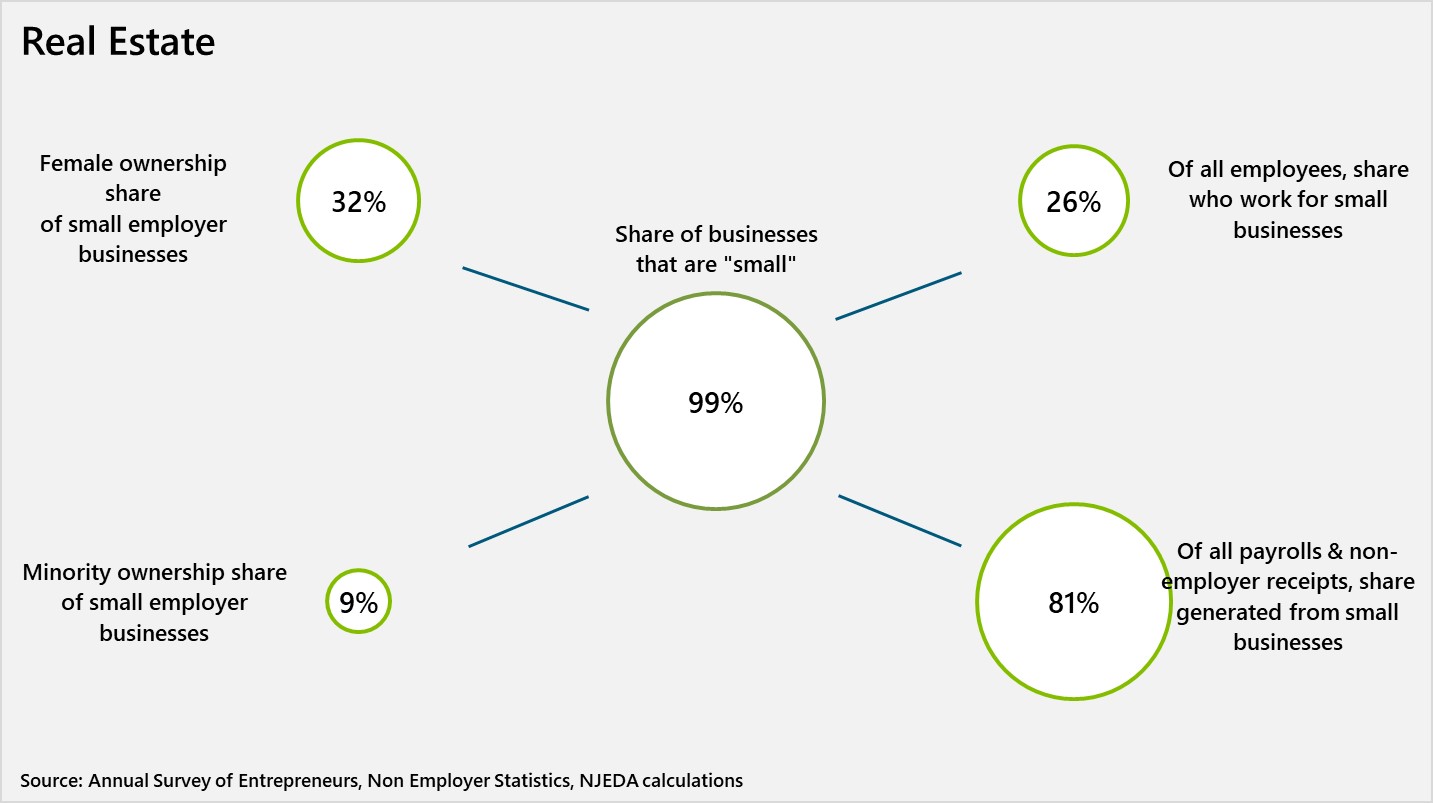
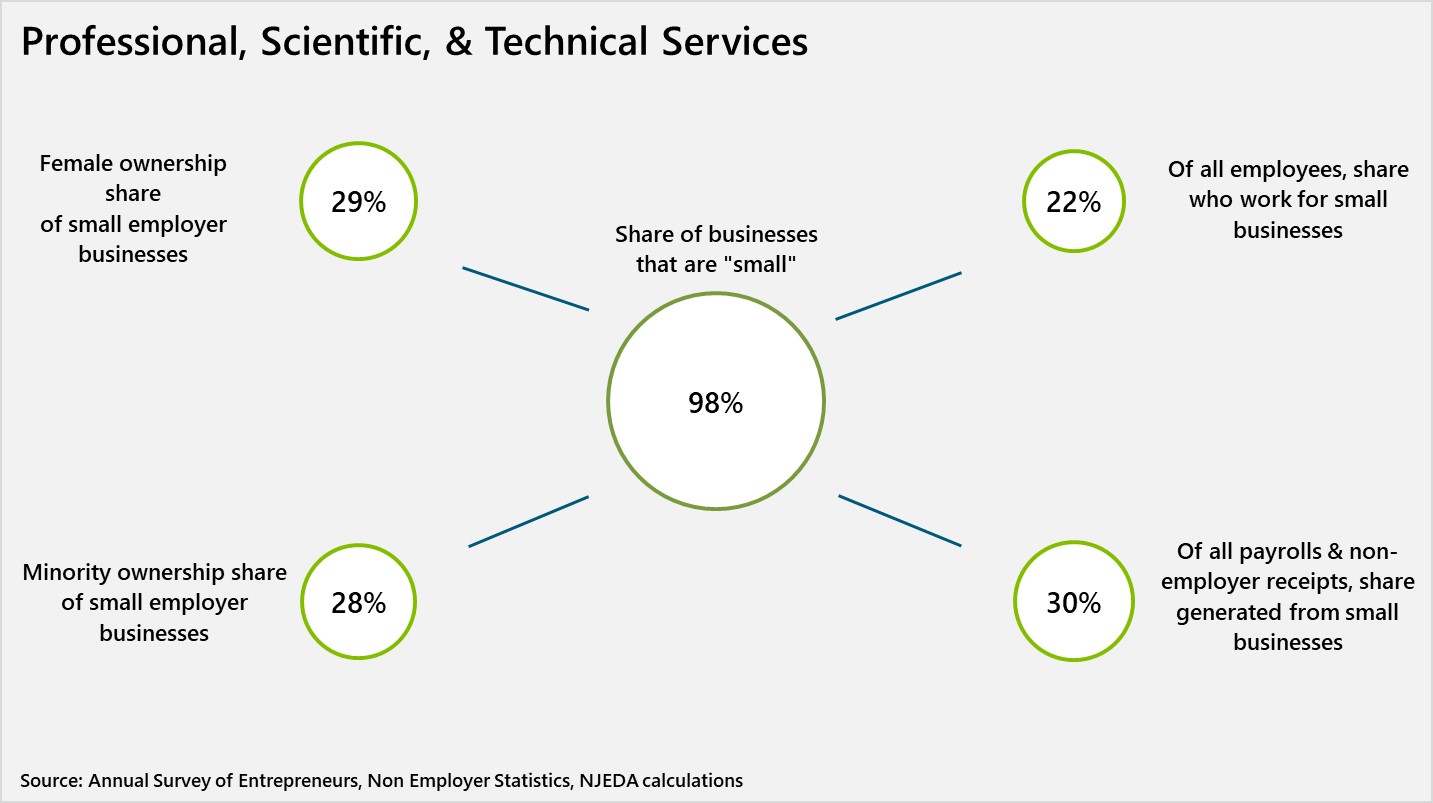
Although these businesses only account for 3 percent of economic activity, they are concentrated in some high value-added industries. For instance, the average nonemployer business earned $59,000, which is right in line with the average annual wage for all employer occupations . In New Jersey, the most nonemployer businesses are in some high value-added industries, including professional, scientific, and technical services (117,000), real estate (103,000), transportation and warehousing (81,000).

Also important about nonemployer businesses is their outsized impact on some economically underrepresented segments of the population. Relative to employer businesses, nonemployer businesses in the US are twice as likely to be female-owned and almost twice as likely to be minority-owned. Also, younger people are more than twice as likely to own a nonemployer firm. This means nonemployer businesses create economic opportunities for segments of the population that would otherwise likely be lacking.

 

RK1.jpg

Lastly, there is a lot of dynamism and growth in the nonemployer business ecosystem. From 2012 through 2017, the number of nonemployer business in New Jersey increased at a 3.3 percent annualized rate and nonemployer business receipts in New Jersey grew at a 3.9 percent annualized rate. These growth rates are both faster than underlying GDP growth in New Jersey, showing nonemployer businesses are a growing segment of New Jersey’s economy.

“Small” Employer businesses in New Jersey

There are approximately 160,000 small employer businesses in New Jersey, accounting for around 87 percent of all employer businesses. Although they are such a large share of businesses, they account for only around 19 percent of New Jersey jobs and 13 percent of payrolls. The reason is most of these small employer businesses are truly small, employing one-to-four employees with an average payroll of around $77,000. Yet, these numbers add up. In sum, approximately 665,000 employees work for small businesses, generating around $28 billion in payroll income per year. 

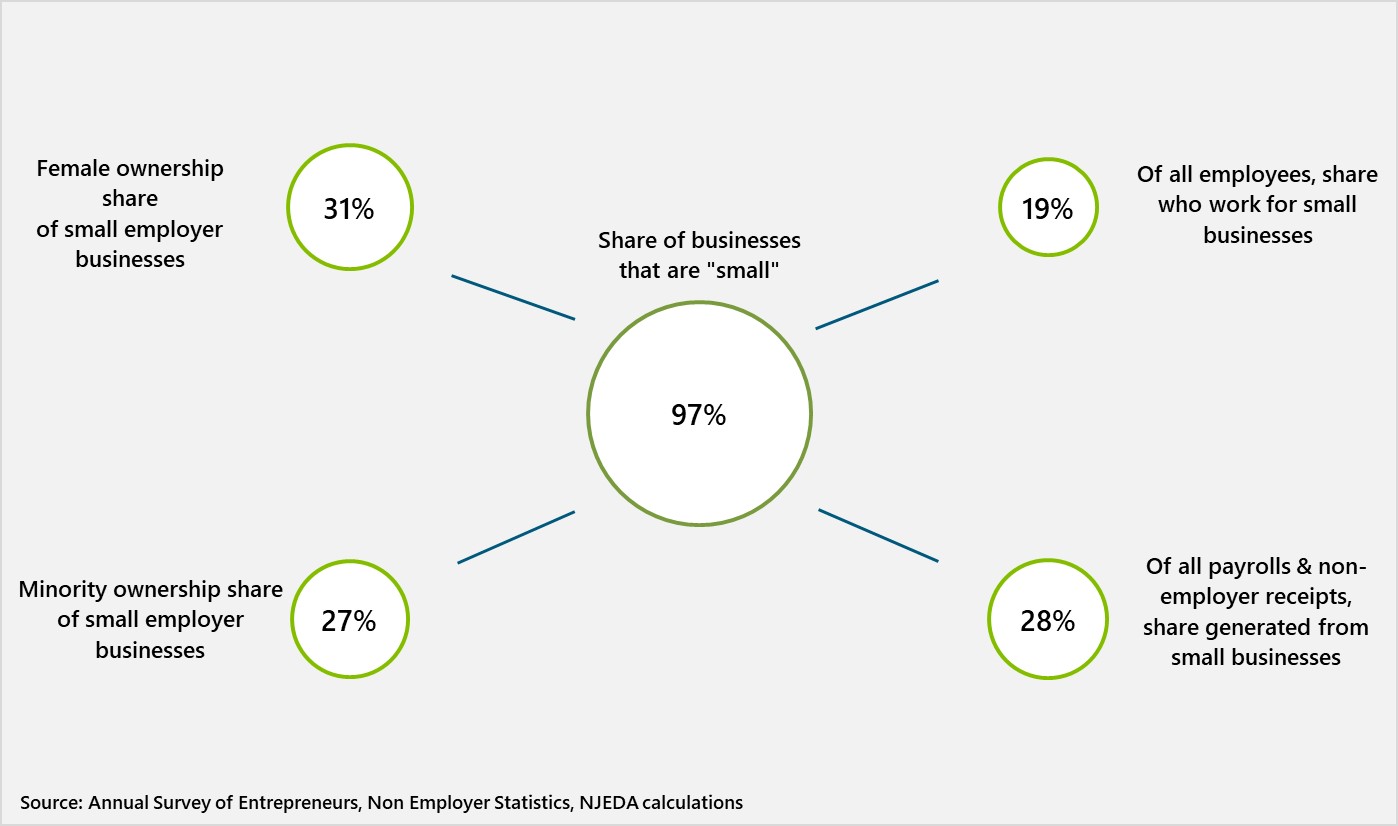
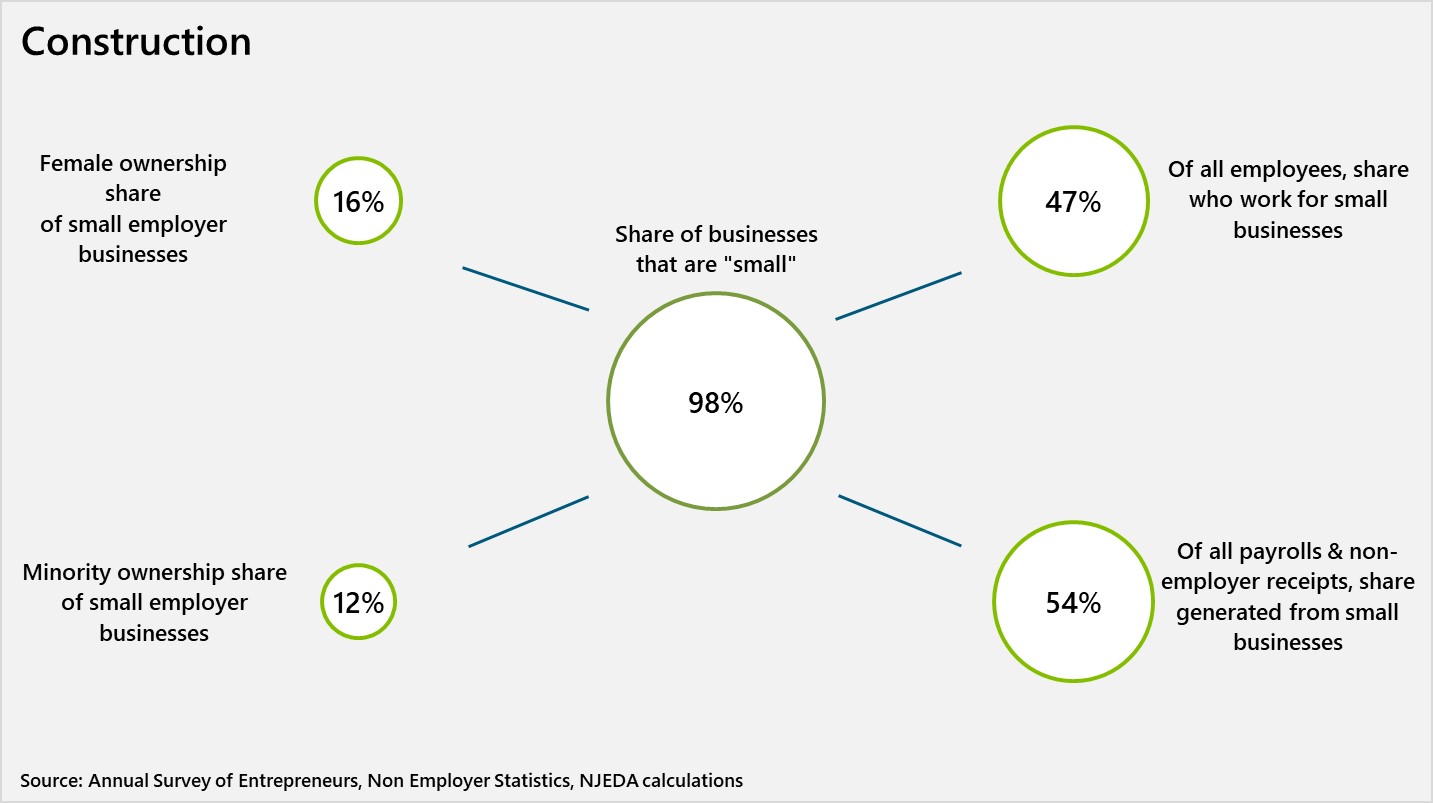
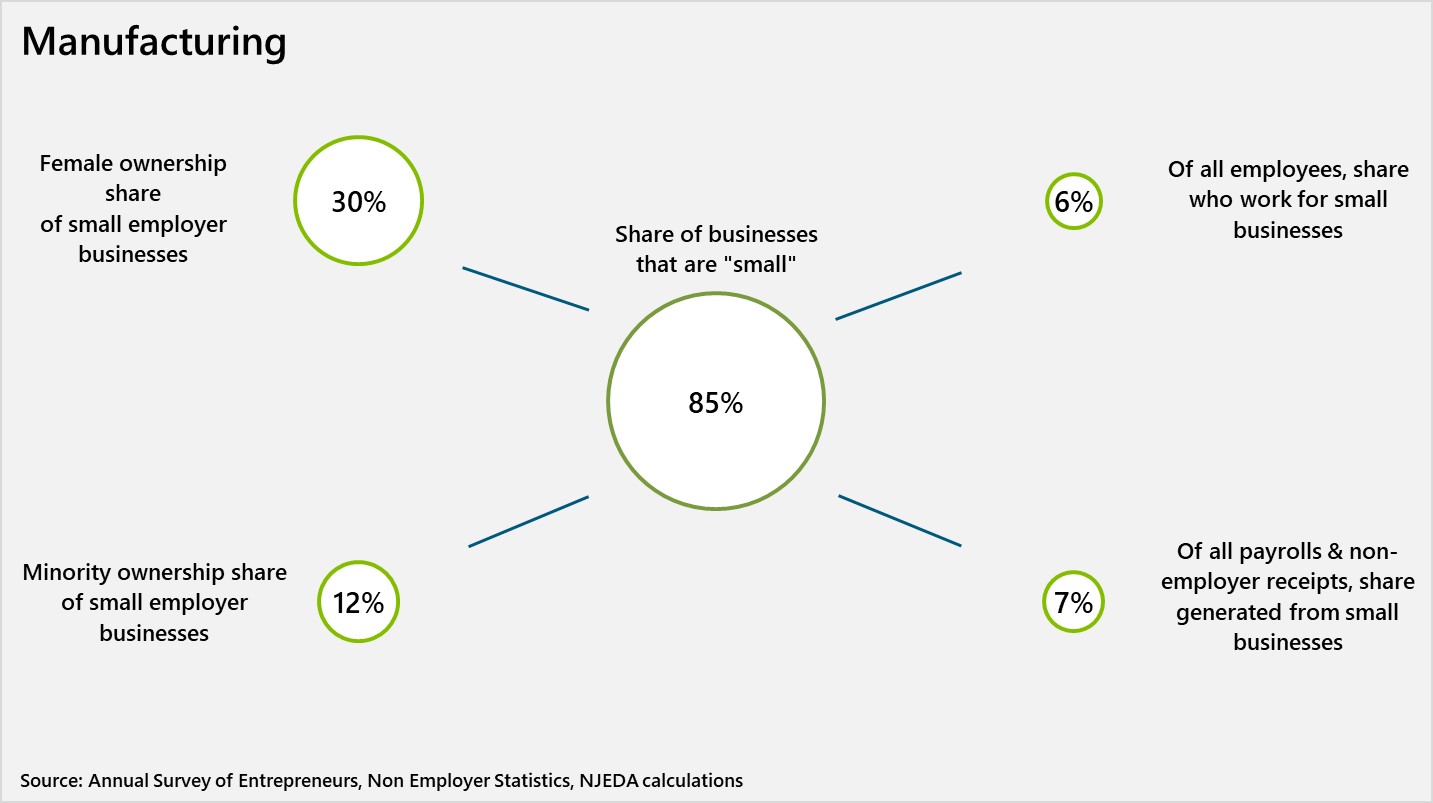
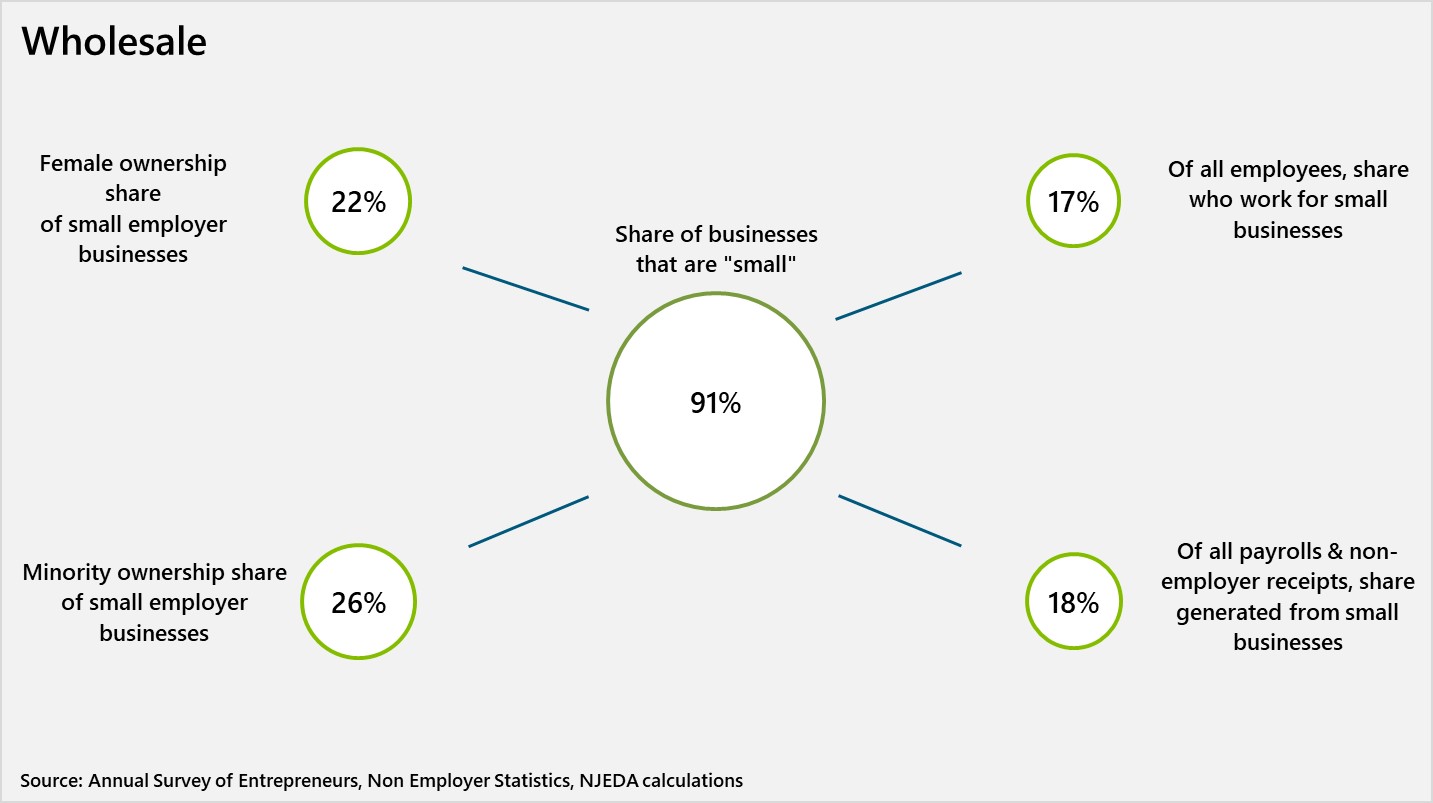
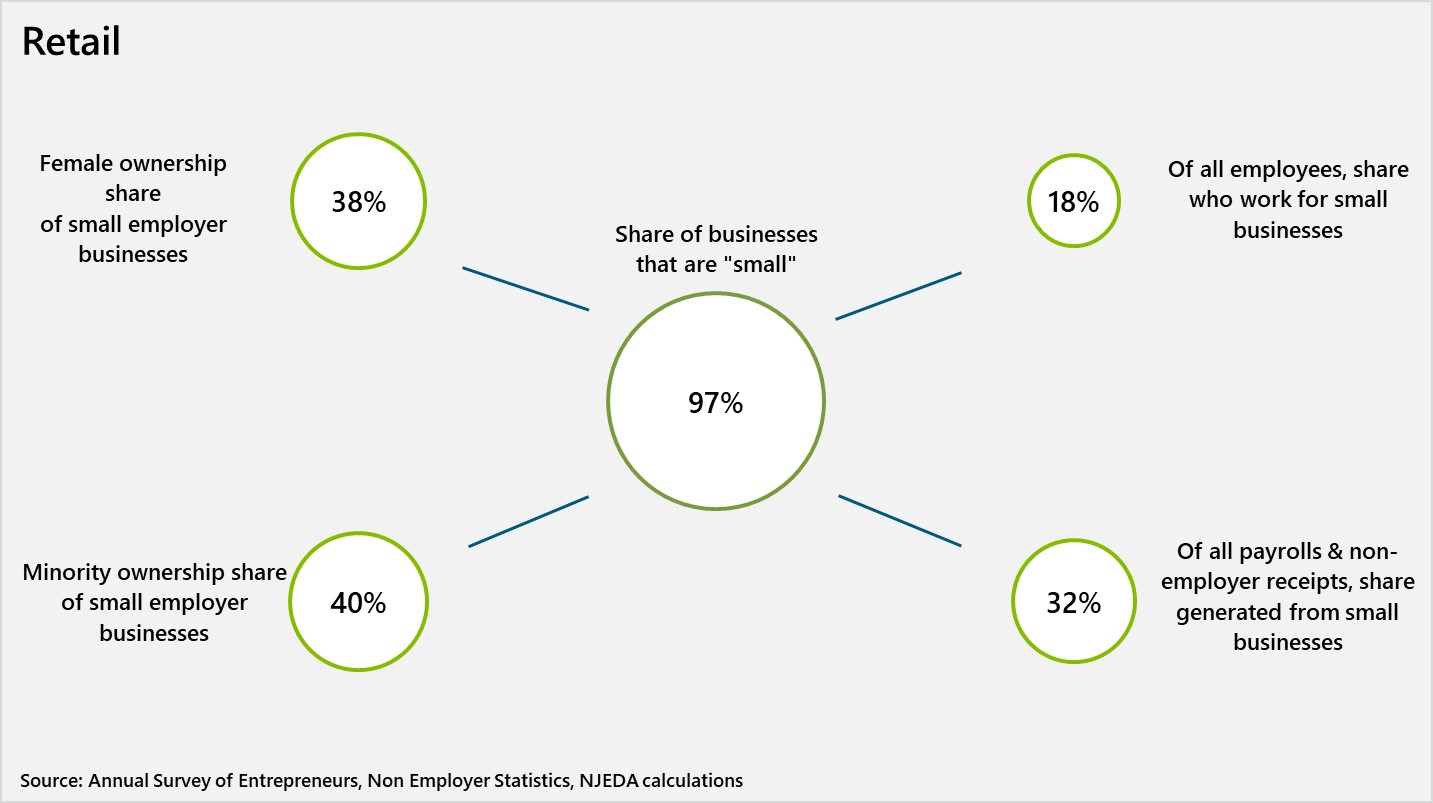
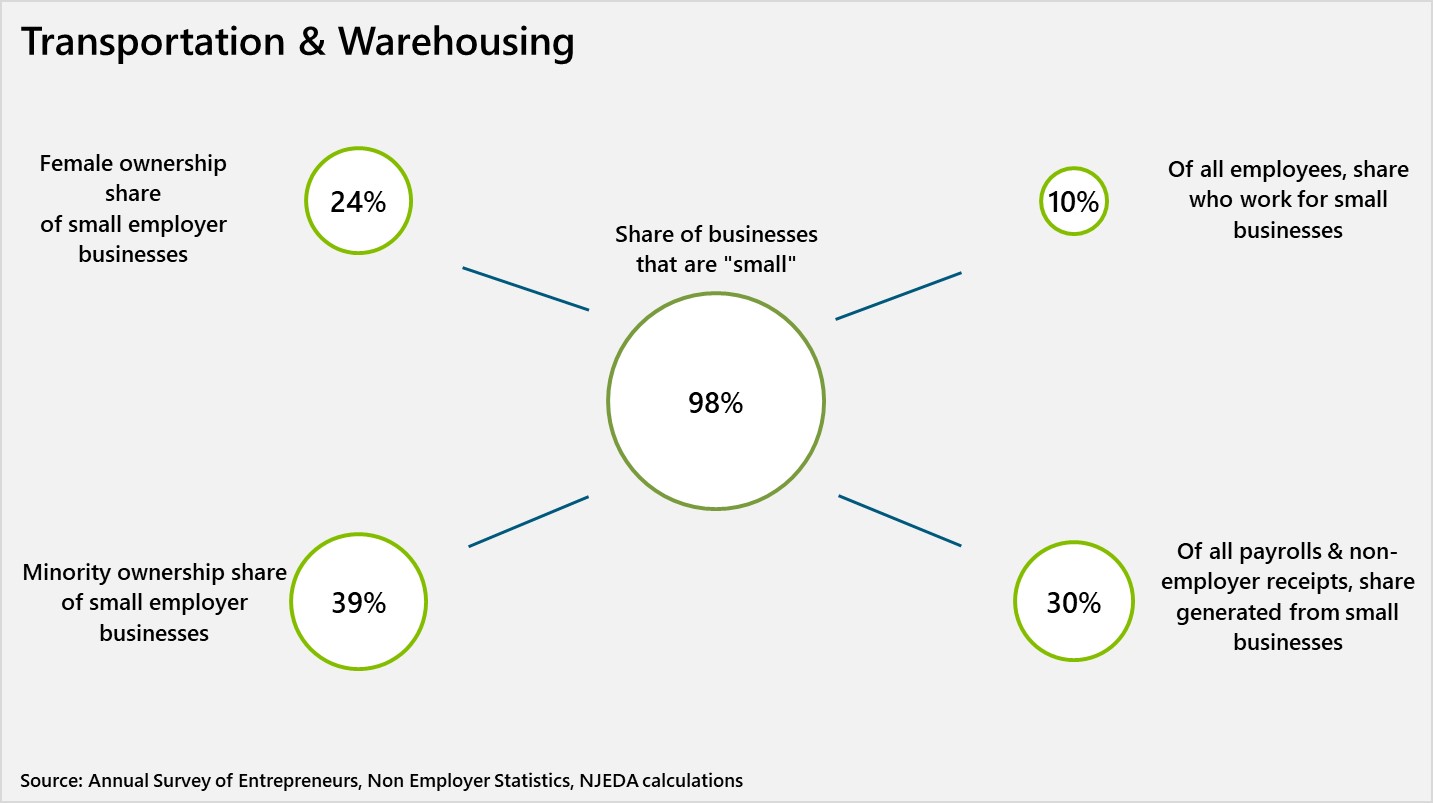
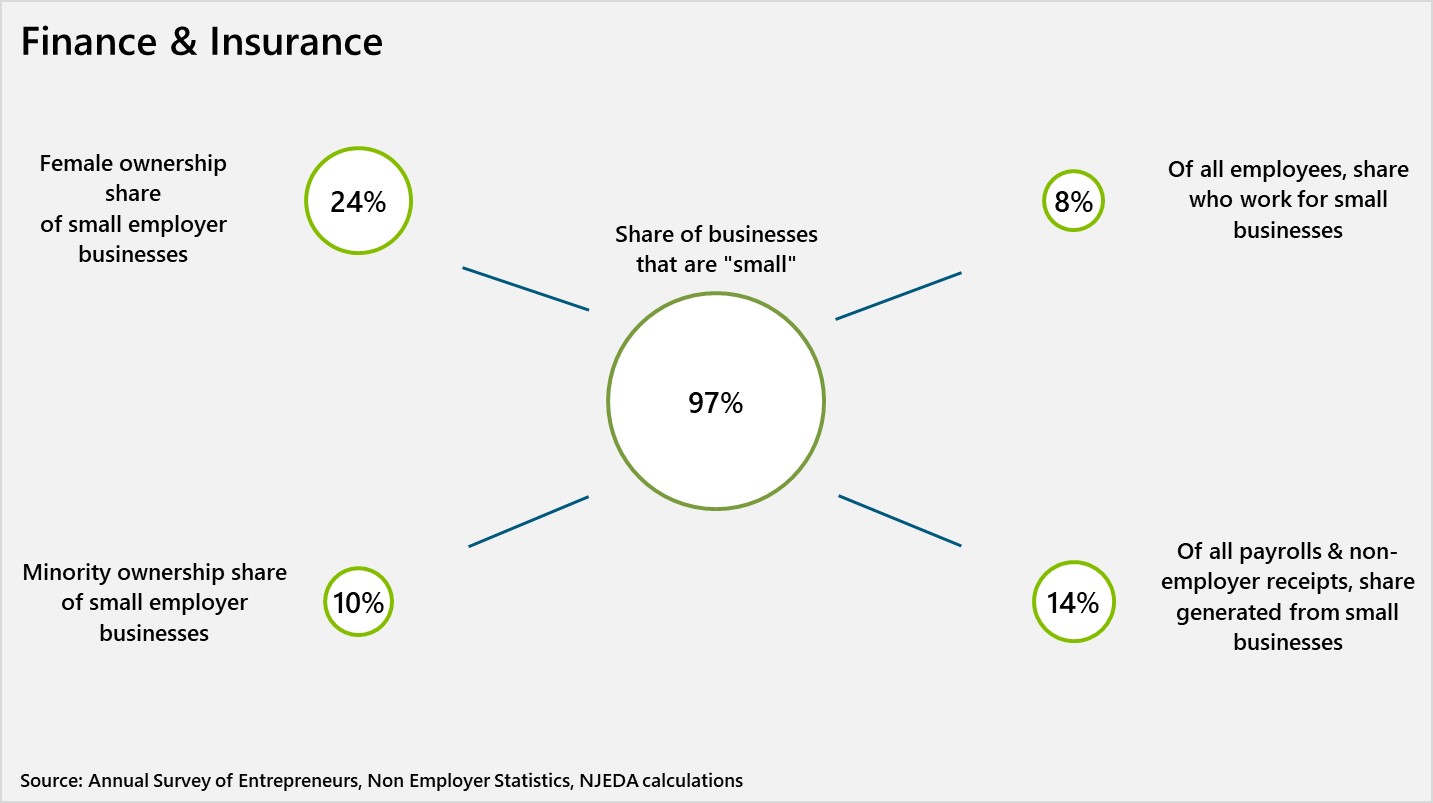
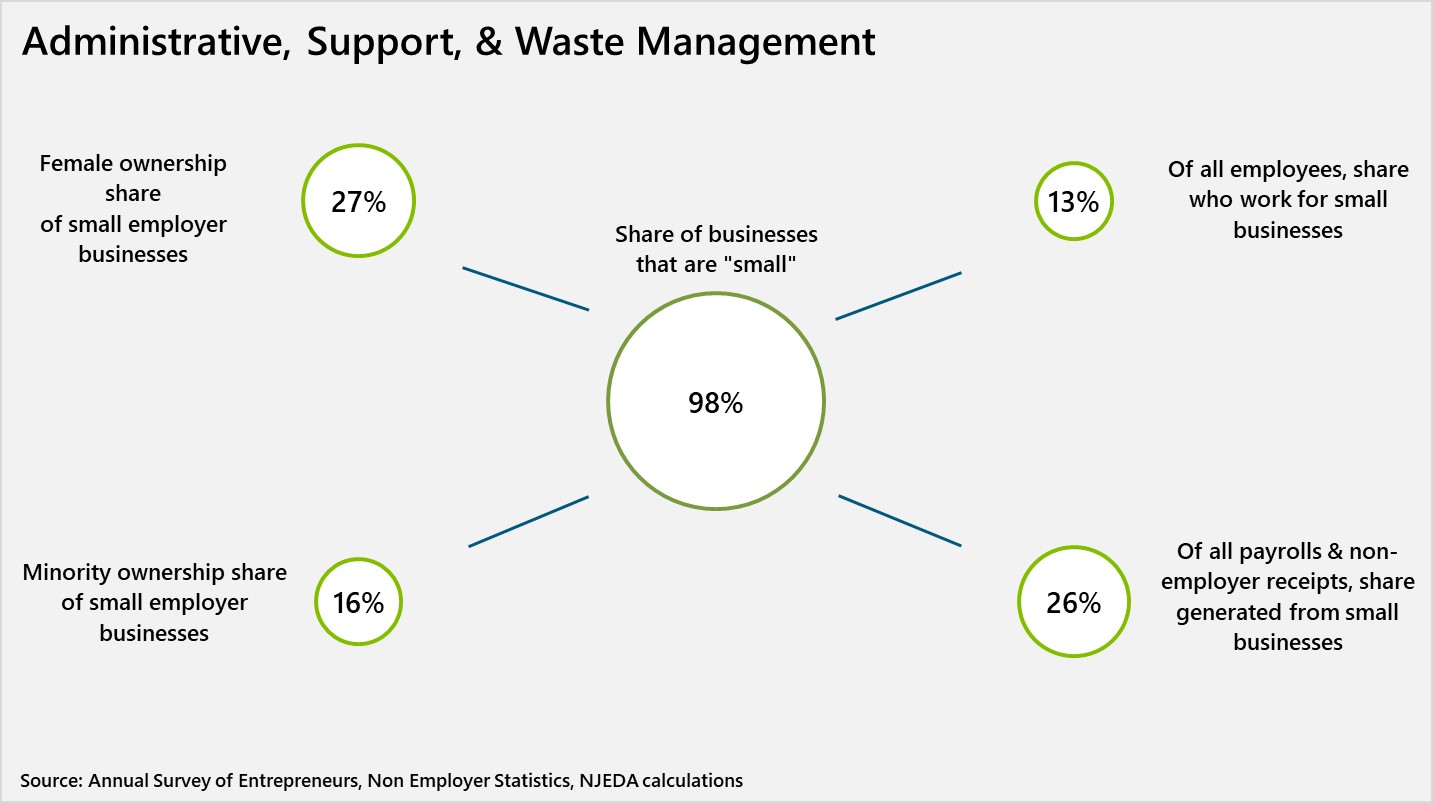
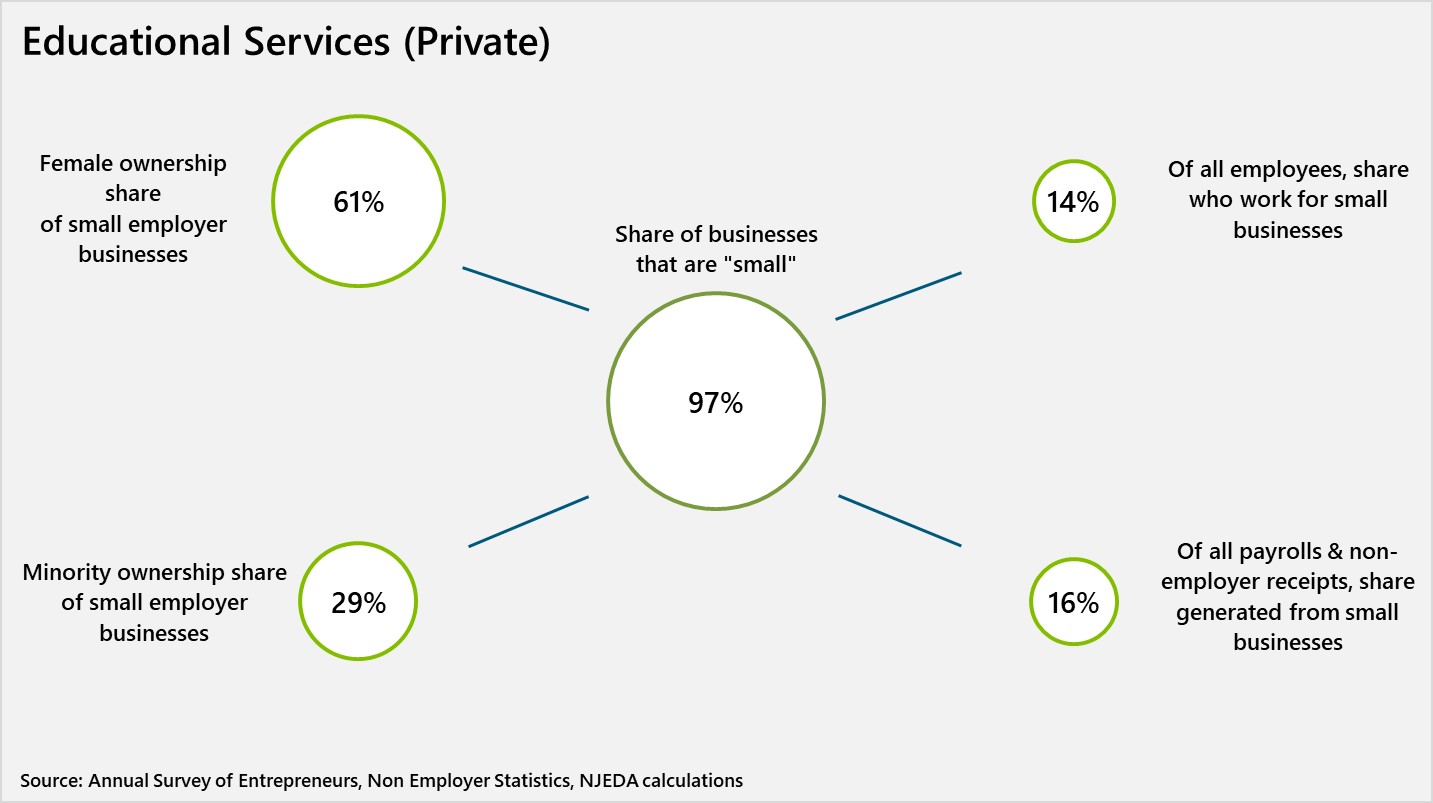
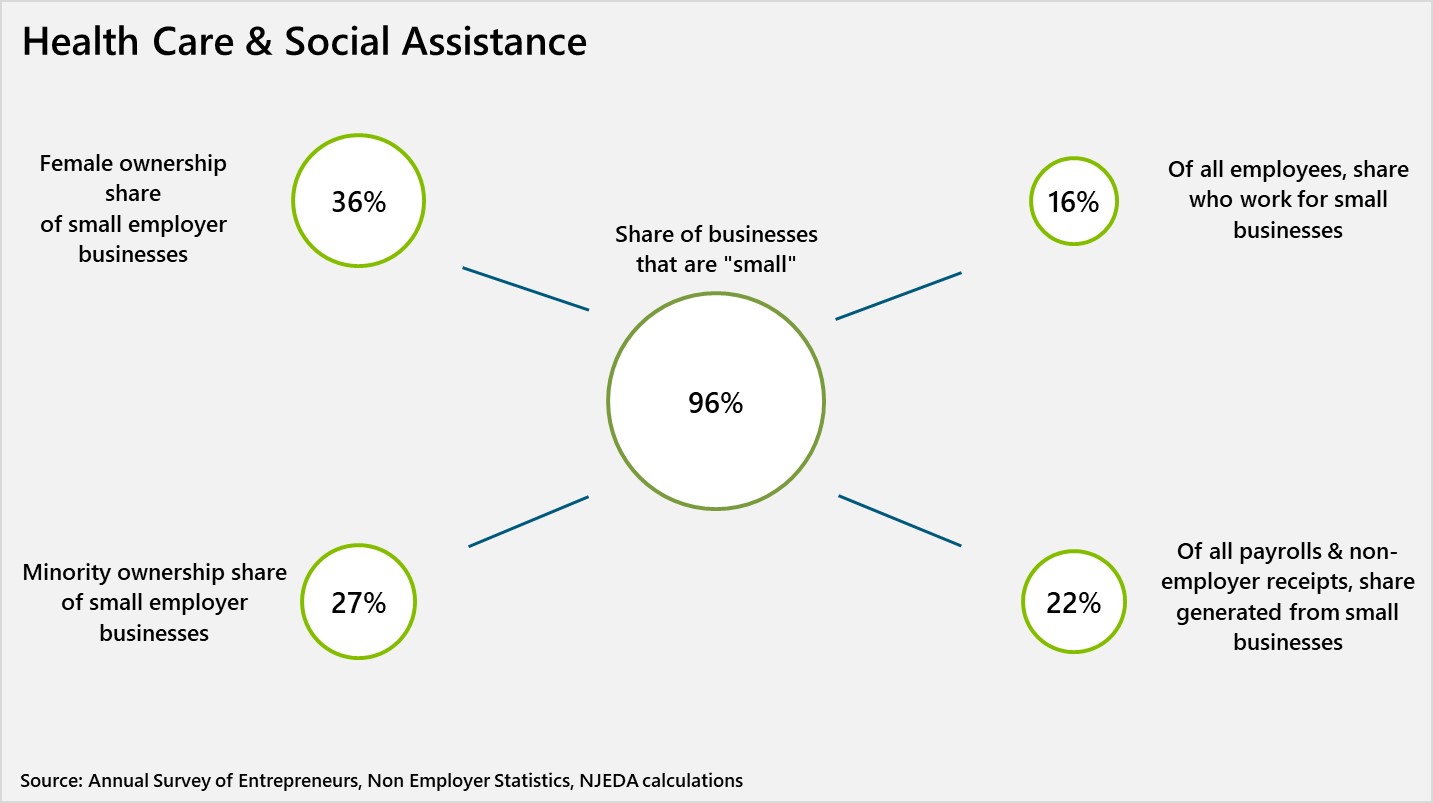
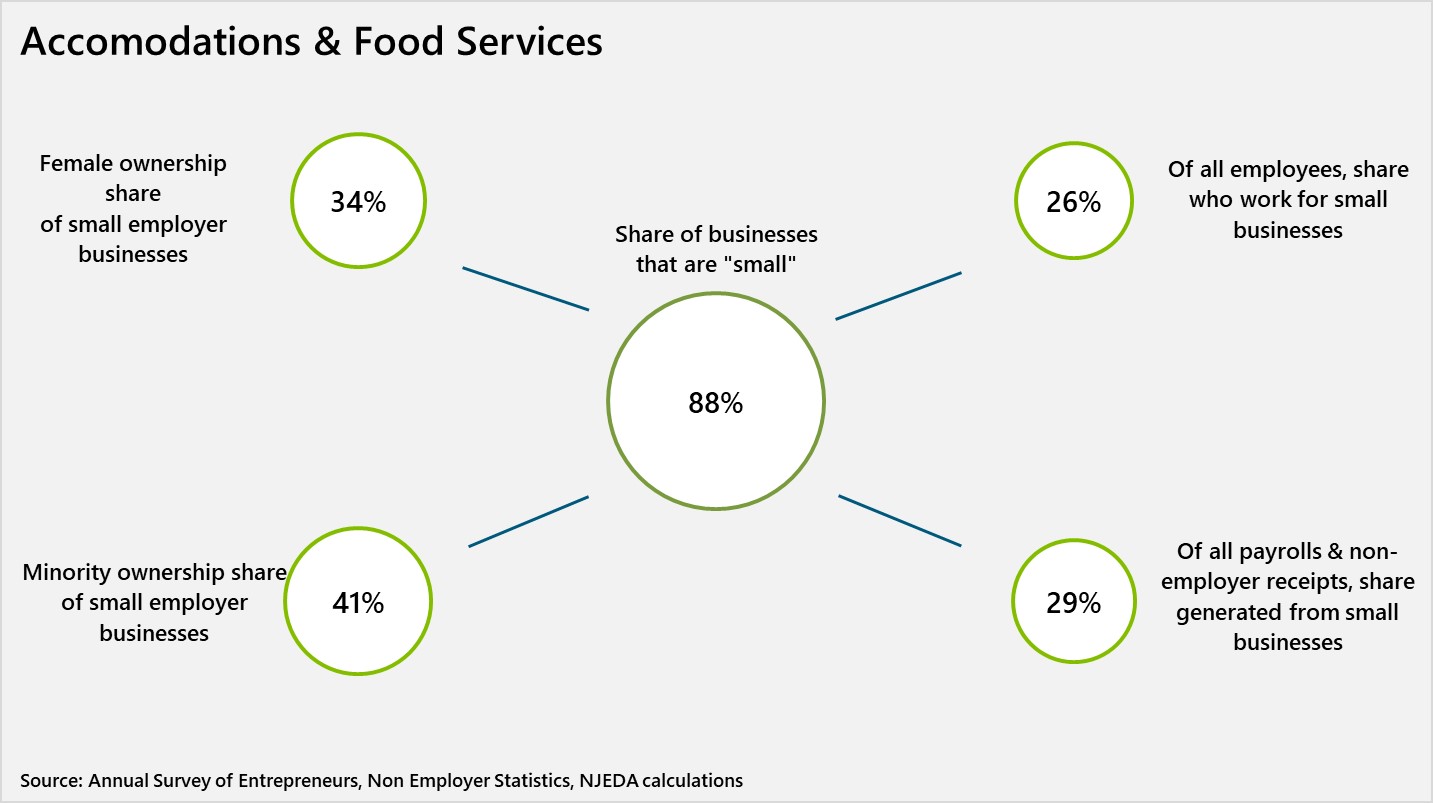
As with nonemployer businesses, small employer businesses are more likely to be minority- or female-owned than larger businesses. Of small businesses, approximately 27 percent are minority owned and 31 percent are female owned. It’s also important to note the significance of small employer businesses varies depending on the industry. For instance, around half of total construction industry income in New Jersey is generated by small employer businesses. This share drops to less than 8 percent in finance and insurance. In construction, 16 percent of small employer businesses are female-owned and 12 percent are minority-owned. In retail, these shares jump to 40 percent minority-owned and 38 percent female-owned. The point being, the impact small businesses have on the economy varies significantly from industry to industry. Graphics depicting the impact of small businesses in New Jersey by industry are displayed at the end of this brief.

The Aggregate Small Business Landscape in New Jersey

Adding together data on small employer businesses and nonemployer businesses allows us to examine the impact of the entire small business universe on New Jersey’s economy. To do so, it is useful to relegate impact into buckets of influence. In the following graphic we’re looking at four main buckets:
 

• The share of all businesses that are small
• The share of all employees who work for small businesses
• The share of payroll income and receipts – a proxy for income – generated by small businesses
• The share of small businesses that are female- or minority-owned

Similar graphics with data on some of New Jersey’s major industries appears at the end of this brief.

RK2.jpg


The data affords some key takeaways:
• Small businesses account for 97 percent of all businesses, yet only 19 percent of all New Jersey employees work for small businesses. Said differently, most employees in New Jersey work for large firms.
• These small businesses generate approximately 28 percent of New Jersey’s income, as estimated using payrolls and receipts. 
On average, 31 percent of small employer businesses and owned by women, and 27 percent are owned by minorities. These shares are not as large as for nonemployer businesses.

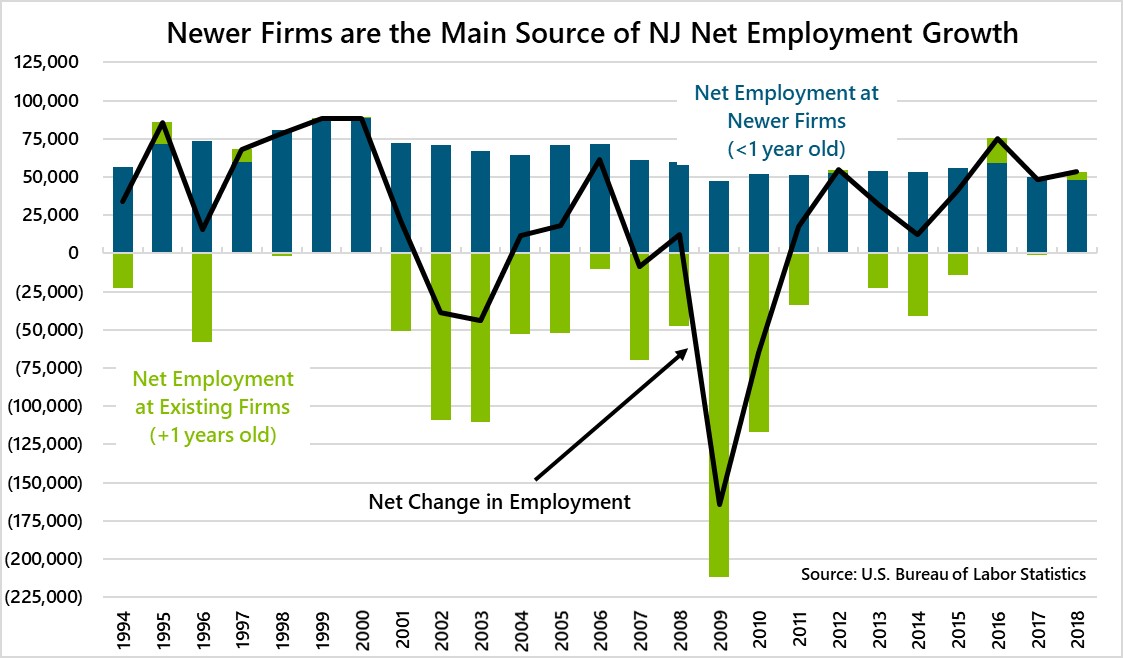
But when it comes to job creation, it’s new businesses – not small businesses — that matter

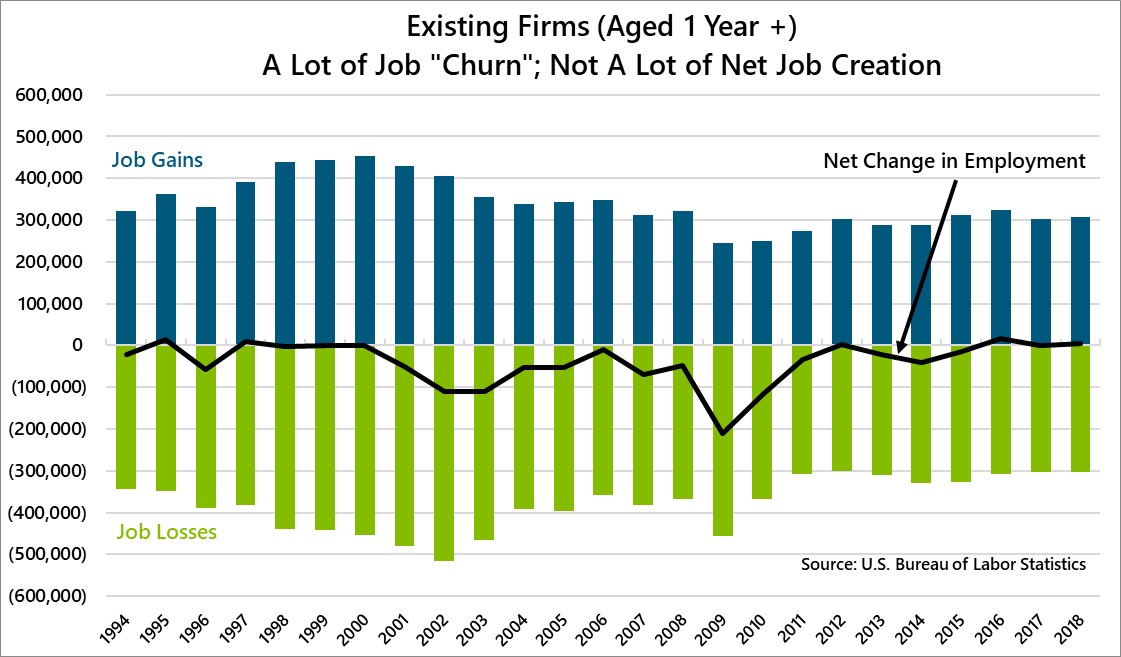
It’s really the creation of new firms, rather than small firms, per se, that’s the lifeblood of an economy. New firms, led by entrepreneurs, are essential to what the famous economist Joseph Schumpeter coined “creative destruction” — the process through which economic growth occurs as new firms replace older, less productive firms. Whereas new firms create net new jobs, firms that have existed for one year or longer essentially shift a lot of employees between firms and create very few net new jobs.

RK3.jpg

This is not to say movement of jobs between firms, often referred to as labor market churn, is not important. Quite contrary, it is very important for income growth of people who leave jobs to take better opportunities elsewhere. But when it comes to actual job creation and productivity, it’s new firms that matter most.

RK4.jpg

Conclusion

In sum, small business is certainly a lifeblood of economic opportunity for certain segments of the population, especially when we consider these businesses create jobs for their owners. Given the important contributions these businesses make to the economic lives of many New Jerseyans, the state should certainly do what it can to enable the creation and ongoing health of these businesses by lowering barriers to entry, providing efficient licensing and regulation, and ensuring a stable legal and tax backdrop so these businesses understand the “rules of the game” and owners feel comfortable investing in and growing their businesses. Moreover, it is important current and prospective small business are well informed about the resources New Jersey provides, such as the Small Business Lease Assistance Program, CDFI Initiative, NJ Ignite, and the recently-expanded Angel Investor Tax Credit, to support small businesses and startup development and growth.

The Small Business Landscape, by Industry

RK5.jpg  RK6.jpgRK7.jpgRK8.jpgRK9.jpgRK10-(2).jpgRK11.jpgRK12.jpgRK13.jpgRK14.jpgRK15.jpgRK16.jpg