Translate
Facebook
X
Instagram
LinkedIn
Youtube

ASPIRE PROGRAM


Aspire is a gap financing tool to support commercial, mixed use, and residential real estate development projects that replaces the Economic Redevelopment and Growth Grant (ERG).

ELIGIBILITY

To be eligible for Aspire support, a project must:

  • Demonstrate through NJEDA analysis that without the incentive award, the redevelopment project is not economically feasible.
  • Demonstrate that a project financing gap exists and/or the redevelopment project will generate a below market rate of return.
  • Be located in a designated “Incentive Area.”
  • Include developer who has an equity participation of at least 20 percent of the total cost.
  • Result in a net positive benefit to the State.
  • Meet specific cost thresholds (for residential projects), depending on where the project is located.

Please be advised: New Jersey State law prohibits most cannabis license and certification holders from receiving or continuing to receive an economic incentive from the NJEDA. If the applicant, or any person who controls the applicant or owns or controls more than one percent of the stock of the applicant, has applied for or received a license or a certification from the New Jersey Cannabis Regulatory Commission (NJ-CRC), the applicant is ineligible for this program and should not proceed with an application. If an application is received from an applicant that meets this criteria, the application will be declined and the application fee will not be refunded. 

PROJECT CAPS

  • 85% of eligible costs up to $120 Million for projects located in Atlantic City, Trenton, and Paterson
  • 80% of eligible costs up to $120 Million for projects located in Camden, East Orange, and New Brunswick
  • 60% of eligible costs up to $90 Million for LIHTC projects or projects located in a qualified incentive tract or enhanced area municipality with a MRI Distress Score of at least 50
    • Enhanced areas include: Jersey City, Newark, Elizabeth, Passaic, Hoboken, Paulsboro, Salem
  • 50% of eligible costs up to $60 million for all other eligible projects
  • Transformative caps are the same percentages noted above but up to $400 Million
  • Tax Credits are disbursed over a ten-year period. Certain projects in GRMs are disbursed either in five- or ten-year period

FISCAL AND RESIDENT PROTECTIONS

To demonstrate local support for the project, the developer must have a letter of support for project from the chief executive of the municipality and must enter into a Community Benefits Agreement and also a Redevelopment Agreement with the project’s municipal governing body. 

APPLICATION

NJEDA is currently accepting applications for the Aspire program.

Consultation with Aspire program staff prior to beginning work on an application is advised because completing the application will require focused time and attention on the applicant’s part; because Aspire program eligibility rules are nuanced; and because application fees are non-refundable.

Aspire program rules are available here for review.

If you are interested in applying for the Aspire Program, please contact an Aspire Program team member at Aspire@NJEDA.gov

The application link can be found here.

FEES
Click table to enlarge.
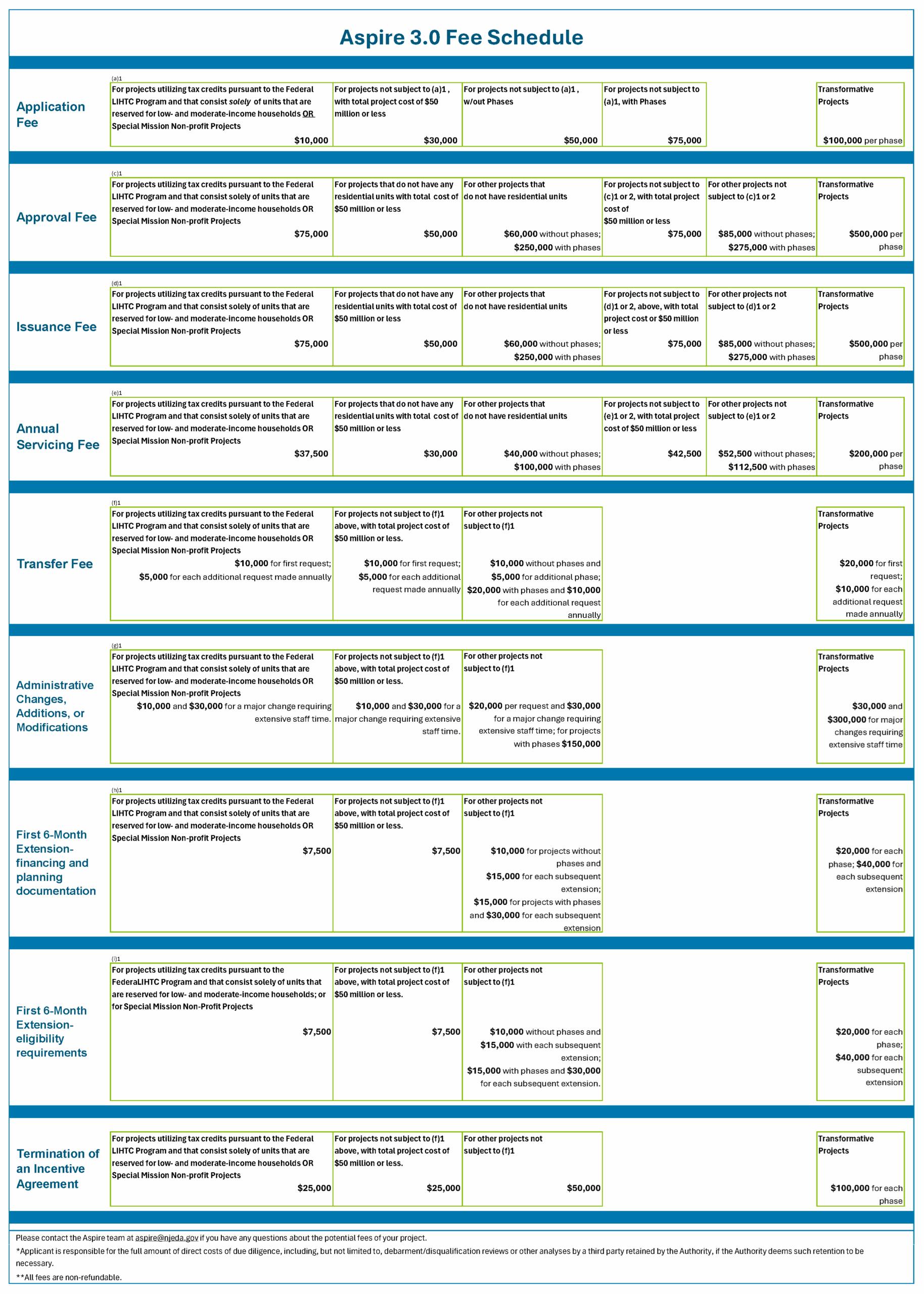
Image Description: Aspire 3.0 Fee Schedule Application Fee for projects utilizing tax credits pursuant to the Federal LIHTC Program and that consist solely of units that are reserved for low- and moderate-income households OR Special Mission Non-profit Projects is $10,000. Application Fee for projects not subject to (a)1 , with total project cost of $50 million or less is $30,000. Application Fee for projects not subject to (a)1, w/out Phases is $50,000. Application Fee for projects not subject to (a)1, with Phases is $75,000. Application Fee for Transformative Projects is $100,000 per phase. Approval Fee projects utilizing tax credits pursuant to the Federal LIHTC Program and that consist solely of units that are reserved for low- and moderate-income households OR Special Mission Non-profit Projects is $75,000 Approval Fee for projects that do not have any residential units with total cost of $50 million or less is $50,000. Approval Fee for other projects that do not have residential units is $60,000 without phases; $250,000 with phases. Approval Fee for projects not subject to (c)1 or 2, with total project cost of $50 million or less is $75,000. Approval Fee for other projects not subject to (c)1 or 2 is $85,000 without phases; $275,000 with phases. Approval Fee for Transformative Projects is $500,000 per phase. Insurance Fee for projects utilizing tax credits pursuant to the Federal LIHTC Program and that consist solely of units that are reserved for low- and moderate-income households OR Special Mission Non-profit Projects $75,000. Insurance Fee for projects that do not have any residential units with total cost of $50 million or less is $50,000. Insurance Fee for other projects that do not have residential units is $60,000 without phases; $250,000 with phases. Insurance Fee for projects not subject to (d)1 or 2, with total project cost of $50 million or less is $75,000. Insurance Fee for other projects not subject to (d)1 or 2 is $85,000 without phases; $275,000 with phases. Insurance Fee for Transformative Projects is $500,000 per phase. Annual Servicing Fee for projects utilizing tax credits pursuant to the Federal LIHTC Program and that consist solely of units that are reserved for low- and moderate-income households OR Special Mission Non-profit Projects $37,500. Annual Servicing Fee projects that do not have any residential units with total cost of $50 million or less is $30,000. Annual Servicing Fee for other projects that do not have residential units is $40,000 without phases; $100,000 with phases. Annual Servicing Fee for projects not subject to (e)1 or 2, with total project cost of $50 million or less is $42,500. Annual Servicing Fee for other projects not subject to (e)1 or 2 is $52,500 without phases; $112,500 with phases. Annual Servicing Fee for Transformative Projects is $200,000 per phase. Transfer Fee for projects utilizing tax credits pursuant to the Federal LIHTC Program and that consist solely of units that are reserved for low- and moderate-income households OR Special Mission Non-profit Projects is $10,000 for first request; $5,000 for each additional request made annually. Transfer Fee for projects not subject to (f)1 above, with total project cost of $50 million or less is $10,000 for first request; $5,000 for each additional request made annually. Transfer Fee for other projects not subject to (f)1 is $10,000 without phases and $5,000 for each additional phase; and $20,000 with phases, and $10,000 for each additional request made annually. Transfer Fee for Transformative Projects is $20,000 for first request; $10,000 for each additional request made annually. Administrative Changes, Additions, or Modifications Fee projects utilizing tax credits pursuant to the Federal LIHTC Program and that consist solely of units that are reserved for low- and moderate-income households OR Special Mission Non-profit Projects is $10,000 and $30,000 for a major change requiring extensive staff time. Administrative Changes, Additions, or Modifications Fee for projects not subject to (f)1 above, with total project cost of $50 million or less is $10,000 and $30,000 for a major change requiring extensive staff time. Administrative Changes, Additions, or Modifications Fee for other projects not subject to (f)1 is $20,000 and $30,000 for a major change requiring extensive staff time; and without and with phases $150,000. Administrative Changes, Additions, or Modifications Fee for Transformative Projects is $30,000 and $300,000 for major changes requiring extensive staff time. The financing and planning documentation fee for the first 6-Month Extension projects utilizing tax credits pursuant to the Federal LIHTC Program and that consist solely of units that are reserved for low- and moderate-income households OR Special Mission Non-profit Projects is $7,500. The financing and planning documentation fee for the first 6-Month Extension for projects not subject to (f)1 above, with total project cost of $50 million or less is $7,500. The financing and planning documentation fee for the first 6-Month Extension for other projects not subject to (f)1 is $10,000 for projects without phases and $15,000 for each subsequent extension; $15,000 for projects with phases and $30,000 for each subsequent extension. The financing and planning documentation fee for the first 6-Month Extension for Transformative Projects is $20,000 for each phase; $40,000 for each subsequent extension. The eligibility requirements fee for the first 6-Month Extension for projects utilizing tax credits pursuant to the Federal LIHTC Program and that consist solely of units that are reserved for low- and moderate-income households OR Special Mission Non-profit Projects is $7,500. The eligibility requirements fee for the first 6-Month Extension for projects not subject to (f)1 above, with total project cost of $50 million or less is $7,500. The eligibility requirements fee for the first 6-Month Extension for other projects not subject to (f)1 is $10,000 without phases and $15,000 with each subsequent extension; $15,000 with phases and $30,000 for each subsequent extension. The eligibility requirements fee for the first 6-Month Extension for Transformative Projects is $20,000 for each phase; $40,000 for each subsequent extension. Termination of an Incentive Agreement Fee for projects utilizing tax credits pursuant to the Federal LIHTC Program and that consist solely of units that are reserved for low- and moderate-income households OR Special Mission Non-profit Projects $25,000. Termination of an Incentive Agreement Fee for projects not subject to (f)1 above, with total project cost of $50 million or less is $25,000. Termination of an Incentive Agreement Fee for other projects not subject to (f)1is $50,000. Termination of an Incentive Agreement Fee for Transformative Projects is $100,000 for each phase. Please contact the Aspire team at aspire@njeda.gov if you have any questions about the potential fees of your project. *Applicant is responsible for the full amount of direct costs of due diligence, including, but not limited to, debarment/disqualification reviews or other analyses by a third party retained by the Authority, if the Authority deems such retention to be necessary. **All fees are non-refundable.

Please contact the Aspire team at aspire@njeda.gov to discuss the potential fees of your application.

* Applicant is responsible for the full amount of direct costs of due diligence, including, but not limited to, debarment/disqualification reviews or other analyses by a third party retained by the Authority, if the Authority deems such retention to be necessary.

** All fees are non-refundable.

The full statutory text of the program can be found in sections 54-67 of the Economic Recovery Act of 2020.

Incentive Areas

Eligible “Incentive Areas” are areas designated pursuant to the “State Planning Act” P.L.1985, c.398 (C.52:18A-196 et seq.), as Planning Area 1 (Metropolitan), Port District, Certain designated Brownfield Sites over 100 acres with certified remediation costs over $10 million, or a Planning Area 2 (Suburban) or Designated Center under the State Development and Redevelopment Plan.  

Cost Thresholds

Minimum project costs for Aspire are based on the population of the municipality where the project is taking place.

Municipality PopulationMinimum Total Project Cost
Population < 200,000$10 million
Population > 200,000$17.5 million

Projects located in a Qualified Incentive Tract or Government Restricted Municipality have a minimum eligible project costs of $5 million.

Commercial Projects must be at least 25,000 square feet if in a GRM and 50,000 square feet elsewhere, except in the case of health care or health service centers shall contain not less than $10,000 square feet.

Transformative Project Criteria

Projects that meet certain criteria can be designated as “Transformative Projects.” These projects can receive awards up to $400 million or 80 percent of eligible total project costs for any transformative project located in a Government Restricted Municipality. Alternatively, 60 percent of total project costs it the transformative project receives LIHTC, or any transformative project located in a qualified incentive tract, enhanced area, or municipality with a municipality with a Municipal Revitalization Index score of at least 50, or 50 percent of total project costs for any other transformative project. Retail projects are typically not eligible for Transformative Project awards.

To be designated as a Transformative Project, the project must satisfy the following criteria:

  • Have a total project cost of at least $150,000,000; and
  • Include the following commercial projects:
    • 200,000 or more square feet of new or substantially renovated industrial, commercial, or residential space for a project located in a government-restricted municipality, exclusive of any parking component;
    • 250,000 or more square feet of film production uses, exclusive of any parking component;
    • 300,000 or more square feet of new or substantially renovated industrial, commercial, or residential space for a project located in an enhanced area, exclusive of any parking component; or
    • 500,000 or more square feet of new or substantially renovated industrial, commercial, or residential space for any other project, exclusive of any parking component;
    • No more than 50% of the square footage can be point of sale retail, including hotels.
    • Further, the project must create 500 newly created full-time jobs
  • For residential projects, the project must include one of the following:
    • The construction of 700 or more newly-constructed residential units; or
    • Is a mixed-use residential project with construction of 30,000 square feet or more of commercial space, exclusive of any parking component, and includes one of the following:
      • If the project is located in a government-restricted municipality, includes the construction of 200 or more newly-constructed residential units;
      • If the project is located in an enhanced area, includes the construction of 300 or more newly-constructed residential units; or
      • If the project is not located in a GRM or enhanced area, and includes the construction of 400 or more newly-constructed residential units.