Under Governor Murphy’s leadership and his plan for a stronger and fairer New Jersey economy, there has been an increased emphasis on the importance of small businesses and new business creation within the Garden State. Last year, the NJEDA realigned its operations to create a new small business-dedicated team, and has since introduced a variety of new small business programs. 

Defining small business

Before we can begin to understand the impact of small business, we need to establish what constitutes a small business. The simple answer is, there is no one generally agreed to principle of what constitutes a small business. The US Small Business Administration uses a definition of an independent business with fewer than 500 employees. But this definition has a couple of inherent flaws. For one thing, this definition creates a net that snares a lot of relatively large businesses in terms of revenue and the scope of the customer base. Moreover, emphasis on number of employees misses an important point – more than 80 percent of all business entities in the US have no employees at all and likely never will.

For the sake of this brief, we’ll constrain our definition of small business to two groups of businesses:
 

1. Nonemployers, which are businesses with no paid employees but are subject to federal income taxes. Most nonemployer firms are sole proprietorships.

2. Employer businesses with fewer than 20 employment jobs, where an employment job is a job offered by an employer to an employee through a contractual relationship.

Nonemployer business in New Jersey

Nonemployer businesses are often overlooked when discussing the impact of small business in New Jersey. In respect to the amount of GDP they create, overlooking them is understandable. In New Jersey, as in the rest of the US, they account for around just 3 percent of GDP. Moreover, since they don’t directly create employment, they generally receive little attention from economic policies focused on job growth. But these businesses are very important in several key ways. For one thing, there are a lot of nonemployer businesses. As of 2017, there were approximately 720,000 nonemployer businesses in New Jersey, which is around 80 percent of all businesses. 

It also should be understood that nonemployer businesses essentially create jobs for their owners. So that’s 720,000 jobs. And although they do not directly create jobs for others, the economic activity they generate does create jobs through multiplier effects, generating economic activity throughout the economy via direct spending of the nonemployer’s income and indirect effects of the business’s expenditures on capital, rent, materials, and inputs from other businesses.

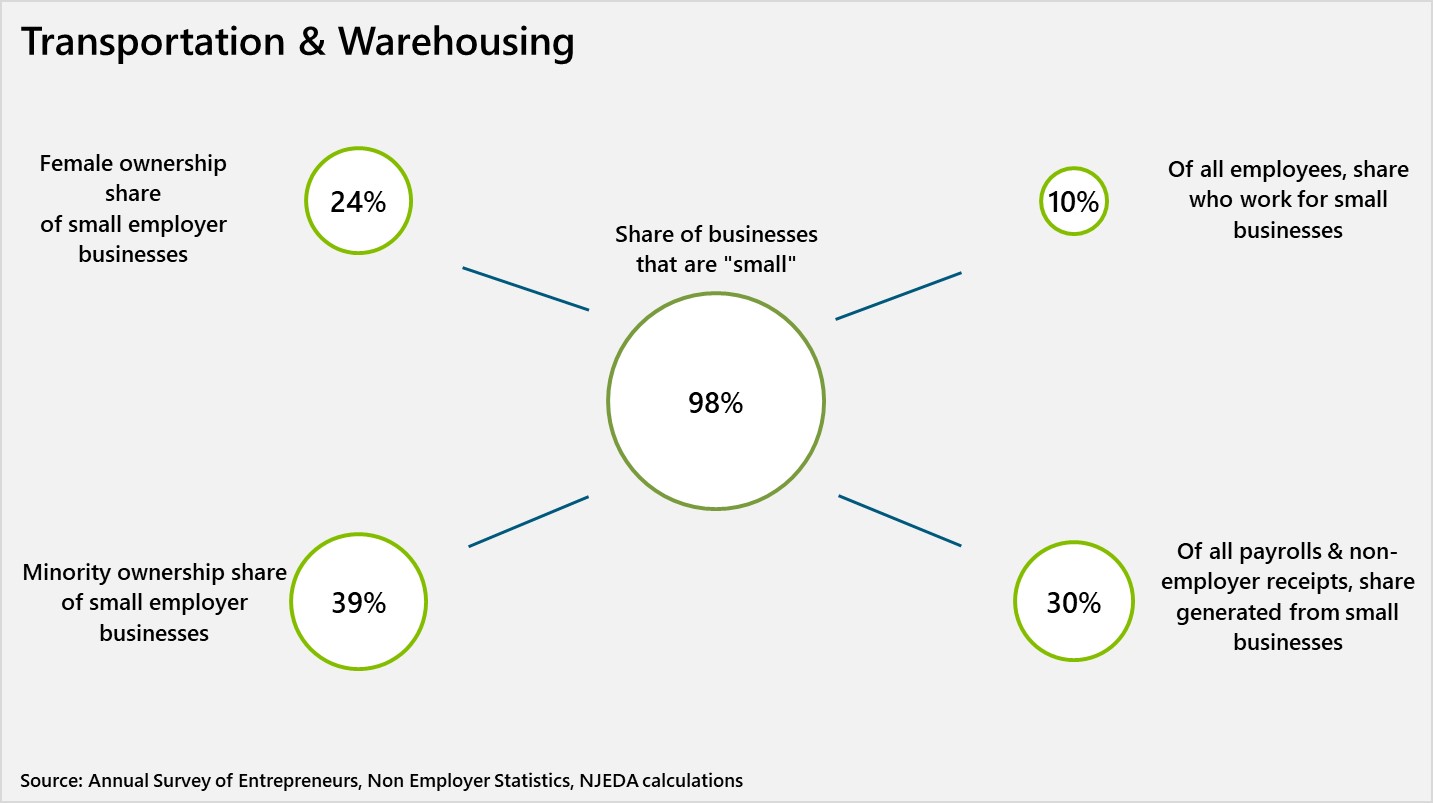
Although these businesses only account for 3 percent of economic activity, they are concentrated in some high value-added industries. For instance, the average nonemployer business earned $59,000, which is right in line with the average annual wage for all employer occupations . In New Jersey, the most nonemployer businesses are in some high value-added industries, including professional, scientific, and technical services (117,000), real estate (103,000), transportation and warehousing (81,000).

Also important about nonemployer businesses is their outsized impact on some economically underrepresented segments of the population. Relative to employer businesses, nonemployer businesses in the US are twice as likely to be female-owned and almost twice as likely to be minority-owned. Also, younger people are more than twice as likely to own a nonemployer firm. This means nonemployer businesses create economic opportunities for segments of the population that would otherwise likely be lacking.

 

RK1.jpg

Lastly, there is a lot of dynamism and growth in the nonemployer business ecosystem. From 2012 through 2017, the number of nonemployer business in New Jersey increased at a 3.3 percent annualized rate and nonemployer business receipts in New Jersey grew at a 3.9 percent annualized rate. These growth rates are both faster than underlying GDP growth in New Jersey, showing nonemployer businesses are a growing segment of New Jersey’s economy.

“Small” Employer businesses in New Jersey

There are approximately 160,000 small employer businesses in New Jersey, accounting for around 87 percent of all employer businesses. Although they are such a large share of businesses, they account for only around 19 percent of New Jersey jobs and 13 percent of payrolls. The reason is most of these small employer businesses are truly small, employing one-to-four employees with an average payroll of around $77,000. Yet, these numbers add up. In sum, approximately 665,000 employees work for small businesses, generating around $28 billion in payroll income per year. 

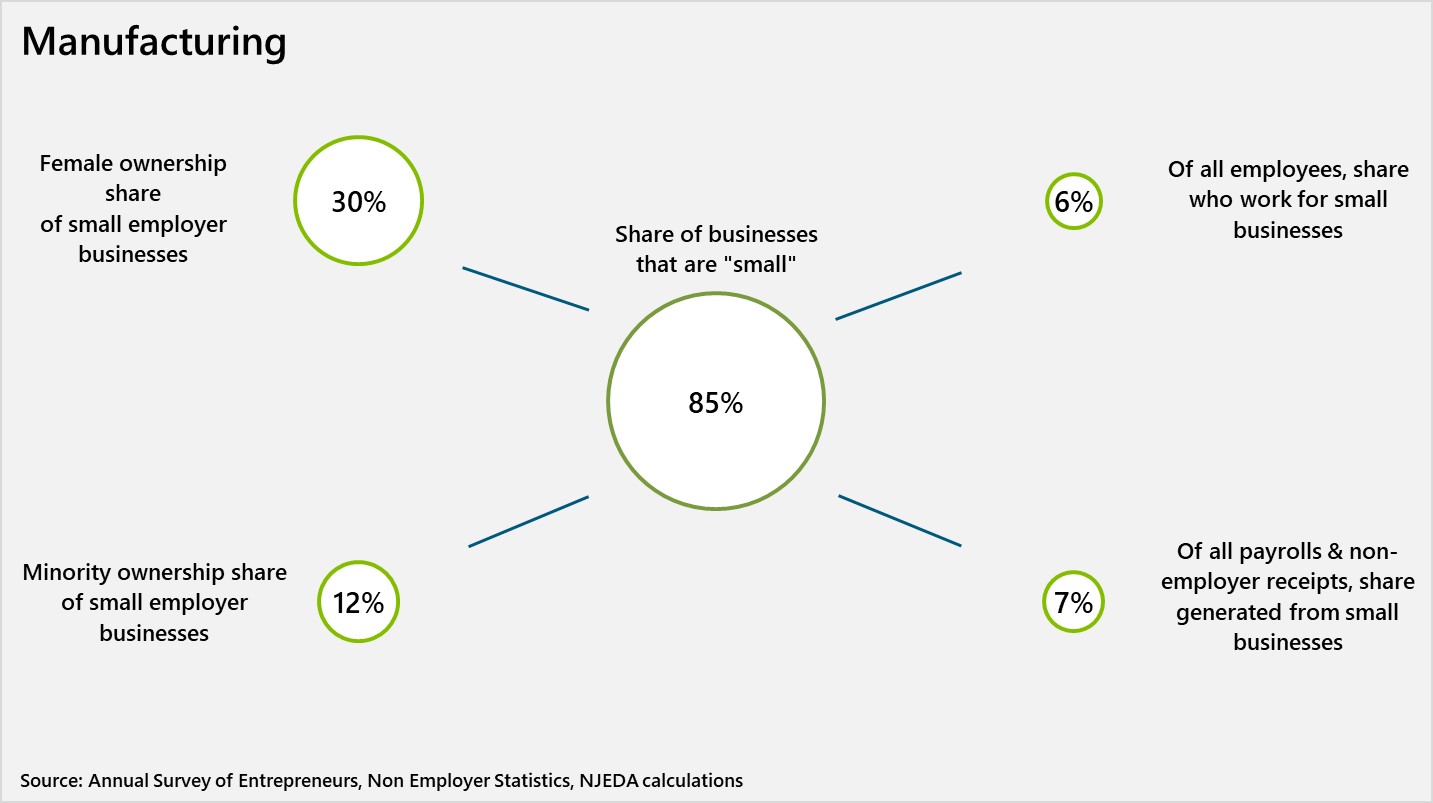
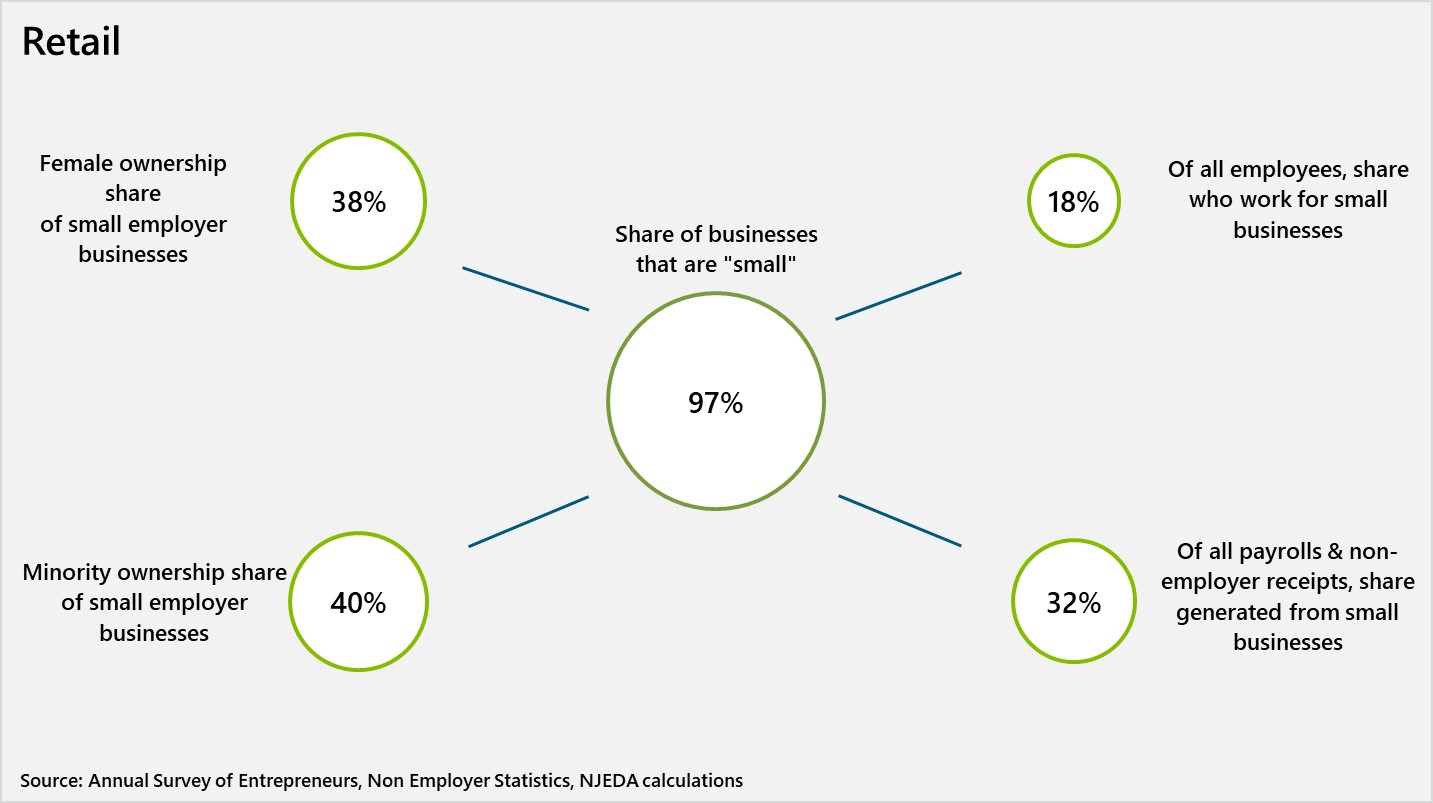
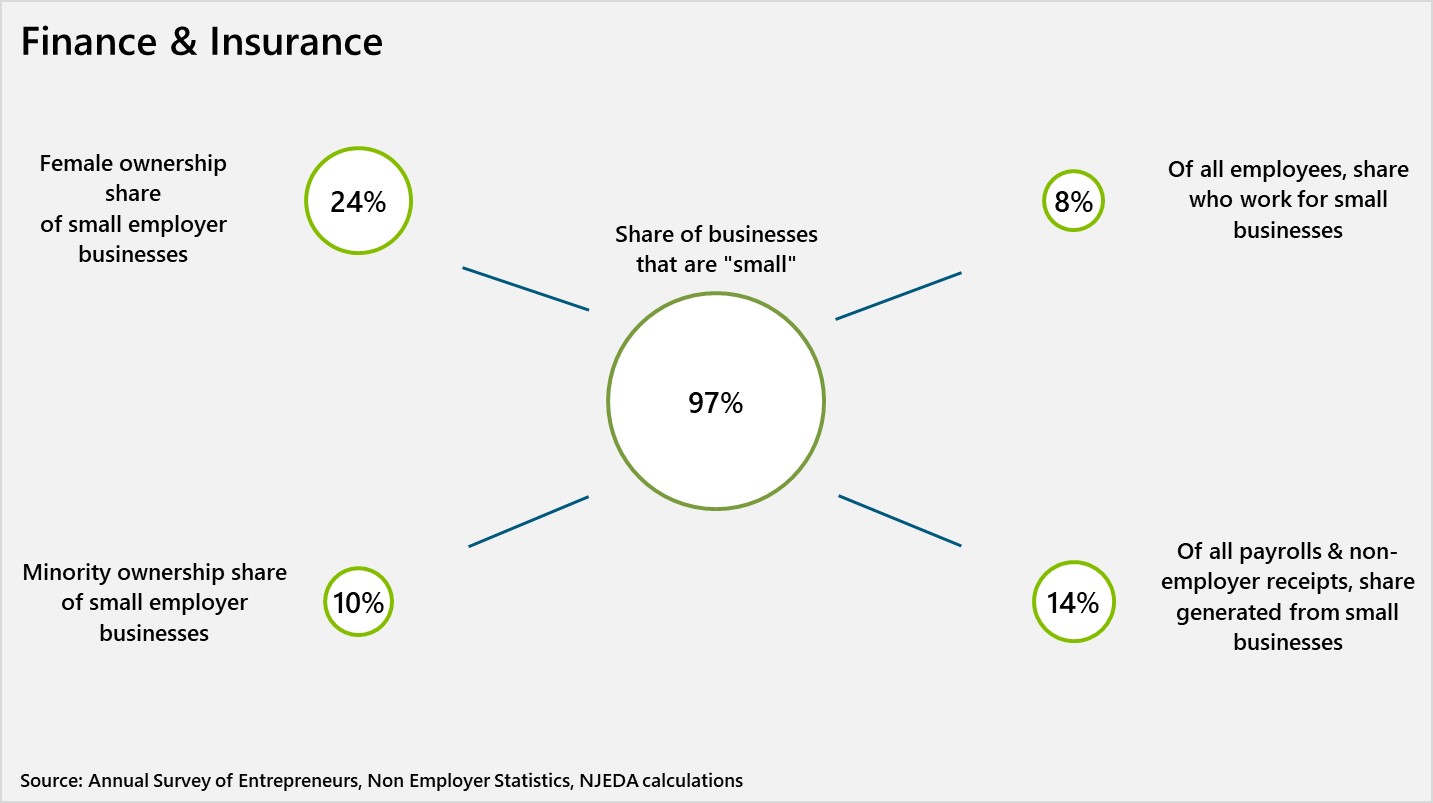
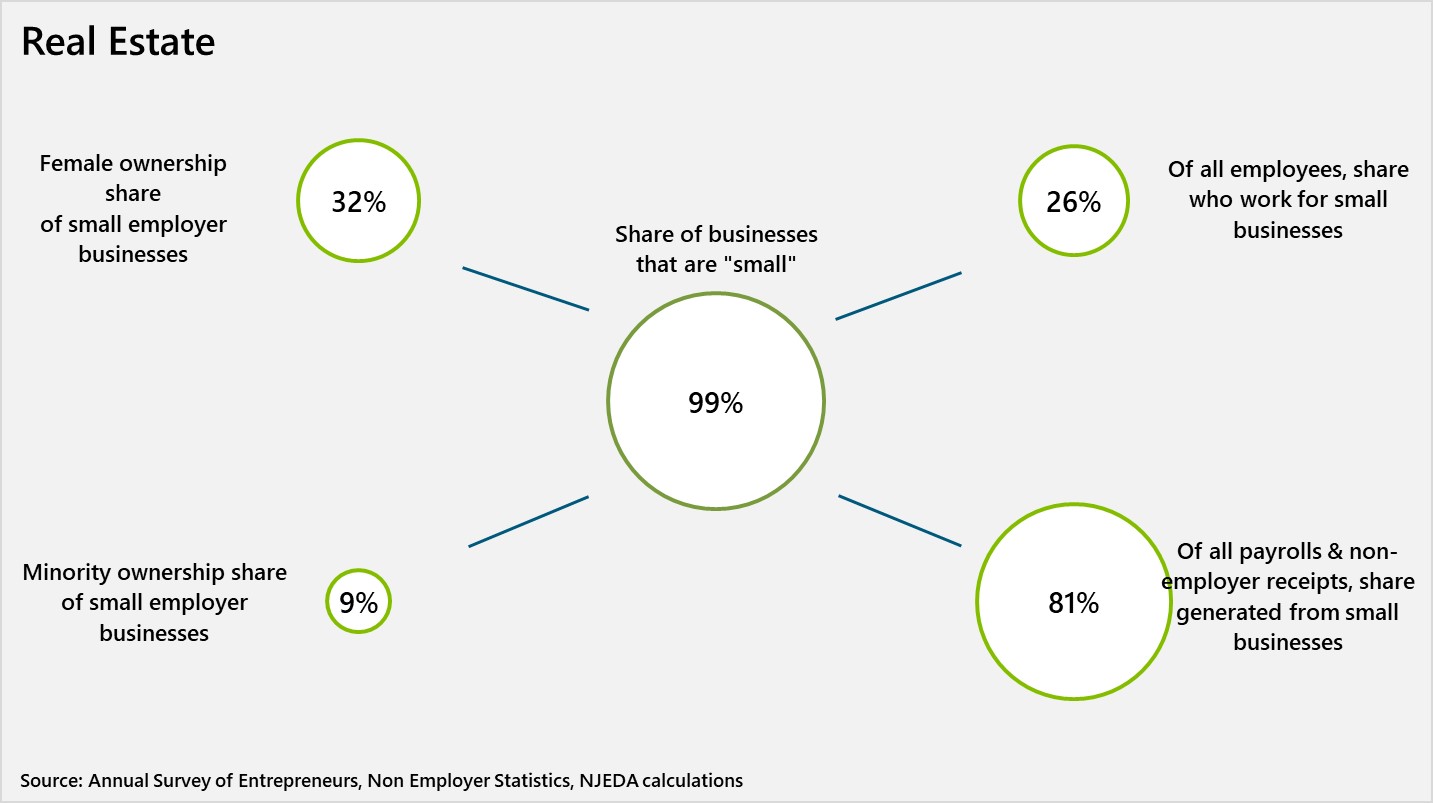
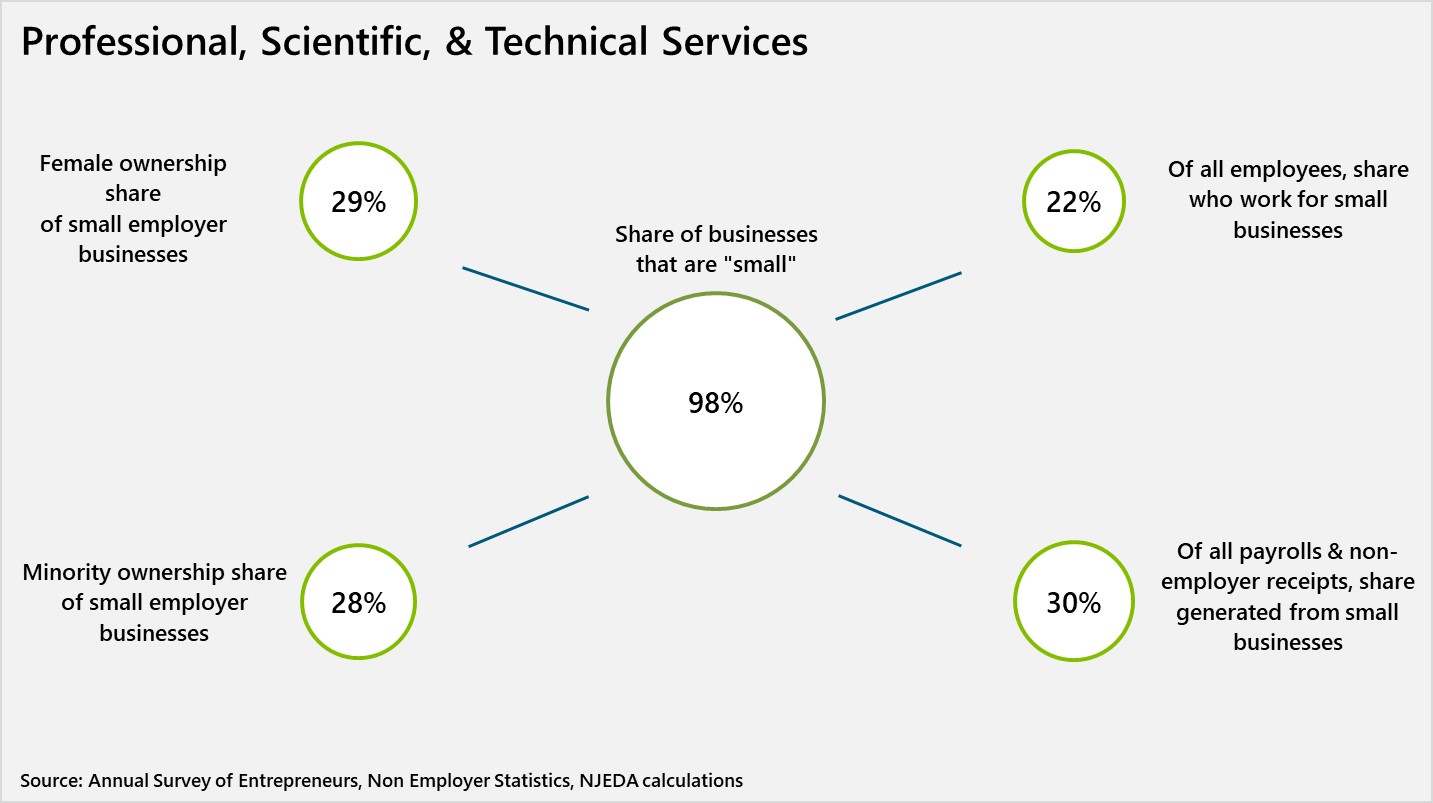
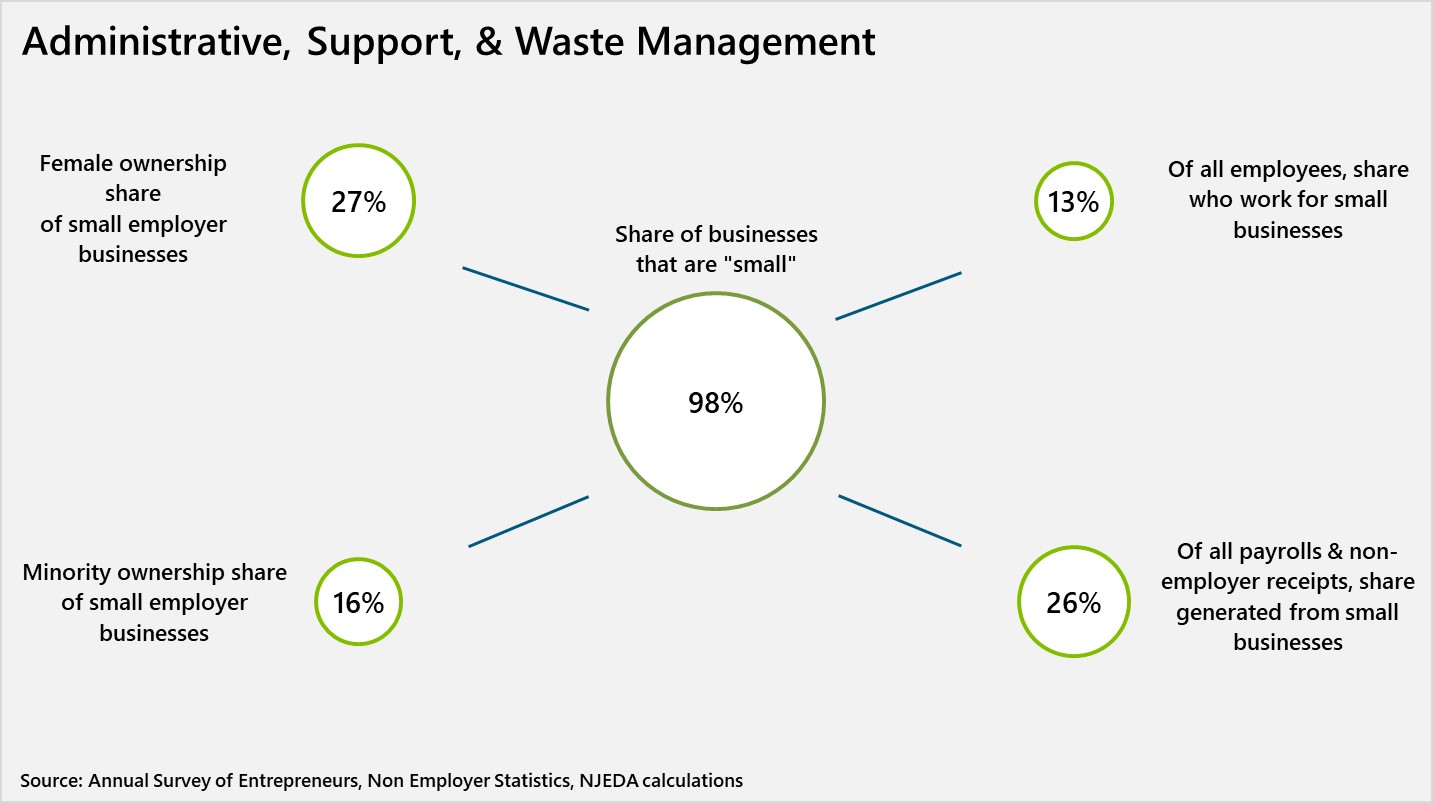
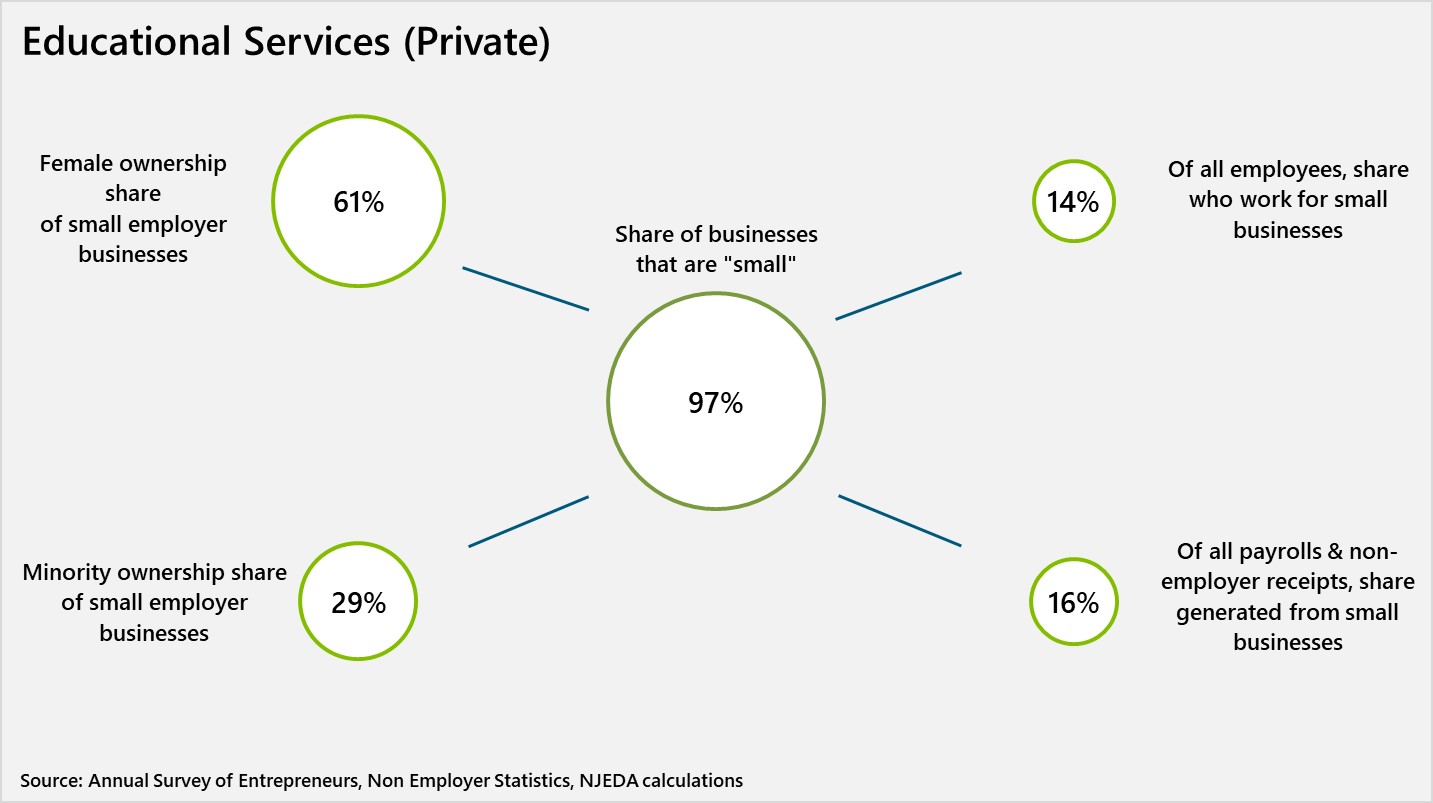
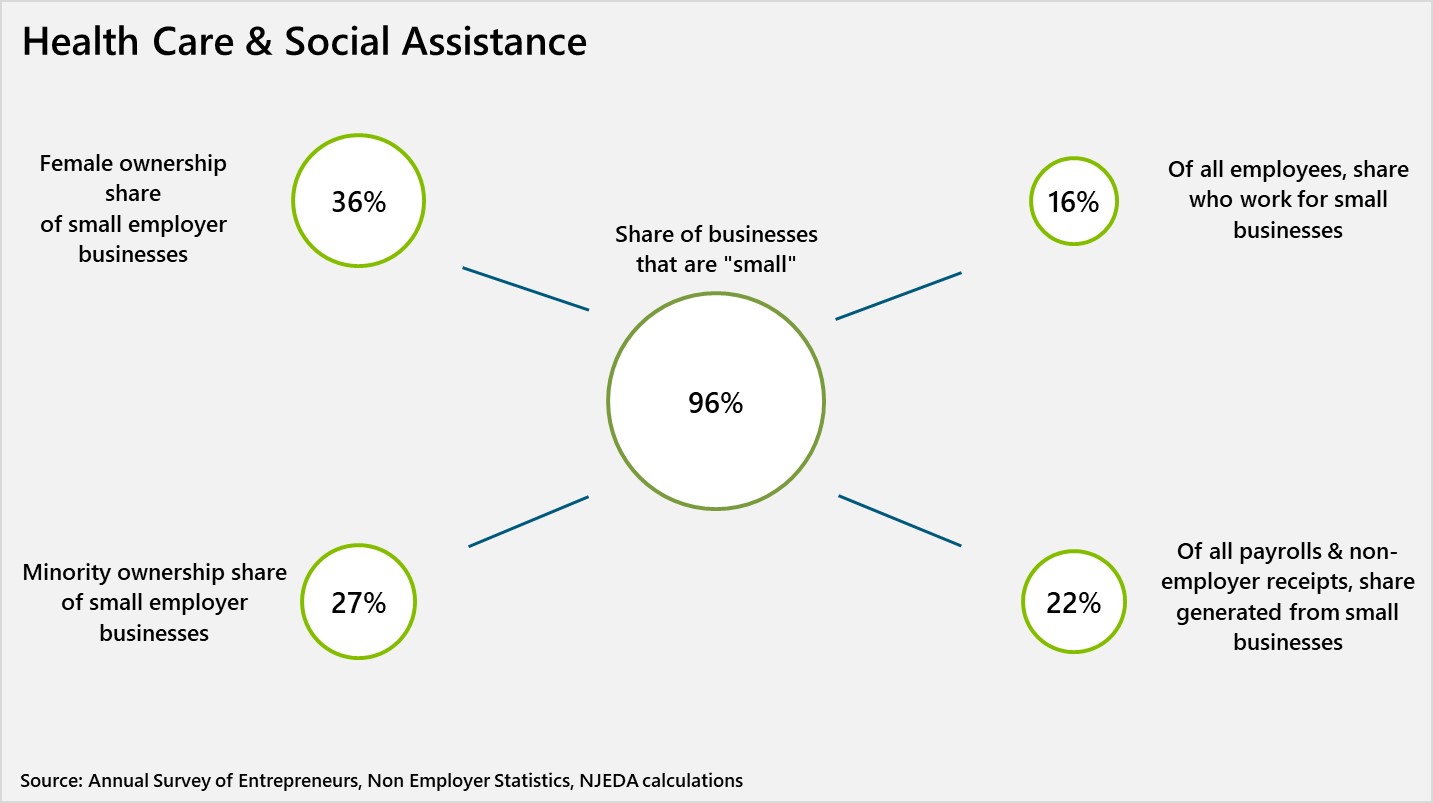
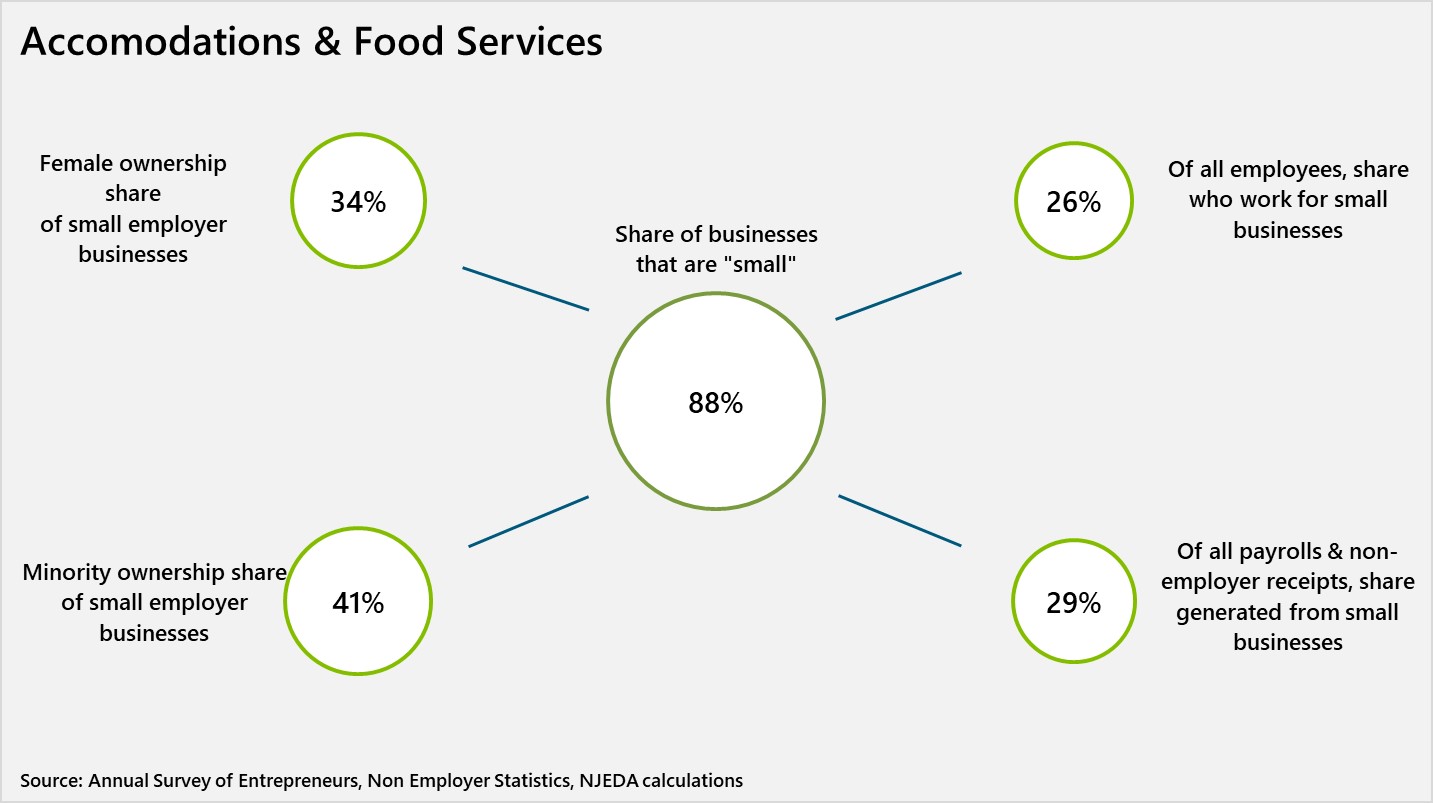
As with nonemployer businesses, small employer businesses are more likely to be minority- or female-owned than larger businesses. Of small businesses, approximately 27 percent are minority owned and 31 percent are female owned. It’s also important to note the significance of small employer businesses varies depending on the industry. For instance, around half of total construction industry income in New Jersey is generated by small employer businesses. This share drops to less than 8 percent in finance and insurance. In construction, 16 percent of small employer businesses are female-owned and 12 percent are minority-owned. In retail, these shares jump to 40 percent minority-owned and 38 percent female-owned. The point being, the impact small businesses have on the economy varies significantly from industry to industry. Graphics depicting the impact of small businesses in New Jersey by industry are displayed at the end of this brief.

The Aggregate Small Business Landscape in New Jersey

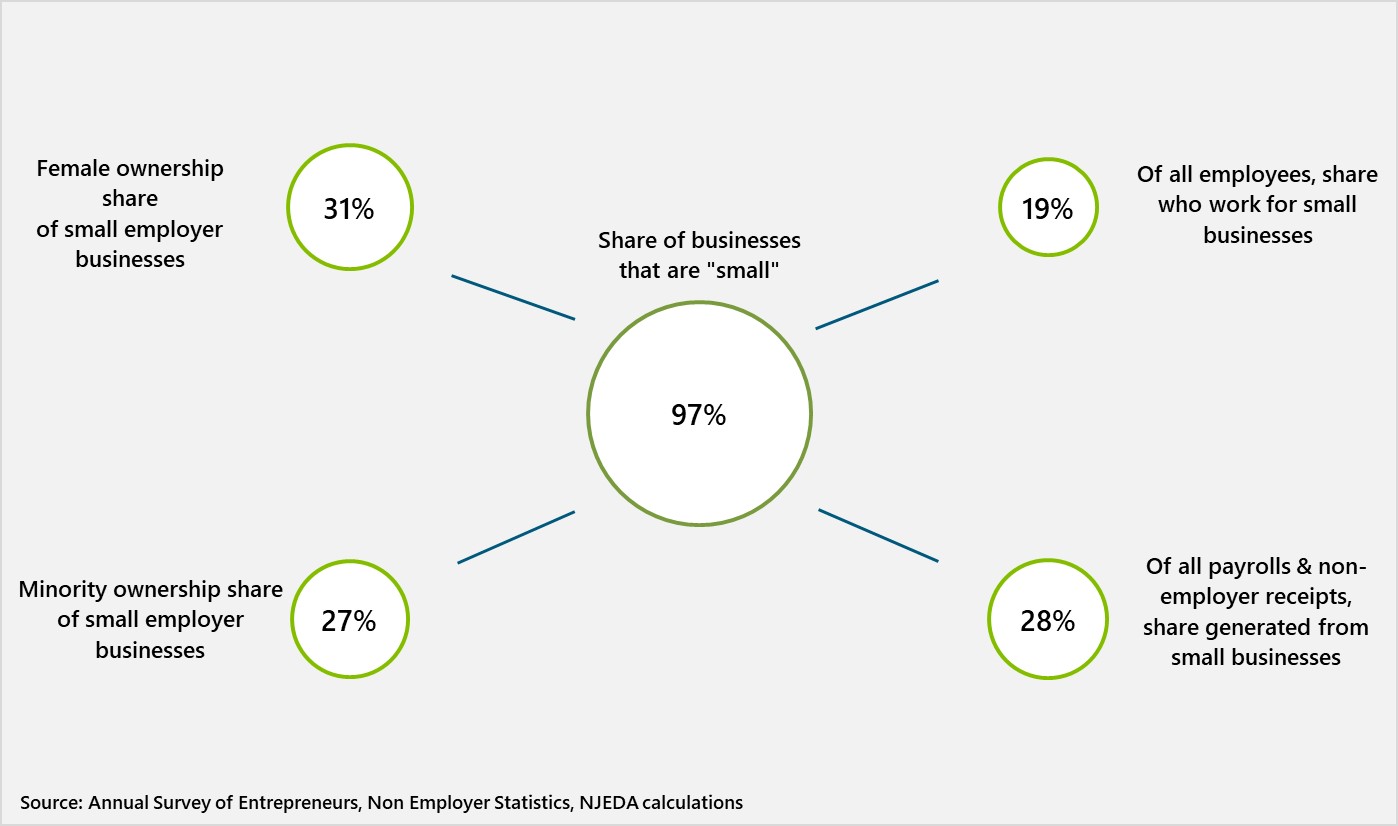
Adding together data on small employer businesses and nonemployer businesses allows us to examine the impact of the entire small business universe on New Jersey’s economy. To do so, it is useful to relegate impact into buckets of influence. In the following graphic we’re looking at four main buckets:
 

• The share of all businesses that are small
• The share of all employees who work for small businesses
• The share of payroll income and receipts – a proxy for income – generated by small businesses
• The share of small businesses that are female- or minority-owned

Similar graphics with data on some of New Jersey’s major industries appears at the end of this brief.
RK2.jpg


The data affords some key takeaways:
• Small businesses account for 97 percent of all businesses, yet only 19 percent of all New Jersey employees work for small businesses. Said differently, most employees in New Jersey work for large firms.
• These small businesses generate approximately 28 percent of New Jersey’s income, as estimated using payrolls and receipts. 
On average, 31 percent of small employer businesses and owned by women, and 27 percent are owned by minorities. These shares are not as large as for nonemployer businesses.

But when it comes to job creation, it’s new businesses – not small businesses — that matter

It’s really the creation of new firms, rather than small firms, per se, that’s the lifeblood of an economy. New firms, led by entrepreneurs, are essential to what the famous economist Joseph Schumpeter coined “creative destruction” — the process through which economic growth occurs as new firms replace older, less productive firms. Whereas new firms create net new jobs, firms that have existed for one year or longer essentially shift a lot of employees between firms and create very few net new jobs.
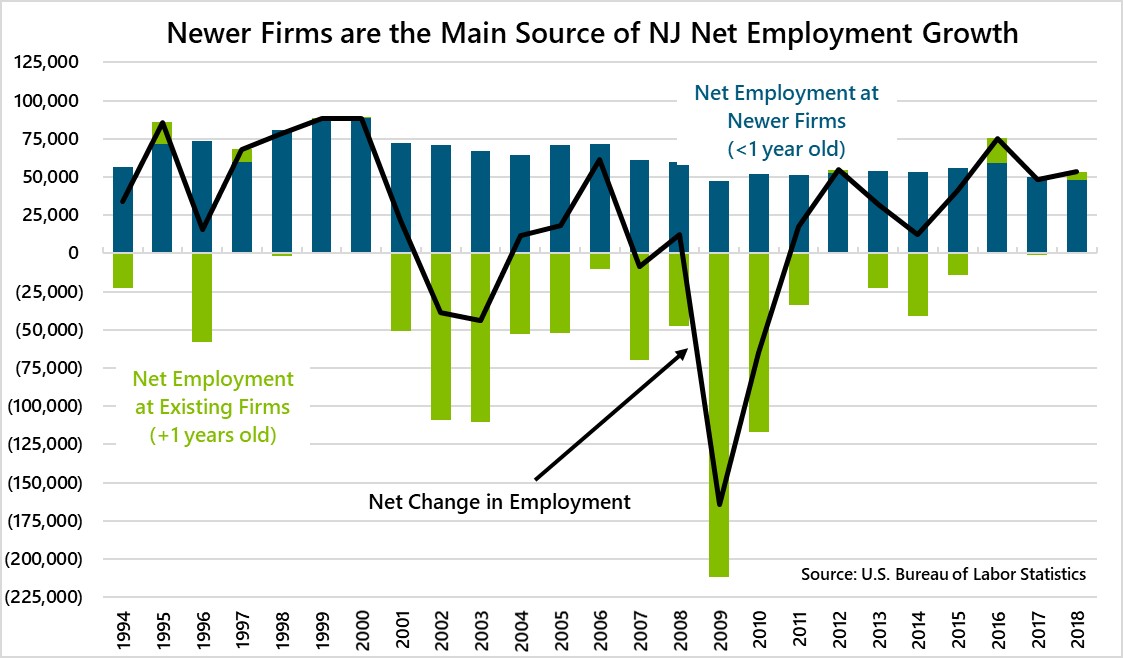
RK3.jpg

This is not to say movement of jobs between firms, often referred to as labor market churn, is not important. Quite contrary, it is very important for income growth of people who leave jobs to take better opportunities elsewhere. But when it comes to actual job creation and productivity, it’s new firms that matter most.
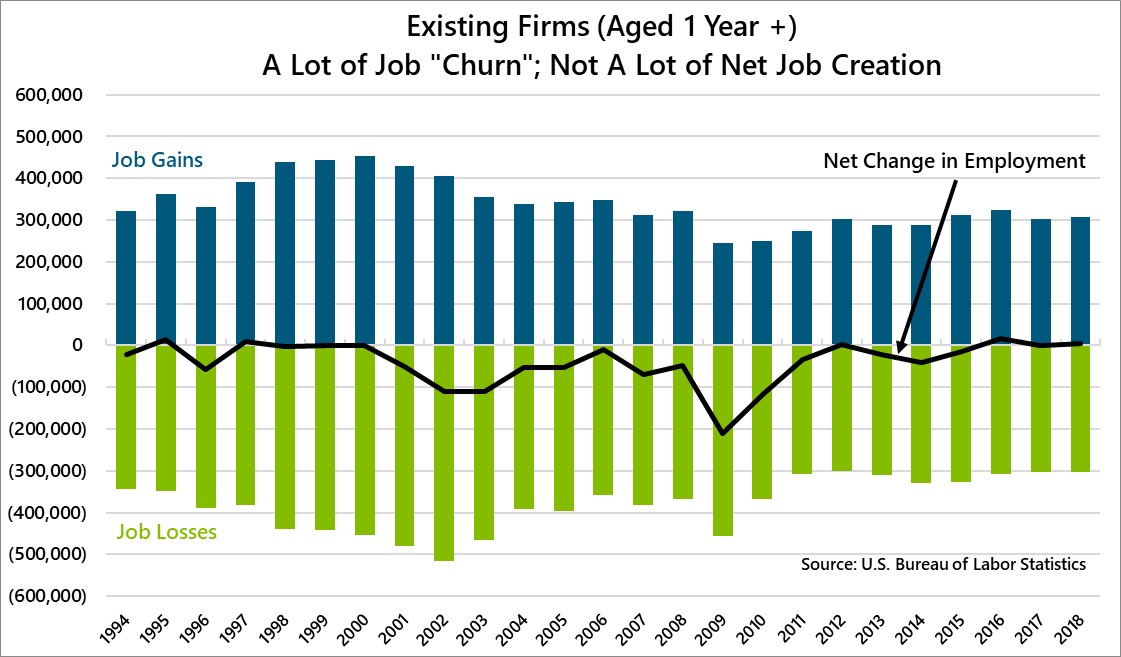
RK4.jpg

Conclusion

In sum, small business is certainly a lifeblood of economic opportunity for certain segments of the population, especially when we consider these businesses create jobs for their owners. Given the important contributions these businesses make to the economic lives of many New Jerseyans, the state should certainly do what it can to enable the creation and ongoing health of these businesses by lowering barriers to entry, providing efficient licensing and regulation, and ensuring a stable legal and tax backdrop so these businesses understand the “rules of the game” and owners feel comfortable investing in and growing their businesses. Moreover, it is important current and prospective small business are well informed about the resources New Jersey provides, such as the Small Business Lease Assistance Program, CDFI Initiative, NJ Ignite, and the recently-expanded Angel Investor Tax Credit, to support small businesses and startup development and growth.

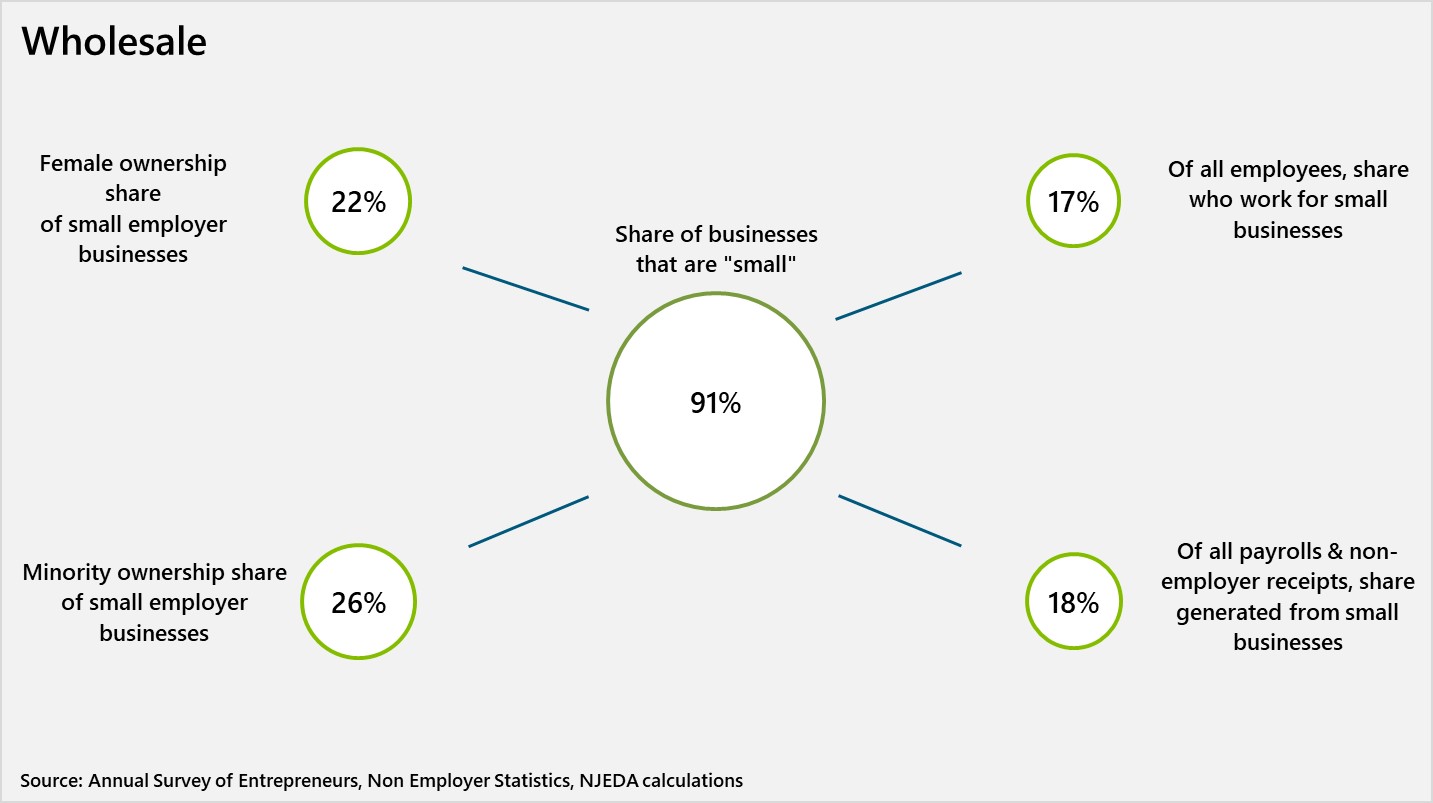
The Small Business Landscape, by Industry
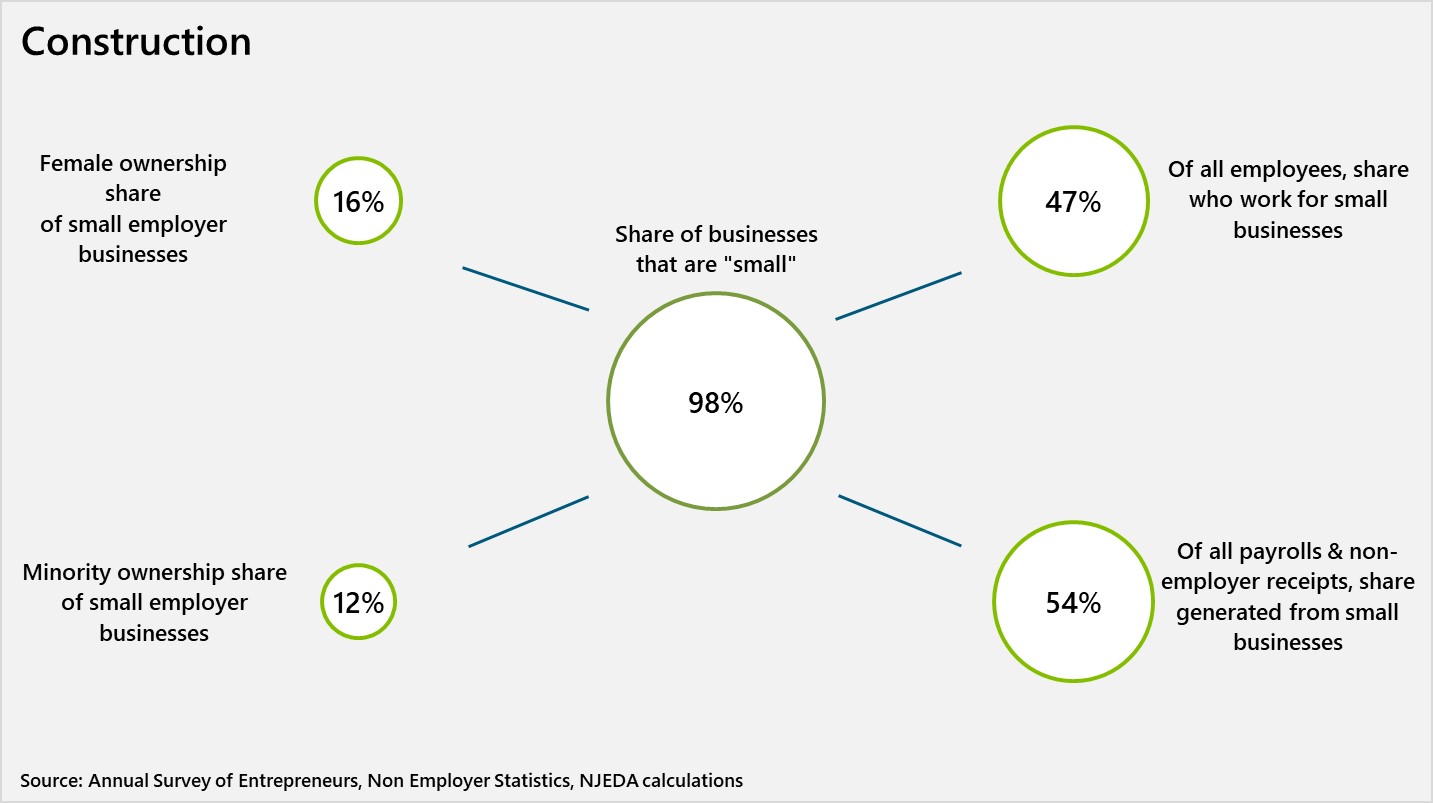
RK5.jpg  RK6.jpgRK7.jpgRK8.jpgRK9.jpgRK10-(2).jpgRK11.jpgRK12.jpgRK13.jpgRK14.jpgRK15.jpgRK16.jpg

Coworking Space is the Latest Approved NJ Ignite Participant

TheCoCo-(1).jpg
NJ Ignite participant The Co-Co offers women for a place to work side-by-side, learn from each other, and empower one another. (Photo credit: Jennifer Lavelle Photography)
 

TRENTON, N.J. (November 22, 2019) – The Co-Co Collaborative LLC (The Co-Co), a women-focused coworking and co-learning space for entrepreneurs and solopreneurs in Summit, recently became the latest collaborative workspace approved to participate in the New Jersey Economic Development Authority’s (NJEDA) NJ Ignite program.   
 

NJ Ignite helps technology and life sciences startup companies realize the benefits of collaborative workspaces – incubators, accelerators, and coworking spaces – by providing up to nine months of rent support for startup technology and life sciences businesses that are moving to an approved collaborative workspace. In addition to benefiting the startups, NJ Ignite is also a unique tool that collaborative workspaces can use to attract new tenants to their facilities. To date, 17 collaborative workspaces have been approved to participate in the program.

The Co-Co opened its doors in January 2019, less than one year after co-founders Suzanne Willian, Lynne Pagano, Lauren Decker, Christine Gilfillan, and Suzanne Spero hosted a listening event at a coffee shop and brainstormed the idea of creating a place for women to work side-by-side, learn from each other, and empower one another. 

“We’re seeing an increase in female owned and/or operated coworking spaces, incubators, and accelerators throughout the Garden State, including nearly half of the participating NJ Ignite collaborative workspaces,” NJEDA Chief Executive Officer Tim Sullivan said. “Investing in women-owned enterprises is an important step in fulfilling Governor Murphy’s vision for creating the most diverse innovation ecosystem in the nation and we look forward to hearing success stories from startups growing out of these workspaces.”

Offering full-time, part-time, and community memberships, The Co-Co currently boasts 175 members, including a life sciences attorney, a technology marketer and investor in several startups, a computer analyst at a customer relationship management company, an employee working remotely for a major pharmaceutical company, and several independent consultants. Members also include women who are at different stages of life and career. Willian added that The Co-Co’s location less than an hour from Manhattan gives a perfect alternative for Union, Essex, and Morris County women looking to avoid commuting into New York City.

In addition to office space and networking opportunities, the co-working space also serves as a co-learning space, hosting six to eight events per month. On December 11, The Co-Co is hosting “Inspiration and Encouragement Cohort: Allies & Advocates, Building Your Personal Board of Directors” and anyone interested in attending is encouraged to register at online.

“Things are buzzing here at The Co-Co and you can really feel the synergy among our members,” Willian said. “With support from the NJ Ignite program, we look forward to attracting even more tenants and adding to the growing list of entrepreneurs and solopreneurs that are taking advantage of all we have to offer.”

To learn more about NJ Ignite and for details on other programs, visit https://www.njeda.gov/tls and follow @NewJerseyEDA on Facebook, Twitter, and LinkedIn.

###


OnkosVisit.jpg
From left: Kathleen Coviello, NJEDA Vice President – Technology and Life Sciences; Dan Librot, Onkos Senior Director, Portfolio and Patient Solutions; Tim Sullivan, NJEDA Chief Executive Officer; Patrick Treacy, Onkos President and CEO; Kara Gropler, Onkos Senor Director, Marketing; Rose Rios, NJEDA Sector Lead, Life Sciences
 

Parsippany, N.J. (November 12, 2019) – Onkos Surgical is a true New Jersey success story. In just four years, the Parsippany-based startup has taken advantage of New Jersey’s highly-skilled talent pool and robust innovation ecosystem to pioneer new treatments for some of the most difficult to treat cancers. On a recent visit to Onkos’s headquarters, representatives from the New Jersey Economic Development Authority (NJEDA) learned how the company is pioneering innovation to deliver patient-specific solutions, including 3D printed offerings.  This work has made it possible for surgeons to complete procedures that used to require amputations or the installation of clunky implants with virtually no long-term effects.

Onkos Co-Founder and CEO Patrick Treacy started the company to improve the lives of patients fighting sarcoma, a rare cancer that develops in bone and connective soft tissue. When Treacy launched the company, there had been virtually no innovations in sarcoma treatment for close to two decades. This meant patients had few treatment options other than highly-invasive surgeries that replaced affected bone with one-size-fits-all implants that often severely compromised their mobility or even removed the bone without an adequate replacement.

Onkos was founded to fill the innovation void for these types of rare musculoskeletal cancers – they are less of a focus for larger device companies because of the complexity associated with successfully treating them.  One of the pillar technologies at Onkos is a new, highly-advanced joint sparing solution for limb salvage surgery. This platform not only salvages the patient’s affected limb, it does so in a way that removes the tumor and affected anatomy and spares that patient’s joint from having to be replaced as well.  Using CT scans from surgeons, Onkos creates three-dimensional models of a patient’s own anatomy, which they then use to design and 3D print patient-specific instrumentation and tools to help the surgeon treat that patient’s presenting anatomy. 
These capabilities have the potential to dramatically change how patients with musculoskeletal cancers are treated. 

“Onkos Surgical is a great example of the kind of businesses that are central to Governor Murphy’s vision for a stronger, fairer New Jersey economy,” said NJEDA Chief Executive Officer Tim Sullivan. “Innovative businesses that are born and grow in New Jersey facilitate equitable, sustainable economic growth by creating good jobs for residents, bringing investment capital into the state, and building New Jersey’s reputation as a leader in the global innovation economy. The NJEDA is proud to support Onkos’s work providing groundbreaking solutions for patients and doctors.”   

Although Onkos now has more than 40 employees, when the company launched in October 2015 it was only seven people. During this early stage, Onkos attracted nearly $1 million in investments through New Jersey’s Angel Investor Tax Credit Program, which offers refundable tax credits against qualified investments for New Jersey businesses to technology businesses with a physical presence in New Jersey that conduct research, manufacturing, or technology commercialization in the state. Onkos also successfully solicited venture capital from high-profile funds such as 1315 Capital and Canaan Partners.

Looking ahead, Onkos plans to build on its success by addressing other challenges surgeons and patients face during sarcoma treatment. The company already provides the only commercially available virtual bone bank for patient-specific limb reconstruction, and it is currently developing a mobile application for surgeons that will improve workflow throughout treatment and reduce complexity during surgery. Given the complexity of surgeries required to treat sarcoma, infection is a common problem. Onkos is also collaborating with another New Jersey company to address infections that can result from sarcoma surgeries by developing an anti-microbial surface treatment for implants that kills bacteria immediately upon contact.

The company is also dedicated to increasing advocacy and awareness leading to a cure for sarcoma. Onkos Surgical partners with organizations such the Sarcoma Foundation of America and others to advocate for change that will impact the lives of cancer patients. Earlier this month, Onkos Surgical raised more than $10,000 through “Strike Out Sarcoma,” a fundraiser the company held during a Somerset Patriots minor league baseball game.

“At Onkos Surgical, we believe we do well by doing good, and locating our headquarters in New Jersey has allowed us to accomplish both of those goals,” said Onkos Surgical CEO Patrick Treacy. “The Garden State’s unparalleled talent pipeline, which includes the best K-12 education system in the country and many of the world’s leading research institutions, has been critical to our success, and the easy access to New York, Boston, and other centers of the medical innovation economy has also facilitated our growth. We are proud to call New Jersey home and look forward to taking advantage of all the state has to offer as we continue to grow in the years to come.”
 
About the New Jersey Economic Development Authority
The New Jersey Economic Development Authority (NJEDA) serves as the State’s principal agency for driving economic growth. The NJEDA is committed to making New Jersey a national model for inclusive and sustainable economic development by focusing on key strategies to help build strong and dynamic communities, create good jobs for New Jersey residents, and provide pathways to a stronger and fairer economy. Through partnerships with a diverse range of stakeholders, the NJEDA creates and implements initiatives to enhance the economic vitality and quality of life in the State and strengthen New Jersey’s long-term economic competitiveness.

About Onkos Surgical
Based in Parsippany, N.J., Onkos Surgical is a privately held surgical oncology company founded in 2015. We believe that individuals with cancer requiring surgery deserve solutions designed specifically for them.  This principle is the driving force behind our Precision Orthopaedic Oncology initiatives.  Built on a digital platform, Onkos solutions are rooted in unmatched expertise in patient imaging analysis, personalized surgical planning, and the latest advancements in 3D printing.  At Onkos, we are passionate about reducing complexity for our customers and addressing the clinical challenges associated with tumor surgery.   www.onkossurgical.com
To learn more about EDA resources for businesses call EDA Customer Care at 609-858-6767 or visit https://www.njeda.gov and follow @NewJerseyEDA on Facebook, Twitter, and LinkedIn.
 

###

The New Jersey Economic Development Authority's next public Board Meeting will be held on Thursday, November 14, 2019 at 10 a.m. at the EDA offices at 36 West State Street, Trenton. A copy of the proposed agenda can be found prior to the meeting at www.njeda.gov/Board. Following the Board Meeting, minutes and the full agenda will also be available at www.njeda.gov/Board.
 
NJEDA offers the public the opportunity to offer public comments during the Open portion of its Board Meetings. Pursuant to provisions of the Open Public Meetings Act, N.J.S.A. 10:4-12, NJEDA is entitled to permit, regulate or prohibit public participation in its meetings.  Members of the public who are interested in offering comment should review the NJEDA’s policy on public comment, which is established to maintain order and prevent disruption of the meeting. The NJEDA’s policy on public comment can be found at www.njeda.gov/publiccomment.

The Commission on Science, Innovation and Technology (CSIT) Board Meeting scheduled for November 1, 2019 has been canceled.

The Capital City Redevelopment Corporation (CCRC) meeting scheduled for October 29, 2019 has been canceled.

LeapInsurance-jpg.jpeg

Leap Insurance Agency, located near the Jersey City waterfront, has attracted more than $1.8 million in funding from investors who participated in the State’s Angel Investor Tax Credit Program. 

TRENTON, N.J. (October 7, 2019) – Leap Insurance Agency, LLC. (Leap) launched last year with a digital platform to pre-qualify renters looking for apartments and insure rent payments to landlords. The company, which cut the ribbon on a 1,900-square-foot office in Jersey City in August 2018, credits the State’s Angel Investor Tax Credit Program with securing funding to help establish the company’s location and add to its workforce. The program is administered by the New Jersey Economic Development Authority (NJEDA).

Leap co-signs leases for renters who are not able to secure leases on their own and covers the loss if the renters default on their rent payments. In a little over a year, Leap has co-signed nearly 1,000 leases for apartments throughout New Jersey and in 35 states throughout the country. Leap Founder and Chief Executive Officer (CEO) Richard “Rory” O’Connell noted that many of the renters are students looking for off-campus housing and millennials needing housing for their first jobs out of college.

“Leap is empowering millennials to move out on their own as they begin their careers,” O’Connell said. “Thanks to a growing customer base and funding from in-state and out-of-state investors through the Angel Investor Tax Credit Program, we’ve been able to scale our model at a rapid pace.”

To date, Leap has attracted more than $1.8 million in funding from investors who participated in the State’s Angel Investor Tax Credit Program. O’Connell said that the funding made the company’s move to Jersey City possible and also supported the hiring of employees. Ten of the company’s 12 employees are based in New Jersey and two are located in Denver to accommodate the company’s success and to connect with renters in West Coast markets.

The Angel Investor Tax Credit Program offers refundable tax credits against qualified investments for New Jersey businesses. It supports technology businesses with a physical presence in New Jersey that conduct research, manufacturing, or technology commercialization in the state. Over the summer, Governor Murphy announced that the tax credit would increase from 10 percent to 20 percent of a qualified investment, with an additional five percent bonus available for investments in a business located in a qualified opportunity zone, low-income community, or a business that is certified by the State as minority- or women-owned. The expanded program parameters will be in effect for investments made after January 1, 2020. 

“Making New Jersey the State of Innovation starts with connecting companies with access to the capital they need to grow and compete in the national marketplace,” NJEDA CEO Tim Sullivan said. “Expanding the Angel Investor Tax Credit is an important and necessary step to bring investment dollars to New Jersey.”

Betsy Bernard, who is a former president of AT&T, chose to invest in Leap because of the company’s value proposition, its business model and, what she describes as its terrific leadership team.

“The Angel Investor Tax Credit is a win/win for both investors and companies,” Bernard said. “Companies like Leap get the funding they need to flourish, and the investors are able to mitigate the risk that is inherent to startups.”

The deadline for applications for the 2019 Angel Tax Credit program is October 20, 2019. Applications received after the deadline will be considered for an approval during calendar year 2020.  All applications must be submitted within six months from the time the investment is made.

To learn more about NJEDA resources for technology and life sciences companies, call NJEDA Customer Care at 609-858-6767 or visit https://www.njeda.gov/tls and follow @NewJerseyEDA on Facebook, Twitter, and LinkedIn.

###


The New Jersey Economic Development Authority's next public Board Meeting will be held on Tuesday, October 8, 2019 at 10 a.m. at the EDA offices at 36 West State Street, Trenton. A copy of the proposed agenda can be found prior to the meeting at www.njeda.gov/Board. Following the Board Meeting, minutes and the full agenda will also be available at www.njeda.gov/Board.
 
NJEDA offers the public the opportunity to offer public comments during the Open portion of its Board Meetings. Pursuant to provisions of the Open Public Meetings Act, N.J.S.A. 10:4-12, NJEDA is entitled to permit, regulate or prohibit public participation in its meetings.  Members of the public who are interested in offering comment should review the NJEDA’s policy on public comment, which is established to maintain order and prevent disruption of the meeting. The NJEDA’s policy on public comment can be found at www.njeda.gov/publiccomment.

A meeting of the Commission of Science, Innovation and Technology (CSIT) Board has been scheduled for Friday, September 27, 2019 at 10:00 am at AT&T Global Network Operations Center (GNOC), One AT&T Way, Bedminster, NJ 07921-0752 (Formerly "900 US Highway 202").


A copy of the proposed agenda can be found at www.njeda.gov/csit