TRENTON, N.J. (November 13, 2020) – The New Jersey Economic Development Authority (NJEDA) Board of Directors today approved the creation of the Sustain and Serve NJ Program, a $2 million grant program that will provide funding to organizations to purchase meals from restaurants that have been negatively impacted by the COVID-19 pandemic and distribute the meals at no cost to New Jersey residents. This program builds on prior NJEDA initiatives supporting restaurants impacted by COVID-19, including $35 million in targeted grant funding for restaurants the Authority made available through Phase 3 of the Small Business Emergency Assistance Grant Program. More information about Sustain and Serve NJ and complete eligibility requirements for potential applicants are available at https://cv.business.nj.gov.  
 
“The COVID-19 pandemic has had devastating impacts on all of our lives, but restaurant owners and their employees have been hit particularly hard,” said NJEDA Chief Executive Officer Tim Sullivan. “Sustain and Serve NJ is an innovative solution that will provide much-needed relief to our restaurant sector while also providing free meals to New Jersey residents. This is crucial to ensuring New Jersey’s communities and economy withstand the pandemic and are in a strong position to recover.”
 
The COVID-19 pandemic has hit restaurants harder than almost any other industry. According to the New Jersey Restaurant and Hospitality Association’s most recent estimates, as many as 30 percent of New Jersey restaurants are at risk of permanent closure and the New Jersey Department of Labor and Workforce Development (NJDOL) reports that more than 134,000 restaurant employees have filed Unemployment Insurance claims.
 
The Sustain and Serve NJ Grant Program approved today will make up to $2 million of funding from the NJEDA Economic Recovery Fund available to organizations working to bolster the strength of New Jersey’s restaurants. Eligible organizations can receive grants of at least $100,000 for prospective bulk purchases of meals from New Jersey-based restaurants.
 
The program will be open to entities, including 501(c) non-profit organizations, that are legally registered to do business in New Jersey and are in good standing with the New Jersey Department of Labor and the New Jersey Division of Taxation. Restaurants may not directly apply for this grant. Grant applicants will be required to demonstrate prior bulk purchases of 3,000 or more meals valued at $50,000 or more from New Jersey-based restaurants between March 9, 2020 and the date of application launch. The NJEDA will not provide reimbursements for meals purchased prior to the program launch. Grantees cannot resell any meals purchased with grant funding.
 
Applicants will also need to identify the restaurant or restaurants from which they will be purchasing meals. To receive funding, the partner restaurants must have 50 or fewer employees; maintain a physical commercial location in New Jersey; be legally registered to do business in New Jersey and in good standing with the New Jersey Department of Labor, New Jersey Division of Taxation, and (where applicable) the New Jersey Division of Alcoholic Beverage Control; and possess valid certification from municipal or county government inspection showing a current rating of Satisfactory per the New Jersey Retail Food Establishment Rating system. Restaurants will also have to certify that they were in operation on February 15, 2020, and detail how their business has been negatively impacted by the COVID-19 pandemic.
 
Grant funding awarded through the Sustain and Serve NJ Program will be restricted to expenses related to the direct cost of purchasing meals, as determined by the grantee’s restaurant partner or partners. This cost may include the restaurant’s cost of food and ingredients, labor, packaging, facilities, and profit margin. Sales tax and gratuity cannot be paid for using grant funds. While the restaurant may charge any amount, the award amount will be capped at $10 per meal. No other expense incurred by the grantee, whether in support of the meal purchase from the restaurant or otherwise, is eligible. Grant funding can only be used to support expenses incurred before or on April 30, 2021.
 
Applications for Sustain and Serve NJ will be available soon. More information about the program can be found at https://cv.business.nj.gov.  
 
In addition to Sustain and Serve NJ, the NJEDA administers a variety of grant, low-cost financing, and technical assistance programs for small and mid-sized businesses impacted by COVID-19, including $35 million of targeted grant funding for restaurants through Phase 3 of the Authority’s Small Business Emergency Assistance Grant Program. Comprehensive information about these programs and other State support for businesses impacted by the pandemic is available at https://cv.business.nj.gov.
 
 
About the New Jersey Economic Development Authority
The New Jersey Economic Development Authority (NJEDA) serves as the State’s principal agency for driving economic growth. The NJEDA is committed to making New Jersey a national model for inclusive and sustainable economic development by focusing on key strategies to help build strong and dynamic communities, create good jobs for New Jersey residents, and provide pathways to a stronger and fairer economy. Through partnerships with a diverse range of stakeholders, the NJEDA creates and implements initiatives to enhance the economic vitality and quality of life in the State and strengthen New Jersey’s long-term economic competitiveness.
 
To learn more about NJEDA resources for businesses call NJEDA Customer Care at 609-858-6767 or visit https://www.njeda.gov and follow @NewJerseyEDA on Facebook, Twitter, Instagram, and LinkedIn.
 

###

  By Richard Kasmin, NJEDA Chief Economist

Our biweekly look at a few key economic indicators and what they can tell us about the state of New Jersey’s economy.

Indicator 1 – Weekly Initial Claims for Unemployment Insurance

Source: New Jersey Department of Labor

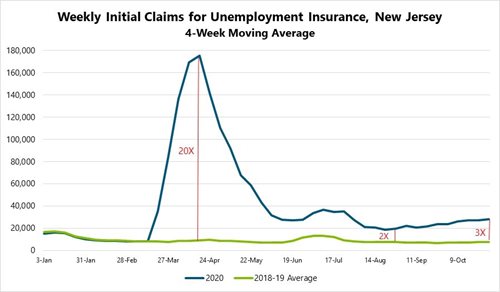
If a macroeconomist is stranded on a desert island and can only have a few economic indicators with which to understand the state of the economy, weekly filings of initial claims for unemployment insurance is a clear choice. Why? Well, for starters, these filings are generally the result of people recently losing their employment and seeking unemployment insurance coverage. Knowing something about the rate at which people are losing jobs is key to understanding how an economy is performing. In general, layoffs and new job creation as businesses come and go and expand and contract are natural components of a healthy economy. Analyzing shifts in the level of initial claims can provide key information about the state of the economy.

In that vein, the chart above shows weekly initial claims for unemployment insurance in 2020 (the dark blue line), and the average for 2018 and 2019 (the green line). During the worst of this year’s economic freeze, initial claims surged to around 20 times the level seen in recent years. But as the economy reopened, initial claims moderated considerably, settling down to around double previous years’ levels. That was relatively good news as it showed labor demand was rebounding; firms were less likely to lay off workers as they became more confident in the pace of economic recovery.

But, in recent months, something concerning has occurred. Instead of the relative level of initial claims continuing to recede as the economy picked up momentum, claims actually increased to around three times the level seen at this time in prior years. That suggests layoffs are rising again, which could be a sign of rising economic challenges in the near future.

Indicator 2 – Employment by Wage Cohorts

Source: Opportunity Insights Economic Tracker

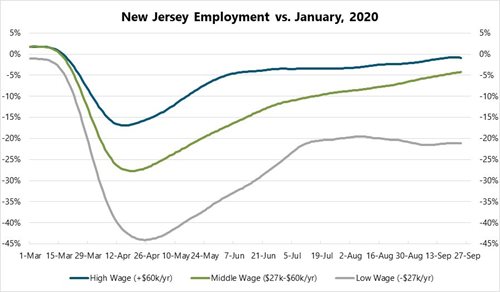
It goes without saying that COVID-19 has not impacted all segments of the economy in equal measure. Economic shocks never do, but the fallout from this shock seems especially lopsided, with those households that can least afford it taking the brunt of the shock.

As the above chart shows, relatively lower-wage jobs have taken the largest economic hit and have struggled to recover. Lower-wage jobs are more likely to be in face-to-face industries, and we know this is where COVID-19 has had an outsized impact. Low-wage employment is still around 20 percent below where it was before the pandemic. Higher-wage employment certainly took a considerable hit but has recovered much more as a considerable share of these jobs can be done from home.

Indicator 3 – High Propensity Business Applications


Source: US Census Bureau

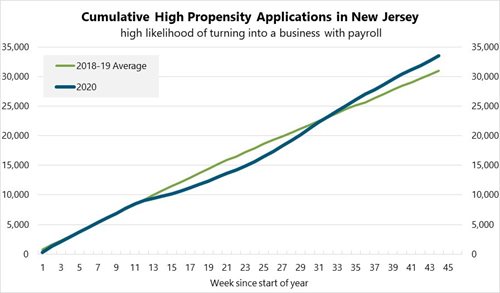
One of the more curious things to happen in New Jersey, and the country for that matter, is the surge in applications for business tax identification numbers. These applications precede the creation of new businesses. In the case of so-called high propensity business applications depicted in the chart above, these are applications to create businesses having a high likelihood of turning into businesses with payroll. Thus, these applications signal the creation of new employer businesses. As the chart shows, cumulative applications in 2020 are around eight percent higher than they were at this time of year in 2018 or 2019. Given all the negative impacts COVID-19 is having on the economy, this is a bright spot as it suggests a surge in entrepreneurial spirit despite (or because of?) the virus.

Some analysts wonder if the surge in applications is merely reflective of a backlog of applications being processed. Others wonder if the destruction of so many small businesses and jobs is leading to creation of new businesses by the owners of now defunct businesses creating sole proprietorships. This could negate the expectation that these new businesses will create jobs. In other words, this jump in applications might not reflect a surge in job-creating new businesses but a jump in sole proprietorship creation reflective of all other income generating options being exhausted.

The jury is out for now, but in the short term this could be a positive sign that creative destruction and entrepreneurial spirit is alive and well in New Jersey and the US.

TRENTON, N.J. (November 13, 2020) – The New Jersey Economic Development Authority (NJEDA) Board of Directors today approved the creation of the Brownfields Loan Program. This program will make low-interest loans of up to $5 million available to brownfield redevelopment projects for all aspects of brownfield revitalization, including assessment, investigation, and demolition. It will be one of the only funding sources available to cover pre-construction planning, demolition, asbestos, PCB removal, and lead-based paint remediation. More information is available at https://www.njeda.gov/brownfields.
 
“Revitalizing contaminated sites and putting them back to productive, locally-appropriate use is an essential component of Governor Murphy’s commitment to building stronger, more vibrant communities across New Jersey,” said NJEDA Chief Executive Officer Tim Sullivan. “The Brownfields Loan Program and the NJEDA’s other collaborations with NJDEP Commissioner McCabe and other partners to support brownfields redevelopment will play a crucial role in building a greener, fairer New Jersey by incentivizing investors to consider brownfields remediation and making resources available to get these projects off the ground.”
 
“Remediating brownfields turns burdens into opportunities. By cleaning up contaminated properties and replacing them with valuable assets that benefit New Jersey’s communities, we create new paths for economic growth,” said New Jersey Department of Environmental Protection Commissioner Catherine R. McCabe. “Projects like these are important to our environmental protection, environmental justice, and economic recovery goals, but need financial resources. The NJEDA’s Brownfields Loan Program will open the door to more successful remediation by filling in one of the most pervasive funding gaps that holds back these projects.”
 
Historically, remediation has been a major barrier to successful brownfield redevelopment projects because of the lack of funding sources available to support site assessment, planning, and cleanup. The Brownfields Loan Program is a unique investment tool that will address this challenge by filling in these funding gaps to make the remediation phase of revitalization projects financially viable. The NJEDA expects this to reactivate long-stalled projects and create new opportunities for commercial, retail, and mixed-use developments that in turn will create jobs and make New Jersey’s communities more vibrant, cleaner places to live and work.   
 
The Brownfields Loan Program will offer low-interest financing of $100,000 to $5 million for all aspects of brownfields revitalization projects, including assessment, investigation, and demolition. Loans will be awarded through a competitive application process beginning in early 2021. Projects will be scored based on various details about the brownfield site itself and the proposed redevelopment project, including the location, the length of time the site has been vacant or underutilized, and how well the proposed redevelopment aligns with local plans. Projects that provide beneficial end uses that promote environmental resiliency, public health, and community well-being will receive higher scores.
 
The Brownfields Loan Program is part of NJEDA Community Revitalization, a suite of solutions designed to support development that transforms underutilized and contaminated spaces into community assets, with the goal of achieving a greener, fairer New Jersey. This includes ensuring that residents living in communities that have historically suffered from disinvestment, environmental contamination, and health disparities benefit from brownfields redevelopment. In addition to the Brownfields Loan Program, NJEDA Community Revitalization initiatives include the Brownfields Impact Fund, the proposed Brownfields Redevelopment Tax Credit, the expanded Community Collaborative Initiative (CCI), and the Brownfields Center at NJIT.
 
“The Brownfields Loan Program is a critical component of the NJEDA’s holistic approach to environmental protection and remediation,” said NJEDA Senior Brownfields Advisor Elizabeth Limbrick. “As one of the only sources of funding available for covering costs associated with pre-construction planning, demolition, and asbestos and lead-based paint remediation, the loan program will be a critical tool to help projects get through the early stages of brownfield remediation and move on to the important work of transforming contaminated sites into community assets more quickly and at lower cost.”
 
More information about the Brownfields Loan Program and other NJEDA Community Revitalization solutions is available at https://www.njeda.gov/brownfields.  
 
 
About the New Jersey Economic Development Authority
The New Jersey Economic Development Authority (NJEDA) serves as the State’s principal agency for driving economic growth. The NJEDA is committed to making New Jersey a national model for inclusive and sustainable economic development by focusing on key strategies to help build strong and dynamic communities, create good jobs for New Jersey residents, and provide pathways to a stronger and fairer economy. Through partnerships with a diverse range of stakeholders, the NJEDA creates and implements initiatives to enhance the economic vitality and quality of life in the State and strengthen New Jersey’s long-term economic competitiveness.
 
To learn more about NJEDA resources for businesses call NJEDA Customer Care at 609-858-6767 or visit https://www.njeda.gov and follow @NewJerseyEDA on Facebook, Twitter, Instagram, and LinkedIn.
 

###
SBBRAP-2020-Graduation_cropped.jpg
40 small business owners graduated from the Small Bonding Business Readiness Assistance Program earlier this week.

TRENTON, N.J. (November 12, 2020) – The New Jersey Economic Development Authority (NJEDA) and the African American Chamber of Commerce of New Jersey (AACCNJ) today congratulated 40 small business owners on their graduation from the Small Business Bonding Readiness Assistance Program on Tuesday night. Since the Small Business Bonding Readiness Assistance Program’s inception in 2018, 67 small-, minority- and woman-owned businesses have participated and more than 46 have qualified for $20.8 million in surety bonding.

The Small Business Bonding Readiness Assistance Program provides a comprehensive series of classes, workshops, and strategic counseling sessions covering a variety of topics relevant to small businesses in all sectors, including bonding and insurance, business development, financial presentation, construction and contract law, construction management, estimating, and credit. At the end of the program, all participating businesses receive a Bonding Readiness Segment Report, which provides an in-depth assessment of their strengths and weaknesses to help them plan for the future.

Tuesday’s virtual graduation celebrated the culmination of months of training for three classes of small-, minority- and women-owned businesses as they learned how to prepare to obtain bonds, a crucial step in competing for state and federal government contracts. The graduation honored the most recent virtual program class, which hailed from Atlantic City and Newark, as well as previous classes of Camden and Jersey City business owners. To date, these classes have already qualified for a total of more than $9.4 million in surety bonding.

“Small businesses are the backbone of New Jersey’s communities, providing opportunities, creating jobs, driving economic growth, and making our state a great place to live and work,” said NJEDA Chief Executive Officer Tim Sullivan. “The fact that these small business owners chose to participate in this program in the midst of a pandemic, when they were juggling pandemic-related challenges in multiple areas of their lives, speaks volumes about their commitment to the success of their businesses and their local economies.”  

Sullivan noted that Governor Phil Murphy has always prioritized supporting minority- and women-owned businesses and he called the Small Business Bonding Readiness Assistance Program “an important mechanism for leveling the playing field” among entrepreneurs vying for state contracts.

Twenty-three of the 40 small business owners who graduated on Tuesday have already received confirmation that they would be favorably considered for bonds ranging from $100,000 to $750,000. Final bond approvals will be conditional upon contract terms and bond forms, confirmation of satisfactory financing, and a favorable review of the underwriting information at the time the small business actually requests the bonds.

“Study after study has shown that COVID-19 has disproportionately affected businesses owned by people of color, making programs like the Small Business Bonding Readiness Assistance Program absolutely essential to helping New Jersey recover from the pandemic in an equitable and inclusive manner,” said John E. Harmon, Sr., IOM, AACCNJ, Founder, President and CEO. “The NJEDA has been a phenomenal partner for us and for the small business community as a whole even before the pandemic and has become a centralized force in helping the Garden State’s economy re-emerge stronger than ever.”

For more information on the Small Business Bonding Readiness Assistance Program, visit https://www.aaccnj.com/bonding-program—sbbrap.html.
 
To read Governor Murphy’s full economic plan, please visit: https://nj.gov/economicplan
 
About the New Jersey Economic Development Authority
The New Jersey Economic Development Authority (NJEDA) serves as the State’s principal agency for driving economic growth. The NJEDA is committed to making New Jersey a national model for inclusive and sustainable economic development by focusing on key strategies to help build strong and dynamic communities, create good jobs for New Jersey residents, and provide pathways to a stronger and fairer economy. Through partnerships with a diverse range of stakeholders, the NJEDA creates and implements initiatives to enhance the economic vitality and quality of life in the State and strengthen New Jersey’s long-term economic competitiveness.
 
To learn more about EDA resources for businesses call EDA Customer Care at 609-858-6767 or visit https://www.njeda.gov  and follow @NewJerseyEDA on Facebook, Twitter, LinkedIn and Instagram.

###

Las empresas con 100 empleados o menos pueden presentar una solicitud para acceder a descuentos del 25% en compras de PPE 


TRENTON, N.J. (10 de noviembre de 2020) – La Autoridad para el desarrollo económico de New Jersey (NJEDA) anunció que ha lanzado la Fase 2 del Programa de acceso a PPE para pequeñas y microempresas de NJ el, 10 de noviembre de 2020 a las 9:00 a.m. Desde ese momento, las pequeñas empresas y organizaciones sin fines de lucro de New Jersey con 100 empleados o menos podrán presentar solicitudes para recibir descuentos del 25% en compras de equipos de protección personal (PPE) a proveedores aprobados por NJEDA. Puede encontrar más información en https://ppe.covid19.nj.gov/es.  
 
"Las pequeñas empresas son el pilar de la economía de New Jersey. Debido a la continuidad de la pandemia de COVID-19, es fundamental que las ayudemos a realizar los cambios necesarios para reabrir y seguir operando de forma segura", expresó el Director ejecutivo de la NJEDA, Tim Sullivan. "El Programa de acceso a PPE para pequeñas y microempresas de NJ es una solución creativa que utiliza recursos del gobierno y privados para ayudar a los propietarios de empresas que han sido más golpeados por la pandemia a adquirir los equipos de protección que necesitan a un precio asequible". 
 
La NJEDA desarrolló el Programa de acceso a PPE para pequeñas y microempresas de NJ en respuesta a las inquietudes constantes que surgían en la Comisión de reinicio y recuperación del gobernador, los comités de los nueve sectores del Consejo asesor en reinicio y recuperación del gobernador e información proveniente de diversas pequeñas y microempresas que indicaba que necesitaban PPE inmediatamente disponible a un precio asequible. Durante la Fase 1 del programa, la NJEDA identificó y examinó a "proveedores designados", incluidos Boxed, Office Depot y Staples, quienes se asociaron con la Autoridad para crear "micrositios" donde las empresas de New Jersey pueden comprar una selección aprobada de PPE con un descuento del 10%. La NJEDA también colaboró con el Departamento de Salud de New Jersey para crear una herramienta de planificación de PPE en línea que ayuda a las empresas a comprender los requisitos de PPE y estimar las necesidades de PPE a nivel de la organización. Puede encontrar enlaces a los micrositios de los proveedores designados y la herramienta de planificación de PPE en https://ppe.covid19.nj.gov/es.
 
La segunda fase del Programa de acceso a PPE destina $20.4 millones para subsidiar la compras de PPE para pequeñas y microempresas en Staples y Office Depot. Durante esta fase, las empresas con 100 empleados o menos equivalentes a tiempo completo (FTE) podrán recibir subsidios equivalentes al 25% del costo de las compras realizadas a estos proveedores designados. Todas las empresas elegibles pueden recibir hasta $400 en descuentos, y las empresas que operan en una de las 715 áreas censales de New Jersey que fueron elegibles para la designación de Zonas de oportunidad pueden recibir hasta $500. Estos subsidios se aplican además del descuento del 10% que se ofrece a todas las empresas, lo que significa que las pequeñas empresas pueden ahorrar hasta un tercio del costo de sus compras de PPE.
 
Las pequeñas empresas y organizaciones interesadas en recibir descuentos del 25% deben presentar una solicitud en https://ppe.covid19.nj.gov/es. Una vez que la NJEDA confirma su elegibilidad, recibirán cupones para realizar compras en un proveedor designado de su preferencia. Este descuento reducirá automáticamente los costos de las compras en línea que realizan las pequeñas empresas u organizaciones en ese proveedor designado en un 25%. Los descuentos vencerán después de 14 días o el 30 de noviembre.
 
Además del Programa de acceso a PPE, la NJEDA administra una variedad de programas de subsidio, financiamiento a bajo costo y asistencia técnica para pequeñas y medianas empresas afectadas por la COVID-19. Puede encontrar información integral sobre estos programas y otros apoyos estatales para las empresas afectadas por la pandemia en https://cv.business.nj.gov. 


Acerca de la Autoridad para el desarrollo económico de New Jersey

La Autoridad para el desarrollo económico de New Jersey (NJEDA) es la agencia principal del Estado para impulsar el desarrollo económico. La NJEDA tiene el compromiso de hacer del Estado de New Jersey un modelo nacional para el desarrollo económico inclusivo y sostenible al centrarse en estrategias claves para ayudar a construir comunidades fuertes y dinámicas, crear buenos trabajos para los residentes de New Jersey y ofrecer oportunidades para una economía más sólida y justa. Mediante asociaciones con diversas partes interesadas, la NJEDA crea e implementa iniciativas para mejorar la vitalidad económica y la calidad de vida en el Estado y para fortalecer la competitividad económica a largo plazo de New Jersey.

 
Para obtener más información acerca de los recursos de la NJEDA para empresas, llame a la línea de atención al cliente de NJEDA al 609-858-6767 o visite https://www.njeda.gov y siga a @NewJerseyEDA en Facebook, Twitter, Instagram y LinkedIn.
 

###


Please be advised that a telephonic meeting of the New Jersey Economic Development Authority is scheduled for 10:00 AM, Friday, November 13, 2020.

The Members will convene to via conference call only.  Members of the public may participate in the meeting by calling in on the conference line.  Members of the public will have an opportunity to speak during the public comment segment of the meeting. The following conference number is being provided:
 
CONFERENCE NAME: NJEDA BOARD MEETING (November 13, 2020)
PARTICIPANT DIAL-IN NUMBER: 877-692-8955
PARTICIPANT ACCESS CODE: 4204420
 
Members of the public are encouraged to call in prior to the time the meeting is scheduled to begin to avoid any delays. 
 
The agenda can be found 48 hours prior to the meeting on our website: www.njeda.gov.

Para ver esta información en español, haga clic aquí

Businesses with 100 or fewer employees can apply for 25 percent discounts on PPE purchases  

TRENTON, N.J. (November 9, 2020) – The New Jersey Economic Development Authority (NJEDA) announced today that it will launch Phase 2 of the NJ Small and Micro Business PPE Access Program tomorrow, Tuesday, November 10, 2020 at 9:00 a.m. At that time, New Jersey-based small businesses and nonprofit organizations with 100 or fewer employees will be able to apply to receive 25 percent discounts on purchases of personal protective equipment (PPE) from NJEDA-approved vendors. More information is available at https://covid19.nj.gov/ppeaccess.   
 
“Small businesses are the cornerstone of New Jersey’s economy. As the COVID-19 pandemic continues, it is crucial that we help them make the necessary changes to reopen and continue operating safely,” said NJEDA Chief Executive Officer Tim Sullivan. “The NJ Small and Micro Business PPE Access Program is a creative solution that leverages government and private resources to help business owners who have been hit the hardest by the pandemic acquire the protective equipment they need at an affordable price.”  
 
The NJEDA developed the NJ Small and Micro Business PPE Access Program in response to consistent concerns emerging from the Governor’s Restart and Recovery Commission, the nine sector-based committees of the Governor’s Restart and Recovery Advisory Council, and input from numerous small businesses indicating the need for readily available, fairly priced PPE. During Phase 1 of the program, the NJEDA identified and vetted “Designated Vendors,” including Boxed, Office Depot, and Staples, who have partnered with the Authority to create “microsites” where New Jersey-based businesses can purchase a curated selection of PPE products at a 10 percent discount. The NJEDA also collaborated with the New Jersey Department of Health to create an online PPE Planning Tool that helps businesses understand PPE product requirements and estimate their organizational PPE needs. Links to the Designated Vendor microsites and the PPE Planning Tool are available at https://covid19.nj.gov/ppeaccess
 
The second phase of the PPE Access Program makes $20.4 million available to subsidize small and micro businesses’ PPE purchases from Staples and Office Depot. During this phase, businesses with 100 or fewer full-time equivalent employees (FTEs) can receive grants equal to 25 percent of the cost of purchases made through these Designated Vendors. All eligible businesses can receive up to $400 in discounts, and businesses operating in one of New Jersey’s 715 census tracts that were eligible to be designated as Opportunity Zones can receive up to $500. These grants are applied in addition to the 10 percent discount offered to all businesses, meaning small businesses can save up to a third of the cost of their PPE purchases.
 
Small businesses and organizations interested in receiving 25 percent discounts must apply at https://covid19.nj.gov/ppeaccess. Once the NJEDA has confirmed their eligibility, they will receive vouchers for purchases from a Designated Vendor of their choice. This discount will automatically reduce the costs of online purchases the participating small business or organization makes from that Designated Vendor by 25 percent. The discounts will expire after 14 days or on November 30th.
 
In addition to the PPE Access Program, the NJEDA administers a variety of grant, low-cost financing, and technical assistance programs for small and mid-sized businesses impacted by COVID-19. Comprehensive information about these programs and other State support for businesses impacted by the pandemic is available at https://cv.business.nj.gov.  
 
 
About the New Jersey Economic Development Authority

The New Jersey Economic Development Authority (NJEDA) serves as the State’s principal agency for driving economic growth. The NJEDA is committed to making New Jersey a national model for inclusive and sustainable economic development by focusing on key strategies to help build strong and dynamic communities, create good jobs for New Jersey residents, and provide pathways to a stronger and fairer economy. Through partnerships with a diverse range of stakeholders, the NJEDA creates and implements initiatives to enhance the economic vitality and quality of life in the State and strengthen New Jersey’s long-term economic competitiveness.
 
To learn more about NJEDA resources for businesses call NJEDA Customer Care at 609-858-6767 or visit https://www.njeda.gov and follow @NewJerseyEDA on Facebook, Twitter, Instagram, and LinkedIn.


New Jersey Economic Development Authority (NJEDA) 
New Jersey Small and Micro Business PPE Access Program Phase 2
Notice of Funding Availability: Applications targeted to become available beginning 9:00am on Tuesday, November 10th
 
BACKGROUND ON SMALL AND MICRO BUSINESS PPE NEEDS

The NJ Small and Micro Business PPE Access Program was developed in response to consistent concerns emerging from the Governor’s Restart and Recovery Commission, the nine sector-based committees of the Governor’s Restart and Recovery Advisory Council and input from numerous small and micro businesses. Both the Commission and the Advisory Council highlighted the need for readily available, fairly priced PPE to accelerate economic recovery.  As small and micro businesses and organizations in historically underserved communities are particularly vulnerable to being crowded out of essential goods when tight market conditions occur, a key consideration of the program has been the need to ensure equitable distribution and pricing of PPE.

More than one third of all New Jersey workers are employed by organizations of 100 employees or fewer. Many of these companies do not have the reach or the resources to obtain goods outside of their normal retail buying channels, particularly in times of significant supply/demand imbalances. PPE falls squarely into the category of a good that was not essential to many of these organizations before the COVID-19 outbreak but is critical today.

PROGRAM PURPOSE

Overall Program

The NJ Small and Micro Business PPE Access Program is designed to make fairly priced PPE more easily available to all the small and micro businesses and non-profit organizations in the state, to prevent the spread of the COVID-19 and reduce their burden of sourcing for the PPEs from the competitive markets. In addition to the above the program will:
 

  1. Facilitate the State’s economic recovery by ensuring that small and micro businesses and non-profit organizations – the customers – can access affordably priced PPE and other safeguarding equipment to protect their employees as they return to work and continue to operate in a COVID-19 environment;
  2. Ensure small and micro businesses and non-profit organizations have access to the information they need to select the appropriate PPE needed for their context;
  3. Ensure that businesses in historically underserved communities are particularly able to access affordable PPE; and
  4. Support the State’s manufacturing sector by providing an offsetting subsidy for purchases of PPE manufactured or assembled at a manufacturing facility in New Jersey.

The Phase 1 Program – Selecting Designated Vendors and Sourcing PPE from NJ Companies

On August 11, 2020, NJEDA approved Phase 1 of the PPE Access Program. The focus of Phase 1 has been to identify and designate qualified vendors to launch online platforms where NJ companies can buy PPE at fair prices from reliable vendors offering a curated array of quality products all at a discount to normal market prices.  Within the Program, these vendors are called “Designated Vendors” (DVs).  Small and micro businesses will access Designated Vendors’ online platforms via a PPE Access Program website hosted on the State’s COVID19.nj.gov site (https://covid19.nj.gov/ppeaccess).  Small businesses will also be able to learn about workplace PPE best practices and use a simple tool to determine their PPE needs.

In addition, Phase 1 includes an economic development component to encourage the Designated Vendors to make wholesale purchases of PPE from NJ manufacturers and from small distributors located in traditionally underserved NJ communities.  To support this aim, the NJEDA approved the creation of a $3.5 million grant pool to be used as subsidies to bridge potential pricing gaps between NJ manufacturers and distributors and the global market.

The Phase 2 Program – Providing Purchase Subsidies to Benefit Small and Micro Businesses

Based on the response received from DVs of varying types and sizes, the program is now being expanded by launching a second Phase, aimed at providing purchase subsidies through DVs to benefit the State’s small businesses with a particular focus on those located in historically underserved communities.

As part of Phase 2, on October 14, 2020, NJEDA approved a grant pool of $20.4 million for purchase price discounts of 25% through Designated Vendors to small and micro businesses.  The subsidized discount will have a cap of $400 per organization generally and $500 for organizations located in historically underserved communities (i.e., located in one of New Jersey's 715 Opportunity Zone Eligible census tracts).  Companies eligible to benefit from these subsidies will be determined by company size (based on full-time equivalent (“FTE”) employment) and location, as described more fully below.

PROGRAM STRUCTURE AND ELIGIBILITY

Benefits through the Program

Phase 2 of the PPE Access Program has been structured to provide $20.4 million of grant funding to cover 25% of eligible small businesses or non-profit’s PPE purchases through the Designated Vendors PPE Access Program sites.  The 25% discount is capped per organization, per round of the Program, at $400 generally, and $500 for organizations in opportunity zone eligible census tracts.  This subsidized discount is in addition to the minimum 10% discount offered by each of the Designated Vendors under Phase 1 of the Program.
Discounts will be made available by the Designated Vendors to businesses and non-profits (“Subsidy-Eligible Recipients” or “SERs”) having 100 or fewer FTE employees, based on EDA confirmation of eligibility.  The program eligibility threshold is at 100 FTEs for the following reasons:
 

  • More than a third of the state’s workforce is employed by companies having 100 or fewer employees; and
  • Companies having 100 or fewer employees are far more likely to lack deep or sophisticated procurement resources; and
  • These businesses tend to have smaller balance sheets and more concentrated operations, increasing the likelihood that COVID-19 has had a greater impact on their ability to survive the pandemic and resulting public health measures that have impacted the economy.

 
A business’s FTE will be determined based on its most recent NJ Department of Labor (“DOL”) form “NJ Employer Report of Wages Paid” (WR-30) where available, or, in limited circumstances where NJ DOL data is not available, through company self-certification.

The program will be run in rounds based upon program demand and available funding.  During each round, a small business will be eligible for a coupon (or functional equivalent discount method)from a single Designated Vendor that would offset 25% of the cost of their PPE purchase through the program.  For the first round of the program, coupons/discounts will be valued at $500 for organizations located in historically underserved communities (defined as those whose registered address is fully or partially within one of the State’s 715 Opportunity Zone Eligible census tracts) and $400 for all other eligible organizations.  

Where possible, Designated Vendors will split the total value of the coupon/discount into multiple coupons/discounts of lower value to enhance flexibility of the program (i.e., allow SERs to split their PPE purchase up over multiple purchases).  The ability to offer that flexibility will be determined by the Designated Vendors’ technical capabilities and may differ by Designated Vendor.

While businesses will have the ability to purchase goods other than PPE from the Designated Vendors, all subsidies under this program will only apply to PPE offered through the Program.
 
General Program process

To simplify the administration of the grant funding for small businesses and non-profits, funds will flow from NJEDA to the Designated Vendors, who will provide the benefits to SERs in the form of a coupon/discount to reduce their payment obligations. 

The flow of application, approval and receipt of subsidies will occur as follows:


  • Small businesses will submit information to confirm subsidy eligibility (as described below) and will self-certify that the PPE they are purchasing with the subsidized funds (i.e., at least 25% of their order) will be: (a) for their own business’ use and (b) used prior to December 31, 2020.
  • If deemed eligible, the SER will select a single Designated Vendor from which it wishes to receive a coupon/discount.  (If deemed ineligible, the applicant may submit an appeal, as outlined below.  In the instance of an appeal, NJEDA will set aside in reserve the amount of funding in question should the appeal have merit.)
  • The coupons/discounts will be issued to the SER directly by the Designated Vendor in the appropriate amount. All discounts will expire 14 days from issuance or on November 30, 2020, whichever is earlier, in order to ensure that the maximum amount of CARES Act money is used.  To the extent possible based on NJ Treasury and CRF deadlines (as may be extended), unused coupon/discount funds will be rolled back into the program budget and reissued through new coupons/discounts.
  • Once Phase 2 of the program has been launched for two weeks, if funding is still available and if the Program demonstrates demand from small businesses for additional discount, NJEDA may launch additional program rounds. At that time, a business that has previously received a coupon/discount can re-register for an additional discount.  In such cases, the small business will need to fill out an additional eligibility assessment and NJEDA will again confirm that the business requires the additional subsidy to support a COVID-19 related PPE business need through a self-certification.
  • The SERs will click through to the DV Program Site and make their product selections.  In the checkout process, the coupon/discount will be applied, and their purchases will be reduced by 25%, up to the limit of their coupon/discount denomination.

NJEDA’s determination that a business is eligible for a coupon/discount amount will be subject to continued funding availability.

Coupon/discount reimbursement to Designated Vendors will be made within 30 days after receipt of accounting documentation. To comply with the expenditure requirements of the CARES Act and the MOU with NJ Treasury, the Designated Vendor must document the PPE purchased by each SER and must request NJEDA disbursement from NJEDA no later than December 1, 2020 (or applicable deadline based upon any updated State and Federal CARES Act disbursement requirements).

Eligibility confirmation process

Organizations seeking to qualify as SERs and to benefit from the Phase 2 subsidies will be required to confirm their eligibility on the PPE Access Program website.  While the subsidy is offered through the Designated Vendors, NJEDA will be responsible for eligibility checks to ensure privacy, timeliness and simplicity. 
Eligibility will be determined once per round per EIN (meaning that businesses that utilize one EIN for multiple locations will only be able to access the coupons/discounts once per round).
Eligibility screening will include:

  • Confirming the business is registered in the State of New Jersey
  • Confirming if the business’ primary business location is in an Opportunity Zone Eligible census tract
  • Confirming the size of company (above or below 100 FTE threshold)
    • To be verified using the most recent WR-30 filing data provided to NJEDA by the NJ Department of Labor
  • Confirming the business is in good standing with the NJ Department of Labor
  • Confirming via self-certification that the company needs discounts provided under the Program to purchase PPE that is related to the COVID-19 emergency for use by their own company before December 31, 2020.  

 
A tax clearance certificate from the New Jersey Department of Treasury’s Division of Taxation will not be required for a small business to benefit from this program.  However, tax clearance certificates continue to be required for the Designated Vendors in the Program.
 
During the eligibility check process, the SER will be required to confirm their correct email address.  SERs will be solely responsible for entering a correct email address; NJEDA will not verify or confirm the email address.
 
Appeals

Organizations will be able to appeal the Authority’s determination of Phase 2 eligibility within 5 days of notice of the determination.  Appeals will be reviewed by a NJEDA member who has not up until that point been directly involved in the eligibility determination. 

As the Authority is not involved in the actual issuance of the coupon/discount, in the use of the coupon/discount, in the sale of the PPE, the operation or functionality of the DV website, or such other actions or decisions under the DV’s sole control, any attempt to appeal from such actions will be rejected, as they are not a protest of an EDA action or decision. 

Similarly, any attempt to appeal because the SER entered and confirmed an incorrect email address will not be a valid basis for an appeal. Funds will be set aside for the maximum amount of subsidy support for any appeals that are lodged with the Authority. 

Post-eligibility audits

NJEDA will conduct audits to confirm that small business self-certifications provided during the eligibility assessment process were accurate.  In such cases where the audit reveals that a self-certification was not accurate, NJEDA may request that the funds be returned and/or may refer these organizations to the relevant State agency for further investigation.

Funding Disbursement

Disbursements (reimbursements of subsidized discounts) to Designated Vendors from the $20.4 million grant pool will be made up to 30 days after receipt of acceptable Phase 2 documentation.  Designated Vendors must submit request for NJEDA disbursement no later than November 30, 2020 to enable enough time for disbursement.
 
Additional Information

Additional information on the New Jersey Small and Micro Business PPE Access Program and this grant may be found at: https://covid19.nj.gov/ppeaccess.
 

The New Jersey Economic Development Authority (NJEDA) today announced that StaplesAdvantage.com has been approved to be a “Designated Vendor” for the Authority’s NJ Small and Micro Business PPE Access Program. The program, which launched in late October, uses an innovative public-private partnership model to provide automatic discounts on PPE purchased through NJEDA-approved “Designated Vendors.” Small businesses can purchase discounted PPE at covid19.nj.gov/ppe.  

Staples joins Boxed, an online shopping club that delivers household essentials in bulk, and Office Depot as Designated Vendors offering “microsites” where New Jersey-based businesses can register and purchase a curated selection of PPE products at a 10 percent discount. Links to these microsites are available at https://covid19.nj.gov/ppeaccess.


“Staples has made it a top priority to work alongside businesses during the COVID-19 pandemic to help keep everyone safe and healthy,” said Sim Sohn, Vice President, Business Development, Staples. “We are proud to partner with the NJEDA to ensure business owners have access to the PPE they need at affordable prices.”


A second phase of the PPE Access Program, expected to launch next week, will make $20.4 million available to subsidize small and micro businesses’ PPE purchases from Designated Vendors. This phase of the program will allow businesses with 100 or fewer full-time equivalent employees (FTEs) to receive grants equal to 25 percent of the cost of purchases made through Designated Vendors. All eligible businesses can receive up to $400 in discounts, and businesses in one of the 715 census tracts that were eligible to be designated as Opportunity Zones can receive up to $500. These grants will be applied in addition to the 10 percent discount offered to all businesses, meaning small businesses will be able to save more than a third of the cost of their PPE purchases.


“Affordable, reliable access to PPE is critical to small businesses having the supplies they need to protect their employees and customers,” said NJEDA Chief Executive Officer Tim Sullivan. “Easing the challenge of operating safely will enable business owners to focus on activities that will contribute to their recovery.”


Small businesses and organizations interested in receiving the additional 25% discounts can sign up for alerts on their availability at https://covid19.nj.gov/ppeaccess. Interested parties may submit questions to the NJ PPE Access Program team at SmallBusinessPPE@njeda.com.


 ###